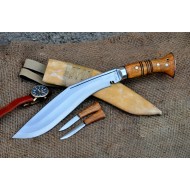


- Model: Modern Kukuri
- Product Code: LEAFKUKRI012
- Location: Kathmandu, Nepal
Available Options
What Is a Leaf Kukri?
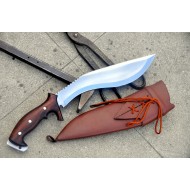
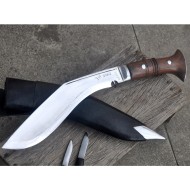
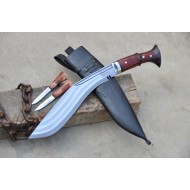
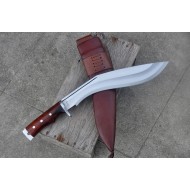
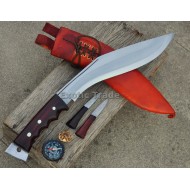
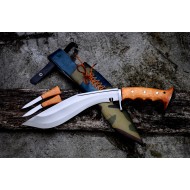
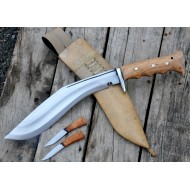
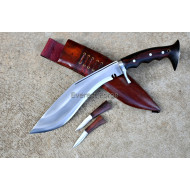
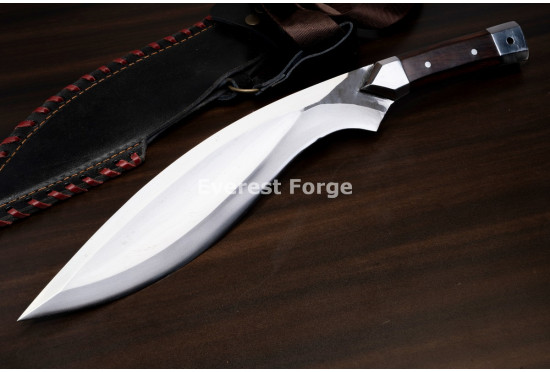
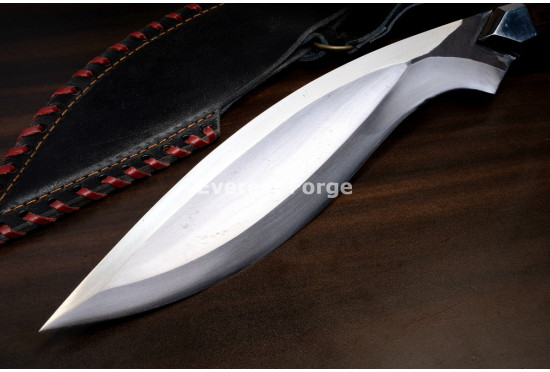
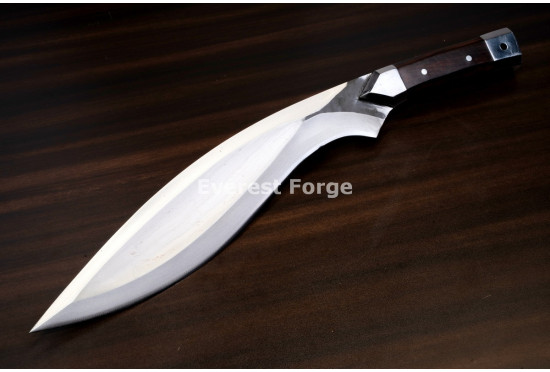
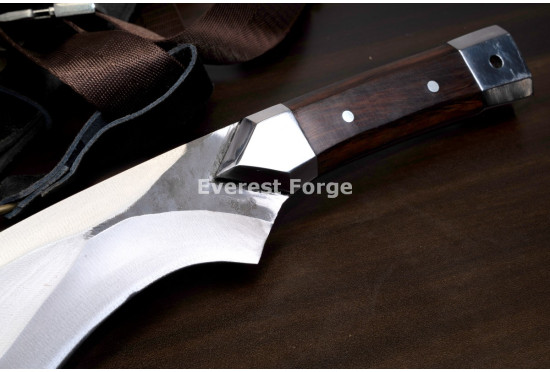
A kukri whose blade is widest in the middle and tapers toward both ends, like a leaf. That sounds small until you put it beside an ordinary kukri, where the blade widens steadily toward a belly carried well forward and finishes where spine and edge converge into a thick, blunt convergence. This one does the opposite at the front: past the widest point the blade narrows again into a fine, usable tip. It is a 12.5 inch blade hand-forged from 5160 high-carbon steel, oil-quenched and tempered, with a deep forward curve, a broad flat grind and a hand-cut cho at the base.
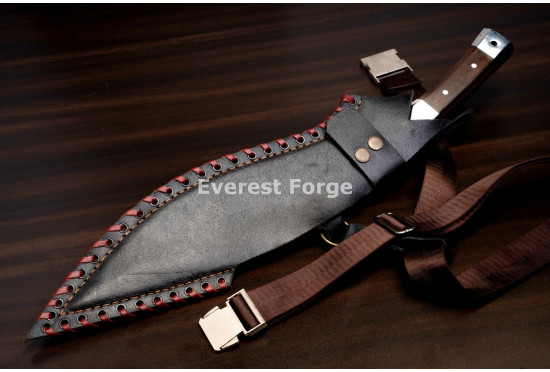
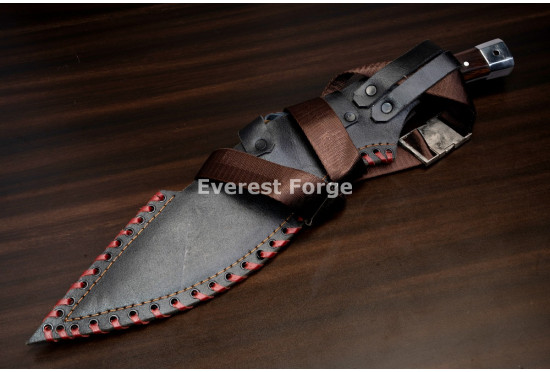
The hilt is 5.5 inches of rosewood built panawal: full-tang slabs riveted through, with an angular faceted steel bolster at the front and a heavy faceted steel butt cap with a lanyard hole behind. It ships in a black leather sheath, red-laced through brass eyelets and saddle-stitched in orange, carried on an adjustable nylon shoulder harness with quick-release buckles. The sheath is leather alone with no wooden core, which is a deliberate choice and one of the more useful things about it.
An honest note. The leaf profile is not a traditional Nepali pattern. Village patterns like the bhojpure and the sirupate are defined by where their mass sits, and neither of them narrows back down after the belly the way this blade does. What is traditional here is everything around it: the deep forward curve, the hand-cut cho, panawal construction, and the fact that it was forged in Kathmandu by our own smiths. This is a modern blade shape on traditional Nepali construction, and we would rather tell you that than let the word kukri carry an implication it has not earned. It is also a heavy piece — look at the specifications before you decide, because this is not a light blade and it is not pretending to be.
Want This Blade Built Your Way?
A different length, a lighter grind, natural or synthetic grip materials, a traditional wooden-cored sheath, or your own drawing entirely. Our smiths in Kathmandu forge to specification and quote before any work begins.
Start a Custom BuildWhat the Leaf Shape Changes
Standard Build and Specifications
Blade length, blade finish and grip material are selectable, so the figures above describe the standard build rather than every version of this kukri. Because each piece is forged, ground and fitted by hand, weights and dimensions vary slightly between examples, and on a heavy blade like this the variation is worth asking about if it matters to you — we will weigh your actual piece before dispatch on request.
Build Options
Is This the Right Kukri for You?
Choose This One If
- You want a kukri with a genuinely usable point as well as a chopping belly
- You want mass, and you are not going to be disappointed by a heavy blade
- You want panawal construction, which is the strongest hilt build we offer
- You want a sheath that flexes and sits close rather than a rigid wooden dap
- You want a blade shape nobody else in the range has
Look Elsewhere If
- You want a light blade — this is one of the heaviest pieces we make, and our deep-fullered 13 inch is built for the opposite priority
- You want a traditional village pattern — the leaf profile is modern, and our bhojpure is the authentic article
- You want maximum sheath protection — a core-less sheath trades rigidity for flexibility
- You want the full traditional kit as supplied — no karda, no chakmak, though we will build the dap
How to Order
Who This Kukri Is For
- Woodsmen who want one blade for everything — the belly chops and the point does the work a chopping convergence cannot
- Buyers who want mass and have found lighter kukris disappointing when the wood got thick
- Collectors of kukri variants looking for a blade shape outside the village patterns
- Anyone carrying over the shoulder rather than on a belt, which is how a piece this heavy wants to be carried
- Buyers who value construction over decoration — there is no ornament on this piece at all
What Is Included
- One hand-forged leaf kukri, sharpened and ready to use
- Black leather sheath, red-laced, with retaining strap
- Adjustable nylon shoulder harness with quick-release buckles
- Everest Forge manufacturer warranty
- Care instructions
No karda and no chakmak are supplied with this kukri. Those companions ride in fitted pockets on the traditional wooden-cored dap, and this piece carries a flexible core-less sheath instead. If you want the traditional arrangement we make it — ask and we will quote it with the kukri.
More From the Everest Forge Collection
Shipping, Returns and Care
Stock builds dispatch from our workshop within 2-3 business days. Custom and made-to-order builds take 4-6 weeks from confirmation, and we photograph the finished piece before it leaves us. We ship worldwide with DHL and FedEx, fully tracked, typically 7-14 business days in transit. Every blade carries the Everest Forge manufacturer warranty against defects in forging and construction.
Blade laws vary by country, state and province and it is the buyer's responsibility to check local restrictions before ordering. We cannot advise on your jurisdiction and we cannot refund a blade seized in transit.
5160 is a high-carbon steel and it will rust if you let it. Wipe the blade dry after use, keep it lightly oiled, and do not store it in the sheath for long periods in a damp climate, because leather holds moisture against steel. That applies with particular force to a core-less sheath, where the leather sits directly against the blade along its whole length with no wooden liner between them. Pay attention to the point as well: a fine tip is the first part of a blade to show rust and the easiest part to damage. Sharpen with a stone or a file rather than a powered grinder, which will draw the temper out of an edge faster than you expect.
Forged by Hand, Not Assembled
Every blade we sell is forged, ground, heat-treated and fitted by our own smiths in Kathmandu. If you want something we do not list, we will make it.
Talk to Our SmithsFrequently Asked Questions
What makes this a leaf blade rather than an ordinary kukri?
Where the width sits and what happens after it. On a standard kukri the blade widens progressively toward a belly carried well forward, and the profile simply runs out at the front where the curve of the edge meets the line of the spine. The widest point is near the front and the blade never narrows again. A leaf blade puts the widest section around the middle of its length and then tapers back down toward the tip, so the outline swells and closes like a leaf or a spearhead. The practical consequence is a point: instead of a thick blunt convergence you get an acute tip with steel behind it. The consequence you feel is a balance point slightly further back than a forward-bellied kukri of the same weight, because less of the mass is out at the far end.
Is it a chopper or a cutter?
Mostly a chopper, with a genuine second act. At 980 grams of blade it has the mass to chop properly and the deep forward curve to deliver that mass at an angle, so for firewood, limbs and brush it does what a kukri is supposed to do. What the leaf profile adds is capability the pattern usually lacks: the point will pierce, bore and do close work that a blunt convergence simply cannot, and the narrowing forward section slices on a draw better than a blade that is still widening at the same place. What it does not do is beat a purpose-built light blade at fine work, because you are still swinging a kilogram of steel. Think of it as a chopper that stopped wasting its front six inches.
What does panawal construction mean?
Panawal is the Nepali term for a full-tang kukri with slab scales riveted through the tang, as opposed to the traditional alternative where a solid grip is fitted over a narrower tang and set with laha, a natural resin adhesive. The difference matters most when a blade is heavy or a climate is unkind. A resin-set hilt is lighter, entirely traditional and perfectly sound in normal use, but the adhesive is the weakest element in the assembly and heat, damp and hard shock all work against it. A panawal hilt has no adhesive holding it together: the steel runs the full length and the rivets pass through it. On a blade of this weight that is the right choice, and it is why we built it this way rather than to look rugged.
Why is the sheath flexible with no wooden core?
Because it buys three things worth having on a blade this heavy. It flexes, so it moves with your body instead of levering against your ribs when you crouch or climb, which a rigid scabbard 18 inches long does constantly. It sits closer to you, because there is no wooden shell adding thickness on both sides. And it weighs less, which is not a small consideration once the piece is already heavy. The trade-off is honest and worth stating: a wooden-cored dap protects the blade better if you drop it or kneel on it, and it holds its shape indefinitely, where leather alone will slowly conform to the blade and can be crushed. We build the traditional dap if you would rather have the protection, and it is the right call if the kukri will spend its life on a wall or in a pack rather than on a shoulder.
How does this compare to your bhojpure?
They are near opposites built to the same purpose. The bhojpure is a genuine eastern Nepali village pattern with a broad belly carried well forward, a 10 inch blade and a plain ringed rosewood grip, and it is a specialist: everything about it is arranged to put mass into the wood and nothing about it pretends to do anything else. This one is longer, heavier, modern in profile, panawal-built, and it keeps a real point at the front. If you want the authentic article and the purest chopping tool, take the bhojpure. If you want more reach, more mass and a blade that can also pierce and do close work, take this. The bhojpure is the better chopper for its weight; this is the more versatile blade.
Why is the butt cap so heavy?
It is a counterweight doing a real job. A 12.5 inch blade weighing 980 grams is a great deal of mass hung off the front of your hand, and left alone it would balance far forward and feel unwieldy through the swing rather than merely heavy. Solid steel at the back of the grip pulls the balance point rearward toward your hand, which makes the blade feel more controllable and lets you stop and redirect it rather than being carried by it. The cost is total weight, and this is where a good part of the 1420 grams sits. The lanyard hole through it is the secondary benefit: a wrist loop on a heavy blade is sensible rather than decorative, particularly if you are working near water or above your own feet.
What is the notch at the base of the blade?
That is the cho, sometimes written kaudi, and it is the diagnostic mark of a genuine kukri. It terminates the edge in a rounded cut rather than letting the edge run straight into the bolster, so a crack starting at the edge has somewhere to stop instead of running back toward the tang. It also carries religious meaning that different communities in Nepal read in different ways. Ours are cut by hand on every blade, which is why no two are exactly alike. We apply the test in both directions: a curved knife with no cho did not come from this tradition whatever a listing calls it, and we have declined to call our own pieces kukris on that basis.
What steel is it?
5160 high-carbon spring steel, oil-quenched and tempered. It is the family of steel used for vehicle leaf springs, which is the origin of the Nepali practice of forging kukris from them, and it is chosen for toughness rather than for maximum hardness. That matters twice over on this piece. A heavy chopper that is too hard chips at the edge when it meets a knot, whereas 5160 at a working temper rolls slightly and can be stoned back. And a fine point in very hard, brittle steel is the classic way to snap a tip, whereas this will bend a little and come back. It is not stainless and it will rust if neglected.
Is it too heavy for most people?
It is heavy, and we would rather you knew that before it arrived than after. At roughly 1420 grams all in, this is one of the heaviest pieces we make, and if you have only handled light camp knives it will surprise you. Whether that is a problem depends entirely on the job. For splitting and for cutting through thick green wood, mass is the thing doing the work and more of it is better. For a long day of light clearing, you will tire faster than you would with a lighter blade and our deep-fullered 13 inch would serve you better. If you like the profile but not the weight, ask us to grind it thinner behind the edge — we can take a meaningful amount off while keeping the shape, and we would rather build the piece you will actually use.
How do I sharpen a leaf profile?
In sections, because the edge changes character along its length. Kukri edges are ground convex, which is stronger at the edge and better suited to impact, so work with a stone in small circles or with a file rather than dragging the blade through a fixed-angle pull-through sharpener, which grinds a flat bevel into a convex edge and undoes it. The specific thing about this profile is that the belly and the forward taper want different attention: the belly is doing chopping work and wants a slightly more obtuse, durable edge, while the narrowing front section does the slicing and piercing and benefits from being taken finer. Most people sharpen the whole length the same way and get an edge that is a compromise at both ends.
How do I look after it?
Standard carbon steel care with two additions specific to this piece. First, the sheath: because there is no wooden core, the leather sits directly against the steel along the blade's whole length, and leather holds moisture. Do not store the kukri sheathed for long periods in a damp climate, and let both dry separately if either gets wet. Second, the point. A fine tip has the least steel around it, so it is the first place rust shows and the easiest place to bend or chip. Oil it deliberately rather than assuming the wipe down the flat reached it, and do not use the point as a pry bar, which is the single most common way a good tip is lost.
Can I have this in a different size?
Yes. The leaf profile scales more gracefully than most kukri patterns, because the shape is defined by proportion rather than by a specific belly position, so it stays recognisable from a short belt blade up to a two-handed piece. Tell us the length you want and we will draw it before we forge it. Worth raising at the same time: if you want a shorter version, say whether you want it proportionally lighter as well, because scaling the length down while keeping the stock thickness produces a very dense small blade that some people love and others find odd in the hand. Grip material, finish, sheath type and carry can all be specified together.
| Specification | |
| Blade: | 12.5 inches. Hand forged from 5160 carbon steel. Leaf profile, widest at mid-length, tapering to an acute point |
| Total Length: | 18 inches |
| Handle: | 5.5 inches, panawal full tang, riveted rosewood slabs, faceted steel bolster and heavy steel butt cap with lanyard hole |
| Weight: | 980 g blade, approx. 1420 g total |
| Note: | As each piece is forged, ground and fitted by hand, slight variation in weight, dimensions and finish may occur. Do not store sheathed in a damp climate - the core-less sheath sits directly against the blade. |