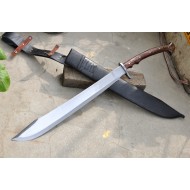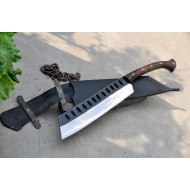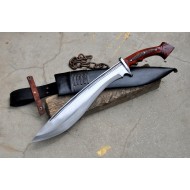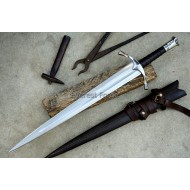
- Model: SINGLE EDGED SWORD
- Product Code: SINGLEEDGE035
- Location: Kathmandu, Nepal
Available Options
A Hand-Forged Langes Messer With a Hat Pommel
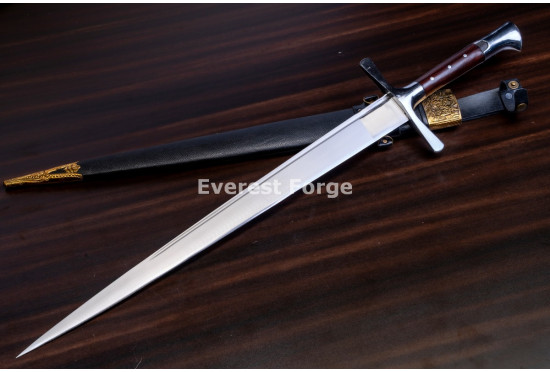
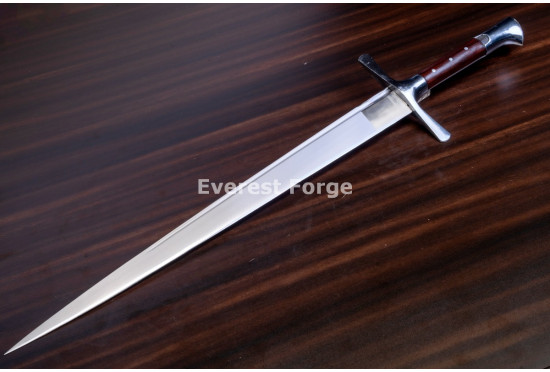
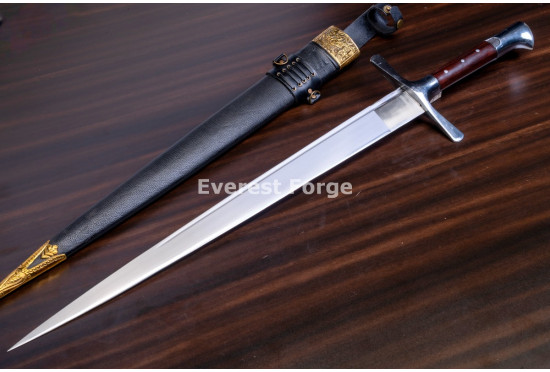
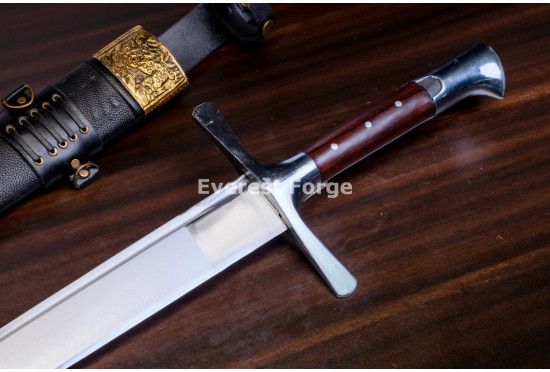
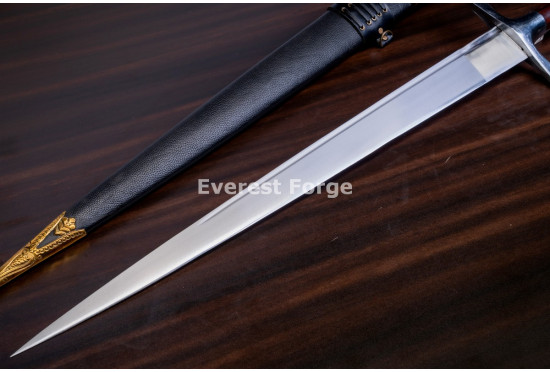
This is a langes messer, hand-forged in Tokha-3, Kathmandu, Nepal from 5160 high-carbon steel, oil-quenched and tempered. The blade runs 25 inches, broad at the ricasso and drawing in a long even taper to a fine point, with a narrow fuller worked down the centre and a satin polish on the flats. The hilt is where the type is decided: rosewood slabs riveted straight through a flat tang, a straight steel cross, and a flared hat pommel curling over the end of the grip. Overall it stands 34 inches. It ships sharpened, with a black leather scabbard dressed with embossed brass-toned fittings at the throat and the chape, on a belt rig.
An honest note. The hilt is the reason this is called a messer rather than a sword, and that is a real distinction rather than a marketing one — a Messer is built like a knife, with a flat slab tang and scales riveted through it, where a sword of the same size uses a narrow tang capped by a pommel that holds the hilt in compression. This piece has the knife construction, the straight cross and the hat pommel, and it is a genuine langes messer hilt. Where it departs from the historical corpus is the blade: surviving langes messer are almost always single-edged, and this blade is broader and more sword-like, with a centred fuller. Read it as a messer-hilted arming blade rather than a strict reconstruction. We also do not repeat the popular story that messers existed as a legal loophole to carry a sword by calling it a knife — historians dispute it, and we would rather say so than pass it on.
Want a Strict Single-Edged Messer?
Our smiths will forge a langes messer to the historical pattern — a single-edged blade with a clipped point, a Nagel projecting from the cross and period-correct slab scales — or build to proportions from a specific surviving example if you have one in mind. Send a reference and we will quote it.
Start a Custom Build →Why This Messer Is Built the Way It Is
Full Specifications
How You Can Configure It
Is This the Right Sword for You?
Buy This If You Want
- Genuine messer construction, not a sword hilt with a messer name on it
- The hat pommel and straight cross that define the German type
- Real forged 5160 with a proper heat treatment
- A riveted slab hilt with no glue joint and nothing to wear through
- A brass-fitted scabbard rather than plain leather
- A smith who will build the strict single-edged version if you ask
Look Elsewhere If You Want
- A strict reconstruction — historical langes messer are single-edged
- A Nagel as standard; it is a custom option on this build
- A pommelled sword hilt; messer construction is deliberately different
- A stainless blade that needs no oiling or care
- A light sword; 25 inches of broad blade carries real mass
- Identical units; every piece is forged and fitted by hand and varies
How to Order
Who This Messer Suits
- HEMA students and readers working through the German sources, where the messer has its own body of technique.
- Collectors of German and Central European arms filling the messer slot beside falchions and arming swords.
- Reenactors portraying late medieval townsmen and militia, for whom the messer was the ordinary sidearm.
- Test cutters after a broad tapering blade with a grip that cannot work loose.
- Display buyers who want a piece with a brass-fitted scabbard as part of the object.
What Is Included
- One hand-forged langes messer, sharpened and ready to use
- Black leather scabbard with embossed brass-toned throat and chape, on a belt rig
- Care and oiling instructions
- Everest Forge manufacturer warranty against defects in forging and heat treatment
Other Hand-Forged Swords
Shipping, Returns and Care
Shipping. Standard builds dispatch in 2 to 3 business days. Custom builds take 4 to 6 weeks. We ship worldwide by DHL or FedEx, 7 to 14 business days, fully tracked. Sword laws vary by country and by state — please check what applies where you live before ordering, as we cannot deliver into a restricted address.
Returns. Standard builds can be returned unused and in the original scabbard within 30 days. Custom builds, altered dimensions and etched pieces are made to your specification and cannot be returned unless there is a fault in forging or heat treatment.
Care. The blade is high-carbon steel: wipe it dry after handling, since fingerprints will etch a satin finish within days, and keep a thin film of oil on it in storage, running a cloth corner down the fuller rather than across it. The brass-toned scabbard fittings need a soft dry cloth only — metal polish strips the finish and packs into embossed relief where you cannot remove it. Rosewood slabs want a light coat of hard wax or furniture oil once or twice a year, particularly around the rivet heads where the grain is exposed. Do not store the blade sheathed for long periods.
Frequently Asked Questions
What is a Nagel, and does this messer have one?
The Nagel — German for nail — is a steel stud or lug projecting sideways from the cross of a messer, standing over the back of the hand. It is the single most recognisable fitting on the type, and it is genuinely functional: on a knife-construction hilt the cross alone sits close to the hand and offers little cover, and the Nagel extends protection out over the knuckles without the weight and bulk of a full guard. Later examples flatten it into a shell or a ring. On this piece there is no Nagel — the cross is plain — and we would rather tell you that than let the term do work the object does not. If you want the classic profile, a Nagel can be fitted on a custom build; say so when you order. A messer without a Nagel is not wrong, and plenty of surviving examples lack one, but with a Nagel is what most people picture.
What is a hat pommel?
A Hutknauf, or hat pommel, is the flared cap that curls over the end of a messer grip, and it is one of the type's signature fittings. Unlike a sword pommel, which is usually a discrete mass threaded onto a narrow tang and peened over, a messer's hat pommel is a shaped cap fitted to the end of a flat slab tang. It does three things: it closes and protects the exposed end grain of the wooden scales, which is where a knife-construction grip takes damage first; it adds a modest counterweight behind the hand; and its curl gives the hand a positive stop so the grip cannot slide backward under a hard cut. The shape varies widely across surviving examples — some are almost flat caps, some curl sharply like the brim of a hat, which is where the name comes from.
Is a messer a sword or a knife?
Both, and the answer depends on which end you look at. By blade length and use it is unambiguously a sword — a langes messer is a battlefield and self-defence weapon with its own body of fencing technique in the German sources, taught alongside the longsword. By construction it is a knife: flat slab tang, scales riveted through, no threaded pommel. That construction is the definition, and it is why a falchion and a messer can carry near-identical blades and still be different weapons. You will often read that messers existed so townsmen could carry a sword by legally calling it a knife. It is a good story and it is disputed by historians; the guild and legal evidence for it is thin, and the construction is more plausibly explained by messers being made by knifesmiths rather than swordsmiths. We mention it because you will encounter it, not because we are repeating it as fact.
Why is this blade not single-edged?
Because it is a messer-hilted blade rather than a strict reconstruction, and we would rather be upfront about it. The surviving langes messer corpus is almost entirely single-edged with a clipped or angled point, and a broad tapering blade with a centred fuller is a sword blade by any normal reading. What makes this piece a messer is the hilt: the flat tang, the riveted slabs, the straight cross and the hat pommel are all correct and all diagnostic. If you want the historical blade form to go with the historical hilt, our smiths will forge a single-edged blade with a clipped point on a custom order, which is one of the more straightforward changes we make.
What steel is it and how is it heat treated?
5160 high-carbon spring steel, oil-quenched and then tempered back. 5160 holds a working edge and flexes under load rather than snapping, which matters on a broad blade of this length. It is also the steel family Nepali smiths have traditionally drawn from vehicle leaf spring, so our forge reads it by colour and by sound at the anvil rather than by instrument alone.
Does it arrive sharp?
Yes. It ships with a working edge, sharpened by hand and ready out of the scabbard. It is not a blunt wall-hanger with a sword-shaped profile ground into it. If it is going into a display case, a costume, or a HEMA or reenactment context whose rules require blunt kit, ask for it blunted in the order note before we ship and we will finish it that way at no extra cost.
How strong is a riveted slab hilt compared to a pommelled one?
Very strong in the direction that matters, and different rather than worse. A riveted slab hilt puts the full width of the tang behind the grip, so there is no narrow section to fatigue and no glue line to fail; the load path from blade to hand is continuous steel. A pommelled sword hilt holds the assembly in compression, which is excellent at resisting a thrust driving straight back along the blade's axis but depends entirely on the pommel staying properly seated. Where the slab hilt gives ground is counterweight: without a heavy pommel mass behind the hand, a messer of a given length balances further forward than a sword of the same length, which is part of why messers feel like they want to cut. The hat pommel recovers some of that, which is exactly why it exists.
Can I have it made longer or shorter?
Yes. Blade length is selectable, and beyond the listed options our smiths will forge to a dimension you specify. Going substantially longer moves the piece toward kriegsmesser proportions and will usually mean lengthening the grip to a hand-and-a-half as well, which we will flag before starting rather than surprise you with. Whichever length you choose, the taper is redrawn rather than simply scaled, because a stretched taper puts the balance in the wrong place.
Is the scabbard included?
Yes. A black leather scabbard with embossed brass-toned fittings at the throat and the chape, on a belt rig, cut around this specific blade profile. If you change the blade length or profile on a custom build, the scabbard is made to the new dimensions. Plain fittings, a different leather colour or a baldric instead of the belt rig can all be specified.
How do I look after the blade, the brass and the scales?
Three materials, three routines. The blade is high-carbon steel: wipe it dry after handling and keep a thin film of camellia, mineral or light gun oil on it in storage, running a cloth corner down the fuller rather than wiping across it, since a fuller holds oil and dust. The brass-toned scabbard fittings want a soft dry cloth and nothing else — metal polish strips the finish and packs into embossed relief where you will never get it out. The rosewood scales need a light coat of hard wax or furniture oil once or twice a year, particularly around the rivet heads, where end grain is exposed and dries first.
Will every piece look exactly like the photograph?
No, and that is inherent to hand forging. Every blade is drawn out under a hammer, so the width at the ricasso and the exact line of the fuller carry small differences from piece to piece. The hat pommel is shaped and finished by hand, so its curl differs on every one. Rosewood is a natural timber, so grain and colour vary on every set of scales, and the brass-toned fittings are worked in relief by hand so their crispness varies. Weights and dimensions vary by a few percent. What is consistent is the steel, the heat treatment, the construction and the edge.
Where is it made and by whom?
Hand-forged in Tokha-3, Kathmandu, Nepal, by our own smiths. Everest Forge is a working forge rather than a reseller putting a name on imported blanks — the steel is cut, drawn, quenched, tempered and ground, the scales shaped and riveted, the pommel formed, the fittings worked and the scabbard stitched, all under one roof. That is why we can change the blade profile to the single-edged historical form, or add a Nagel, on a custom order.
| Specification | |
| Blade: | 25 inches. Hand forged from 5160 carbon steel |
| Total Length: | 34 inches |
| Handle: | 9 inches, flat full-width tang with rosewood slabs riveted through, straight steel cross and flared hat pommel |
| Weight: | 1750 grams approx, as shipped with the scabbard |
| Note: | handmade variation in weight, dimensions and finish may occur; keep blade lightly oiled when not in use |