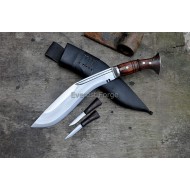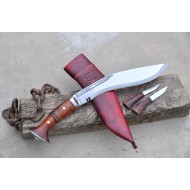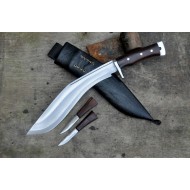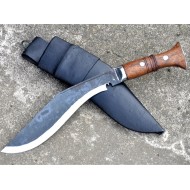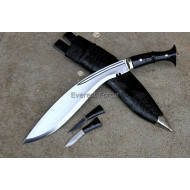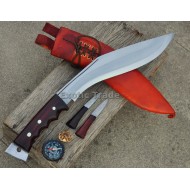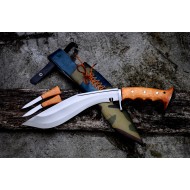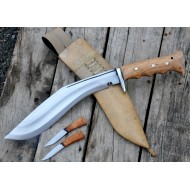


- Model: Signature Kukri/Khukuri
- Product Code: SIGNATURELHK014
- Location: Kathmandu, Nepal
Available Options
A 14 Inch Kukri on a Stacked Leather Grip
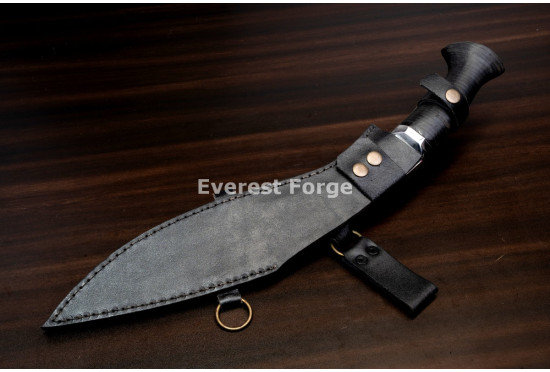
A stacked leather grip is built rather than carved. Rings of leather are punched, threaded onto the tang one after another, compressed hard, and then turned and finished as a single piece — so what looks like one dark handle is actually forty or fifty individual washers under pressure. It is the grip fitted to military knives for most of the twentieth century, and it is here for the same reasons they used it: it does not crack, it does not get slippery when your hand is wet, and it absorbs shock rather than transmitting it.
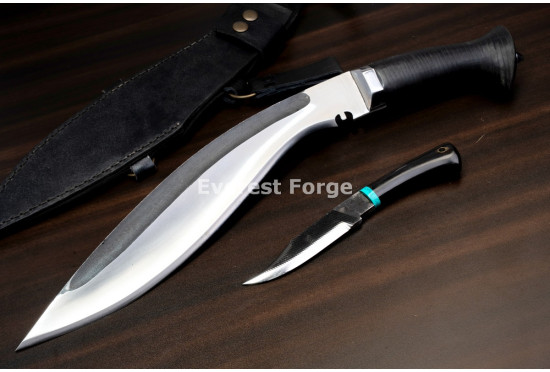
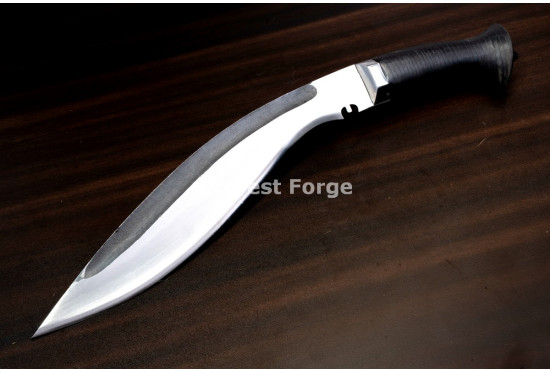
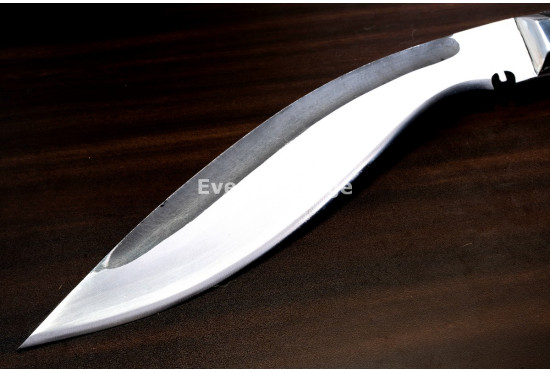
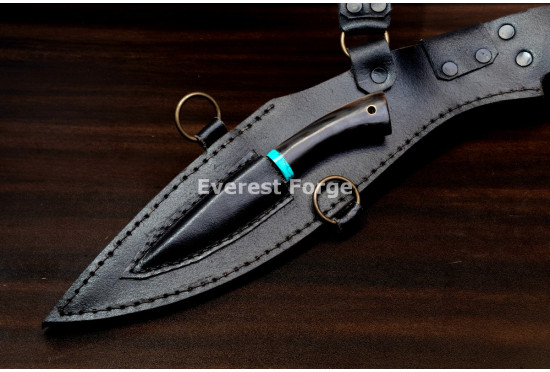
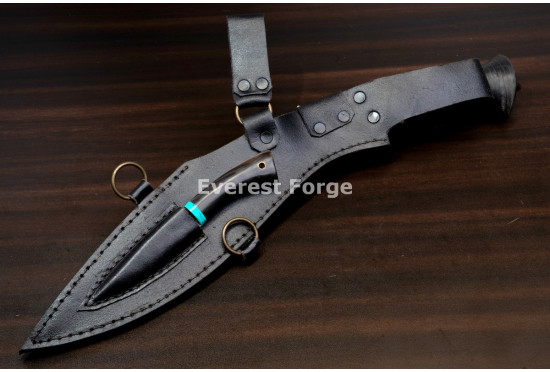
The blade is 14 inches, hand-forged from 5160 high-carbon steel, oil-quenched and tempered, with a single fuller ground down the flat, a deep belly, a hand-cut cho at the base and a polished steel bolster. It weighs 710 grams. Over a 14 inch blade that works out at 50.7 grams per inch, which makes it the lightest blade we make at any length above 12 inches — the fuller is doing exactly what a fuller is for, taking weight out of the middle of the section and moving the balance back toward the hand. It comes with a small companion knife re-forged from a sharpening file, and a black leather scabbard with brass rings and a fitted companion pocket.
An honest note. Two things worth saying. First, the single fuller genuinely does what we say it does, but it is not the only reason this blade is light — the stock thickness and the grind matter at least as much, and any seller telling you a fuller alone transforms a blade is overstating it. Compare it against our four chirra kukri, which is the same length with four grooves and still comes in slightly heavier at 52.1 grams per inch. Fuller count is one variable among several. Second, stacked leather is a working material and it will change: it darkens with handling, it takes the shape of your hand over years, and it needs oiling like any leather. If you want a grip that looks the same in a decade, take horn or wood instead.
Want This Built Your Way?
A different blade length, another fuller arrangement, horn or wood in place of the leather, a traditional karda and chakmak instead of the file knife, or your own drawing entirely. Our smiths in Kathmandu forge to specification and quote before any work begins.
Start a Custom BuildWhat You Are Looking At
Standard Build and Specifications
Blade length, blade finish, grip material and fuller arrangement are all selectable, so the figures above describe the standard build rather than every version. Because each piece is forged, ground and fitted by hand, weights and dimensions vary slightly between examples, and the file knife varies more than most since no two files start out identical.
Build Options
Is This the Right Kukri for You?
Choose This One If
- You want 14 inches of reach at the lowest weight we can give you at that length
- You work in the wet — stacked leather grips better with a wet hand than any hard material
- You feel shock in your wrist after a session with a hard-handled chopper
- You like a grip that becomes yours rather than staying factory-new
- You want a plain working kukri with no decoration on it at all
Look Elsewhere If
- You want a grip that stays unchanged — leather darkens, compresses and moves; horn and micarta do not
- You want maximum chopping mass — this is the lightest long blade we make, and our leaf kukri is the opposite
- You want low maintenance — a leather grip needs oiling and must not be stored damp
- You want decoration — there is none here
- You want a short blade — 19.5 inches overall is a lot to carry
How to Order
Who This Kukri Is For
- Anyone who works in wet conditions — rain, rivers, game, weather that makes a polished grip a liability
- Buyers who chop for hours and have felt the difference a shock-absorbing grip makes by the end of it
- Those who want reach without mass — 14 inches at the lightest we can grind it
- People who like a tool that ages rather than one that stays pristine
- Buyers who want no ornament at all and would rather the cost went into the blade and the grip
What Is Included
- One hand-forged kukri on a stacked leather grip, sharpened and ready to use
- One companion knife re-forged from a sharpening file, sharpened
- Black leather scabbard with fitted companion pocket, brass rings and belt loop
- Everest Forge manufacturer warranty
- Care instructions
More From the Everest Forge Collection
Shipping, Returns and Care
Stock builds dispatch from our workshop within 2-3 business days. Custom and made-to-order builds take 4-6 weeks from confirmation, and we photograph the finished piece before it leaves us. We ship worldwide with DHL and FedEx, fully tracked, typically 7-14 business days in transit. Every blade carries the Everest Forge manufacturer warranty against defects in forging and construction.
Blade laws vary by country, state and province and it is the buyer's responsibility to check local restrictions before ordering. Note that this package contains two blades. We cannot advise on your jurisdiction and we cannot refund a blade seized in transit.
5160 is a high-carbon steel and it will rust if you let it. Wipe both blades dry after use and keep them lightly oiled, paying attention to the bottom of the fuller and to the file teeth on the companion, both of which a cloth drawn along the flat will bridge without touching. The grip needs different care from anything else in our range: stacked leather wants a light leather conditioner two or three times a year and it must never be stored wet, because water sitting between compressed washers is how a stacked grip eventually loosens. Dry it slowly at room temperature if it gets soaked, never near a heater, and never leave it sheathed damp.
Forged by Hand, Not Assembled
Every blade we sell is forged, ground, heat-treated and fitted by our own smiths in Kathmandu. If you want something we do not list, we will make it.
Talk to Our SmithsFrequently Asked Questions
What is a stacked leather grip?
A handle built from many separate rings of leather rather than shaped from one piece of material. Each washer is punched with a hole, threaded onto the tang, and the whole column is compressed hard before the outside is turned true and finished, so what you hold feels like one solid handle and is actually dozens of layers under pressure. It was the standard grip on military and hunting knives for most of the twentieth century and it survived that long because it is genuinely good. It grips when wet, it is warm in cold weather where steel and horn are not, and it absorbs impact instead of passing it into your hand. The trade-off is that it is organic: it darkens, it compresses slightly, and it needs looking after. A stacked grip that has been used for ten years looks nothing like a new one, which most owners consider the point.
Why does a stacked grip absorb shock?
Because leather is compressible and layered, and a hard grip is neither. When a blade strikes wood, the impact travels back down the steel into the handle and then into your hand and wrist. Horn, micarta and dense timber are all stiff, so most of that energy arrives. Compressed leather has some give in it, and crucially the give is distributed across dozens of interfaces between washers rather than concentrated in one material, so each impact is damped slightly as it passes through. The difference on a single stroke is small enough that you would struggle to notice it. Over an afternoon of chopping it is the difference between a wrist that aches and one that does not, which is why the material stayed in service on working knives long after synthetics were available.
How does leather behave when it gets wet?
Better than you would expect in the hand and worse than you would like in storage, and both halves matter. Wet leather grips well — it swells very slightly and its surface stays tacky where a polished hard material becomes slick, which is the original reason the military used it on knives carried in all weathers. So using this in rain or around water is exactly what it was made for. What it will not tolerate is being put away wet. Water sitting between compressed washers softens the leather from the inside, and over time the column loses compression and the grip can loosen against the tang. Dry it at room temperature if it gets soaked, never near a fire or a radiator, which will cook and shrink it, and never leave it in a damp scabbard overnight.
What does the single fuller do?
It takes weight out of the blade and moves the balance back toward your hand. A fuller is a groove ground down the flat, removing material from the middle band of the blade's width where bending stress is lowest and the steel is doing the least work, so you lose mass without losing meaningful strength. Because that mass comes out along the length of the blade rather than at the hilt, the balance point shifts rearward, which is what makes a long blade feel manageable rather than nose-heavy. The numbers here: 710 grams over 14 inches, or 50.7 grams per inch, which is the lowest figure of any blade we make above 12 inches. Our four chirra kukri is the same length with four grooves and comes in at 52.1, which tells you something useful — the fuller matters, but stock thickness and grind matter at least as much.
Is a light 14 inch blade still worth having?
Yes, but be clear about what you are buying. Length gives you reach and arc speed: the belly sits further from your hand, so it travels faster at the point of contact for the same effort at the grip, and you can take a limb without stepping in close. Weight gives you authority per stroke. This piece is deliberately at the light end, so you get the reach and the arc but each individual stroke does less work than a heavy blade of the same length would. What you gain in exchange is stamina and control — you can swing it far longer before your forearm gives out, and it is easier to place accurately. For clearing, trail work and long sessions that is the better trade. For splitting seasoned rounds, take something heavier and accept the weight.
What is the notch at the base of the blade?
That is the cho, sometimes written kaudi, and it is the diagnostic mark of a genuine kukri. It terminates the edge in a rounded cut rather than letting the edge run straight into the bolster, so a crack starting at the edge has somewhere to stop instead of running back toward the tang. It also carries religious meaning that different communities in Nepal read in different ways. Ours are cut by hand on every blade, which is why no two are exactly alike. You will occasionally see the cho sold as a blood channel or similar, and we would rather not: the structural and religious explanations are the ones that hold up, and the rest is marketing that has attached itself to the shape over the years.
Is the small knife really made from a file?
Yes. Nepali smiths have always worked from repurposed steel — kukris are forged from vehicle leaf springs because springs are good steel and they turn up, and an old sharpening file is the same proposition at a smaller scale. The file teeth left visible on the flats are the evidence rather than a decorative finish. What matters is what happens after: a file as it comes is very hard and correspondingly brittle, which is what a file needs to be and exactly what a knife must not be, so ours are re-forged to shape, re-hardened and then tempered back to a working temper. Our single fuller kukri sets that out in more detail. The practical note for you: file teeth are dozens of small recesses that hold moisture, so brush the companion rather than wiping it.
What steel are the two blades?
Different, and deliberately so. The kukri is 5160 high-carbon spring steel, oil-quenched and tempered, chosen for toughness rather than maximum hardness, so a hard-used edge rolls slightly rather than chipping when it meets a knot, and a rolled edge comes back with a few passes on a stone. The companion is whatever the file was made from, typically a high-carbon tool steel and generally harder than 5160 once re-tempered, which suits a small knife that holds an edge longer and is never asked to survive impact. Neither is stainless, so both will rust if neglected, and the leather grip means this piece in particular should not be left damp.
How does it compare to your other 14 inch kukris?
Three 14 inch blades now and they separate clearly. Our four chirra kukri is the grinding showcase: four parallel grooves, horn and brass fittings, karda and chakmak, and at 52.1 grams per inch it is very slightly heavier than this. Our double chirra is the decorated one, with brass inlay along the spine and a skinner companion. This is the plain one and the lightest of the three at 50.7, with no decoration anywhere, a stacked leather grip instead of horn and brass, and a file-forged companion. If you want to look at it, take one of the chirra pieces. If you want to work with it in bad weather for a long time, take this.
How do I sharpen them?
The kukri has a convex edge, which is stronger at the edge and better suited to impact, so work it with a stone in small circles or with a file rather than dragging it through a fixed-angle pull-through sharpener, which grinds a flat bevel into a convex edge and undoes it. The companion is simpler: a small flat bevel on a straightforward profile, easy to maintain on any stone, though being harder steel it takes longer to sharpen and needs it less often. One thing specific to this piece — when you are working the kukri on a stone, keep the leather grip clear of water and swarf. Wet grinding slurry worked into a stacked handle is unpleasant to get out and does the leather no good.
How do I look after the leather grip?
Treat it like a good boot rather than like a knife handle. Two or three times a year, work a small amount of leather conditioner or neatsfoot oil into it with your fingers and let it absorb — not so much that it goes soft, just enough to stop it drying out and cracking at the edges of the washers. Handling it does most of the work for you, since the oils from your hands are part of why a used stacked grip looks better than a new one. What you must not do is store it wet, dry it with heat, or leave it in a damp scabbard, because water between compressed washers is the one thing that will genuinely damage it over time. Done properly a stacked grip outlasts the person who bought it; done badly it loosens in a few years.
Can I have a different size, grip or companion?
All three. On size, we forge this profile from belt-sized blades up to two-handed pieces and the fuller scales with it. On the grip, horn, rosewood and micarta are all available if you want something that stays as it arrived — leather is the only one of the four that will change with use, and that is either the appeal or the problem depending on who you are. On the companion, the file knife is standard but a traditional karda and chakmak or a skinner can be fitted instead, with the scabbard pocket cut to match, which means deciding at the point of order rather than later. Tell us how you intend to use it and we will say what we would build.
| Specification | |
| Blade: | 14 inches. Hand forged from 5160 carbon steel. Single fuller ground down the flat |
| Total Length: | 19.5 inches |
| Handle: | 5.5 inches, STACKED LEATHER washers turned and finished, flared butt, polished steel bolster |
| Weight: | Approx. 710 g blade, approx. 1070 g total |
| Note: | The leather grip needs conditioner two or three times a year and must never be stored wet. Dry at room temperature, never near heat. |