Menu
Your Cart

Hand-Forged Kukri, Narrow Deep Fuller

Hand-Forged Kukri, Narrow Deep Fuller
$154.99
Ex Tax: $154.99
  • Model: Modern Kukuri
  • Product Code: PRINCENAYA013
  • Location: Kathmandu, Nepal

Available Options

A 13 Inch Kukri That Handles Light

Most 13 inch kukris ask you to accept weight as the price of reach. This one does not. It is a 13 inch forward-curved blade hand-forged from 5160 high-carbon steel, oil-quenched and tempered, weighing 720 grams with the spine left at a full 7 millimetres. That works out at 55.4 grams per inch of blade, the lightest figure of any blade we make at any length, and it is achieved by taking material out of the middle of the section rather than by grinding the blade thin.

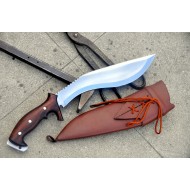
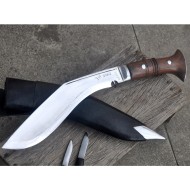
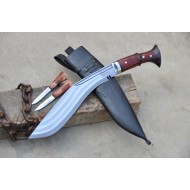
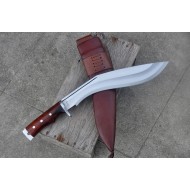
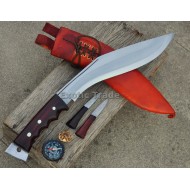
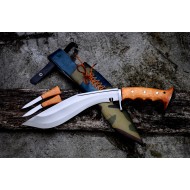
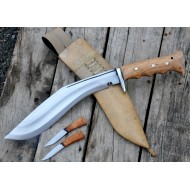
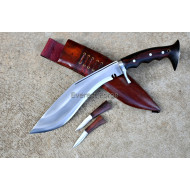
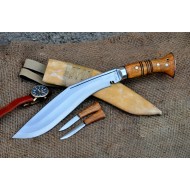
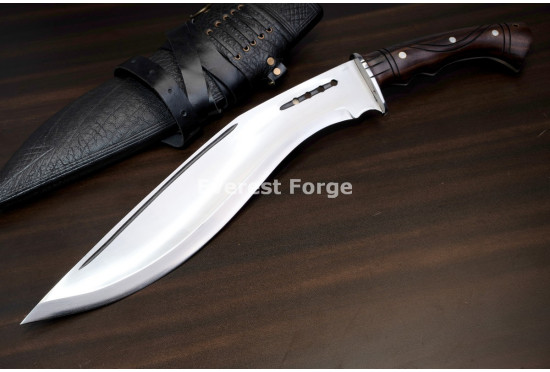
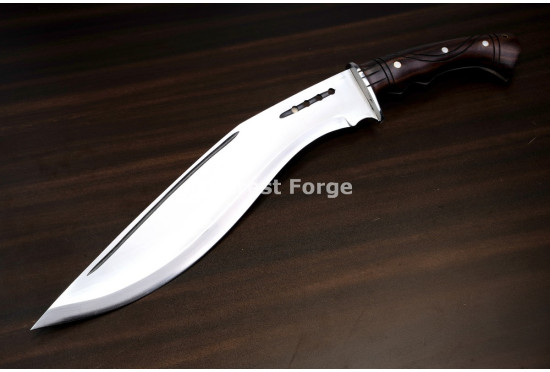
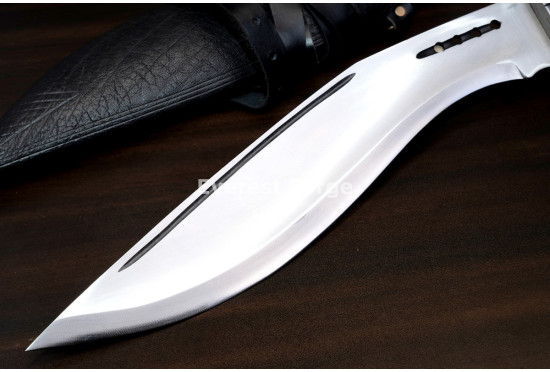
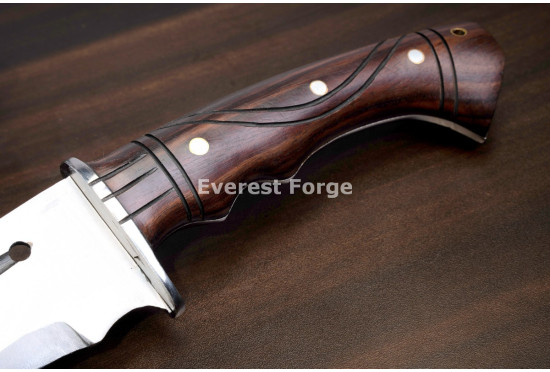
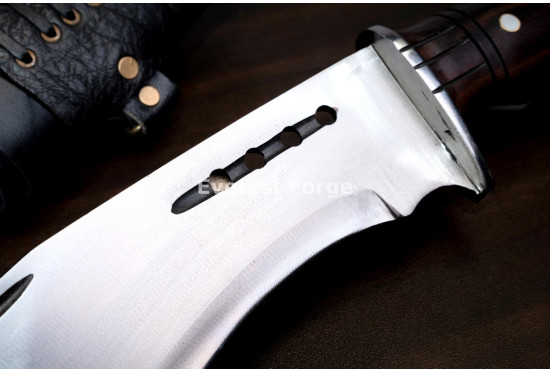
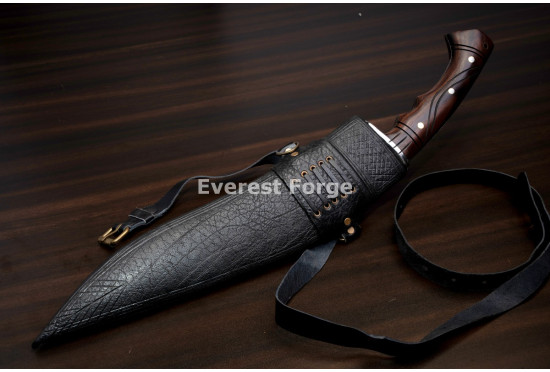
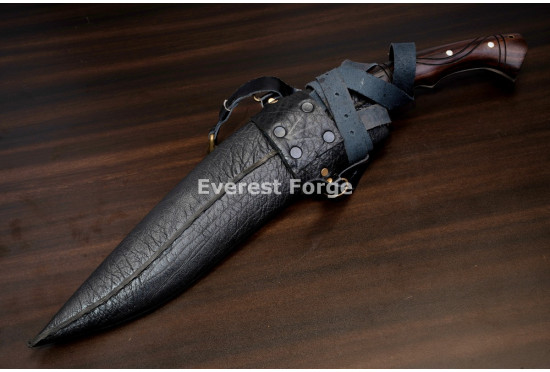
The blade carries a narrow deep fuller running most of the working length, with a pierced panel near the forte, a deep belly and a hand-cut cho at the base. The hilt is 6 inches of sculpted rosewood, carved with sweeping incised lines and pinned through a full tang, with a fitted steel bolster and a dark spacer behind it. It ships in a black tooled leather sheath, brass-eyelet laced at the throat, on a long black leather belt with a brass buckle.

An honest note. The cutwork on this blade is a modern design decision. Traditional Nepali kukris are not pierced, and we are not going to invent a heritage for the pattern or claim it makes the blade cut better. It looks striking, it removes a little mass, and the plain version of this blade would be marginally the stronger of the two. If you want maximum strength above all, ask us for it plain and we will make it that way. What we will stand behind is the rest: 5160 at a working temper, a full 7 millimetre spine, a full tang, and a hand-cut cho on a blade forged by our own smiths.

Custom Forge

Want This Blade Built Your Way?

A plain blade with no cutwork, a different fuller, another length, natural or synthetic grip materials, or your own drawing entirely. Our smiths in Kathmandu forge to specification and quote before any work begins.

Start a Custom Build

What Makes This Blade Different

Light Without Being Thin720 grams over 13 inches, which is 55.4 grams per inch. The lightest blade we make, and the spine is still a full 7mm. Weight comes out of the middle of the section, not off the back of the blade.
Narrow Deep FullerNot the broad flat chirra of our other kukris but a narrow groove cut deep. It removes a similar amount of material from a much smaller footprint and leaves the polished flats intact either side.
7mm Spine, UnreducedThick stock for a 13 inch blade. This is what lets the blade be light in the hand and still take a hard downstroke into seasoned wood.
Sculpted Rosewood HiltShaped slabs carved with sweeping incised lines and pinned through a full tang, with a lanyard hole at the butt. Contoured to the hand rather than turned to a traditional profile.
Fitted Steel BolsterA steel collar fitted between blade and grip with a dark spacer behind it, sealing the joint where the tang enters the handle and stiffening the assembly.
Hand-Cut ChoThe notch at the base of the edge, cut individually by the smith. However modern the design, this is a real kukri blade and it carries the mark that says so.

Standard Build and Specifications

Blade Length13 inches
Handle Length6 inches
Total Length19 inches
Blade WeightApprox. 720 grams
Total WeightApprox. 970 grams
Spine ThicknessApprox. 7 mm
Blade Steel5160 high-carbon spring steel, oil-quenched and tempered
Blade GeometryForward-curved with a deep belly and a narrow deep fuller
CutworkPierced panel near the forte (standard build — plain blade available on request)
ChoHand-cut at the base of the edge
FinishPolished (standard build — selectable)
ConstructionFull tang, pinned through the grip, fitted steel bolster with spacer
GripSculpted rosewood with incised carving and lanyard hole (standard build — selectable)
SheathBlack tooled leather, brass-eyelet laced at the throat, brass studs
CarryLong black leather belt with brass buckle
EdgeSharpened and ready to use
OriginHand-forged in Tokha-3, Kathmandu, Nepal

Blade length, blade finish, grip material and cutwork are all selectable, so the figures above describe the standard build rather than every version of this kukri. Because each piece is forged, ground and carved by hand, weights, dimensions and detail spacing vary slightly between examples.

Build Options

Blade Length13 inches as standard. Shorter for a lighter belt carry, longer for a two-handed chopper. We will confirm what the fuller and cutwork will take at your chosen length before quoting.
Blade FinishPolished as standard. Satin reduces glare and hides working marks. A dark forge finish leaves the forging skin on the flats with the edge bevel brought bright.
Grip MaterialSculpted rosewood as standard. Water buffalo horn, micarta and plain contoured slabs are all available, and the incised carving can be cut deeper, changed or left off entirely.
Plain or Cut BladeThe pierced panel is the standard build. A plain blade with no cutwork is available on request at no extra cost, and is marginally the stronger of the two. Cutwork is done before hardening, so specify it at the point of order.
Sheath and CarryBlack tooled leather on a long belt as standard. A shorter belt loop, a shoulder harness or a leg strap are all available, as are other leather colours and tooling patterns.
EngravingInitials, a name, a date or a unit marking cut or etched into the flat of the blade or the bolster. Send us the text and we will show you the layout first.

Is This the Right Kukri for You?

Choose This One If

  • You want 13 inches of reach without 13 inches of weight in your hand
  • You want thick stock: a full 7mm spine on a blade that weighs 720 grams
  • You are carrying a big blade for a long day rather than for short bursts
  • You want a contoured, carved grip rather than a turned traditional one
  • You want traditional-leaning leather carry: tooled, laced, on a belt

Look Elsewhere If

  • You want maximum chopping mass — a heavier blade does more work per stroke, and our bhojpure is built for exactly that
  • You want a fully traditional kukri — the blade profile is traditional, the design is not
  • You want the full traditional kit — no karda, no chakmak, no wooden dap
  • You want a short belt knife — 19 inches overall is a lot to carry on a hip

How to Order

Choose Your BuildTake the standard build as shown, or set blade length, finish, grip material and cutwork to suit you.
Decide Plain or CutCutwork is done before the blade is hardened and cannot be added afterwards, so tell us at the point of order if you want the blade plain.
Check Your Local LawBlade laws differ by country, state and province, and fixed blades of this size are restricted in some places. Check before you order — we cannot advise on your jurisdiction and we cannot refund a seizure.
We Forge and ConfirmStock builds dispatch in 2-3 business days. Custom builds take 4-6 weeks. We photograph the finished piece before it ships.

Who This Kukri Is For

  • Woodsmen and campers who want a full-size kukri they can swing repeatedly without their forearm giving out first
  • Anyone carrying a 13 inch blade all day — on a pack or a belt, 720 grams is a different proposition from 900
  • Collectors of kukri variants who already own traditional builds and want a modern designed piece alongside them
  • Buyers who like visible making — cutwork, carving and fitted metalwork all done by hand
  • Gift buyers looking for a piece with real presence that is still a genuine forged tool

What Is Included

  • One hand-forged kukri, sharpened and ready to use
  • Black tooled leather sheath with brass-eyelet lacing
  • Long black leather belt with brass buckle
  • Everest Forge manufacturer warranty
  • Care instructions

No karda and no chakmak are supplied with this kukri. Those companions ride in fitted pockets on the traditional wooden-cored dap, and this piece carries a tooled belt sheath instead. If you want the traditional arrangement we make it — ask and we will quote it with the kukri.

More From the Everest Forge Collection

Shipping, Returns and Care

Stock builds dispatch from our workshop within 2-3 business days. Custom and made-to-order builds take 4-6 weeks from confirmation, and we photograph the finished piece before it leaves us. We ship worldwide with DHL and FedEx, fully tracked, typically 7-14 business days in transit. Every blade carries the Everest Forge manufacturer warranty against defects in forging and construction.

Blade laws vary by country, state and province and it is the buyer's responsibility to check local restrictions before ordering. We cannot advise on your jurisdiction and we cannot refund a blade seized in transit.

5160 is a high-carbon steel and it will rust if you let it. Wipe the blade dry after use, keep it lightly oiled, and do not store it in the sheath for long periods in a damp climate, because leather holds moisture against steel. Give the fuller and the cutwork an extra moment: both are enclosed surfaces a cloth drawn along the flat never reaches, and both are where water sits. Sharpen with a stone or a file rather than a powered grinder, which will draw the temper out of an edge faster than you expect.

Made in Nepal

Forged by Hand, Not Assembled

Every blade we sell is forged, ground, heat-treated and fitted by our own smiths in Kathmandu. If you want something we do not list, we will make it.

Talk to Our Smiths

Frequently Asked Questions

Why is this the lightest 13 inch kukri you make?

Because the weight has been taken out of the middle of the blade rather than off its back. There are two ways to make a blade lighter. The crude way is to grind the spine thinner, which lightens the blade and weakens it at the same time, since the spine is one of the two surfaces carrying the load when you chop. The better way is to remove material from the middle band of the blade's width, where bending stress is lowest and the steel is doing least work. That is what a fuller does, and it is what the cutwork does here. The result is 720 grams over 13 inches, or 55.4 grams per inch, with the spine still measuring a full 7 millimetres. For comparison, our traditional 13 inch build runs 56.9 grams per inch and our bhojpure 57.0.

Is a lighter blade worse at chopping?

Not worse, different, and which one suits you depends on how long you are swinging it. A heavier blade does more work per stroke because momentum does the cutting for you, which is why our bhojpure carries mass forward on purpose. A lighter blade of the same length asks a bit more of each stroke and gives back stamina: you can keep going considerably longer before your forearm is the limiting factor. For clearing a trail, processing a day's firewood or any job measured in hundreds of strokes rather than dozens, the lighter blade usually wins on total work done. For splitting a few thick rounds and stopping, take the heavier one.

What are the holes in the blade for?

They are part of the design, and they take a little weight out while they are there. The panel sits in the middle band of the blade's width, which is the same reasoning that puts a fuller there: bending stress peaks at the spine and the edge and falls away toward the centre, so material in that band carries the least load. Being straight with you about the size of the effect — the cutwork accounts for a small share of this blade's lightness, and the fuller and the grind do most of it. A hole does concentrate stress at its edges, which is why the panel is short, confined to one area and surrounded by 7 millimetres of stock. If you want the strongest version of this blade, order it plain and we will make it that way at no extra cost.

How is this fuller different from a chirra?

A chirra, in the sense our other kukris use the word, is a broad shallow fuller ground across a wide band of the flat, leaving a flat panel bounded by ridges on either side. This blade takes the opposite approach to the same end: a narrow groove cut deep. Both remove roughly comparable material, but they do it with different footprints and they look completely different. The narrow version leaves the polished flats intact on both sides, so the blade reads as a mirror surface with a single dark line running through it. The broad version creates a large flat panel, which is why it is the one we use when a blade is going to be decorated. Neither is better than the other. They are different design decisions with different results.

What does 13 inches give you over a 10 or 12 inch kukri?

Reach and leverage, mostly. A longer blade puts the sweet spot of the belly further from your hand, which means more speed at the point of contact for the same effort at the grip, and it lets you take a limb without stepping in as close. It also clears a wider arc, which matters when you are cutting brush rather than a single stem. What you give up is control in tight work and convenience in carry: 19 inches overall is a lot of knife to have on a belt, and for close jobs like preparing kindling or notching a stake a 10 inch blade is genuinely easier to steer. Most people who own several end up reaching for a 13 inch when there is real cutting to do and something shorter the rest of the time.

How does this compare to your other 13 inch kukri?

Same length, different intent. Our traditional 13 inch chirra is the heavier of the two at 740 grams, with a broad chirra ground down the flat, a turned black horn grip, a fitted bolster and a sharpened section of back edge, carried in a laced sheath on a shoulder harness. It is the traditional article, and the back edge brings legal considerations with it in some jurisdictions. This one is lighter at 720 grams, with a narrow deep fuller, a sculpted rosewood grip and a tooled belt sheath, and a plain spine with the simpler legal position that comes with it. Choose the chirra if you want tradition and a working point. Choose this if you want the same reach carried more easily.

What is the notch at the base of the blade?

That is the cho, sometimes written kaudi, and it is the diagnostic mark of a genuine kukri. It terminates the edge in a rounded cut rather than letting the edge run straight into the bolster, so a crack starting at the edge has somewhere to stop instead of running back toward the tang. It also carries religious meaning that different communities in Nepal read in different ways. Ours are cut by hand on every blade, which is why no two are exactly alike. We apply the test in both directions: a curved knife with no cho did not come from this tradition whatever a listing calls it, and we have declined to call our own pieces kukris on that basis.

What steel is it, and how hard?

5160 high-carbon spring steel, oil-quenched and tempered. It is the family of steel used for vehicle leaf springs, which is the origin of the Nepali practice of forging kukris from them, and it is chosen for toughness rather than for maximum hardness. A chopper that is too hard chips at the edge when it meets a knot; 5160 at a working temper rolls slightly instead, and a rolled edge can be steeled or stoned back in a few minutes. The trade-off is that it needs sharpening a little more often than a harder, more brittle steel would, which is the right trade for a tool you swing. It is not stainless and it will rust if neglected.

Why the fitted bolster and spacer?

The bolster is a steel collar fitted between the blade and the grip, with a dark spacer sitting behind it. Its main job is sealing: it closes the joint where the tang enters the handle, which is the one place on a knife where water and debris can get in behind the scales and sit against steel you cannot see. It also stiffens the front of the assembly and takes some of the shock of a hard downstroke before it reaches the wood. Not every kukri needs one — our kukri machete is built deliberately without, and that page explains the case for leaving it off. On a piece like this, with sculpted wood scales and a long blade, it earns its place.

Is this a working kukri or a display piece?

A working kukri that has been designed to be looked at. It carries the same 5160 steel, the same 7 millimetre spine and the same full-tang construction as our plain blades, so it will chop, and being the lightest 13 inch we make it will chop for longer than most. What it will not do is stay looking like these photographs while you use it: the polish scuffs, carbon steel patinates, and the fuller and cutwork collect marks. None of that is damage. But if you want it pristine in five years, it needs to be the piece on the wall rather than the one in the pack.

How do I clean and oil it?

Get into the recesses, because a cloth drawn along the flat will not. Wiping a blade like this cleans everything you can see and misses two things entirely: the bottom of the fuller and the inside walls of the cutwork. Both are enclosed surfaces where water and residue collect and sit, and on carbon steel that is where rust starts. After cleaning, run an oiled cotton bud or the corner of an oiled cloth along the fuller and through the cut panel, then wipe the flats. It takes an extra minute. Be particularly careful after cutting anything green, since plant sap is acidic and lodges in exactly those places, and after any use near salt water.

Can I have this in a different size or without the cutwork?

Both, yes. A plain blade with no cut panel costs nothing extra and is marginally the stronger of the two — just tell us at the point of order, since cutwork is done before the blade is hardened and cannot be added to a finished blade. On size, we forge this profile from belt-sized blades up to two-handed choppers. One caution: the cut panel needs blade width to sit in, and below about 10 inches there is not enough room between the fuller and the edge to place it without crowding both, so on a short blade we will usually suggest leaving it plain. Grip material, finish, sheath, carry and engraving can all be specified at the same time.

Specification
Blade: 13 inches. Hand forged from 5160 carbon steel. Narrow deep fuller with a cut panel near the forte
Total Length: 19 inches
Handle: 6 inches, full tang, sculpted rosewood with incised carving, pinned, fitted steel bolster with spacer, lanyard hole
Weight: Approx. 720 g blade, approx. 970 g total
Note: As each piece is forged, ground and carved by hand, slight variation in weight, dimensions and finish may occur. Oil along the fuller and inside the cut panel, not just across the flats.

Write a review

Note: HTML is not translated!
Bad Good
Captcha