- Model: Kopis Sword
- Product Code: KOPIS022
- Location: Kathmandu,Nepal
Available Options
A Battle-Ready Hand-Forged Greek Kopis With a Triple-Fullered Blade
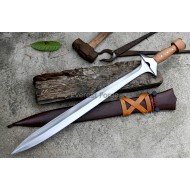
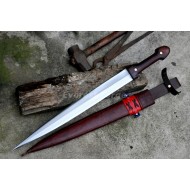
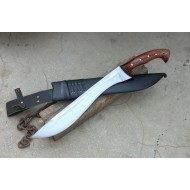
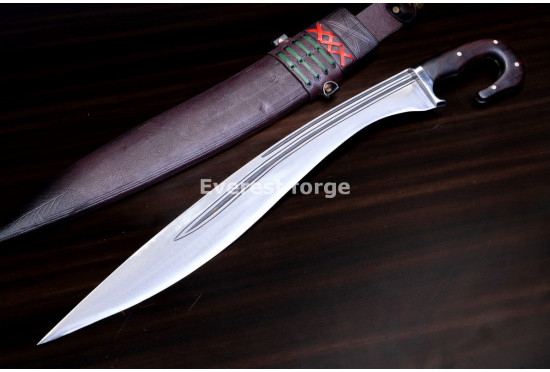
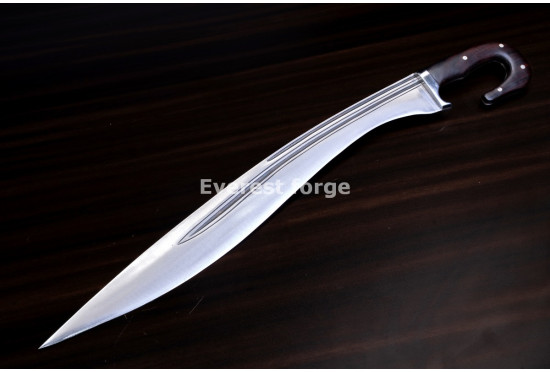
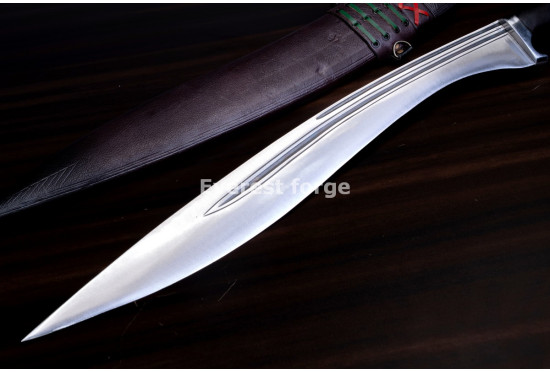
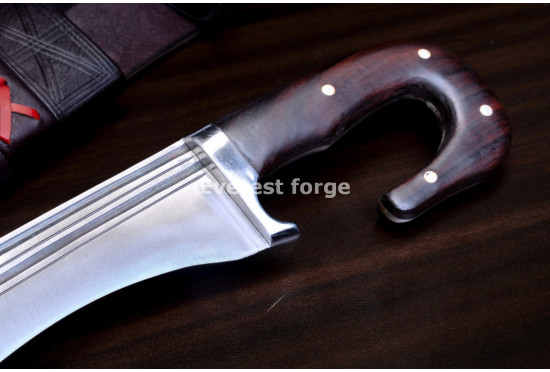
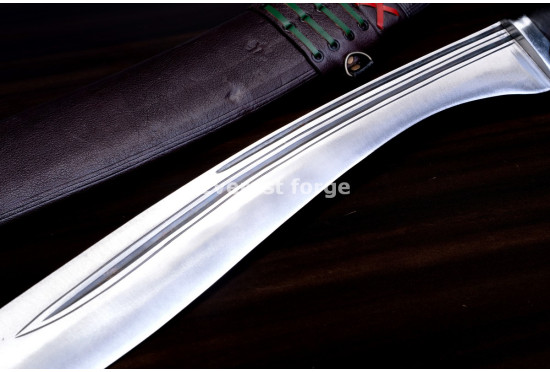
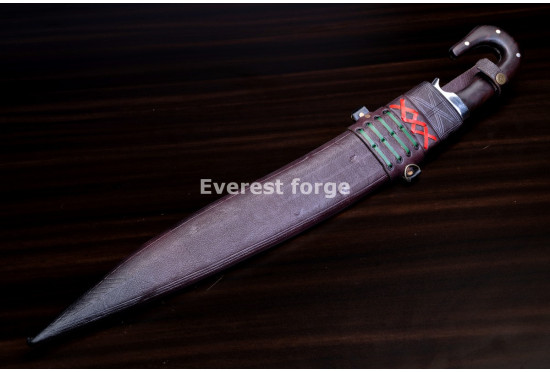
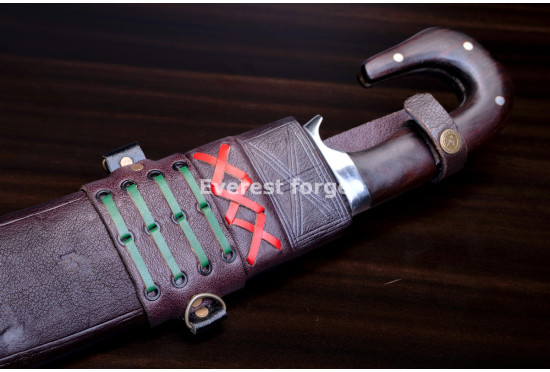
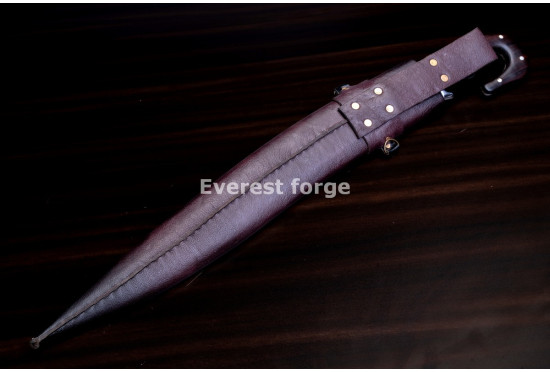
This is a 22 inch hand-forged kopis, the forward-curved single-edged sword of the Greek and wider Hellenistic world. The blade narrows just ahead of the hilt, swells through a broad belly and draws out into a long acute point, with three fine parallel fullers running the length inside the spine. The hilt is rosewood, pinned through a full tang, fitted to a polished steel bolster and curving over at the butt into a closed hook. Overall length is 28 inches and the sword weighs approximately 980 grams. It is forged from 5160 high-carbon steel in Tokha-3, Kathmandu, and supplied in a tooled oxblood leather scabbard with a red and green laced throat panel.
An honest note. This is a kopis in form rather than a reconstruction of any excavated example. Surviving kopides are shorter than this one, usually somewhere between sixteen and twenty-four inches of blade with the majority nearer the lower end, and their hilts were built quite differently — typically with a hooked guard rising from the grip and, on many Iberian examples, a chain or a solid bar running from that hook down to the pommel to protect the hand. This sword has the hook without the knuckle bar and a modern full-tang hilt with pinned rosewood scales. If you want the historical arrangement, our smiths will build it and it is the first option below. What is correct here is the blade: the forward curve, the recurved waist, the forward mass and the drawn point are all the real geometry, and they are what the weapon was about.
Have This Kopis Forged Your Way
Blade length, the depth of the curve, the hilt form and the scabbard are all decided at the forge. Send a description or a photograph of a museum piece and our smiths will quote it.
Start a Custom Forge Order →Why This Sword Is Built the Way It Is
Specifications
Build Options
Is This the Right Sword for You?
Buy This If You Want
- The forward-curved Greek cutting sword with the geometry actually correct
- A blade that cuts like a chopper and still has a point you can use
- Full tang construction under the scales, which the originals did not have
- A piece that reads instantly as ancient Mediterranean rather than generically old
- The starting point for a proper reconstruction, with the hilt corrected
Look Elsewhere If You Want
- An accurate museum reconstruction out of the box — the hilt here is modern
- The Iberian form specifically, which we build as a separate sword
- A straight thrusting sword, since everything about this blade is built around the cut
- A stainless blade needing no care, since 5160 is carbon steel and will rust if left wet
- A sparring or HEMA trainer, which needs rolled edges and a rebated point
Reconstructions Built to a Museum Piece
Send photographs, measurements or a catalogue entry for an excavated kopis or falcata and our smiths will forge to it, hook, knuckle bar and all.
Talk to the Forge →How to Order
Who This Sword Is For
- Collectors of ancient Mediterranean arms who want the blade geometry right rather than approximated
- Re-enactors and living history groups covering the Greek, Hellenistic and Punic periods
- Film, stage and photography armourers needing a blade that reads as ancient in a single frame
- Anyone planning a full reconstruction, for whom this is the base the smiths work from
What Is Included
- One hand-forged kopis, sharpened and ready
- Fitted tooled leather scabbard with laced throat panel
- Certificate of hand-forging from the workshop
- Everest Forge manufacturer warranty against defects in forging and heat treatment
Explore the Collection
Shipping, Returns and Care
Stock pieces are dispatched within two to three business days. Custom builds take four to six weeks at the forge before they ship. Everything travels tracked with DHL or FedEx and typically arrives in seven to fourteen business days. Every piece carries the Everest Forge manufacturer warranty against defects in forging and heat treatment.
Long blades are restricted in some countries and in some states and provinces within them. It is your responsibility to check that this sword may lawfully be imported and possessed where you live before ordering, because a parcel seized by customs cannot be returned to us and cannot be refunded. Ask us before you buy if you are unsure and we will tell you what we know about your destination.
5160 is a high-carbon steel and it will rust if left wet or stored damp. Wipe the blade dry, keep a light film of oil on it, and pay attention to the fullers, which hold moisture that a cloth passes straight over. Do not store the sword in the scabbard for long periods. The rosewood scales take an occasional coat of oil and the leather an occasional conditioning.
Frequently Asked Questions
Kopis, falcata or machaira — what is the difference?
They overlap, and two of the three words are not being used the way the Greeks used them. Machaira was the general Greek term for a single-edged cutting sword or large knife, and ancient writers apply it fairly loosely. Kopis is the narrower term, from the verb meaning to cut or chop, and it is the one modern scholarship attaches to the forward-curved single-edged sword found across the Greek world and adopted widely in the Achaemenid Persian empire. Falcata is not an ancient word at all: it is a nineteenth-century coinage from the Latin phrase ensis falcatus, a sickle-shaped sword, generally credited to the Spanish scholar Fernando Fulgosio writing in 1872, and it is now used specifically for the Iberian version of the same weapon. So the practical answer is that kopis and falcata describe the same family, distinguished by where they were made rather than by shape, and machaira is the wider Greek category that contains the kopis. We build the Iberian form as a separate sword, and this is the Greek one.
Is the kukri descended from the kopis?
Probably not, and it is worth answering carefully because we are a Nepali forge and the claim follows us around. The story usually runs that Alexander's armies carried the kopis into the Indian subcontinent in the fourth century BC and that the kukri descends from it. It is a good story, it is repeated constantly, and the evidence for it is thin. Alexander's campaigns did not reach Nepal, the surviving kukris that can be securely dated are very much later, and there is no chain of intermediate finds connecting the two. The better explanation is convergent design. A forward-curved single-edged blade with mass ahead of the hand is simply a very effective way to make a chopping weapon out of limited steel, and it has been arrived at independently in Greece, Iberia, Nepal, Indonesia and West Africa. The kopis and the kukri look related because they solve the same problem the same way, which is a more interesting fact than descent would be.
What was the kopis actually used for?
Cutting, and cavalry are the specific case worth knowing. Xenophon, writing in the fourth century BC in his treatise on horsemanship, advises a rider to carry a machaira rather than a straight sword, on the reasoning that a man on a horse cuts downward from height and a curved chopping blade does that far better than a thrusting one. That is a rare thing in ancient sources: a practical, first-hand statement about why one weapon suits a situation better than another, from someone who commanded cavalry himself. On foot the kopis appears alongside the straight xiphos rather than replacing it, and Greek art shows both. What the blade is bad at is the tight formation fighting of a phalanx, where a long cutting stroke has nowhere to go and a short straight blade is better. So it is a sword for open fighting and for riders, which is exactly where the geometry pays.
Why does the blade get wider toward the tip?
To put mass where the cut lands. On a straight sword with even taper, the weight is fairly evenly spread and a cut relies mostly on speed. A blade that is narrow at the hand and broad through the forward third moves its centre of mass out along the blade, so at the moment of impact there is considerably more steel arriving. That is why the forward-curved family — kopis, falcata, kukri, yatagan — all share this outline despite having nothing to do with one another. The cost is handling: a forward-heavy sword is slower to change direction and more tiring in the wrist, which is why they tend to be shorter than straight swords of the same period. The recurved waist just ahead of the hilt is part of the same idea, removing steel from where it does least good.
Are three fullers better than one?
No, and we would rather you knew that before choosing. A fuller removes metal from the middle of the blade where it contributes least to stiffness, so the blade gets lighter without getting much weaker — the same principle that makes an I-beam efficient. The first fuller does nearly all of that work. A second and third remove progressively less useful metal and add a great deal of grinding time, and on a blade of this size the difference in weight between one fuller and three is small enough that you would struggle to feel it. What three fullers genuinely do is look striking, catch light along the blade, and demonstrate that somebody spent time on it. Those are legitimate reasons. If you want the honest engineering answer, order a single deep fuller; if you want the blade in the photograph, order three, and we will not pretend it is a performance decision.
What is the hook at the end of the grip?
It is the characteristic hilt form of this whole family and it does two things. It stops the hand sliding off the back of a forward-heavy sword, which matters more here than on a balanced blade because the weight is constantly trying to pull the hilt out of your grip. And on many surviving examples, particularly Iberian ones, the hook is the anchor point for a knuckle guard: either a solid bar or a length of chain running from the hook down to the front of the grip, enclosing the hand. That is the arrangement we would build if you want the historical version, and it is offered above. Our hook curls fully closed, which is a modern interpretation rather than a copy of a specific find. On many originals it is more open and more clearly modelled — horse heads and bird heads both appear.
What steel is it, and how is it heat treated?
5160 high-carbon spring steel, brought to temperature in the forge, quenched in oil and tempered back so the edge is hard while the body of the blade stays springy. The originals were iron and early steel of very variable quality, sometimes with the blade buried in the ground for a period as a crude test of the metal, and a modern homogeneous alloy is stronger and far more predictable than anything available in the fourth century BC. It is not stainless, deliberately: on a heavy cutting blade, toughness matters far more than rust resistance, and stainless grades that genuinely resist rust give the toughness up.
Is it full tang?
Yes. The tang is the full width and shape of the grip with rosewood scales pinned through it, and you can see the line of steel between the scales along the outline of the handle. That is stronger than the historical construction and we would rather say so than let it pass as authentic. Surviving hilts in this family are built in several ways, commonly with organic grip plates riveted to a flat tang, which is closer to what we have done than not, but with the hook and any knuckle bar forged as part of the same piece rather than shaped from the scales. If you want that arrangement it is a custom order and it is the change that most affects how the sword looks in the hand.
How is this different from your Iberian Falcata?
They are the same weapon family from two regions, and we build them as separate swords because that is genuinely how the record divides. This page is the Greek kopis: the term used across the Greek and Hellenistic world and adopted through the Achaemenid empire. The falcata is the Iberian development, made in the Spanish peninsula, and it is where the most elaborate surviving hilts come from — hooked pommels modelled as horse and bird heads, knuckle chains, and inlaid silver decoration. The blades are close enough that in isolation you would struggle to assign one to a region; the hilts are what separate them. If you want the Greek weapon, this is it. If you want the Iberian one with the decorated hilt tradition, take the falcata.
Is it battle-ready, and how sharp does it arrive?
Yes, with one important qualification. Battle-ready is trade shorthand rather than a standard, so here is exactly what we mean by it: the tang is full width and runs the length of the grip, the blade is forged from 5160 and properly heat treated rather than left soft, the geometry and mass distribution are correct for the type, nothing on the sword is cast or stamped decoration standing in for structure, and it arrives with an edge put on by hand at the forge. It is a functional weapon rather than a wall-hanger, and it will do what a sword of this type is supposed to do. What battle-ready does NOT mean, and this matters because the term is used loosely across the industry, is that it is safe for re-enactment combat. Steel-on-steel contact against another person needs rebated edges roughly two millimetres thick and a flared blunted tip, and this sword has a live edge and an acute point. If you need a piece for group combat, tell us and we will forge it blunt and rebated from the start — that is a different build, not a modification. If you would prefer it shipped unsharpened for display or for a gift, we will do that at no extra cost.
Can you build it to a specific find?
Yes, and it is the work our smiths most enjoy. Send photographs, measurements, a catalogue entry or a museum accession record and we will forge to it: the right blade length and curve, a period hilt with the hook and knuckle bar, and decoration if the original carries it. What we will tell you honestly is where a request cannot be met and why. We work in modern homogeneous steel and we are not going to claim ancient metallurgy. Everything about the shape, the section, the fittings and the decoration is achievable. Send the reference before you order rather than after, because it changes the forging from the first heat.
Where is this made, and by whom?
In our own workshop in Tokha-3 on the northern edge of Kathmandu, Nepal, by around ten smiths, most from families that have forged blades for generations. Everest Forge has operated since 2010. A Greek sword made in Nepal deserves the same word we give our bowie and our seax: this is not our own tradition and we do not pretend it is, which is why this page tells you what is documented and what is modern. The one thing we would say in its favour is that a forward-curved chopping sword is not a foreign object here. Our smiths make blades on that principle every working day, and it shows in the geometry more than it would in a workshop that only ever made straight swords.
| Specification | |
| Blade: | 22 inches. Hand forged from 5160 carbon steel |
| Total Length: | 28 inches long in total |
| Handle: | 6 inches. Full tang with rosewood scales pinned through, hooked pommel, steel bolster |
| Weight: | approx 980g sword, 1410g with scabbard |
| Note: | Some variation in weight, dimensions and finish may occur as each piece is hand forged. Keep the blade lightly oiled when not in use |