- Model: SINGLE EDGED SWORD
- Product Code: KOPIS0029
- Location: Kathmandu,Nepal
Available Options
A Hand-Forged Iberian Falcata With a Horse-Head Pommel
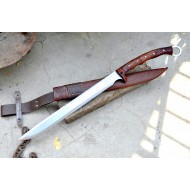
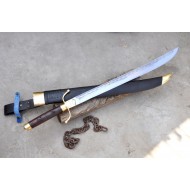
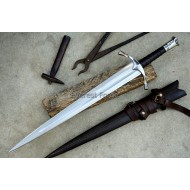
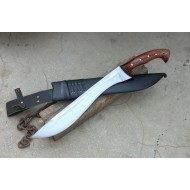
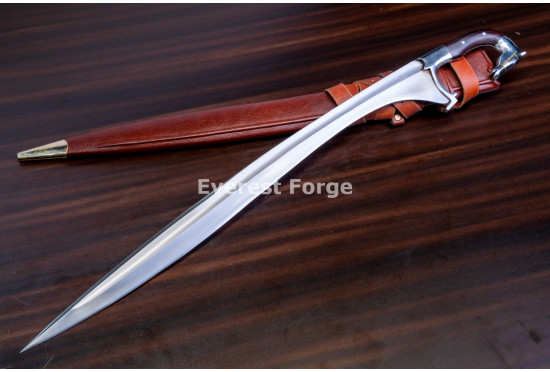
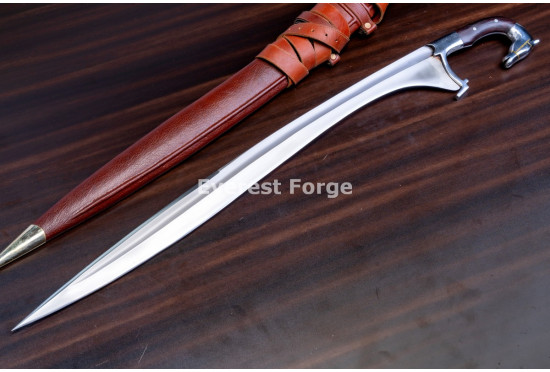
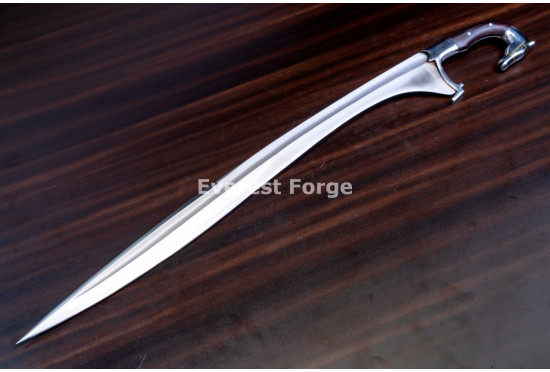
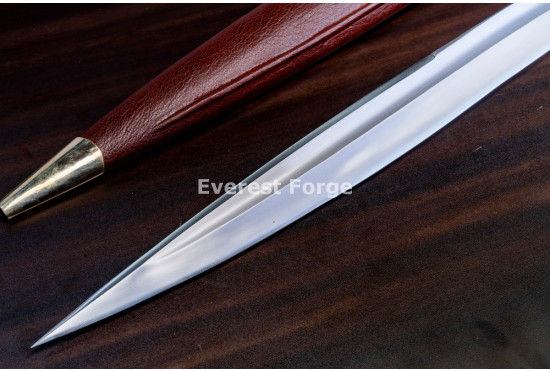
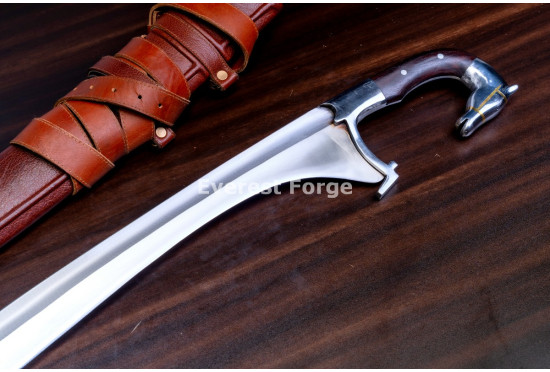
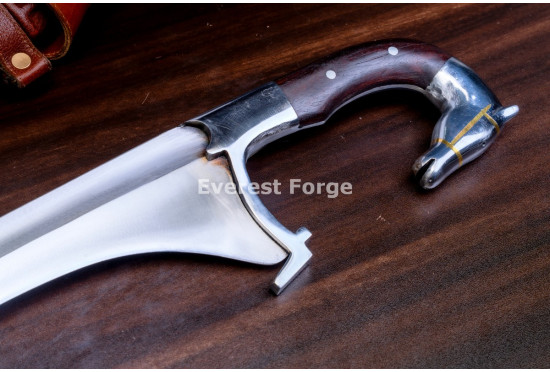
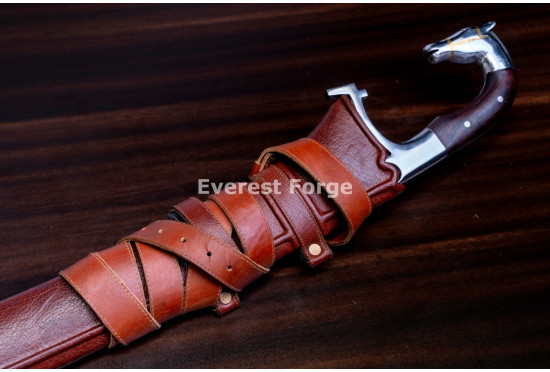
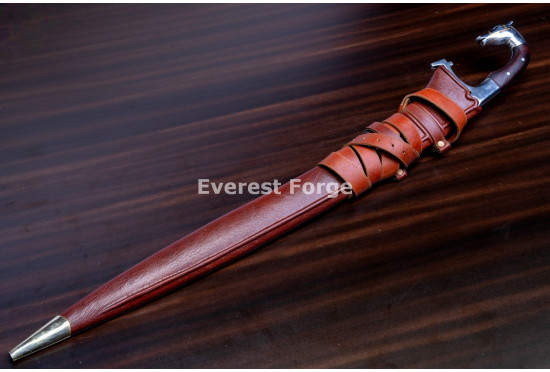
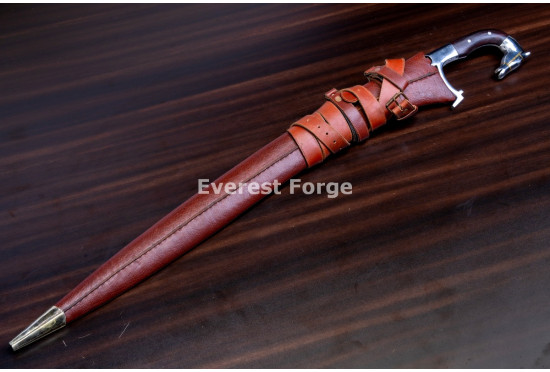
This is a falcata, hand-forged in Tokha-3, Kathmandu, Nepal from 5160 high-carbon steel, oil-quenched and tempered. The blade runs 29 inches, single-edged and curving forward through a narrow waist into a broad belly before drawing to a fine point, with the cutting edge carried on the inner curve. The hilt is what names the piece: a steel bow sweeping up from the blade and over the hand to close on the pommel, a rosewood grip, and a sculpted horse head finishing the whole. Overall it stands 35.5 inches. It ships sharpened, in a brown leather scabbard with a metal chape.
An honest note. This blade is often sold as a Greek kopis, and the blade alone would justify that — kopis, falcata and machaira all share the forward curve with the edge on the inside. But the hilt on this piece is specifically Iberian. The bow that sweeps from the blade over the hand and closes on the pommel, finished with a sculpted horse head, is the diagnostic falcata hilt, and Greek kopides generally carried nothing of the kind. Calling it a falcata is the more precise answer, so that is what we call it. The horse head itself is a modern sculpt in the Iberian tradition rather than a copy of a specific excavated example.
Want a Greek Kopis Instead?
Our smiths will forge the same forward-curved blade on a plain Greek kopis hilt with no bow and no zoomorphic pommel, or reproduce a specific excavated falcata, or cut a different head — bird, hound or a device of your own. Send a reference and we will quote it.
Start a Custom Build →Why This Falcata Is Built the Way It Is
Full Specifications
How You Can Configure It
Is This the Right Sword for You?
Buy This If You Want
- The Iberian form with its proper closed bow, not a plain curved blade
- A sculpted horse-head pommel, the characteristic falcata terminal
- Real forged 5160 with a proper heat treatment
- A forward-curved chopper with genuine mass in the belly
- Full hand enclosure, which very few ancient swords offer
- A smith who will build the plain Greek kopis version if you prefer
Look Elsewhere If You Want
- A strict copy of one excavated find — the horse head is a modern sculpt
- A Greek kopis; the hilt on this piece is specifically Iberian
- A thrusting sword — the geometry is built to cut
- A light sword; the forward mass is the whole point of the shape
- A stainless blade that needs no oiling or care
- Identical units; every piece is forged and sculpted by hand and varies
How to Order
Who This Falcata Suits
- Ancient-world collectors filling the Iberian slot beside Greek, Roman and Celtic pieces.
- Test cutters who want to feel what a forward-curved blade with a closed hilt actually does to a target.
- Reenactors and living-history groups covering the Punic wars and Iberian peninsula, where the falcata is the signature weapon.
- Display buyers after a sword whose hilt is as much of the object as the blade.
- Gift buyers looking for something with a sculpted terminal that can be swapped for a personal device.
What Is Included
- One hand-forged falcata, sharpened and ready to use
- Brown leather scabbard with a metal chape
- Care and oiling instructions
- Everest Forge manufacturer warranty against defects in forging and heat treatment
Other Hand-Forged Curved Swords
Shipping, Returns and Care
Shipping. Standard builds dispatch in 2 to 3 business days. Custom builds take 4 to 6 weeks. We ship worldwide by DHL or FedEx, 7 to 14 business days, fully tracked. Sword laws vary by country and by state — please check what applies where you live before ordering, as we cannot deliver into a restricted address.
Returns. Standard builds can be returned unused and in the original scabbard within 30 days. Custom builds, altered dimensions and custom pommels are made to your specification and cannot be returned unless there is a fault in forging or heat treatment.
Care. The blade is high-carbon steel: wipe it dry after handling and keep a thin film of oil on it in storage, paying attention to the inside of the curve, where a cloth naturally skips. The closed hilt is the awkward part — the bow encloses the grip, so you cannot simply wipe around it; use a narrow strip of cloth or a soft brush to reach the inner face of the bow and the recesses of the horse head, and keep metal polish away from the sculpted detail, where it dries white in every hollow. The rosewood grip wants a hard wax or furniture oil once or twice a year. Do not store the blade sheathed for long periods.
Frequently Asked Questions
Falcata, kopis or machaira: what is the difference?
All three share the forward curve with the edge on the inside, and the words are used loosely, so here is the working distinction. MACHAIRA is the broadest Greek term, applied to a range of single-edged cutting swords and knives, and in modern usage it usually means the earlier, straighter, sabre-like Greek forms. KOPIS is the Greek forward-curved chopper proper, with a pronounced recurve and the mass thrown forward, generally on a relatively plain hilt with at most a simple guard. FALCATA is the Iberian development of the same idea, and it is distinguished almost entirely by its hilt: a bow sweeping up from the blade and over the hand to close on the pommel, forming a fully enclosed grip, and terminating in a sculpted head, most often a horse or a bird. The blade shapes overlap heavily; the hilts do not. This piece has the Iberian bow and the horse head, which is why we call it a falcata rather than a kopis. It is worth adding that the name falcata is modern — a nineteenth-century coinage from a Latin phrase — and no Iberian warrior ever used it.
How did Iberian smiths make their steel?
By a method that has passed into legend, and which is worth reporting carefully because the evidence is thinner than the story. Classical writers, principally Diodorus Siculus, describe Iberian smiths burying iron plates in the ground for a period of years, allowing the weaker metal to corrode away, and then forging what survived into blades. Whether or not the burial happened as described, the underlying logic is sound: bloomery iron of the period was wildly inconsistent, and any process that let a smith discard the poor material and keep the good would produce noticeably better swords. Roman writers certainly regarded Iberian blades as exceptional, and the quality of Iberian metalwork is one of the reasons Rome eventually adopted a Spanish sword pattern of its own. We flag it as a tradition reported by ancient sources rather than as established fact, because that is what it is. Our own blades are 5160 spring steel with a modern oil quench and temper, which sidesteps the problem the Iberians were solving.
What does the closed knuckle bow actually do?
It encloses the hand completely, which almost no ancient sword does. On an open hilt your fingers are protected by a crossguard at best and by distance and timing at worst; on this hilt a blade coming down the edge meets the bow rather than your knuckles. It also does something less obvious: because the bow is fixed to both the blade and the pommel, the whole hilt becomes a rigid loop, and the sword cannot twist in the hand the way an open-hilted chopper can when it lands off-square. That matters on a forward-curved blade, which carries its mass well ahead of the grip and therefore wants to rotate on impact. The Iberians arrived at this several centuries before European swords rediscovered enclosed hilts, and it is one of the more striking cases of a good idea appearing early and then being forgotten.
What steel is it and how is it heat treated?
5160 high-carbon spring steel, oil-quenched and then tempered back. 5160 holds a working edge and flexes under load rather than snapping, which is what a heavy forward-weighted blade needs. It is also the steel family Nepali smiths have traditionally drawn from vehicle leaf spring, so our forge reads it by colour and by sound at the anvil rather than by instrument alone.
Does it arrive sharp?
Yes. It ships with a working edge along the inner curve, sharpened by hand and ready out of the scabbard. It is not a blunt wall-hanger with a sword-shaped profile ground into it. If it is going into a display case, a costume or a reenactment group whose rules require blunt kit, ask for it blunted in the order note before we ship and we will finish it that way at no extra cost.
Is the tang full length?
Yes. The tang runs the full length of the hilt with the bow, grip and pommel fitted to it, so the assembly is held by steel rather than by adhesive. The closed hilt makes this more important than usual, not less: because the bow is anchored at both ends, any load applied to it is transmitted straight through the tang, and a partial tang under a closed hilt has two places to fail rather than one.
Can I have the Greek kopis hilt instead?
Yes, and it is a genuinely different sword to hold. A plain kopis hilt has no bow, so the hand is open and the sword feels lighter and quicker in the wrist, at the cost of the protection and the anti-rotation stiffness the closed hilt gives you. It is also the correct choice if you are portraying a Greek or Macedonian figure rather than an Iberian one. Say which you want when you order; the blade is the same either way.
Can I have a different pommel head?
Yes. Bird heads are as well attested on surviving falcatas as horses, and hounds appear too, so any of those is a historically defensible choice. Beyond that our workshop will model and cast a device of your own — a crest, a monogram or another animal. Allow extra lead time beyond the usual custom window, since a new head has to be modelled and a mould taken before any forging starts.
Can I have it made longer or shorter?
Yes. Blade length is selectable, and beyond the listed options our smiths will forge to a dimension you specify. Worth knowing: surviving falcatas are generally SHORTER than this one, often in the range of 45 to 60 centimetres of blade, because they were fighting swords carried alongside a shield. At 29 inches this piece is built at display scale. If you want the historical proportions, ask for them.
Is the scabbard included?
Yes. A brown leather scabbard with a metal chape comes with the sword, cut around this specific blade profile. A forward-curved blade only fits a scabbard made to its own curve, so this is not a generic sleeve. A belt frog, a baldric or different fittings can be specified, and if you change the blade length on a custom build the scabbard is made to the new dimensions.
How do I look after a closed hilt?
It is the one genuinely fiddly part of this sword. The bow encloses the grip, so you cannot wipe around the hilt the way you would on an open sword — use a narrow strip of cloth threaded through, or a soft brush, to reach the inner face of the bow where your fingers sit and where sweat collects. The sculpted horse head has recesses around the ears, eye and muzzle that a cloth bridges over entirely; a brush handles those, and metal polish should be kept away from sculpted detail because it dries white in every hollow. For the blade itself, wipe dry and oil as usual, paying attention to the inside of the curve.
Where is it made and by whom?
Hand-forged in Tokha-3, Kathmandu, Nepal, by our own smiths. Everest Forge is a working forge rather than a reseller putting a name on imported blanks — the steel is cut, drawn, quenched, tempered and ground, the bow shaped and fitted, the pommel modelled and finished, the grip turned, and the scabbard cut and stitched, all under one roof. That is why the hilt type and the pommel device can both be changed on a custom order.
| Specification | |
| Blade: | 29 inches. Hand forged from 5160 carbon steel |
| Total Length: | 35.5 inches |
| Handle: | 6.5 inches total with a 4.5 inch grip, full tang, closed steel knuckle bow from blade to pommel, rosewood grip, sculpted horse-head pommel |
| Weight: | 1750 grams approx, as shipped with the scabbard |
| Note: | handmade variation in weight, dimensions and finish may occur; keep blade lightly oiled when not in use |