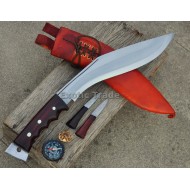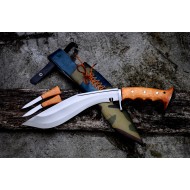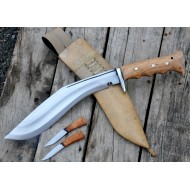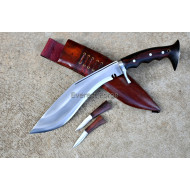


- Model: Modern Kukuri
- Product Code: DOUBLEDGEFULLER013
- Location: Kathmandu, Nepal
Available Options
What Is a Guarded Kukri?
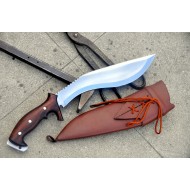
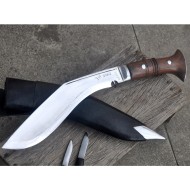
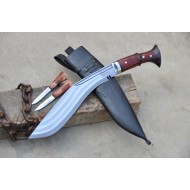
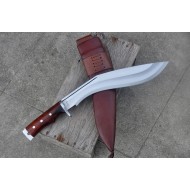
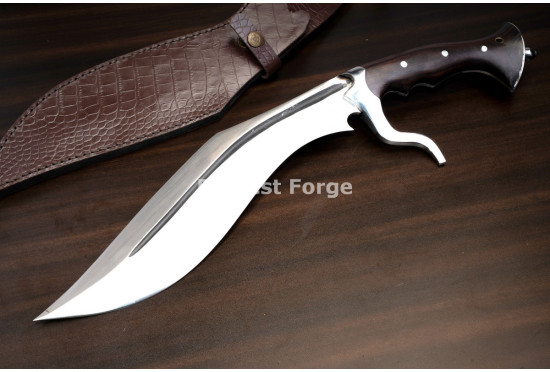
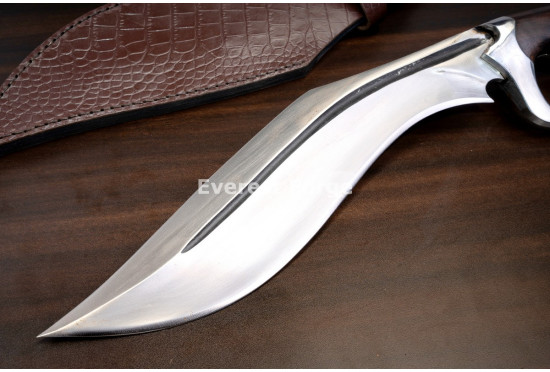
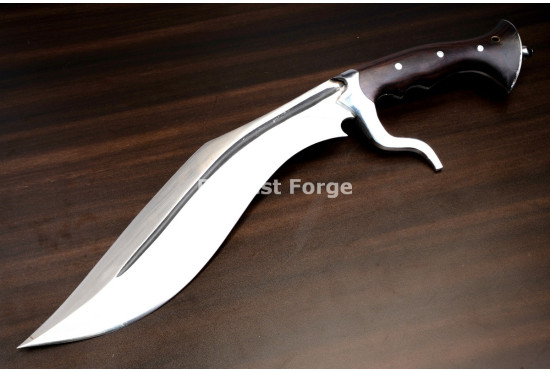
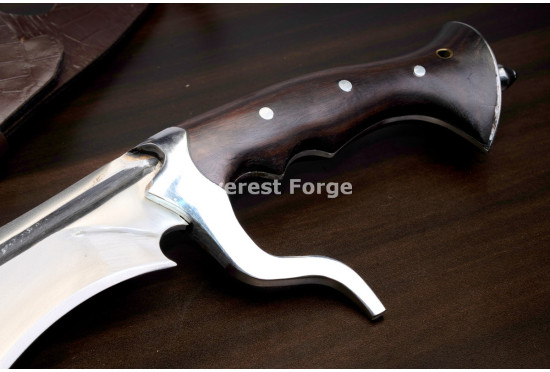
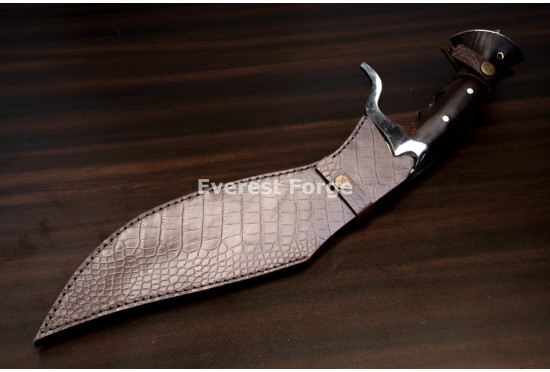
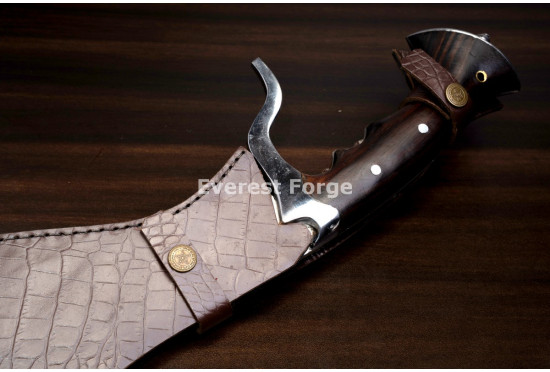
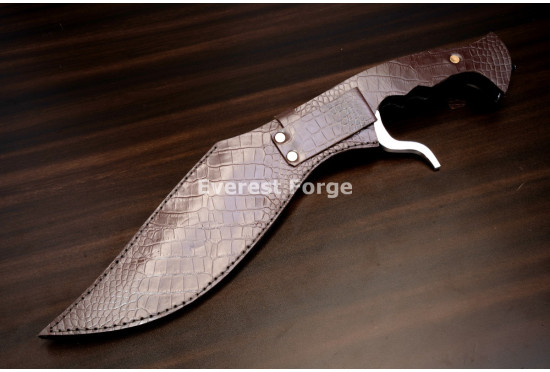
A kukri with a steel guard. That sounds unremarkable until you look at the rest of the range and notice that not one other kukri we make has one, and neither does any traditional Nepali kukri. This is a 13 inch forward-curved blade hand-forged from 5160 high-carbon steel, oil-quenched and tempered, with a swept steel quillon rising from the ricasso and curving forward beneath the hand. The blade carries a narrow deep fuller down most of its working length, a deep belly, an unusually acute point and a sharpened section of back edge. The hilt is 6.5 inches of contoured rosewood cut with finger grooves and pinned through a full tang, with a brass lanyard eyelet and a canted butt cap. It ships in a brown crocodile-embossed leather sheath on a brass stud.
The guard is the whole point of this piece, and it exists for a specific reason. A traditional kukri has a blunt convergence where belly and spine meet, and it is not really designed to thrust. This blade is. It has a fine acute point and a sharpened back edge, which makes it capable of a stabbing motion the traditional pattern is not, and the moment a blade can be thrust the question of what stops your hand sliding forward onto it becomes a real one. The quillon is the answer to that question. Everything else here follows from it.
An honest note. This is not a traditional kukri and we are not going to imply that it is. The blade profile is Nepali, the cho at the base is hand-cut, and it is forged by our own smiths in Kathmandu, but the guard, the finger grooves and the point geometry come from a different design tradition entirely. Two consequences worth knowing before you buy. The back edge is sharpened, and in a number of countries, states and provinces the legal test is whether a blade carries a second sharpened edge at all rather than how long that edge runs, so this piece can fall under restrictions our plain-spined kukris escape. We will build it with a plain spine at no extra cost if you prefer. And the guard means this will not fit a traditional dap, so it comes in a sheath cut to clear the quillon.
Want This Blade Built Your Way?
A plain spine with no back edge, no guard at all, a different grip material, another length, or your own drawing entirely. Our smiths in Kathmandu forge to specification and quote before any work begins.
Start a Custom BuildWhat the Guard Changes
Standard Build and Specifications
Blade length, blade finish, grip material and the back edge are all selectable, so the figures above describe the standard build rather than every version of this kukri. Because each piece is forged, ground and fitted by hand, weights and dimensions vary slightly between examples. Individual blade and guard weights can be measured on your actual piece before dispatch if those numbers matter to you.
Build Options
Is This the Right Kukri for You?
Choose This One If
- You want a kukri with a real point rather than a chopping convergence
- You want your hand positively stopped from running forward under a thrust
- You like the design and want something no other kukri in the range offers
- You want a hilt that indexes the same way every time you pick it up
- You are a collector building a range that includes departures from the tradition
Look Elsewhere If
- You want a traditional kukri — the blade is Nepali, the design is not
- You want a pure chopper — the guard gets in the way of the grips a heavy chopping session wants, and our bhojpure is built for that job
- You want the simplest legal position — a sharpened back edge complicates it in some jurisdictions
- You want it in a traditional dap — the guard will not allow it
- You want the full traditional kit — no karda, no chakmak
How to Order
Who This Kukri Is For
- Collectors of kukri variants who already own traditional builds and want the clearest departure from the pattern we make
- Buyers who want a point and have been frustrated by kukris that will chop all day and thrust into nothing
- Anyone who wants a positive hand stop on a large blade, whether for confidence or for the way it handles
- Buyers drawn to the design — the swept quillon and grooved grip are the reason most people buy this piece, and that is a good enough reason
- Display buyers who want a forged working blade rather than a cast reproduction of one
What Is Included
- One hand-forged guarded kukri, sharpened and ready to use
- Brown crocodile-embossed leather sheath, cut to clear the guard
- Everest Forge manufacturer warranty
- Care instructions
No karda and no chakmak are supplied with this kukri. Those companions ride in fitted pockets on the traditional wooden-cored dap, which a guarded blade cannot use. The sheath here is cut specifically around the quillon instead.
More From the Everest Forge Collection
Shipping, Returns and Care
Stock builds dispatch from our workshop within 2-3 business days. Custom and made-to-order builds take 4-6 weeks from confirmation, and we photograph the finished piece before it leaves us. We ship worldwide with DHL and FedEx, fully tracked, typically 7-14 business days in transit. Every blade carries the Everest Forge manufacturer warranty against defects in forging and construction.
Blade laws vary by country, state and province and it is the buyer's responsibility to check local restrictions before ordering. This piece carries a sharpened back edge in its standard build, which brings it under double-edged restrictions in some jurisdictions. We cannot advise on your jurisdiction and we cannot refund a blade seized in transit.
5160 is a high-carbon steel and it will rust if you let it. Wipe the blade dry after use, keep it lightly oiled, and do not store it in the sheath for long periods in a damp climate, because leather holds moisture against steel. Two places on this piece need particular attention: the bottom of the fuller, which a cloth drawn along the flat will bridge and never touch, and the junction where the guard meets the ricasso, which is a tight angle that traps moisture. Work an oiled cloth corner into both. Sharpen with a stone or a file rather than a powered grinder, which will draw the temper out of an edge faster than you expect.
Forged by Hand, Not Assembled
Every blade we sell is forged, ground, heat-treated and fitted by our own smiths in Kathmandu. If you want something we do not list, we will make it.
Talk to Our SmithsFrequently Asked Questions
Why does no traditional kukri have a guard?
Because the traditional pattern solves the same problem a different way, and because it does not have the problem as acutely to begin with. A kukri is a chopping tool. The force in a chop runs down through the blade and away from you, not back along the handle toward your hand, so the failure a guard prevents is not the one a chopper faces. What a chopper does face is the hand travelling forward under repeated shock, and Nepali smiths solved that with the flared butt behind the hand and, on many patterns, turned rings under it, letting the kukri be held loosely while staying where it belongs. The other half of the answer is the point: a traditional kukri point is simply where belly and spine converge, thick and blunt, and a blade you cannot really thrust with does not need a guard. Change the point, as this piece does, and the calculation changes with it.
What does the guard actually do here?
It stops your hand. On a thrust into anything that resists, the hand wants to keep going after the blade has stopped, and on a hilt with no positive barrier the only things preventing your fingers from meeting the edge are grip strength and luck. The quillon takes that out of the equation by putting steel between your hand and the blade. It sweeps forward rather than standing straight out, which does the same job while keeping the profile close to the hilt and giving you a place to hook a finger for control in fine work. It also protects the front of the grip in a way a bare ricasso does not. All of that only matters because this blade has a point worth thrusting with, which most kukris do not.
What does the guard cost you?
Three things, and they are worth weighing honestly. First, chopping grips. Heavy chopping often wants the hand to shift back toward the butt for maximum leverage or forward for control, and a guard limits how freely the hand moves along the hilt. Second, batoning and choked-up work: there are jobs where you want a hand or a thumb up near the ricasso, and the quillon occupies that space. Third, carry. A guarded blade cannot go into a traditional dap and needs a sheath cut around it, which is why this piece ships in a modern sheath rather than the traditional article. If you are buying a kukri primarily to process firewood all afternoon, those costs are real and our bhojpure or our deep-fullered 13 inch will serve you better. If you want a blade with a point and a hand stop, they are a fair trade.
Why does the sheath sit around the guard?
Because it has to. A traditional kukri sheath is a wooden-cored dap covered in leather, closed all the way around, and the blade drops into it until the bolster meets the throat. That geometry assumes nothing sticking out at the hilt. A quillon breaks the assumption completely, so a sheath for a guarded blade has to be cut with an open throat that lets the guard sit proud rather than trying to swallow it. That is what you are seeing here: the leather stops short and the quillon rides outside it, held by the retaining strap. It is a modern solution to a problem the tradition never had to solve, and it is another reason we do not describe this piece as traditional.
Is the back edge sharpened, and does that matter?
Yes, over the forward section of the spine, and it matters more legally than practically. In a number of countries, states and provinces the statutory test is whether a blade carries a second sharpened edge at all rather than how far along the spine it runs, which means a piece like this can fall under double-edged restrictions that our plain-spined kukris escape entirely. We set out the detail on our back-edged chirra kukri rather than repeating it here, and it is worth reading before you order if you are anywhere the law is strict. The practical short version: we will grind this blade with a plain spine at no extra cost, it costs you nothing but the asking, and it cannot be reversed once the blade is finished.
How does this compare to your other 13 inch kukris?
It is the outlier of the group and deliberately so. Our traditional chirra is the classic article: broad chirra, turned horn grip, fitted bolster, laced sheath, and a back edge of its own. Our deep-fullered 13 inch is the lightest blade we make, built for long working sessions with a plain spine and no complications. This one is neither. It has the acute point neither of those has, a guard nothing else in the range has, grooved grip contours instead of a traditional profile, and a sheath cut to accommodate all of it. Take the chirra for tradition, the deep-fullered for work, and this one if what you actually want is the design.
What is the cho, and does the guard replace it?
No, they do entirely different jobs and this blade has both. The cho is the notch at the base of the edge, sometimes written kaudi, and it is the diagnostic mark of a genuine kukri. It terminates the edge in a rounded cut so a crack starting at the edge has somewhere to stop rather than running back toward the tang, and it carries religious meaning read differently by different communities in Nepal. It protects the blade. The guard protects the hand. Ours are cut individually by hand on every blade, which is why no two are quite alike, and we apply the test in both directions: a curved knife with no cho did not come from this tradition, whatever a listing calls it.
What steel is it?
5160 high-carbon spring steel, oil-quenched and tempered. It is the family of steel used for vehicle leaf springs, which is the origin of the Nepali practice of forging kukris from them, and it is chosen for toughness rather than for maximum hardness. That choice suits a blade with a fine point particularly well: an acute point in very hard, brittle steel is the classic way to snap a tip, whereas 5160 at a working temper will bend slightly and come back. The trade-off is that it takes sharpening a little more often than a harder steel. It is not stainless and it will rust if neglected.
Is this a fighting knife?
It borrows its vocabulary from fighting knives — the guard, the acute point, the sharpened back edge and the indexed grip all come from that lineage rather than from Nepali village smithing. We sell it as a collector's piece and a capable utility blade, and that is how we would encourage you to think about it. What we will not do is dress it up in tactical language it does not need or make claims about what it is for beyond cutting. If you are buying a large knife with a view to carrying it for protection, please check what your local law says first, because in most places the answer is unwelcome and a listing description is no defence.
What are the finger grooves for?
Indexing. They put your hand in one position and keep it there, so the blade is oriented the same way every time you pick it up without needing to look. On a knife with an asymmetric point and a sharpened back edge that consistency is worth something, because knowing where the edges are by feel matters more than it does on a plain blade. The trade-off is the usual one with grooved grips: they suit hands they fit and annoy hands they do not, and unlike a smooth contour they cannot be held comfortably in a range of positions. If you have found grooved handles uncomfortable before, ask for the plain contour instead — it costs nothing and we would rather you had the one that fits.
How do I clean and oil it?
Two places need more than a wipe. The first is the fuller: a cloth drawn along the flat bridges the groove and never touches the bottom of it, which is exactly where water collects on a blade like this. The second is the junction where the guard meets the ricasso, a tight internal angle that traps moisture and holds it against two pieces of steel at once. Work an oiled cloth corner or a cotton bud into both after cleaning, then wipe the flats. Everything else is standard carbon steel care: dry after use, oil lightly, do not store it in the sheath in a damp climate. Take particular care after cutting anything green, since plant sap is acidic and settles in exactly those recesses.
Can I have this without the guard, or in another size?
Both. Without the guard it becomes a conventional kukri hilt and we will fit a bolster in its place, though at that point you may prefer one of our other 13 inch builds, and we will say so rather than take the order if it sounds like the better fit. The guard can also be reshaped: shorter, straighter, or doubled to both sides of the hilt. On size, we forge this profile from belt-sized blades up to two-handed pieces. One caution specific to this design: guard proportions do not scale linearly, and a quillon sized for a 13 inch blade looks and handles wrong on an 8 inch one, so we redraw it for the length rather than shrinking it. We will show you the shape before forging.
| Specification | |
| Blade: | 13 inches. Hand forged from 5160 carbon steel. Narrow deep fuller, acute point, forward section of spine sharpened |
| Total Length: | 19.5 inches |
| Handle: | 6.5 inches, full tang, contoured rosewood with finger grooves, three pins, brass lanyard eyelet, canted butt cap |
| Weight: | Approx. 1320 g total |
| Note: | As each piece is forged, ground and fitted by hand, slight variation in weight, dimensions and finish may occur. Oil into the fuller and into the guard-to-ricasso junction, not just across the flats. |