Menu
Your Cart

Hand-Forged Grosses Messer, Shell Nagel

Hand-Forged Grosses Messer, Shell Nagel
$349.99
Ex Tax: $349.99
  • Model: SINGLE EDGED SWORD
  • Product Code: MESSER0029
  • Location: Kathmandu,Nepal

Available Options

A Hand-Forged Grosses Messer With a Shell Nagel

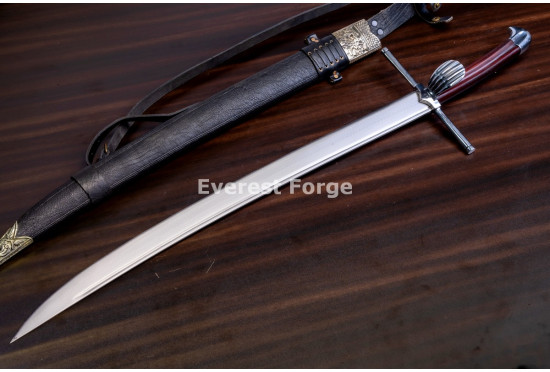
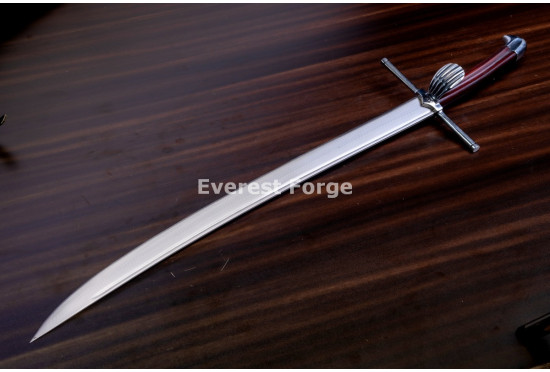
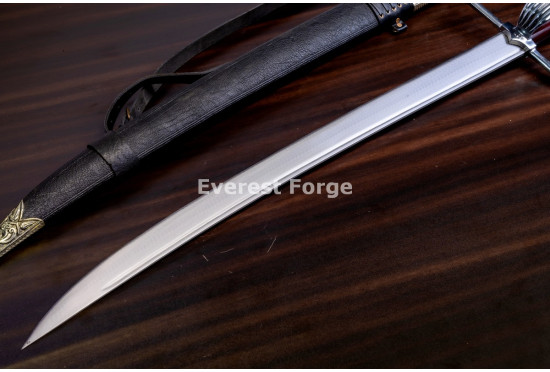
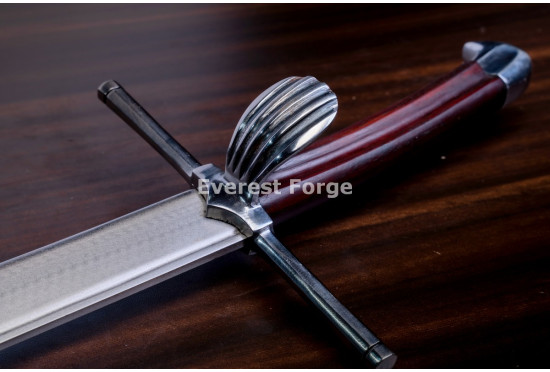
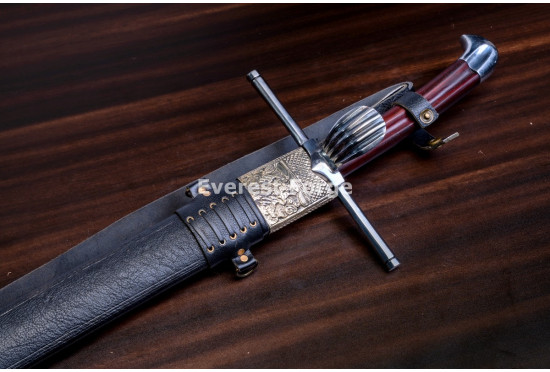
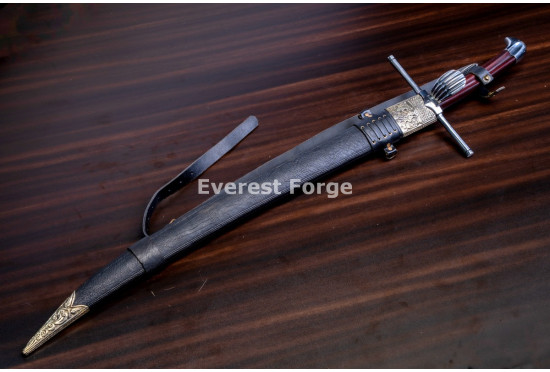
This is a grosses messer — a great knife — hand-forged in Tokha-3, Kathmandu, Nepal from 5160 high-carbon steel, oil-quenched and tempered. The blade runs 29 inches, single-edged with a gentle forward curve through its length and a long upswept point, satin polished across the flats. The hilt carries the fitting that defines the type: a fluted shell Nagel standing proud of the cross on the outside of the hand, backed by a straight steel cross with turned terminals, a shaped rosewood grip and a beaked pommel cap curling over the end. Overall it stands 38.5 inches, which puts it at the large end of the messer family. It ships sharpened, in a black leather scabbard.

An honest note. Messer terminology is loose, in the period sources as much as in modern usage, so it is worth saying what we mean. Grosses messer means great knife, and it sits at the larger end of a family that runs from the single-hand langes messer up to the two-handed kriegsmesser, with the boundaries blurred and the same weapon sometimes called two different things in two different manuscripts. At 29 inches of blade on a 9.5 inch hilt this piece is genuinely at the big end, hand-and-a-half in use. What is not in doubt is the Nagel: the shell standing off the cross is the diagnostic messer fitting, and it is the feature that most reproductions leave off entirely.

Custom Forge

Want a Different Point in the Messer Family?

Our smiths will forge to any point on the range — a single-hand langes messer, a two-handed kriegsmesser, a plain stud Nagel instead of the shell, or proportions taken from a specific surviving example. Send a reference and we will quote it.

Start a Custom Build →

Why This Messer Is Built the Way It Is

Shell NagelThe fluted plate standing off the cross covers the back of the hand on the outside, where a plain cross leaves it exposed. It is the single most diagnostic messer fitting and the one most reproductions skip.
Gentle Forward CurveThe blade eases forward rather than bending hard, which keeps the mass spread along its length. It cuts on a drawing stroke without becoming a chopper.
Long Upswept PointThe last section rises to a fine point with the false edge meeting it cleanly, so a single-edged blade can still thrust.
Straight Cross With Turned TerminalsPlain, square-set and finished with turned ends. Messer crosses are working furniture rather than decoration, and the plainness is period-correct.
Beaked Pommel CapCurling over the end of the grip so the hand has a positive stop, and closing the end grain of the timber where a knife-construction grip takes damage first.
5160 High-Carbon SteelSpring steel, oil-quenched and tempered. It takes an edge and flexes under load rather than shattering — the same family Nepali smiths have drawn from leaf spring for generations.

Full Specifications

Blade Length29 inches
Handle Length9.5 inches
Overall Length38.5 inches
Blade Steel5160 high-carbon spring steel, oil-quenched and tempered
Blade ProfileSingle-edged with a gentle forward curve and a long upswept point
EdgeSingle edge with a false edge at the point, sharpened and ready to use
NagelFluted shell standing proud of the cross
HiltStraight steel cross with turned terminals, shaped rosewood grip, beaked pommel cap
Weight1880 grams approx, as shipped with the scabbard
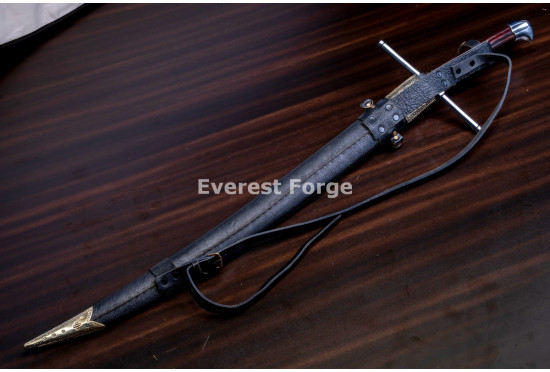
ScabbardBlack leather, fitted to the blade profile
OriginHand-forged in Tokha-3, Kathmandu, Nepal
Standard Build29 inch blade, satin finish, rosewood grip. Blade length, blade finish and grip material are selectable above — the photographed piece shows the standard build.

How You Can Configure It

Blade LengthShorter toward langes messer proportions, or longer toward a kriegsmesser. The curve is redrawn rather than stretched so the balance stays right.
Nagel FormThe fluted shell as photographed, a plain stud, or a ring — all three appear on surviving examples and each changes the character of the hilt.
Blade FinishA bright satin that shows the curve and the grind, or a darker finish that reads as older and heavier.
Grip MaterialRosewood as standard, or hardwood, horn or a leather wrap. Horn is the most period-appropriate on a messer.
Edge GeometryA keen cutting edge, or a blunted display edge for a case, a costume or a HEMA context that requires it.
MarkingsInitials, a name, a date or a maker's mark etched on the flat or at the ricasso. Send the text with your order note.

Is This the Right Sword for You?

Buy This If You Want

  • A messer with the Nagel actually fitted, rather than a bare cross
  • The large end of the family — 29 inches of blade, hand-and-a-half
  • A single-edged curved blade with a working false edge at the point
  • Real forged 5160 with a proper heat treatment
  • Correct German hilt architecture: cross, Nagel, beaked cap
  • A smith who will move it up or down the family on a custom build

Look Elsewhere If You Want

  • A single-hand sidearm; at 38.5 inches this is the big one
  • A strict reconstruction of one named surviving example
  • A double-edged blade; the messer is single-edged by definition
  • A stainless blade that needs no oiling or care
  • A light sword — 29 inches of single-edged blade carries mass
  • Identical units; every piece is forged and fitted by hand and varies

How to Order

Choose Your BuildSet blade length, Nagel form, finish and grip material from the options above, then add to cart.
Add Any NotesA different point in the messer family, etching text or a blunted edge go in the order note.
We Forge and FitStandard builds dispatch in 2 to 3 business days. Custom builds take 4 to 6 weeks from confirmation.
Tracked DeliveryDHL or FedEx, 7 to 14 business days worldwide, tracked door to door and covered by our manufacturer warranty.

Who This Messer Suits

  • HEMA students working the messer material in the German sources, where the Nagel is assumed by the technique.
  • Collectors of German and Central European arms who already own a plain messer and want the shell-hilted one.
  • Reenactors portraying late medieval militia and townsmen, for whom the messer was the ordinary sidearm.
  • Test cutters after a long single-edged curve that draws through a target rather than chopping into it.
  • Display buyers wanting a piece whose distinguishing feature is visible from across a room.

What Is Included

  • One hand-forged grosses messer, sharpened and ready to use
  • Black leather scabbard fitted to the blade profile
  • Care and oiling instructions
  • Everest Forge manufacturer warranty against defects in forging and heat treatment

Other Hand-Forged Swords

Shipping, Returns and Care

Shipping. Standard builds dispatch in 2 to 3 business days. Custom builds take 4 to 6 weeks. We ship worldwide by DHL or FedEx, 7 to 14 business days, fully tracked. Sword laws vary by country and by state — please check what applies where you live before ordering, as we cannot deliver into a restricted address.

Returns. Standard builds can be returned unused and in the original scabbard within 30 days. Custom builds, altered dimensions and etched pieces are made to your specification and cannot be returned unless there is a fault in forging or heat treatment.

Care. The blade is high-carbon steel: wipe it dry after handling, since fingerprints will etch a satin finish within days, and keep a thin film of oil on it in storage. The shell Nagel is the part people miss — it has a fluted face and an underside that sits against the cross, and a cloth passes straight over both, so give it a moment with a corner of cloth or a soft brush every time. The rosewood grip wants a light coat of hard wax or furniture oil once or twice a year, particularly at the ends. Do not store the blade sheathed for long periods.

Frequently Asked Questions

Langes messer, grosses messer, kriegsmesser: what is the difference?

They are points on one continuum rather than three separate weapons, and the period sources are not consistent about where the lines fall. LANGES MESSER, long knife, is the single-hand end: a blade of roughly 20 to 26 inches carried as an everyday sidearm, the weapon the German fencing manuals treat alongside the longsword. GROSSES MESSER, great knife, is the larger middle: longer in the blade and often long enough in the grip for a second hand to help, as here. KRIEGSMESSER, war knife, is the two-handed extreme, with blades past 30 inches and a grip built for two hands throughout. The same surviving object is sometimes labelled differently in two different manuscripts, and modern collectors argue about the boundaries constantly. What unites all three is construction and the Nagel, not size. This piece sits in the grosses messer band: 29 inches of blade on a 9.5 inch hilt, hand-and-a-half in use.

Why did the Nagel grow from a stud into a shell?

Because hand protection was the problem every European hilt spent three centuries solving, and the messer's answer got progressively larger. The earliest Nagel is a simple steel stud or nail projecting sideways from the cross — enough to catch a blade sliding down toward the fingers, and cheap to forge. As armour declined through the fifteenth and sixteenth centuries and unarmoured fighting became the norm, an exposed hand became a much more attractive target, so the stud broadened into a flat plate, then curved into a shell like the one on this piece, covering a real area of the back of the hand. The same pressure produced side rings on arming swords, then knuckle bows, then the full swept hilts and cup guards of the rapier era. The messer's shell Nagel is one branch of that story, and it is a good illustration of why a fitting that looks decorative usually is not: every one of those additions was answering a specific way people were getting hurt.

Is the Nagel actually useful, or is it decoration?

Genuinely useful, and the technique assumes it. On a knife-construction hilt the cross sits close to the hand and gives little cover, so a blade sliding down your edge has a short journey to your fingers. The Nagel intercepts that and turns it outward. It also gives you something to bind against and a reference point for hand position, which matters in the messer plays where the hand is often forward of the guard. In practice you notice it most in the bind: with a plain cross you are relying on distance and timing to keep your hand safe, and with a Nagel you have a physical barrier doing part of that work.

What steel is it and how is it heat treated?

5160 high-carbon spring steel, oil-quenched and then tempered back. 5160 holds a working edge and flexes under load rather than snapping, which matters on a 29 inch single-edged blade where the spine takes the load unevenly. It is also the steel family Nepali smiths have traditionally drawn from vehicle leaf spring, so our forge reads it by colour and by sound at the anvil rather than by instrument alone.

Does it arrive sharp?

Yes. It ships with a working edge and a false edge at the point, sharpened by hand and ready out of the scabbard. It is not a blunt wall-hanger with a sword-shaped profile ground into it. If it is going into a display case, a costume, or a HEMA or reenactment context whose rules require blunt kit, ask for it blunted in the order note before we ship and we will finish it that way at no extra cost.

Is the tang full length?

Yes. The tang runs the full length of the hilt with the cross, Nagel, grip and pommel cap fitted to it, so the assembly is held by steel rather than by adhesive. It matters here because the Nagel is a lever: it projects sideways from the cross and anything striking it applies torque to the whole hilt assembly, which is a load a poorly built messer simply does not survive. A properly seated cross and a full-length tang put that load through steel.

Why is a single edge better on a blade like this?

Because the back of the blade earns its keep. A single-edged blade puts all its thickness behind one cutting edge, which makes the edge better supported and the whole blade stiffer for its weight than a double-edged blade of the same dimensions. The unsharpened back also gives you something you can safely put a hand on, press against, or bind with — and in the messer plays that is used deliberately. The cost is that you cannot cut on the return stroke, which is why this blade carries a false edge at the point: sharpening the last few inches of the back recovers the thrust and a short backhand cut without giving up the stiffness along the rest of the blade.

Can I have it made longer or shorter?

Yes. Blade length is selectable, and beyond the listed options our smiths will forge to a dimension you specify — which on this piece effectively means choosing where in the messer family you want to sit. Shorter takes you toward a single-hand langes messer; longer takes you toward a two-handed kriegsmesser, and past a point the grip needs lengthening to match, which we will flag before starting. The curve is redrawn rather than stretched at every size.

Can I have a different Nagel?

Yes, and it changes the character of the piece more than you might expect. A plain stud is the earliest and simplest form and gives the hilt a spare, workmanlike look. A ring encloses more of the hand and reads as later and more developed. The fluted shell fitted here is the most substantial of the three and the most visible from a distance. All three appear on surviving examples, so none is more correct than another; it is a question of which period and which look you are after. Say which when you order.

Is the scabbard included?

Yes. A black leather scabbard cut around this specific blade profile comes with the messer. A curved single-edged blade only fits a scabbard made to its own curve, so this is not a generic sleeve the sword happens to slide into. A belt frog, a baldric or different fittings can be specified, and if you change the blade length or curve on a custom build the scabbard is made to the new dimensions.

Will every piece look exactly like the photograph?

No, and that is inherent to hand forging. Every blade is drawn out under a hammer, so the depth of the curve and the exact point at which the upsweep begins carry small differences from piece to piece. The Nagel is shaped and fluted by hand, so the number and depth of the flutes vary — this is the most visible variation on the piece. Rosewood is a natural timber, so grain and colour differ on every grip. Weights and dimensions vary by a few percent. What is consistent is the steel, the heat treatment, the construction and the edge.

Where is it made and by whom?

Hand-forged in Tokha-3, Kathmandu, Nepal, by our own smiths. Everest Forge is a working forge rather than a reseller putting a name on imported blanks — the steel is cut, drawn, quenched, tempered and ground, the cross and Nagel shaped and fitted, the grip turned, the pommel cap formed, and the scabbard cut and stitched, all under one roof. That is why the Nagel form, the blade length and the position in the messer family can all be changed on a custom order.

Specification
Blade: 29 inches. Hand forged from 5160 carbon steel
Total Length: 38.5 inches
Handle: 9.5 inches, straight steel cross with fluted shell Nagel, shaped rosewood grip and beaked pommel cap
Weight: 1880 grams approx, as shipped with the scabbard
Note: handmade variation in weight, dimensions and finish may occur; keep blade lightly oiled when not in use

Write a review

Note: HTML is not translated!
Bad Good
Captcha