Menu
Your Cart

Hand-Forged Four Chirra Kukri

Hand-Forged Four Chirra Kukri
$174.99
Ex Tax: $174.99
  • Model: CHIRRA KHUKURI
  • Product Code: 4CHIRRAKUKRI014
  • Location: Kathmandu, Nepal

Available Options

A Four Chirra Kukri

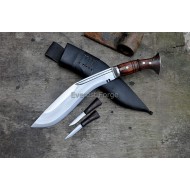
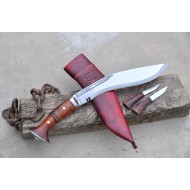
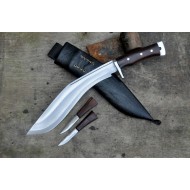
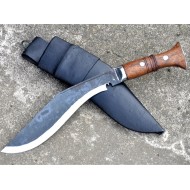
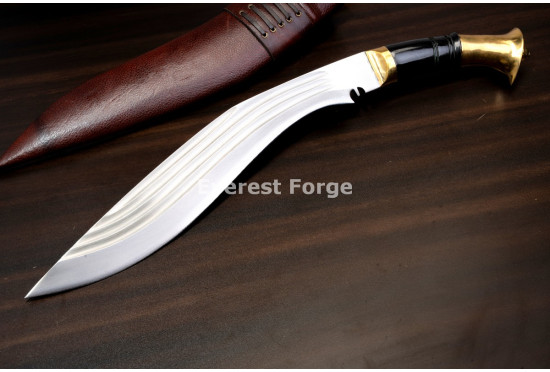
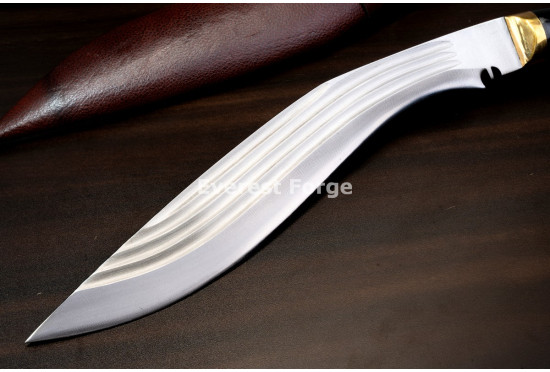
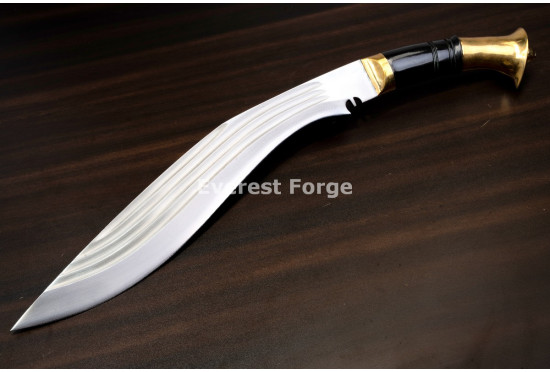
Chirra is the Nepali word for the fuller, the groove ground down the flat of a kukri blade. Most fullered kukris carry one. This one carries four, ground parallel down the length of a 14 inch blade, and it is the most demanding grinding our smiths do — four grooves that each have to hold their line against the next, on a surface curving in two directions at once.

The number is not decoration. Fullers take material out of the middle band of the blade's width, where bending stress is lowest and the steel is doing the least work, and the ridges left standing between them stiffen what remains. The result is measurable: this blade weighs 730 grams over 14 inches, which is 52.1 grams per inch of blade. Our 13 inch chirra runs 56.9 and our 10 inch bhojpure 57.0. A longer blade coming in lighter per inch than both is the chirras doing exactly what fullers are for.

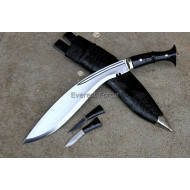
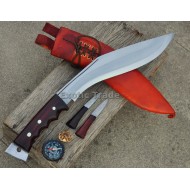
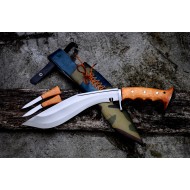
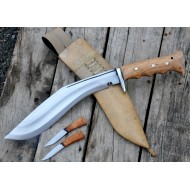
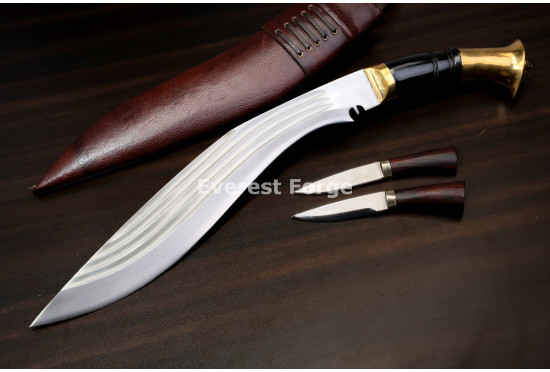
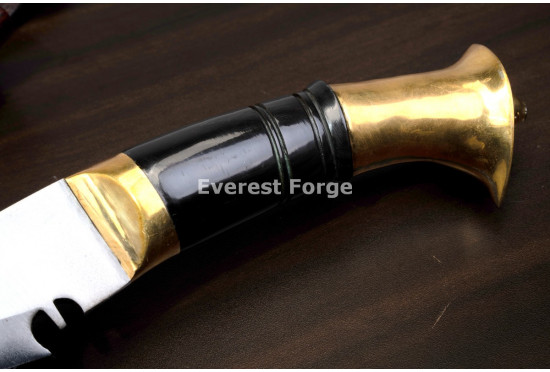
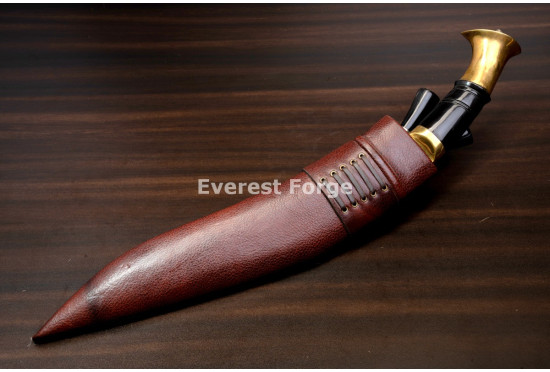
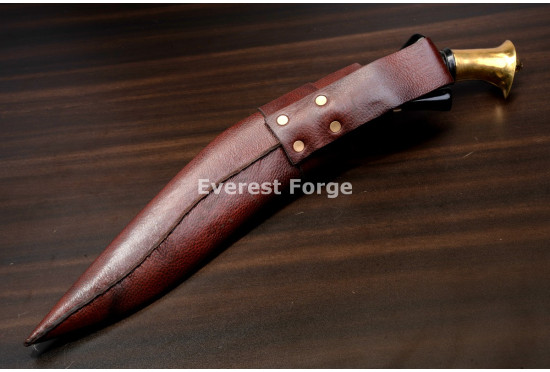
The blade is hand-forged from 5160 high-carbon steel, oil-quenched and tempered, forward-curved with a deep belly and a hand-cut cho at the base. The 6 inch hilt is built in sections: a brass bolster at the blade, a ringed black horn grip, and a flared brass pommel. It comes with its karda and chakmak, as a traditional khukuri does, in a wooden-cored leather scabbard laced through brass eyelets at the throat.

An honest note. Four chirras are display grinding as much as engineering. They genuinely lighten and stiffen the blade — the weight figure above is real — but the fourth groove does considerably less of that than the first, and past two the returns fall away sharply. What you are paying for beyond the second chirra is the skill it takes to grind four parallel grooves down a curved blade without any of them wandering, and whether that is worth it to you is a fair question to ask yourself before ordering. A single-chirra blade cuts identically. We will build this with one, two or three instead, and each step down costs less.

Custom Forge

Want This Built Your Way?

A different number of chirras, another blade length, a different grip material, or your own drawing entirely. Our smiths in Kathmandu forge to specification and quote before any work begins.

Start a Custom Build

What You Are Looking At

Four Parallel ChirrasGround down the length of a curved, tapering blade, each holding its line against the next. Any wander shows instantly against a polished finish, which is why this is the hardest grinding in the range.
Lightest Long Blade We Make52.1 grams per inch over 14 inches, against 56.9 for our 13 inch chirra and 57.0 for the bhojpure. The grooves are the reason.
Stiffened by the RidgesWhat is left between four grooves is a series of ridges running the length of the blade, and a ribbed section resists flexing better than a flat one of the same weight.
14 Inch BladeThe longest kukri we list. More reach, more arc, and a genuinely different tool from a 10 or 12 inch piece.
Jointed Horn and Brass HiltBuilt in three sections rather than turned from one: brass bolster, ringed horn grip, flared brass pommel. The traditional arrangement, with metal protecting the horn at both ends.
Hand-Cut ChoThe notch at the base of the edge, cut individually by the smith. The diagnostic mark of a genuine kukri, and on a piece this traditional it would be conspicuous by its absence.

Standard Build and Specifications

Blade Length14 inches
Handle Length6 inches
Total Length20 inches
Blade WeightApprox. 730 grams
Total WeightApprox. 1100 grams
ChirrasFour, ground parallel down the blade (standard build — one, two or three available)
Blade Steel5160 high-carbon spring steel, oil-quenched and tempered
Blade GeometryForward-curved with a deep belly
ChoHand-cut at the base of the edge
FinishPolished (standard build — selectable)
Hilt ConstructionJointed — brass bolster, ringed horn grip, flared brass pommel
Grip MaterialBlack horn (standard build — selectable)
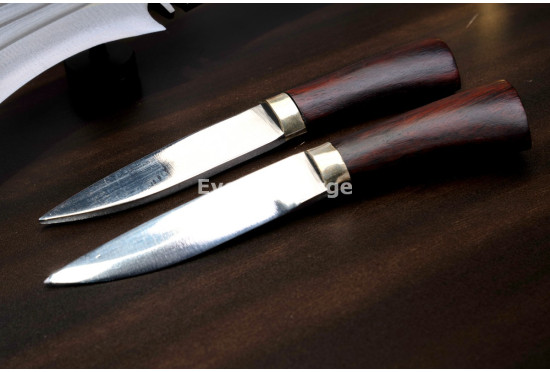
CompanionsKarda and chakmak, rosewood grips, carried in the scabbard
ScabbardBrown leather over a wooden core, brass-eyelet laced throat
EdgeKukri and karda sharpened. Chakmak intentionally blunt
OriginHand-forged in Tokha-3, Kathmandu, Nepal

Blade length, blade finish, grip material and the number of chirras are all selectable, so the figures above describe the standard build rather than every version. Because each piece is forged, ground and fitted by hand, weights, dimensions and chirra spacing vary slightly between examples.

Build Options

Number of ChirrasFour as standard. One, two or three can be ground instead, each progressively less work and less expensive. A single broad chirra is the more common arrangement in Nepal and leaves a flat panel rather than a ribbed one, which is also what you want if the blade is to be decorated later.
Blade Length14 inches as standard, the longest we list. Shorter is easier to carry and handle; longer moves into two-handed territory. The chirras scale with the blade and stay in proportion.
Grip MaterialBlack horn as standard, which is the traditional material for this arrangement. Rosewood is available, and micarta if you want something that ignores humidity entirely.
FittingsBrass bolster and pommel as standard. Steel or white metal can be fitted instead, which reads plainer and needs no polishing.
Blade FinishPolished as standard, which is what makes four chirras read as four rather than as a blur. Satin softens them considerably and we would generally talk you out of it on this piece.
ScabbardWooden-cored leather as standard. Colour and lacing can be changed, and a shoulder harness or belt frog fitted in place of the traditional arrangement.

Is This the Right Kukri for You?

Choose This One If

  • You want to see grinding skill rather than decoration — the four chirras are the craftsmanship
  • You want reach with a light blade, which is what the fullering buys you
  • You want a traditional jointed horn and brass hilt rather than a modern slab handle
  • You want 14 inches, the longest blade we list
  • You are a collector and want a piece a Nepali smith would call correct

Look Elsewhere If

  • You want the simplest thing that chops — a plain blade cuts identically and our bhojpure costs less
  • You want mass — this is fullered to be light, and a heavier blade does more work per stroke
  • You want low maintenance — four chirras, horn and brass all want more care than a plain blade with a wooden grip
  • You want easy carry — 20 inches overall in a rigid wooden scabbard is a lot to wear

How to Order

Decide How Many ChirrasFour is the standard and the most work. Two or three still read clearly at lower cost, and one is the traditional arrangement. Tell us which and we will quote it.
Choose Your BuildBlade length, finish, grip material, fittings and scabbard. Take the standard build as shown if it already suits you.
Check Your Local LawBlade laws differ by country, state and province, and this package contains three blades rather than one. Check before you order — we cannot advise on your jurisdiction and we cannot refund a seizure.
We Forge and ConfirmStock builds dispatch in 2-3 business days. Custom builds take 4-6 weeks, and multi-chirra grinding sits at the longer end of that. We photograph the finished piece before it ships.

Who This Kukri Is For

  • Buyers who value hand skill — four parallel chirras on a curved blade is the clearest demonstration of grinding ability we can offer
  • Collectors of Nepali blades who want a traditionally built piece rather than a modern interpretation
  • Anyone who wants reach without weight — at 14 inches this is the longest blade we make and among the lightest per inch
  • Buyers comparing fullered kukris who want to know what the grinding actually costs and does
  • Gift buyers wanting a piece with genuine cultural weight behind it

What Is Included

  • One hand-forged four chirra kukri, sharpened and ready to use
  • Karda companion knife, sharpened
  • Chakmak burnisher, intentionally blunt
  • Wooden-cored leather scabbard
  • Everest Forge manufacturer warranty
  • Care instructions

More From the Everest Forge Collection

Shipping, Returns and Care

Stock builds dispatch from our workshop within 2-3 business days. Custom and made-to-order builds take 4-6 weeks from confirmation, and we photograph the finished piece before it leaves us. We ship worldwide with DHL and FedEx, fully tracked, typically 7-14 business days in transit. Every blade carries the Everest Forge manufacturer warranty against defects in forging and construction.

Blade laws vary by country, state and province and it is the buyer's responsibility to check local restrictions before ordering. Note that this package contains three blades. We cannot advise on your jurisdiction and we cannot refund a blade seized in transit.

5160 is a high-carbon steel and it will rust if you let it. Wipe all three blades dry after use and keep them lightly oiled. This piece needs more attention than most because it has more places for moisture to hide: four chirras, each a groove a cloth drawn along the flat will bridge without touching the bottom, and the joints between brass, horn and steel on the hilt. Work oil down each chirra with a cloth corner. The brass will tarnish to a deeper tone if left, which many owners prefer — polish it sparingly if you want it bright, and keep polish off the horn and out of the joints.

Made in Nepal

Forged by Hand, Not Assembled

Every blade we sell is forged, ground, heat-treated and fitted by our own smiths in Kathmandu. If you want something we do not list, we will make it.

Talk to Our Smiths

Frequently Asked Questions

What does four chirra mean?

Chirra is the Nepali word for a fuller, the groove ground into the flat of a blade, and the number simply counts how many run down it. This blade has four, ground parallel from the forte toward the belly, leaving three ridges standing between them and a fourth edge along each side. One chirra is the common arrangement and the one most fullered kukris carry; two and three appear regularly; four is at the upper end of what is normally ground. Our ringed hilt kukri sets out how chirra counts are used across different Nepali patterns and what the various arrangements signify, and it is worth reading if you are comparing pieces. What matters on this page is what four of them cost to make and what they do to the blade.

Why is grinding four chirras harder than grinding one?

Because each groove has to hold its line relative to the last one, on a surface that is curving in two directions at once. A kukri blade sweeps forward and tapers as it goes, so a groove ground down it is not travelling in a straight line — the smith is following a curve by eye and hand while keeping the depth even. Do that once and any small wander is invisible, because there is nothing to compare it against. Do it four times and every error is measured against three neighbours: if one groove drifts a fraction closer to the next halfway along, the eye catches it immediately, and a polished finish makes it worse by throwing a clean highlight down each ridge. That is the honest test of the work, and you can apply it to any multi-chirra blade from any maker. Hold it under a light and look down the length. The ridges should stay parallel and the highlights should run unbroken from end to end.

What do the chirras actually do to the blade?

They make it lighter and stiffer, and the effect is measurable rather than theoretical. When a blade bends under load, the stress is highest at the two outer surfaces — the spine and the edge — and falls away toward the middle of the blade's width. Material sitting in that middle band carries relatively little of the load, so removing it costs you less strength than it saves you weight. That is the whole principle behind a fuller. The ridges left standing between the grooves then act like the flanges of a girder, resisting flex better than a flat section of the same mass. The numbers on this piece: 730 grams over 14 inches, or 52.1 grams per inch, against 56.9 for our 13 inch single-chirra kukri and 57.0 for our plain 10 inch bhojpure. A longer blade coming in lighter per inch than both shorter ones is not a coincidence.

Is 14 inches too long?

It depends what you are doing with it, and it is worth thinking about before ordering because this is the longest blade we list. What you gain is reach and arc: the belly sits further from your hand, so it travels faster at the point of contact for the same effort at the grip, and you can take a limb without stepping in close. The fullering means you get that reach without the weight penalty a plain 14 inch blade would carry. What you give up is control in tight work and, more practically, convenience — 20 inches overall in a rigid wooden scabbard is a substantial thing to wear and genuinely awkward in a vehicle or a crowded pack. If this is going into a collection, length is only an advantage. If you intend to carry it regularly, our 12 inch pieces are easier to live with.

What is a jointed horn and brass hilt?

It means the grip is built from separate pieces fitted together rather than turned from a single block. Working from the blade back: a brass bolster caps the front where the tang enters, a ringed section of black horn forms the grip your hand sits on, and a flared brass pommel closes the butt. Each is shaped separately and assembled over the tang. It is the traditional Nepali arrangement and it exists for practical reasons as much as decorative ones — metal at both ends protects the horn, which is the vulnerable part, and the flare at the butt stops the hand travelling forward on a downstroke while letting you hold the kukri loosely, which is how a chopper should be held. The trade-off is that a jointed hilt has seams, and seams are where moisture gets in.

What are the two small knives?

The karda and the chakmak. A traditional khukuri is made with both, carried in the scabbard alongside the main blade, and they are not an addition or an upgrade — a khukuri simply comes with them. The karda is the small sharpened utility knife, and it handles everything the kukri is too big and too curved for: whittling, cutting cord, food work, anything needing a small blade held close. The chakmak is not a knife at all but a blunt steel burnisher, used to straighten a rolled edge in the field. Between them the three cover the work: the big blade cuts, the small one does the fine work, and the burnisher keeps the big one going between proper sharpenings.

Why is the chakmak blunt?

Because sharpening it would stop it working. A burnisher does not cut steel — it pushes it. When a hard-used edge rolls slightly to one side, which is exactly what a tough steel like 5160 does instead of chipping, the metal is still there and still sound, just bent out of line. Running a harder blunt steel firmly along it pushes that rolled metal back into position and the edge cuts again, without removing any material at all. That is why a chakmak is blunt, thick and hard: it needs to survive being pressed against an edge without deforming itself, and a sharpened one would bite in and damage what it is meant to repair. We mention this because new owners occasionally write to us reporting that one of their small blades arrived without an edge.

What is the notch at the base of the blade?

That is the cho, sometimes written kaudi, and it is the diagnostic mark of a genuine kukri. It terminates the edge in a rounded cut rather than letting the edge run straight into the bolster, so a crack starting at the edge has somewhere to stop instead of running back toward the tang. It also carries religious meaning that different communities in Nepal read in different ways. Ours are cut by hand on every blade, which is why no two are exactly alike. We apply the test in both directions: a curved knife with no cho did not come from this tradition whatever a listing calls it, and we have declined to call our own pieces kukris on that basis.

What steel is it?

5160 high-carbon spring steel, oil-quenched and tempered, for the kukri and the karda alike. It is the family of steel used for vehicle leaf springs, which is the origin of the Nepali practice of forging kukris from them, and it is chosen for toughness rather than for maximum hardness. On a blade this long that matters: a 14 inch chopper generates real force at the point of impact, and a hard, brittle steel chips there where a tough one rolls. A rolled edge is exactly what the chakmak is for, which is a neat illustration of how the whole arrangement was designed around the steel available. It is not stainless and it will rust if neglected.

How does it compare to your other chirra kukris?

Three fullered pieces now, and they take three different approaches. Our back-edged chirra is 13 inches with a single broad chirra ground across a wide band of the flat, leaving a flat panel between ridges. Our deep-fullered 13 inch takes the opposite route: one narrow groove cut deep, leaving the polished flats intact either side. This one multiplies the first approach, four narrower grooves side by side, which is why it is the lightest of the three per inch and by far the most work. If you want the traditional single-chirra article take the back-edged, if you want the lightest working blade take the deep-fullered, and if you want to see what grinding looks like when it is the point of the piece, take this.

How do I look after it?

This piece has more places for moisture to hide than anything else in our range, so the routine matters. The four chirras are the main thing: each is a groove that a cloth drawn along the flat bridges completely without touching the bottom, so water sits in four channels you cannot see. Work an oiled cloth corner or a cotton bud down each one. The hilt joints, where brass meets horn and horn meets steel, are the second place — a seam holds moisture against three materials at once. Beyond that it is standard carbon steel care: wipe dry after use, oil lightly, and do not store it in the scabbard for long periods in a damp climate. The brass darkens naturally if left alone, which most owners prefer to a polished shine.

Can I have fewer chirras, or a different size?

Both, and fewer is worth considering seriously rather than treating as the budget option. One, two or three chirras can be ground instead of four, each step down is less work and costs less, and the blade cuts identically whichever you choose — a single broad chirra is the most common arrangement in Nepal for good reason. On size, we forge this profile from belt-sized blades up to two-handed pieces and the chirras scale with the blade. One caution specific to multiple chirras: below about 10 inches there is not enough width between the spine and the edge to place four grooves without crowding them, and crowded chirras look considerably worse than fewer well-spaced ones. We will say so before quoting rather than after.

Specification
Blade: 14 inches. Hand forged from 5160 carbon steel. Four parallel chirras ground down the length
Total Length: 20 inches
Handle: 6 inches, jointed construction - brass bolster, ringed black horn grip, flared brass pommel
Weight: Approx. 730 g blade, approx. 1100 g total
Note: As each piece is forged, ground and fitted by hand, slight variation in weight, dimensions and chirra spacing may occur. Oil down each of the four chirras individually - a cloth drawn along the flat bridges all of them.

Write a review

Note: HTML is not translated!
Bad Good
Captcha