- Model: Custom Forged Swords
- Product Code: LEAFSWORD0029
- Location: Kathmandu,Nepal
Available Options
Hand-Forged Fantasy Leaf-Blade Sword — Hand-and-a-Half Hilt in 5160 Carbon Steel
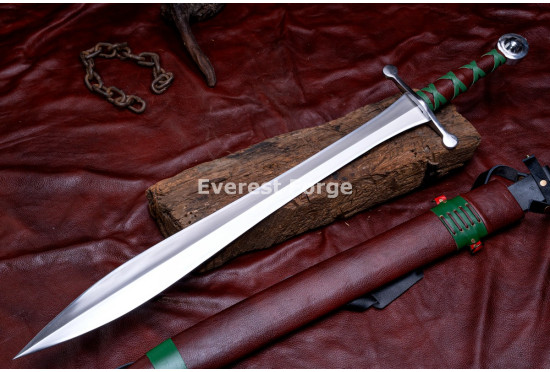
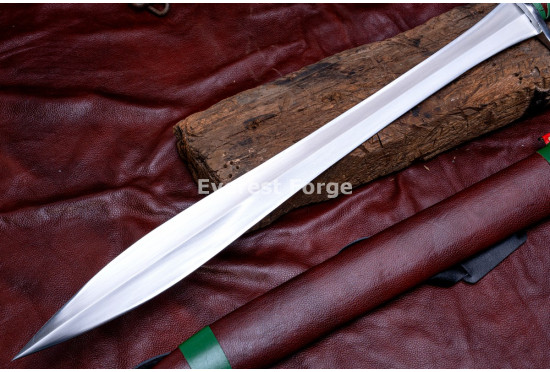
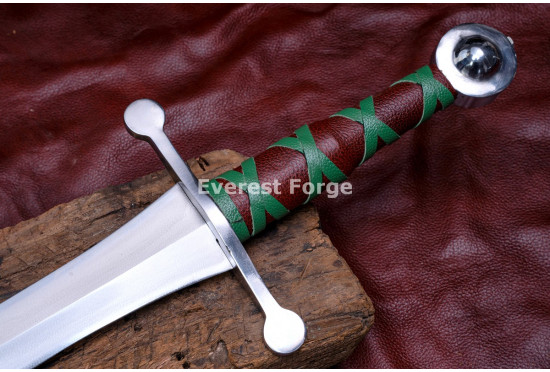
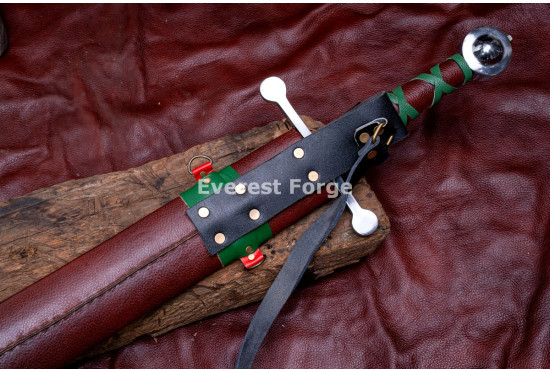
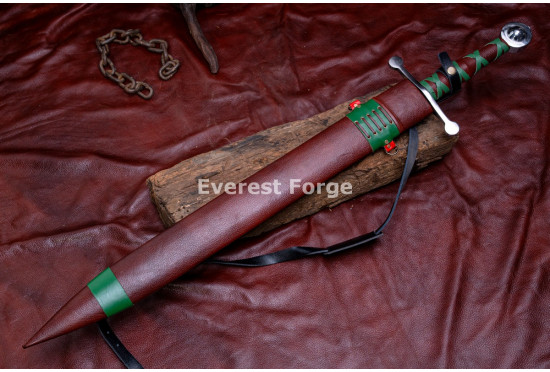
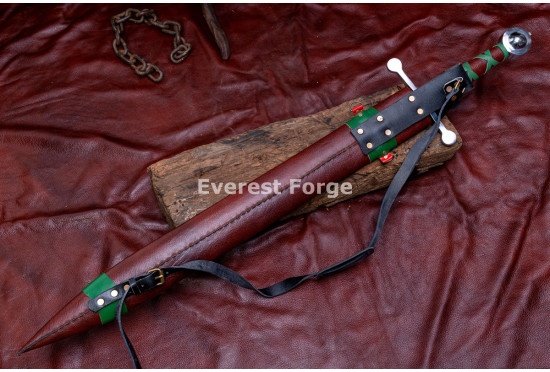
This is a hand-forged, fully functional fantasy leaf-blade sword — a broad blade that swells through its lower half before tapering to a long point, forged in Nepal from 5160 high-carbon spring steel, oil-tempered, full tang, and sharpened to a true edge. The hilt is high-medieval in style: a straight steel cross with spatulate quillon terminals, a wood grip under a green and oxblood cord wrap, and a plain domed pommel. It ships with a dark cherry leather scabbard with green fittings and a black leather belt frog. Every sword is made to order in your chosen length, finish, and engraving.
The standard blade is 29 inches on a 9-inch hilt with a 6.7-inch grip, for an overall length around 38 inches. That grip length is the important number — it takes one hand comfortably and a second hand when you want the leverage, which is what hand-and-a-half means. The leaf profile carries the mass forward, so this cuts considerably harder than a straight-tapered blade of the same length, and the oil-tempered 5160 steel and full tang make it a working sword rather than a cast wall-hanger.
An honest note. This sword is a deliberate hybrid, and it is worth explaining because the two halves come from very different places. The leaf-shaped blade belongs to the Bronze Age and the classical Mediterranean — the Greek xiphos and the leaf swords of Bronze Age Europe — and those weapons were short, generally under two feet of blade. The hilt is high-medieval European, with a spatulate cross, a wrapped grip and a domed pommel, and the proportions here are a longsword's rather than an ancient sword's. No historical weapon combined the two. This is an original fantasy design and we are not claiming otherwise. If you want a historically correct leaf-bladed short sword, we will build one through Custom Forge.
Bespoke Service
Forge a Leaf-Blade Sword to Your Own Design
Want a shorter historical blade length, a different pommel, a wheel or brazil-nut form, another wrap colour, or your own engraving? Our Custom Forge service builds swords to your spec, by hand in Kathmandu.
Request a Custom Forge →What Is a Leaf-Blade Sword?
A leaf blade is one that widens through its lower or middle section before drawing back to a point, giving it the silhouette of a leaf rather than the steady taper of a medieval sword. It is one of the oldest sword shapes there is. Bronze Age smiths across Europe worked in the form, and it survives in the Ewart Park and Hallstatt swords; the Greeks carried it as the xiphos, worn as a sidearm alongside the spear; and Celtic and Italic smiths produced their own versions. The shape persisted for a practical reason rather than an aesthetic one, which is explained in the questions below. What no historical culture did was build a leaf blade at longsword proportions on a medieval hilt, which is exactly what this sword is.
Specifications
Customize Your Leaf-Blade Sword
Every sword is forged to order. Set your options before you add to cart:
Hand-Forged, Not a Wall-Hanger
This Leaf-Blade Sword
- Hand-forged 5160 high-carbon spring steel
- Oil-tempered, hard edge and flexible spine
- Full tang, peened over the pommel
- Leaf profile forged in, with a real distal taper behind it
- Sharpened, balanced, made to your spec
A Wall-Hanger
- Cast stainless, brittle under load
- No real heat treatment
- Rat-tail tang that snaps at the guard
- Flat profile ground from bar stock, no taper
- Blunt, display-only
How It Is Made
Who It Is For
- Fantasy collectors who want a blade shape that stands out from the usual straight taper
- Cutting practitioners who want mass forward for heavy cutting on soft targets
- Collectors drawn to Bronze Age and classical blade forms but wanting a full-length sword
- Buyers who want a sword that works one-handed but takes a second hand for power
- Larp and costume users, who should order the display-blunt option
- Gift buyers personalizing a blade with a name, date, or engraving
What Is Included
- One hand-forged fantasy leaf-blade sword, built to your chosen spec
- Dark cherry leather scabbard with green fittings and a black leather belt frog
- Wood grip under a green and oxblood cord wrap, with polished steel cross and domed pommel
- Any personalization or engraving you ordered
- A satin-finished, sharpened blade
- Everest Forge manufacturer warranty
Explore More Hand-Forged Swords
Shipping, Returns & Care
Shipping
In-stock specs dispatch within 2 to 3 business days; fully custom builds take roughly 4 to 6 weeks to forge before dispatch. We ship worldwide by DHL or FedEx in 7 to 14 business days, tracked. Import and blade laws vary by country, so please check your local rules before ordering.
Returns & Warranty
Every blade is backed by the Everest Forge warranty against forging and material defects. If something is wrong with your order, we will repair, replace, or refund it. Personalized and custom-engraved blades are made to order, so please confirm your spec carefully before purchase.
Care
Wipe the blade clean and dry after handling, and apply a light coat of oil before storage to protect the high-carbon steel from moisture. Treat the cord wrap and the leather scabbard occasionally with a conditioner, and keep dyed leather out of prolonged direct sun so the cherry and green do not fade. Do not store the sword inside the scabbard for long periods, as leather traps damp against steel.
From The Forge
Build a Sword That Is Yours Alone
Beyond the options here, our Custom Forge service will build a historically proportioned leaf-bladed short sword if that is what you are after, or shape this fantasy pattern to your own length, pommel and wrap. Roughly 4 to 6 weeks from order.
Start a Custom Forge →Frequently Asked Questions
What is a leaf-blade sword?
A leaf blade widens through its lower or middle section before drawing back to a point, giving it the outline of a leaf rather than the steady taper of a medieval sword. It is one of the oldest sword shapes in existence. Bronze Age smiths across Europe worked in the form and it survives in the Ewart Park and Hallstatt swords; the Greeks carried it as the xiphos, a sidearm worn alongside the spear; and Celtic and Italic smiths produced their own versions. It persisted for a practical reason rather than a decorative one.
Why is the blade leaf-shaped, and what does that do?
It moves mass toward the point of the cut. On a blade that tapers steadily from the shoulder, the heaviest part sits near your hand where it does the least work. A leaf blade puts the widest, heaviest section further out, close to where the edge actually meets the target, so the same swing lands with more behind it — the same principle that makes a kukri or a falchion cut so hard. The shape also had a manufacturing logic in the Bronze Age: bronze is soft, and swelling the blade added stiffness where a cast blade would otherwise bend. When iron replaced bronze that constraint disappeared, but smiths kept the shape for a while because it simply cut well. The trade-off is handling — a blade-heavy sword is slower to recover and harder to bring back on line between cuts.
Is this a historical sword type?
No, and it is a hybrid worth explaining. The leaf blade belongs to the Bronze Age and the classical Mediterranean, and those swords were short — a Greek xiphos blade generally ran under two feet. The hilt here is high-medieval European: a straight cross with spatulate terminals, a wrapped grip, and a domed pommel, furniture that Oakeshott would place somewhere between the 13th and 15th centuries. And the proportions are a longsword's, not an ancient sword's. No historical culture built a leaf blade at this length on this kind of hilt. It is an original fantasy design.
How does this differ from your Medieval Fantasy Longsword?
They are the same size and the same class, so the blade is what separates them. The Medieval Fantasy Longsword carries a fullered blade with a steady taper — lighter in the hand, faster to recover, better balanced for point work. This one carries a leaf profile that swells through the lower half, which puts mass forward and makes it a noticeably harder cutter and a slower, more deliberate sword to handle. The fittings differ too: a spatulate cross and domed pommel with a green and oxblood cord wrap here, against the longsword's own furniture. Buy the longsword if you want speed and balance; buy this if you want cutting power and a blade shape nobody else on the shelf has.
Is it one-handed or two-handed?
Hand-and-a-half, which is the useful middle ground. The 6.7-inch grip is long enough to take a second hand behind the first for extra leverage on a committed cut, but short enough that the sword works properly in one hand with a shield or buckler. On a blade-heavy sword like this the second hand is worth having — it does a lot to control the recovery.
Is this a real, functional sword?
Yes. It is hand-forged from 5160 high-carbon spring steel, full tang, oil-tempered, and sharpened to a true cutting edge before it ships. The cross and pommel are solid steel and the tang is peened over the pommel rather than glued or threaded. It handles tatami mats, water bottles and light green targets well. Do not use it on bone, metal, seasoned hardwood, or anything you would not put a good knife through.
What steel is it, and is it oil-tempered?
The blade is forged from 5160 high-carbon spring steel, the same alloy used in heavy-duty truck leaf springs, prized for toughness and edge retention. It is oil-tempered for a hard cutting edge backed by a flexible, shock-absorbent spine. On a blade-heavy sword that toughness matters — the leaf profile delivers a lot of energy on impact and the steel has to absorb what comes back without taking a set.
Is it full tang?
Yes. The tang runs the full length of the hilt and is peened over at the pommel, so the cross and grip are mechanically captured on the tang itself. There is no rat-tail, no weld, and no glued-in stub to fail. On a forward-weighted sword that construction matters more than usual, because the leverage a blade-heavy blade exerts on the hilt under a hard cut is exactly what breaks stub tangs.
It looks heavy. How does it handle?
It is a substantial sword and the weight sits forward, which is the whole point of a leaf blade. On a cut it does the work for you and goes through soft targets without much technique. What you pay for that is recovery — it is slower to bring back on line than a fullered longsword of the same length, and it will tire your forearms sooner in a long session. Use the second hand. If you want the leaf shape with less mass, ask through Custom Forge for a subtler swell and a thinner section.
What are the grip, fittings and scabbard made of?
The grip is a wood core under a cord wrap in green and oxblood. The cross and the plain domed pommel are polished steel — solid, not cast alloy or plated pot metal. The scabbard is dark cherry leather with green leather fittings and a black leather belt frog, made by hand to fit the blade size you order. Because leather and dye are natural materials, colour varies slightly between pieces.
Can I order a different length, pommel, or blade profile?
Yes. Blade length, the depth of the leaf swell, pommel style, wrap colour and finish are all adjustable to order. A subtler swell gives you a faster sword; a shorter blade at historical leaf-sword proportions gives you something much closer to a xiphos. Tell us how you want it to handle rather than only what dimensions you want, and we will tell you honestly what the trade-offs are before we forge it.
Do you ship worldwide, and how long does it take?
Yes. We ship worldwide from Nepal by DHL or FedEx in 7 to 14 business days with tracking. In-stock specs dispatch within 2 to 3 business days; fully custom builds take roughly 4 to 6 weeks to forge first. Import and blade laws vary by country, so please check your local rules before ordering.
| Specification | |
| Blade: | 29 inches. Hand forged from 5160 carbon steel |
| Total Length: | 38 inches |
| Handle: | 9 inches overall with a 6.7 inch grip section. Full tang, wood under a green and oxblood cord wrap, with polished steel spatulate cross and plain domed pommel |
| Weight: | Approx 2050 grams total (blade approx 1370 grams) |
| Note: | As every piece is forged by hand, slight variation in weight, dimensions and finish may occur. Leather and dye colour vary slightly between pieces. Keep the blade lightly oiled when not in use. |