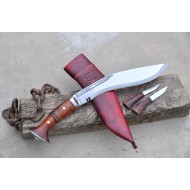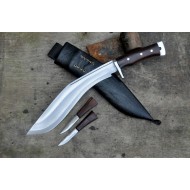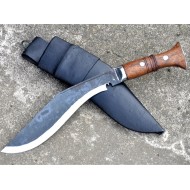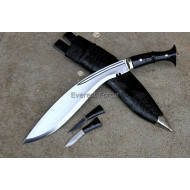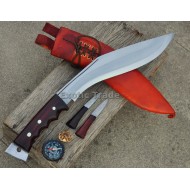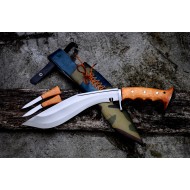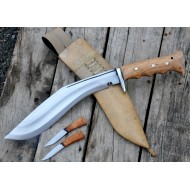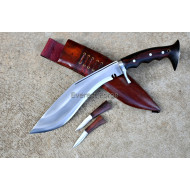
- Model: Signature Kukri/Khukuri
- Product Code: SIGNATURE0075
- Location: Kathmandu, Nepal
Available Options
A Hand-Forged Double-Edged Kukri With a Stacked Leather Grip
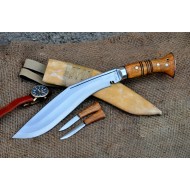
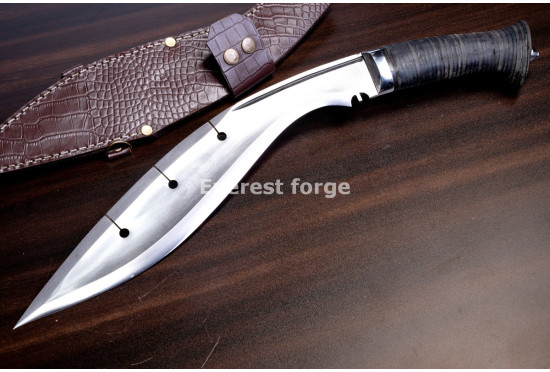
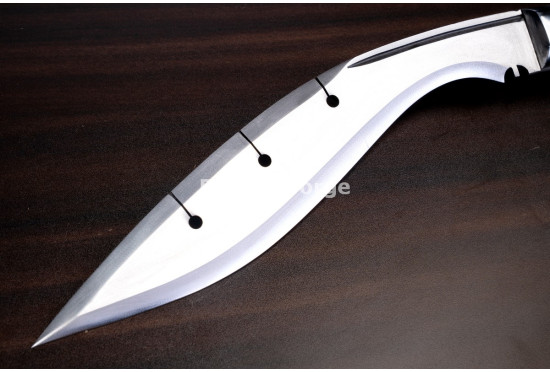
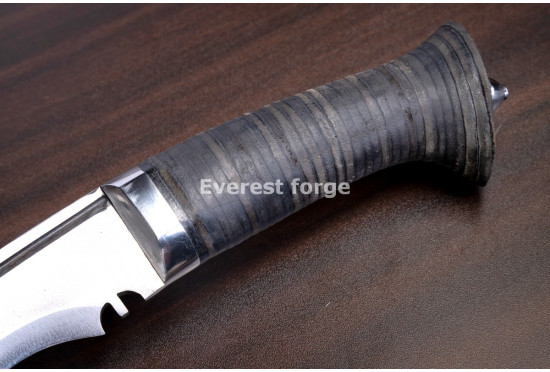
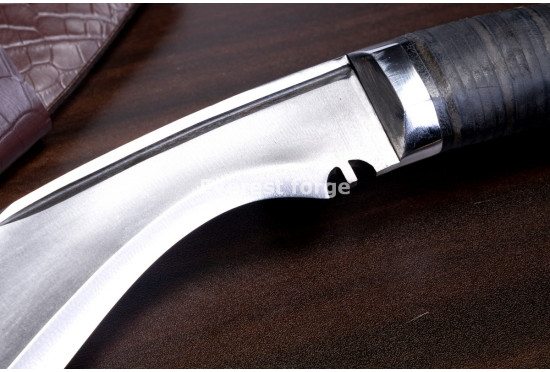
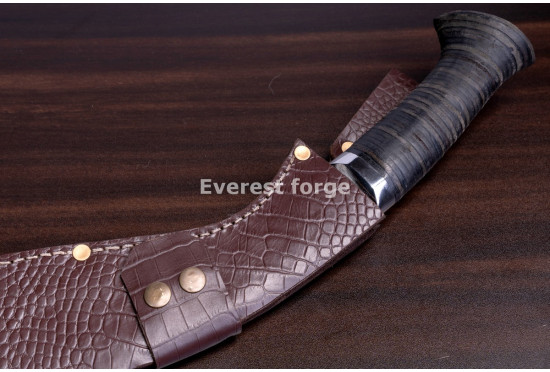
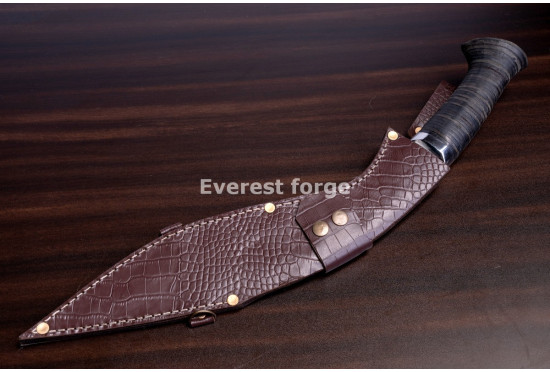
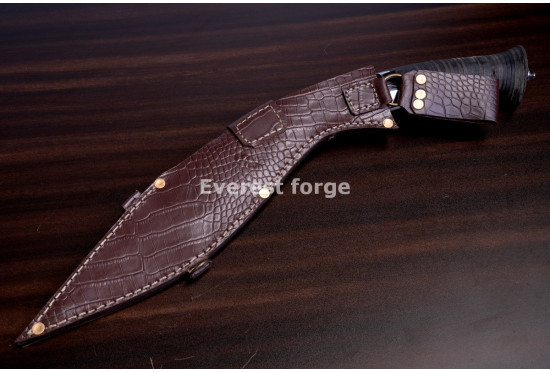
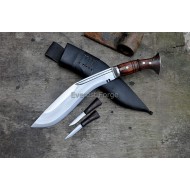
This is a kukri forged in our own workshop in Tokha-3, Kathmandu, from 5160 high-carbon steel, oil-quenched and tempered. The blade runs 14.5 inches, carrying the forward drop and broad belly of the traditional profile but ground with a working edge on both the inner curve and the back, and finished with three inlaid dots set along the flat. Behind it sits a steel bolster and a grip built from stacked leather washers, compressed and turned smooth, closed with a domed butt cap. Overall it stands 20.5 inches. It ships sharpened, in a fitted brown leather sheath.
An honest note. The double edge is the departure here and it is worth naming. A kukri is single-edged by definition — the whole design puts the edge on the inner curve and leaves the spine thick, and that spine is not dead weight but a working surface a Nepali user leans on, guides with a thumb, or drives with a stick. Grinding a second edge onto the back changes what the tool can do, and it should be a choice rather than an accident. The stacked leather grip is the second departure: traditional kukri handles are horn, wood or bone, and stacked leather comes from the Western military knife tradition. Both are deliberate, both are ours, and neither is how a village smith in Bhojpur would have made it.
Want the Traditional Build Instead?
Our smiths have forged khukuri for generations. We will build this in the traditional pattern — single edge, thick spine, horn or hardwood grip, hand-stitched sheath with karda and chakmak — or to any regional pattern you name. Tell us what you want and we will quote it.
Start a Custom Build →Why This Kukri Is Built the Way It Is
Full Specifications
How You Can Configure It
Is This the Right Kukri for You?
Buy This If You Want
- A kukri forged in Nepal by smiths who have made nothing else for generations
- A back edge for reverse cuts, and you know what it costs you
- A shock-absorbing leather grip rather than horn or timber
- Real 5160 with a proper heat treatment, not stamped stainless
- Full-tang construction you can put genuine force into
- A blade a smith will build in the traditional pattern if you ask
Look Elsewhere If You Want
- A traditional kukri — that is single edged, and we build it to order
- To baton the spine or rest a hand on it; a ground back edge rules both out
- A horn or hardwood grip as standard
- A karda and chakmak fitted as standard; they are a sheath option
- A stainless blade that needs no oiling or care
- Identical units; every piece is forged by hand and varies slightly
How to Order
Who This Kukri Suits
- Kukri collectors who already own traditional patterns and want a workshop variant rather than another standard build.
- Bushcraft and camp users after a chopper that clears brush and processes wood without an axe.
- Buyers who prefer a leather grip, whether for the shock absorption or because a horn grip has dried and split on them before.
- Gift buyers wanting a Nepali blade with genuine provenance, etched with a name or a date.
- Anyone commissioning a traditional build who wants to see the workshop's hand before ordering one.
What Is Included
- One hand-forged kukri, sharpened and ready to use
- Fitted brown leather sheath with belt loop and retention strap
- Care and oiling instructions
- Everest Forge manufacturer warranty against defects in forging and heat treatment
Other Hand-Forged Blades
Shipping, Returns and Care
Shipping. Standard builds dispatch in 2 to 3 business days. Custom builds take 4 to 6 weeks. We ship worldwide by DHL or FedEx, 7 to 14 business days, fully tracked. Blade laws vary by country and by state — please check what applies where you live before ordering, as we cannot deliver into a restricted address.
Returns. Standard builds can be returned unused and in the original sheath within 30 days. Custom builds, altered dimensions and etched pieces are made to your specification and cannot be returned unless there is a fault in forging or heat treatment.
Care. 5160 is a high-carbon steel and it will rust if you neglect it. Wipe the blade dry after use, keep a thin film of oil on it in storage, and never leave it sheathed wet, because leather holds moisture against steel. The stacked leather grip needs its own attention: leather washers absorb sweat and water, so dry the grip away from direct heat and give it a leather conditioner once or twice a year, and check the butt cap stays tight, since a stacked grip is held in compression and can loosen slightly as the leather settles. Strop or steel both edges regularly rather than grinding them back once a year.
Frequently Asked Questions
What does a double edge change on a kukri?
More than people expect, and the trade is worth understanding before you choose. A traditional kukri leaves the spine thick and unsharpened, and that spine is not wasted material — it is a working surface. Users rest a thumb on it to guide a fine cut, place a palm on it to push through green wood, and strike it with a stick or a second piece of timber to baton through a log. In Nepal you will also see the spine used to hammer, to scrape hide and to lever. Grinding a second edge onto the back removes all of that in exchange for a genuine backhand cut and a cleaner reverse draw. If the blade is a working tool that will see camp use, the traditional single edge is usually the better choice, and we will build it that way. If it is a collection or display piece, or you specifically want the reverse cut, the double edge is a legitimate variant — it is simply not the traditional one, and we would rather say so.
What is the notch at the base of a kukri blade for?
That notch is the cho, also called the kaudi, and it is one of the few features found on almost every genuine Nepali kukri regardless of region or age. Nobody can tell you with certainty what it is for, and anyone who claims otherwise is guessing confidently. The explanations fall into three groups. The practical: it terminates the edge cleanly at the ricasso, which stops a crack propagating from the sharpened edge back into the tang — a real engineering benefit and probably the strongest argument. The functional: it catches and traps an opposing blade, or it lets blood run off before reaching the grip. The symbolic: it is variously read as a representation of Shiva's trident, of a cow's hoof, or of the female principle, and it carries genuine religious weight for many Nepali makers. Our own view, having forged these for generations, is that the structural explanation is the one that survives scrutiny and the symbolic meaning is what kept the feature alive after the reason was forgotten. Both can be true at once.
Why a stacked leather grip rather than horn or wood?
Because each solves a different problem, and leather solves the one most people actually hit. Traditional Nepali kukri handles are water buffalo horn, hardwood or occasionally bone, and horn in particular is beautiful and hard-wearing — but horn is a natural material that dries out, and a horn grip that has spent a winter in a heated house or a summer in a car will sometimes crack or shrink away from the bolster. Stacked leather is built from washers compressed onto the tang and turned smooth, which is a construction borrowed from Western military knives. It absorbs the shock of a chop noticeably better than timber, it stays warm to the hand in cold weather where steel and horn go cold, and it will not crack. What it gives up is the look and the tradition, and it needs conditioning like any leather. If you want horn, wood or bone, all three are available.
What steel is it and how is it heat treated?
5160 high-carbon spring steel, oil-quenched and then tempered back. This is the material a kukri has effectively always been made from since leaf spring became available in Nepal — village smiths have drawn kukri blades from vehicle leaf spring for generations, and 5160 is that same spring steel supplied to a known specification rather than salvaged. It holds a working edge and bends under abuse rather than shattering, which is exactly what a chopper needs. Our smiths read the steel by colour and by sound at the anvil, which is how the craft is taught here.
Does it arrive sharp?
Yes. It ships with a working edge on the inner curve and along the back, sharpened by hand and ready out of the sheath. It is not a display piece with an edge suggested rather than ground. If you want the primary edge taken finer for slicing, or left with a stouter shoulder for hard chopping, say so in the order note before we ship and we will grind it that way.
Is the tang full length?
Yes. The tang runs the full length of the grip with the leather washers stacked onto it and the butt cap closing the assembly under compression. That construction is strong, and it is worth knowing how it differs from a traditional kukri: a Nepali horn or wood handle is usually fitted over a narrower tang and set with laha, a natural resin adhesive, which is an entirely serviceable method that has worked for centuries but relies on the resin. A compressed stacked grip relies on the butt cap staying tight instead. Check it occasionally, as covered in the care notes.
What are karda and chakmak, and can I have them?
They are the two small companion tools that ride in a pocket on a traditional kukri scabbard. The karda is a small utility knife for fine work the big blade cannot do — whittling, food prep, anything needing a point. The chakmak is a blunt steel rod used to true and burnish the kukri's edge between proper sharpenings, and historically it doubled as a fire striker against flint. A full traditional rig has both, and a kukri sold without them is missing part of the set as a Nepali user would understand it. This piece ships with a plain leather sheath, so they are not included; a traditional hand-stitched scabbard with both fitted is available as an option and we would recommend it if you want the complete thing.
Can I have the traditional single-edged build?
Yes, and for a working blade we would generally suggest it. The traditional build means a single edge on the inner curve, a full-thickness spine you can hold, guide and baton, a horn or hardwood grip, and a hand-stitched scabbard. Beyond that our smiths will build to a named regional pattern — the slim sirupate, the heavy budhume, the military-issue patterns — if you tell us which you want. This is the workshop's core craft rather than a sideline, and a traditional commission is the most straightforward thing we make.
Can I have it made longer or shorter?
Yes. Blade length is selectable, and beyond the listed options our smiths will forge to a dimension you specify. Worth knowing how length changes the blade's character: shorter kukris around 10 to 12 inches carry well on a belt and handle quickly, the 14 to 16 inch range is the general working and military band, and longer blades move toward the slim sirupate profile which trades chopping mass for speed and reach. Tell us what you will cut and we will proportion it, redrawing the curve rather than simply scaling it.
Is the sheath included?
Yes. A fitted brown leather sheath with a belt loop and a retention strap comes with the kukri, cut around this specific blade profile. A kukri is an awkward shape to sheath safely, so it is made around the piece rather than being a generic pouch. A traditional hand-stitched scabbard with karda and chakmak fitted is available instead on request, and on a custom blade length the sheath is made to the new dimensions.
How do I look after the blade and the leather grip?
Two different routines. The blade is high-carbon steel: wipe it dry after every use, especially after cutting anything green or acidic, and keep a thin film of camellia, mineral or light gun oil on it in storage. With a double edge there is no safe spine to hold, so handle it with more care than a traditional kukri when cleaning. The stacked leather grip absorbs sweat and water, so dry it away from direct heat rather than near a fire or a radiator, which will make leather shrink and go hard, and give it a leather conditioner once or twice a year. Check the butt cap stays tight, since a stacked grip is held in compression and can settle over time.
Where is it made and by whom?
Hand-forged in Tokha-3, Kathmandu, Nepal, by our own smiths. Khukuri forging is the workshop's original craft and the foundation of everything else we make — the steel is cut, drawn over the anvil, quenched, tempered, ground, fitted and sheathed under one roof, by people who learned the blade before they learned anything else. That is also why a traditional commission is straightforward for us: there is no pattern of kukri our smiths have not made.
| Specification | |
| Blade: | 14.5 inches. Hand forged from 5160 carbon steel |
| Total Length: | 20.5 inches |
| Handle: | 6 inches, full tang with steel bolster, stacked leather washer grip and domed butt cap |
| Weight: | 1110 grams approx, as shipped with the sheath |
| Note: | handmade variation in weight, dimensions and finish may occur; keep blade lightly oiled when not in use |