Menu
Your Cart

Hand-Forged Double Chirra Kukri

Hand-Forged Double Chirra Kukri
$174.99
Ex Tax: $174.99
  • Model: Signature Kukri/Khukuri
  • Product Code: SIGNATURE14Ko
  • Location: Kathmandu, Nepal

Available Options

A Double Chirra Kukri With a Skinning Knife

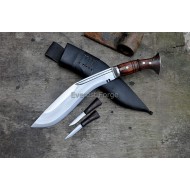
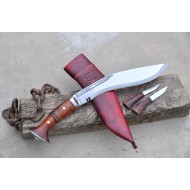
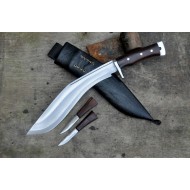
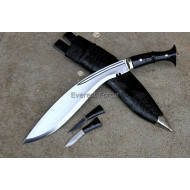
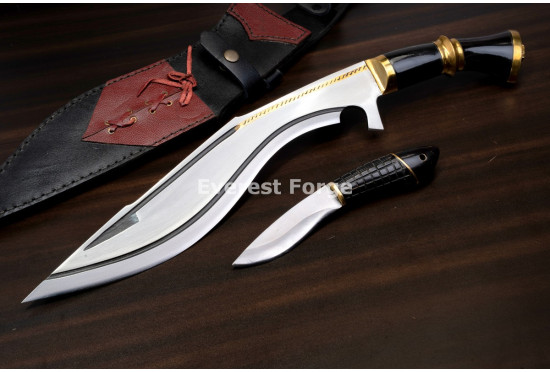
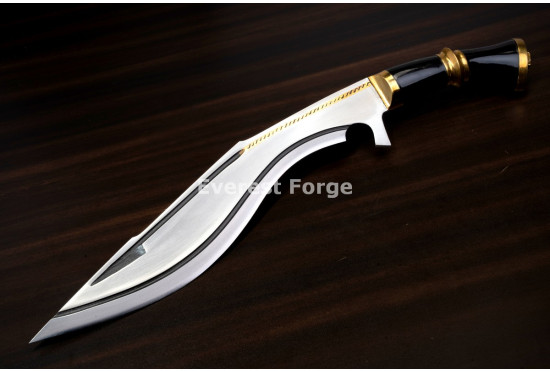
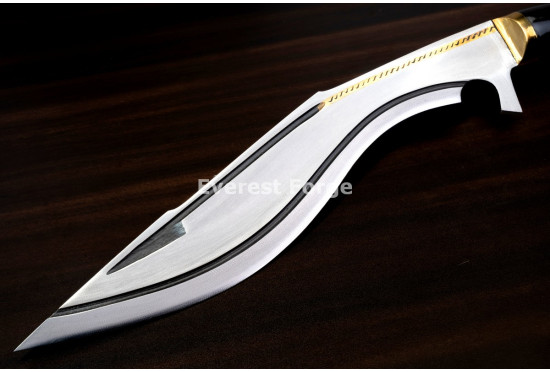
Chirra is the Nepali word for the fuller, the groove ground down the flat of a kukri blade. This one carries two, running the length of a 14 inch blade, with a fine wavy line and a straight line worked along the spine above them, gold against the polished steel. The companion that comes with it is not the usual karda: it is a skinner, with a deep belly and an upswept point, which is a different tool for a different job.

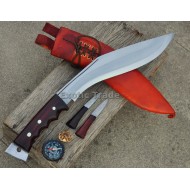
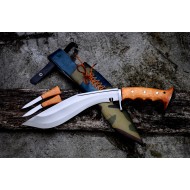
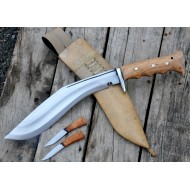
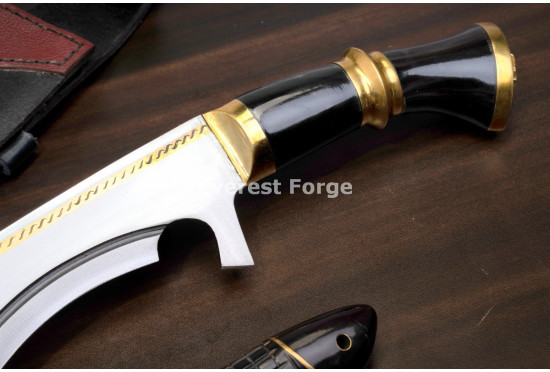
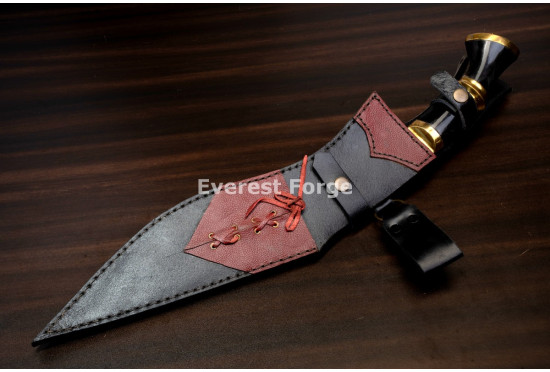
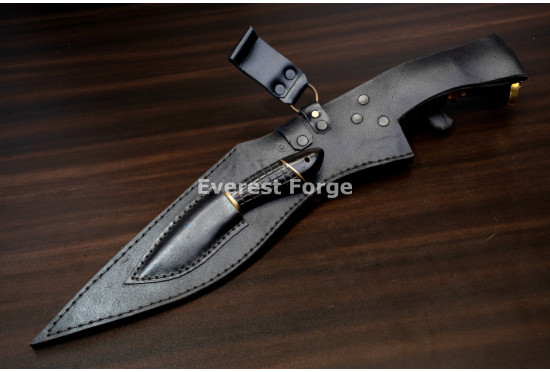
The blade is hand-forged from 5160 high-carbon steel, oil-quenched and tempered, forward-curved with a deep belly and a hand-cut cho at the base. It weighs 740 grams over 14 inches, or 52.9 grams per inch, which puts it among the lightest blades we make at any length — two chirras removing material from the middle of the section is most of the reason. The 6 inch hilt is black horn with three brass fittings: a bolster at the blade, a collar at the waist and a flared cap at the butt. The scabbard is black leather with a red laced panel worked through brass eyelets, a fitted pocket for the skinner, and a separate belt frog hung on a brass ring.

An honest note. This is a decorated piece and we would rather say so than let you assume otherwise. The spine work, the red laced panel and the triple brass fittings are all ornament, and none of them makes the kukri cut better. What is not ornament is the fullering, which measurably lightens the blade, and the steel and heat treatment, which are the same as on our plainest working pieces. If you want the same blade without the decoration we will build it, and it will cost less. The other thing worth knowing: the companion here is a skinner, not a karda or a chakmak, so if you specifically want the traditional pair, ask and we will fit them instead.

Custom Forge

Want This Built Your Way?

A plain spine with no decoration, a different chirra count, a karda and chakmak in place of the skinner, another blade length, or your own drawing entirely. Our smiths in Kathmandu forge to specification and quote before any work begins.

Start a Custom Build

What You Are Looking At

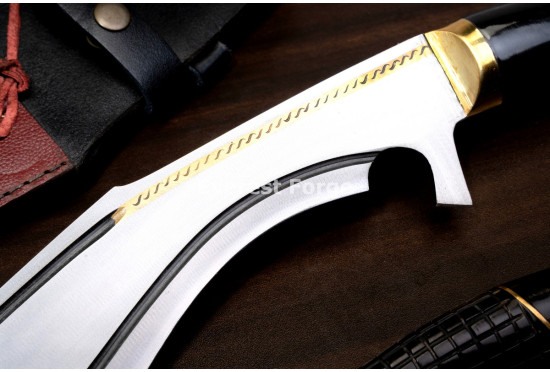
Two ChirrasGround parallel down a curved, tapering blade. They take material from the middle band of the width where the steel does least work, and the ridge left between them stiffens what remains.
Light for 14 Inches740 grams over a 14 inch blade is 52.9 grams per inch, against 56.9 for our 13 inch single-chirra and 57.0 for the plain bhojpure. Longer and lighter per inch than both.
Decorated SpineA wavy line and a straight line worked along the back of the blade in gold against the polish. Ornament rather than function, and the page treats it as such.
Triple Brass FittingsBolster, waist collar and flared butt cap, all in brass against black horn. More metalwork than our other traditional hilts carry.
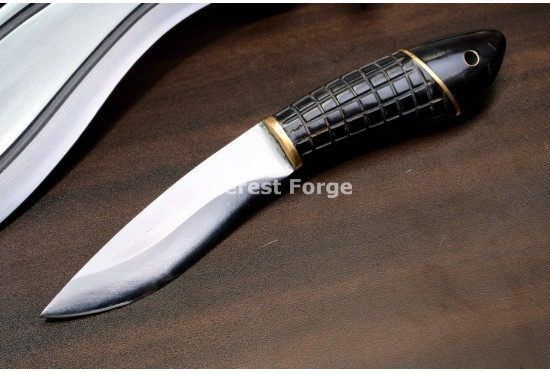
Skinner CompanionDeep belly, upswept point, cross-hatched horn grip. Built for dressing game rather than for the general utility work a karda handles.
Frog and Ring CarryThe scabbard hangs from a separate belt frog on a brass ring, so it swings rather than being locked flat against the hip.

Standard Build and Specifications

Blade Length14 inches
Handle Length6 inches
Total Length20 inches
Blade WeightApprox. 740 grams
Total WeightApprox. 1190 grams
ChirrasTwo, ground parallel down the blade (standard build — other counts available)
Blade Steel5160 high-carbon spring steel, oil-quenched and tempered
Blade GeometryForward-curved with a deep belly
Spine DecorationWavy and straight lines worked along the spine in gold (standard build — plain available)
ChoHand-cut at the base of the edge
FinishPolished (standard build — selectable)
HiltBlack horn with brass bolster, waist collar and flared butt cap (standard build — selectable)
CompanionSkinning knife — deep belly, upswept point, cross-hatched horn grip with brass ferrule
ScabbardBlack leather with red laced panel on brass eyelets, fitted skinner pocket
CarrySeparate belt frog on a brass ring
EdgeBoth blades sharpened and ready to use
OriginHand-forged in Tokha-3, Kathmandu, Nepal

Blade length, blade finish, grip material, chirra count and spine decoration are all selectable, so the figures above describe the standard build rather than every version. Because each piece is forged, ground and fitted by hand, weights, dimensions and chirra spacing vary slightly between examples.

Build Options

Number of ChirrasTwo as standard, which is a sensible middle: enough fullering to lighten the blade meaningfully, less grinding than three or four. One is the most common arrangement in Nepal. Four is the most work we do and we build that too.
Plain or Decorated SpineThe spine work is the standard build. A plain spine costs less and is the better choice if the kukri is going to be used hard, since any decoration on a blade is one more place for moisture to sit.
Companion KnifeThe skinner is standard. A traditional karda and chakmak pair can be fitted instead, or alongside if you want all three, and the scabbard pocket is cut to match whichever you choose.
Blade Length14 inches as standard, the longest we list. Shorter is easier to carry and handle; longer moves into two-handed territory. The chirras scale with the blade.
Hilt Material and FittingsBlack horn with brass as standard. Rosewood or micarta are available, and steel or white metal fittings read considerably plainer than brass and need no polishing.
ScabbardBlack leather with the red laced panel as standard. Plain leather, other colours, different lacing or a shoulder harness in place of the frog can all be built.

Is This the Right Kukri for You?

Choose This One If

  • You want a decorated traditional kukri rather than a plain working one
  • You hunt or dress game — the skinner is a purpose-built companion, not a general utility blade
  • You want reach without weight, which is what two chirras on a 14 inch blade buy
  • You want horn and brass rather than wood and steel
  • You like a scabbard that hangs and swings rather than sitting locked against the hip

Look Elsewhere If

  • You want a plain working tool — ask for this without the decoration, or take our bhojpure
  • You want the traditional karda and chakmak — we will fit them, but they are not what ships as standard
  • You want to see the most grinding we can do — that is our four chirra kukri
  • You want low maintenance — horn, brass, two chirras and spine work all want more care than a plain blade
  • You want easy carry — 20 inches overall is a lot to wear

How to Order

Choose Your CompanionThe skinner ships as standard. If you want the traditional karda and chakmak instead, or all three, say so at the point of order so the scabbard pocket is cut to match.
Decorated or PlainThe spine work is standard and cannot be removed once the blade is finished. A plain blade costs less and is the sensible choice for hard use.
Check Your Local LawBlade laws differ by country, state and province, and this package contains two blades. Check before you order — we cannot advise on your jurisdiction and we cannot refund a seizure.
We Forge and ConfirmStock builds dispatch in 2-3 business days. Custom builds take 4-6 weeks. We photograph the finished piece before it ships.

Who This Kukri Is For

  • Hunters who want a large blade for camp work and a proper skinner for the animal, carried together
  • Collectors of Nepali blades who want a decorated traditional piece rather than a plain one
  • Buyers who want reach without weight — 14 inches at 52.9 grams per inch
  • Anyone drawn to horn and brass rather than the plainer wood-and-steel builds in the range
  • Gift buyers looking for something with visible decoration that is still a genuine forged blade

What Is Included

  • One hand-forged double chirra kukri, sharpened and ready to use
  • One skinning knife with cross-hatched horn grip, sharpened
  • Black leather scabbard with red laced panel and fitted skinner pocket
  • Belt frog on a brass ring
  • Everest Forge manufacturer warranty
  • Care instructions

More From the Everest Forge Collection

Shipping, Returns and Care

Stock builds dispatch from our workshop within 2-3 business days. Custom and made-to-order builds take 4-6 weeks from confirmation, and we photograph the finished piece before it leaves us. We ship worldwide with DHL and FedEx, fully tracked, typically 7-14 business days in transit. Every blade carries the Everest Forge manufacturer warranty against defects in forging and construction.

Blade laws vary by country, state and province and it is the buyer's responsibility to check local restrictions before ordering. Note that this package contains two blades. We cannot advise on your jurisdiction and we cannot refund a blade seized in transit.

5160 is a high-carbon steel and it will rust if you let it. Wipe both blades dry after use and keep them lightly oiled. This piece has several places a cloth drawn along the flat will miss entirely: the bottom of each chirra, the worked lines along the spine, the seams where brass meets horn on the hilt, and the cross-hatching on the skinner's grip. Work oil into all of them with a cloth corner or a cotton bud. The brass will darken naturally if left alone, which many owners prefer — polish it sparingly if you want it bright, and keep polish out of the hilt joints and off the horn. If you use the skinner on game, clean it immediately: blood is both salty and acidic and will mark carbon steel within hours.

Made in Nepal

Forged by Hand, Not Assembled

Every blade we sell is forged, ground, heat-treated and fitted by our own smiths in Kathmandu. If you want something we do not list, we will make it.

Talk to Our Smiths

Frequently Asked Questions

Why does it come with a skinner rather than a karda?

Because they are built for different jobs, and this piece is aimed at someone who has the second job. A karda is the traditional companion: a small general-purpose knife with a straightforward point, used for whittling, cord, food and everything the kukri is too big for. A skinner is a specialist. Its edge curves into a deep belly and sweeps up to a point that sits high and turns away from the cut, and both features exist for one reason — opening a hide without puncturing what is underneath. The belly gives you a long curved edge that does the work with a drawing motion rather than a point, and the upswept tip lets you run the blade under skin with the point riding clear. Try that with a straight-pointed karda and you will nick the gut, which is the mistake that ruins the meat. If you want the traditional karda and chakmak instead, we will fit them and cut the scabbard pocket to suit.

What does double chirra mean?

Chirra is the Nepali word for a fuller, the groove ground into the flat of a blade, and the number counts how many run down it. This blade has two, ground parallel with a single ridge standing between them. Fullers remove material from the middle band of the blade's width, where bending stress is lowest, so the blade loses weight without losing meaningful strength — our four chirra kukri sets that principle out in full, and our ringed hilt kukri covers how chirra counts are used across different Nepali patterns. Two is a practical middle: enough to lighten the blade properly, considerably less grinding than three or four, and the result here is a 14 inch blade at 52.9 grams per inch, lighter for its length than either our 13 inch single-chirra or our plain 10 inch bhojpure.

What is the decoration along the spine?

A fine wavy line with a straight line beside it, running the length of the blade along the spine in gold against the polished steel. It is ornament and nothing else — it does not affect how the blade cuts, how it balances or how long it holds an edge, and we would rather tell you that than invent a meaning for it. Decorated spines have a long history on Nepali blades and this is in that tradition, but the specific pattern here is our own rather than a regional one. Two practical notes. Any worked line on a blade is a place moisture can sit where a cloth drawn along the flat will not reach, so it wants attention when you oil the blade. And a plain spine is available at no extra cost, which is the sensible choice if the kukri is going to be worked hard rather than looked at.

What is the cross-hatching on the skinner's grip?

Grip, and on a skinner specifically it earns its place more than on most knives. Dressing an animal means your hands are wet with blood and fat, which is about the most slippery combination a knife handle will ever meet, and polished horn under those conditions is genuinely dangerous — a hand sliding forward onto a sharp edge while you are working close to your own fingers is how people get hurt. The cross-hatching is cut into the horn in a grid so the skin has somewhere to key into rather than relying on friction against a smooth surface. It is the same principle as checkering on a gun stock. The trade-off is that cut horn holds residue in the grooves and needs proper cleaning rather than a wipe, which matters more here than it would on a knife that only ever cut wood.

What is the frog and ring on the scabbard?

A separate carry piece rather than a fixed loop. The scabbard hangs from a brass ring, which in turn hangs from a leather frog that takes your belt, so the whole assembly pivots instead of being locked flat against your hip. That matters on a 20 inch package: a rigidly mounted scabbard of this length levers against your leg when you sit, crouch or climb, where one that can swing simply moves out of the way and settles again. It is also easier to take off — the frog stays on the belt and the scabbard lifts off the ring. The trade-off is that a swinging scabbard is exactly that, so if you want the knife held still and close, ask for a fixed loop or a shoulder harness instead and we will build it.

How does this compare to your four chirra kukri?

Same length, near-identical weight, different priorities. Both are 14 inch blades and they come in within ten grams of each other, so in the hand they feel much alike. The four chirra is about the grinding: four parallel grooves is the hardest work our smiths do, the hilt is plainer, and it carries the traditional karda and chakmak. This one puts its effort into decoration instead — two chirras rather than four, but worked lines along the spine, three brass fittings rather than two, and a red laced panel on the scabbard — and it swaps the traditional companions for a purpose-built skinner. Choose the four chirra if you want to own a demonstration of grinding skill. Choose this if you want a decorated piece, or if the skinner is the companion you would actually use.

What is the notch at the base of the blade?

That is the cho, sometimes written kaudi, and it is the diagnostic mark of a genuine kukri. It terminates the edge in a rounded cut rather than letting the edge run straight into the bolster, so a crack starting at the edge has somewhere to stop instead of running back toward the tang. It also carries religious meaning that different communities in Nepal read in different ways. Ours are cut by hand on every blade, which is why no two are exactly alike. We apply the test in both directions: a curved knife with no cho did not come from this tradition whatever a listing calls it, and we have declined to call our own pieces kukris on that basis.

What steel is it?

5160 high-carbon spring steel, oil-quenched and tempered, for both blades. It is the family of steel used for vehicle leaf springs, which is the origin of the Nepali practice of forging kukris from them, and it is chosen for toughness rather than for maximum hardness. On the kukri that means an edge which rolls slightly rather than chipping when it meets a knot in seasoned wood. On the skinner it means a blade you can work hard against bone without worrying about the tip. The trade-off is that both need sharpening a little more often than a harder, more brittle steel would, and neither is stainless, so both will rust if neglected — which matters more than usual on a knife you intend to use on game.

How do I sharpen two different blades?

Differently, because they have different geometry. The kukri has a convex edge, which is stronger at the edge and better suited to impact, so work it with a stone in small circles or with a file rather than dragging it through a fixed-angle pull-through sharpener, which grinds a flat bevel into a convex edge and undoes it. The skinner is the more demanding of the two despite being smaller: a deep belly means the edge is curving constantly, so you have to roll the blade steadily as you work along it to keep the angle consistent, and most people rush the last inch and leave the upswept tip blunter than the rest. Take the tip separately if it helps. A skinner that is sharp everywhere except the point is a skinner that will tear rather than cut exactly where precision matters most.

Can I have a chakmak as well, or a different companion?

Yes. The skinner is what ships as standard, but we build the traditional karda and chakmak and can fit either or both in place of it, or all three together if you want the full complement. The scabbard pocket is cut to match whichever you choose, so this has to be decided at the point of order rather than added later — a pocket sized for a skinner will not hold a chakmak securely, and one cut for three companions is a different piece of leather. If you are unsure, tell us what you actually intend to do with the kukri and we will suggest the arrangement rather than sell you the most pieces.

How do I look after it?

This piece has more places for moisture to hide than a plain kukri, so the routine matters. Four things a cloth drawn along the flat will miss completely: the bottom of each chirra, the worked lines along the spine, the seams where brass meets horn on the hilt, and the cross-hatching on the skinner's grip. Work oil into all of them with a cloth corner or a cotton bud. Beyond that it is standard carbon steel care — wipe dry after use, oil lightly, do not store either blade in the scabbard for long periods in a damp climate. One point specific to the skinner: if you use it on an animal, clean it immediately rather than at the end of the day. Blood is salty and acidic and will mark carbon steel within hours.

Can I have a different size or chirra count?

Both. We forge this profile from belt-sized blades up to two-handed pieces, and the chirras scale with the blade. On the count: one is the most common arrangement in Nepal and gives a flat panel rather than a ribbed one, two is what this piece carries and a sensible middle, and three or four is progressively more grinding and more cost for progressively less additional benefit — our four chirra kukri is honest about where those returns fall away. One caution on shorter blades: below about 10 inches there is not much width between the spine and the edge, and chirras crowded into that space look worse than a plain blade would. We will say so before quoting rather than after.

Specification
Blade: 14 inches. Hand forged from 5160 carbon steel. Two parallel chirras, with brass inlaid along the spine in a traditional pattern
Total Length: 20 inches
Handle: 6 inches, black horn with brass bolster, waist collar and flared butt cap
Weight: Approx. 740 g blade, approx. 1190 g total
Note: As each piece is forged, ground and fitted by hand, slight variation in weight, dimensions and chirra spacing may occur. Clean the skinner immediately after use on game - blood marks carbon steel within hours.

Write a review

Note: HTML is not translated!
Bad Good
Captcha