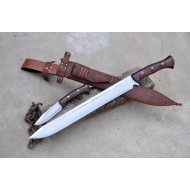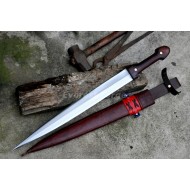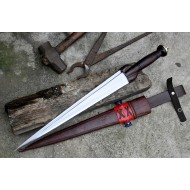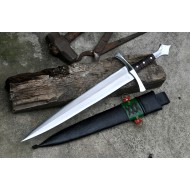


- Model: Dagger
- Product Code: ToothPickdagger012
- Location: Kathmandu,Nepal
Available Options
What Is a Commando Dagger?
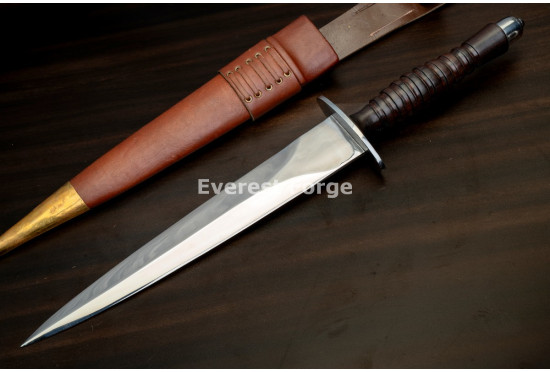
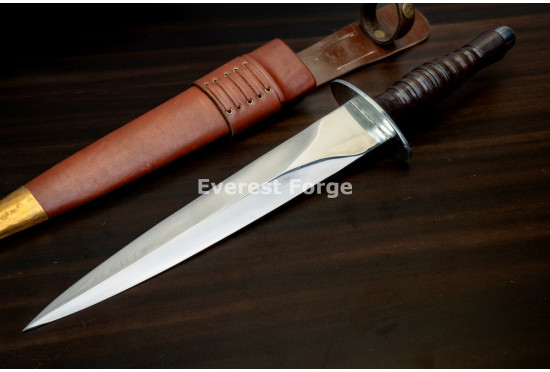
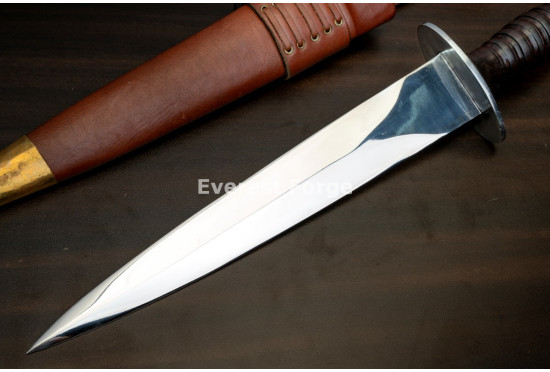
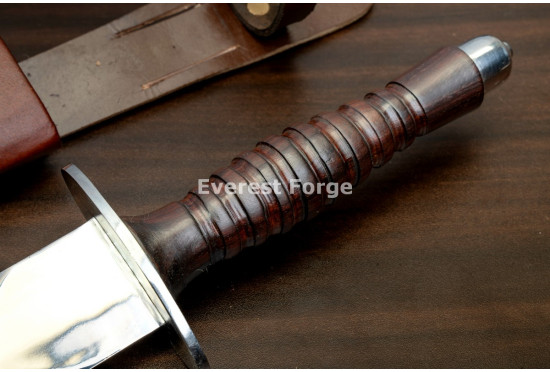
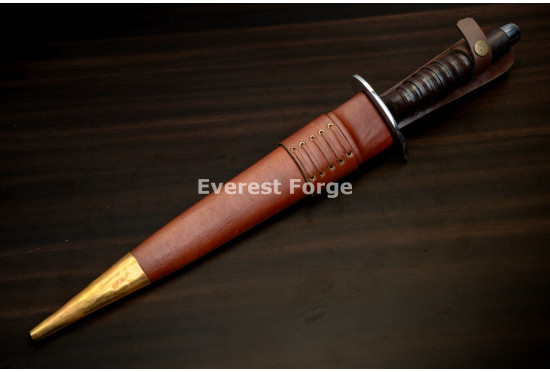
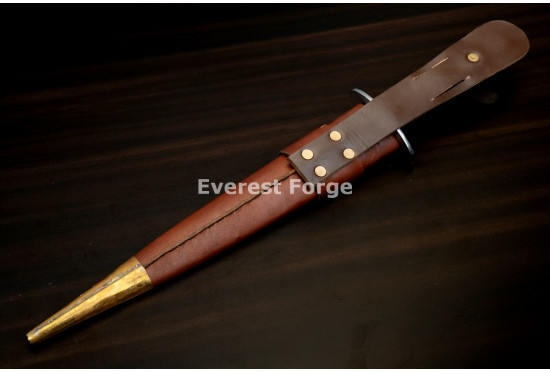
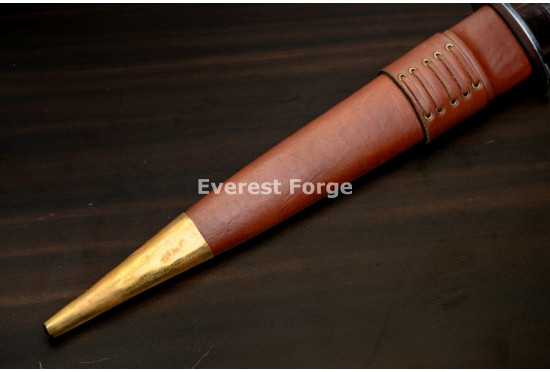
A commando dagger is a long, slender, double-edged fighting knife with a small guard and a ribbed grip, built around a single idea: reaching something through heavy clothing. The pattern comes from the Fairbairn-Sykes knife of 1940, and every element of the hilt exists for a reason. This one has a 12 inch mirror-polished blade, a small oval steel guard, a turned wooden grip cut in parallel rings, and a domed pommel cap, running to 19 inches overall. Hand-forged in Nepal from 5160 high-carbon spring steel, in a russet leather scabbard with a long brass chape, a laced throat panel and a riveted belt frog.
Two things to be clear about immediately. This is a collector's and display piece, and we sell it as one. And it is considerably longer than the knife it descends from, which is a design decision of ours rather than a historical proportion. Both points are set out properly below rather than left for you to work out.
An honest note. The original Fairbairn-Sykes knife carries a blade of roughly seven inches. This is twelve. That difference is not a detail; it changes what the object is. A seven inch F-S is a compact weapon designed to be carried concealed and used at arm's length. A twelve inch blade on the same hilt is a display piece with real presence and no claim to being a faithful reproduction of anything. It also shifts the balance forward, so it does not handle like the knife it resembles. If you want something closer to the original proportion, we will forge it at seven or eight inches at no extra cost, and it will be a better object for it. We would rather tell you that than sell you the bigger one by default.
Please check your local law before ordering. This is a double-edged fixed blade of 12 inches, and both facts carry legal weight. A great deal of knife legislation treats double-edged daggers as a restricted category in their own right, independent of size, and blade length thresholds then apply on top. Some jurisdictions name fighting knives or stilettos specifically. At 12 inches this sits above ordinary knife allowances in most places. Import rules frequently differ from possession and carry rules, so check all three for your own address. We ship worldwide but we cannot advise on your jurisdiction. If the second edge is the obstacle, we will sharpen one side and leave the other blunt at no extra cost.
Want It at the Original Proportion?
A seven or eight inch blade on the same hilt gives you something much closer to the knife this descends from, and it handles far better. No extra cost, and it is what we would build for ourselves.
Specify a Shorter Build →Why This Dagger Is Built the Way It Is
Full Specifications
Blade length, blade finish and grip material are selectable on this listing. The figures above describe the standard build as photographed; what you receive will match the options you choose at checkout. Small variations in weight, dimension and finish are normal in hand-forged work.
Build It Your Way
What This Dagger Does Well, and What It Does Not
What It Is Good At
- Display. A 19 inch mirror-polished blade with a brass-chaped scabbard holds a wall or a case easily
- Collecting. The pattern is one of the most recognisable knife designs of the twentieth century
- Costume and film work set in the 1940s, where the silhouette reads instantly
- Grip security. Ringed turning gives purchase at any rotation, wet or gloved
- Thrusting, which is the only thing the geometry was ever arranged around
What It Is Not Good At
- Historical accuracy. The blade is nearly twice the length of the knife it descends from
- Utility and camp work. A slender double-edged blade cannot be gripped by the spine or used against a board
- Chopping, batoning or prying. The point is fine and the section is thin; it will bend if you lever with it
- Balance. Twelve inches of blade on a seven inch hilt is nose-heavy by design of ours, not theirs
- Carry. At 12 inches and double-edged, it is outside ordinary knife allowances in most places
How to Order a Custom Dagger
Looking for an Earlier Dagger?
We forge the quillon dagger in plain and decorated builds, the bollock hilt in period and modern forms, and a Renaissance parrying dagger. This is the only twentieth century piece on the bench.
See the Historical Daggers →Who This Dagger Is For
- Collectors of twentieth century military designs, which are almost entirely absent from reproduction forges
- Display and interior buyers who want a silhouette that is instantly recognisable
- Costume and film buyers working in the 1940s, where anything medieval would read wrong
- Buyers who want the pattern at scale and know they are getting presence rather than accuracy
- Anyone commissioning a faithful build, since the shorter blade is a free option and closer to the original
It is not for you if you want a working knife, in which case any of our single-edged hunting or bushcraft blades will serve you better and be legal in more places, or if you want a strict reproduction, in which case order the seven inch build and tell us so.
What Is Included
- The hand-forged commando dagger, sharpened and ready for display
- A russet leather scabbard with a brass chape, laced throat and riveted belt frog
- A certificate of authenticity from the workshop
- Care instructions for high-carbon steel and polished finishes
- Everest Forge manufacturer warranty against forging and material defects
Other Blades From the Everest Forge Workshop
Shipping, Returns and Care
Dispatch. Stock pieces leave the workshop within 2-3 business days. Custom builds take 4-6 weeks depending on the queue, and we will give you the honest date rather than an optimistic one.
Shipping. Tracked worldwide by DHL or FedEx, typically 7-14 business days in transit from Kathmandu. Customs paperwork is completed accurately and in full. At 12 inches and double-edged, and with a design some jurisdictions name specifically, this piece attracts more import scrutiny than an ordinary knife. Please check your own country's rules before ordering.
Returns and warranty. Covered by the Everest Forge manufacturer warranty against defects in forging and materials. Custom builds made to your own specification cannot be returned for a change of mind, which is why we confirm everything in writing first.
Care. Mirror-polished high-carbon steel is the least forgiving finish we sell, and our wheel pommel dagger page explains why in detail. Wipe the blade after every handling and keep a light film of oil on it. The two places to pay attention on this build are the grooves between the rings on the grip, where a cloth drawn along the handle never reaches the bottom, and the joint where the guard meets the blade, which is the classic spot for moisture to sit on a knife with a fitted guard. Feed the leather once or twice a year, keeping conditioner off the steel, and do not store the dagger sheathed for long periods.
Questions Answered
Is this a Fairbairn-Sykes knife?
It is built on that pattern, and it is not a reproduction of one. The Fairbairn-Sykes fighting knife was designed in 1940 by William Fairbairn and Eric Sykes, two former Shanghai Municipal Police officers who had spent decades in a city with a genuinely violent policing environment, and it was made in quantity by Wilkinson Sword for British commando and special forces units. Its hilt is the small oval guard, ribbed grip and domed pommel you see here, and that arrangement is what makes the design recognisable at a glance eighty years later. Ours takes that hilt and puts it on a much longer blade, in Nepali spring steel, forged by hand rather than produced to a wartime specification. If you want a faithful F-S reproduction, buy one from a maker who specialises in them. If you want this pattern hand-forged and at scale, that is what this is.
Is it an Arkansas toothpick?
The blade could pass for one; the hilt could not. An Arkansas toothpick is an American type of the Bowie era, a large straight double-edged dagger with a needle point, and by blade alone this fits the description well. But the hilts are nothing alike. A period toothpick carries a simple crossguard and a plain wood, bone or horn handle in the American idiom of the 1830s to 1860s. This has a small oval guard, a ringed turned grip and a domed pommel cap, which is a twentieth century British arrangement and instantly recognisable as one to anybody who collects. We call things by what they actually are, so this is a commando dagger. If a proper Arkansas toothpick is what you are after, tell us and we will forge one with the correct hilt.
A real one has a seven inch blade. Why is this twelve?
Because it is built as a display piece rather than a reproduction, and we would rather say so than let the discrepancy sit there unexplained. Nearly doubling the blade changes the object in two ways. It stops being concealable, which was the entire premise of the original: a knife meant to be carried under clothing and brought out at close quarters. And it moves the balance point forward, so a twelve inch blade on a seven inch hilt feels nose-heavy where the original feels quick and neutral. What you gain is presence, and on a wall or in a case that is not a small thing. What you lose is fidelity and handling. The seven or eight inch build costs the same, is closer to the historical proportion, and is the one we would put on our own wall.
Why is the guard so small?
Because on this design a large guard would be a liability. The pattern was arranged around drawing quickly from under clothing, and a wide crossguard catches on a coat, a pocket edge and the mouth of the scabbard on the way out. So the guard is cut down to just enough steel to stop the hand travelling onto the blade when a thrust lands and comes to a stop, which is the one thing a dagger guard must do. It is a good example of how a design intended for a specific use ends up looking the way it does. It is also worth knowing as a general point about daggers: unlike a sword, a dagger's guard is not there to meet another blade, so it can be as small as its one job allows, and every maker's decision about how much steel to leave tells you what they thought the knife was for.
Why is the grip ribbed?
So the hand knows where it is without looking. Parallel rings cut around the full circumference give purchase in any rotation, which matters when a grip is round and there are no flats to index against, and they hold through a wet or gloved hand where a smooth turned handle would slip. The original used a checkered brass grip for the same reason. Our fishtail guard dagger page covers how a grip tells the hand its orientation in more detail, since it is the same underlying problem solved a different way.
How do I spot a cheap version of this pattern?
It is one of the most copied knife designs in existence, and most of the copies are poor, so this is worth knowing whoever you buy from. Four tells. First, the guard: on a bad one it is cast zinc or pot metal rather than steel, and you can see it in the slightly soft edges and the way it rings dead when tapped. Second, the guard-to-blade joint: it should be tight enough that you cannot see daylight or work it with a thumbnail. Third, the grip: a hollow cast grip is much lighter than a solid turned one and sounds hollow when tapped near the pommel. Fourth, the pommel cap, which should sit dead flush against the grip with no gap and no rotation; on this pattern the pommel is what draws the whole hilt tight, so any movement there means the assembly is already loose. Apply all four to ours as readily as to anyone else's.
Is this meant for fighting?
It descends from a design that was, and we sell it as a collector's and display piece. We are not going to pretend the history is something else, and we are also not going to write technique or tactical copy around it, because that is not what this shop is for and it is not why our customers buy. What we can tell you honestly is that a twelve inch blade on this hilt would be a poor choice for the purpose the original served anyway, for the reasons set out above. People buy this because the pattern is iconic, because it is hand-forged rather than stamped out, and because it looks superb on a wall. Those are the reasons we make it.
Is it sharpened on both edges, and how is the blade ground?
Both edges as standard. The blade carries a central ridge with the faces falling away to each edge, and tapers evenly from the guard to the point rather than running parallel and then dropping to a tip. The section is deliberately slender, because the whole design is arranged around penetration rather than cutting, and a narrow cross-section is also what keeps a blade of this length light enough to handle. The trade is that it is not a robust blade: it will bend if you lever with it and the last few inches are fine by design. If a double edge is a problem where you live, we will sharpen one side and leave the other blunt at no extra cost.
Is a blade this long legal where I live?
We cannot answer that for you, and this piece needs more care than most. Three provisions can apply. Many jurisdictions treat double-edged daggers as their own restricted category regardless of size. Blade length thresholds apply independently on top, and 12 inches is above the ordinary knife allowance in most places. And some legislation names fighting knives, stilettos or commando knives specifically, by design rather than by dimension. Import rules are frequently different again from possession and carry rules. Check all of them for your own address before ordering. If length is the obstacle, the seven or eight inch build costs no more and is closer to the original anyway.
What steel is it, and how is it heat treated?
5160 high-carbon spring steel, the same stock our smiths use for kukris and swords, forged down from leaf spring in the Nepali tradition. It is oil-quenched and then tempered back, producing a blade that holds an edge but stays tough rather than brittle. Toughness matters more than usual on a blade this narrow, because a slender section loaded sideways is exactly where a hard, brittle steel snaps and a properly tempered one flexes and returns. It is not stainless and it will take a patina with use.
How does it compare with your other daggers?
It is the only twentieth century piece we make, and that is the whole distinction. Our bollock daggers are medieval civilian sidearms, our quillon daggers are medieval knightly ones built like small swords, and our parrying dagger is a Renaissance companion weapon meant to be used alongside a rapier. All of those are historical types. This one is a modern military design, and it looks modern: no ornament, no decoration, a hilt shaped entirely by function and a blade with nothing on it at all. If you want a dagger that reads as old, take one of the others. If you want the one design on the bench that a hundred million people would recognise on sight, take this.
Will my dagger look exactly like the photographs?
Close, but not identical, and that is the nature of forged work. The blade profile is drawn out by eye against a pattern, the taper is ground by hand, the guard is cut and fitted individually, and the grip is turned one at a time so the ring spacing varies slightly. Timber differs board to board in colour and figure. What does not vary is the specification: length, steel, construction, heat treatment and sharpness are held to the same standard on every piece. Our kukri machete page sets out in more detail what can and cannot differ between two blades from the same bench.
| Specification | |
| Blade: | 12 inches. Hand forged from 5160 carbon steel |
| Total Length: | 19 inches |
| Handle: | 7 inches, small oval steel guard, turned hardwood grip cut in parallel rings, domed steel pommel cap |
| Weight: | 580 grams the dagger, 740 grams with the scabbard |
| Note: | handmade variation in weight, dimensions and finish may occur; keep blade lightly oiled when not in use |