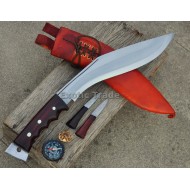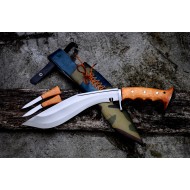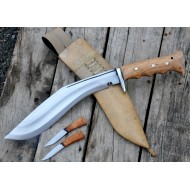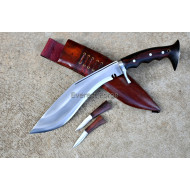


- Model: Hybrid Kukri
- Product Code: Floweretched012
- Location: Kathmandu, Nepal
Available Options
What Is an Etched Chirra Kukri?
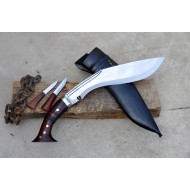
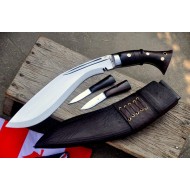
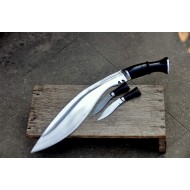
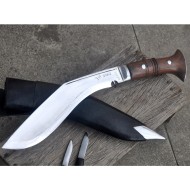
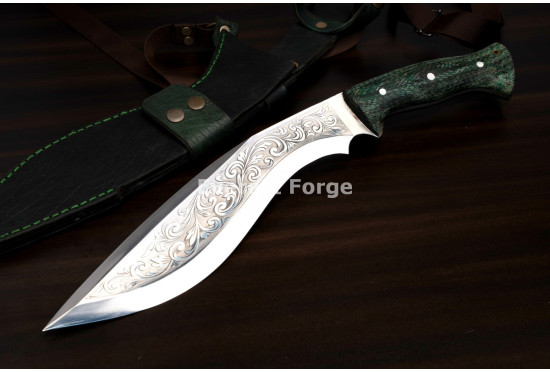
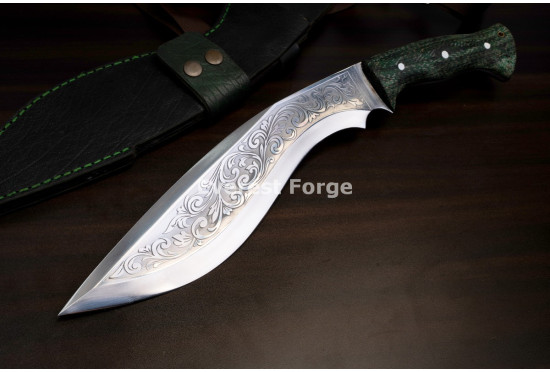
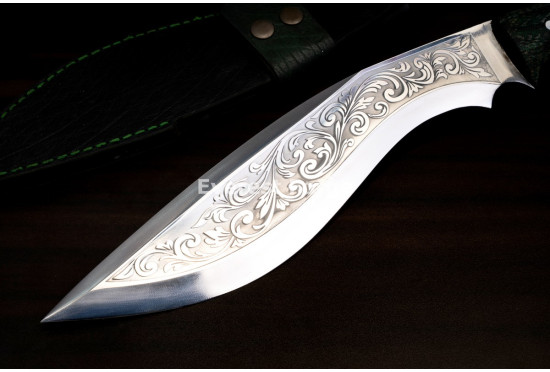
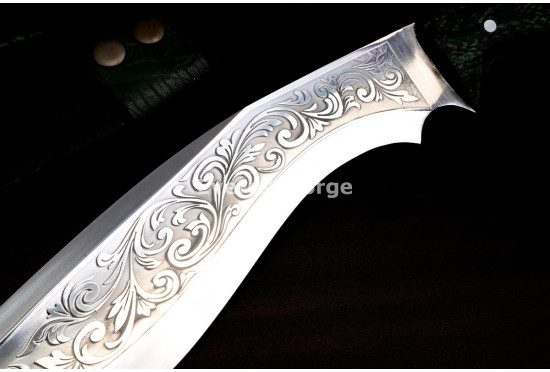
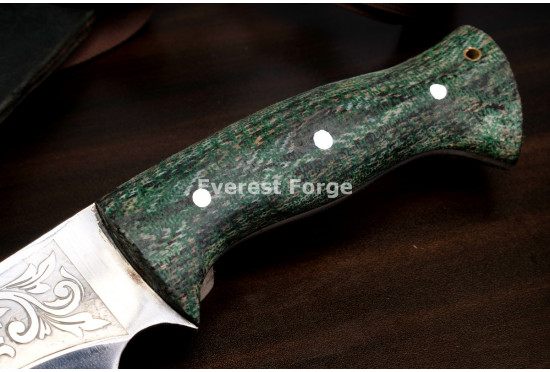
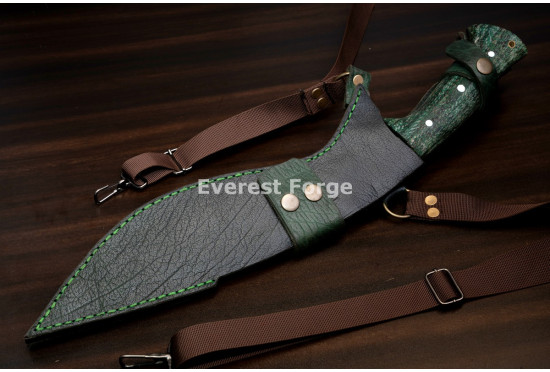
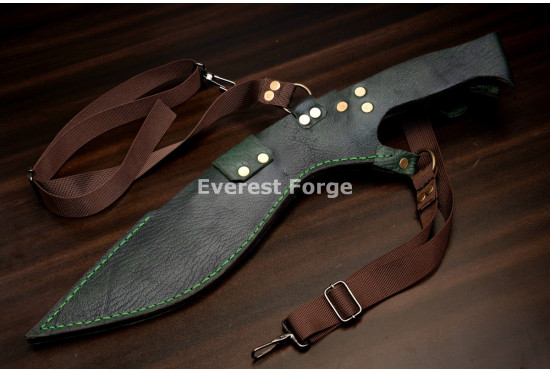
Chirra is the Nepali word for the fuller, the long groove ground down the flat of a kukri blade. This one is a 12 inch forward-curved blade hand-forged from 5160 high-carbon steel, oil-quenched and tempered, carrying a single broad chirra with a foliate flower pattern etched into the flat it creates, on both sides. Below it sits a deep belly and a hand-cut cho at the base. The hilt is 6 inches of green micarta slab pinned through a full tang with three pins and a brass-lined lanyard hole at the butt. It ships in a black leather sheath saddle-stitched in green thread, with a green retaining strap on brass studs and an adjustable nylon shoulder harness.
The spine measures 7 millimetres. That is thick stock for a 12 inch kukri, and it is the number the rest of the page argues from. Blade weight is 740 grams over 12 inches, or 61.7 grams per inch of blade, which sits between our 10 inch bhojpure at 57.0 and our 12 inch recurve knife at 75.0. Those figures agree with each other, which is the point of publishing them: a blade this thick should weigh roughly this much, and it does.
An honest note. The flower pattern is etched, not hand-engraved. Those are different processes and the difference is worth money, so we are not going to blur it. Etching removes metal chemically through a resist and leaves a pattern of even depth with a matte floor. Hand engraving cuts the metal with a graver and leaves bright walls that flash as you turn the blade in the light. Both are legitimate decoration and this is good etching, cleanly registered on both faces, but it is etching. The second thing worth saying plainly: micarta is a modern synthetic material and there is nothing traditional about it. This is a traditional Nepali blade pattern on a modern hilt, and we would rather tell you that than let the word kukri imply otherwise.
Want This Blade Built Your Way?
A plain blade with no etch, a different pattern, hand engraving quoted properly, natural handle materials, a different length or your own drawing entirely. Our smiths in Kathmandu forge to specification and quote before any work begins.
Start a Custom BuildWhy This Build Differs From Our Traditional Chirra
Standard Build and Specifications
Blade length, blade finish, grip material and the etched pattern are all selectable, so the figures above describe the standard build rather than every version of this kukri. Because each piece is forged, ground and etched by hand, weights, dimensions and the exact registration of the pattern vary slightly between examples.
Build Options
Is This the Right Kukri for You?
Choose This One If
- You want a decorated blade that is still built to be used
- You want a handle that will not move with humidity — micarta ignores damp that timber and horn respond to
- You want thick stock: 7mm at the spine on a 12 inch blade
- You want a full tang you can see rather than one you have to trust
- You want shoulder carry rather than a belt sheath
Look Elsewhere If
- You want hand engraving — this is etched, and we will quote engraving separately rather than pretend
- You want a traditional kukri — the blade is traditional, the micarta slab hilt is not
- You want the full traditional kit — no karda, no chakmak, no wooden dap
- You want a plain working tool — ask for the plain blade, or take our bhojpure instead
How to Order
Who This Kukri Is For
- Buyers who want decoration without a wall-hanger — an etched blade on 7mm stock that will still take work
- Collectors of kukri variants who already own a traditional build and want the modern counterpart of the same pattern
- Anyone in a humid climate where a natural grip moves, swells or shrinks with the season
- Buyers who want the tang visible rather than concealed inside a turned grip
- Gift buyers who want a piece that looks like an occasion and is not secretly unusable
What Is Included
- One hand-forged chirra kukri, etched on both faces, sharpened and ready to use
- Black leather sheath with green saddle stitching and retaining strap
- Adjustable nylon shoulder harness
- Everest Forge manufacturer warranty
- Care instructions
No karda and no chakmak are supplied with this kukri. Those companions ride in fitted pockets on the traditional wooden-cored dap, and this piece carries a modern harness sheath instead. If you want the traditional arrangement we make it — ask and we will quote it with the kukri.
More From the Everest Forge Collection
Shipping, Returns and Care
Stock builds dispatch from our workshop within 2-3 business days. Custom and made-to-order builds take 4-6 weeks from confirmation, and we photograph the finished piece before it leaves us. We ship worldwide with DHL and FedEx, fully tracked, typically 7-14 business days in transit. Every blade carries the Everest Forge manufacturer warranty against defects in forging and construction.
Blade laws vary by country, state and province and it is the buyer's responsibility to check local restrictions before ordering. We cannot advise on your jurisdiction and we cannot refund a blade seized in transit.
5160 is a high-carbon steel and it will rust if you let it. Wipe the blade dry after use, keep it lightly oiled, and do not store it in the sheath for long periods in a damp climate, because leather holds moisture against steel. Pay particular attention to the etched panel: the relief holds moisture and residue that a wipe across a flat surface will skip, so oil it with a cloth worked into the pattern rather than drawn across it. Sharpen with a stone or a file rather than a powered grinder, which will draw the temper out of an edge faster than you expect. The micarta needs nothing at all.
Forged by Hand, Not Assembled
Every blade we sell is forged, ground, heat-treated, etched and fitted by our own smiths in Kathmandu. If you want something we do not list, we will make it.
Talk to Our SmithsFrequently Asked Questions
Is the flower pattern etched or hand-engraved?
Etched. We say so plainly because the two are often sold as if they were the same thing and they are not. Acid etching masks the blade with a resist, cuts the pattern through the resist, and lets acid eat away the exposed metal. The result has an even depth and a matte floor, and it reproduces exactly the same on every blade. Hand engraving cuts the steel with a graver pushed by hand, leaving walls that are bright and angled, so the pattern flashes and changes as you turn the blade under a light. Here is the test you can apply to any seller's photographs: look at how the pattern behaves across the image. Etching stays uniformly matte wherever the light falls. Engraving throws bright glints from the cut walls on one side of each line and goes dark on the other. If a listing shows a pattern that looks the same tone all over and the description says hand-engraved, ask the question.
Why is the pattern set inside the fuller?
Because it is the only place on the blade with room for it. A kukri blade curves forward, tapers toward the point and is ground with a convex bevel, so almost none of its surface is genuinely flat. The chirra changes that. Grinding a broad fuller down the length of the blade cuts a flat panel into a shape that otherwise has none, bounded by clean ridges on both sides. That flat is what an etcher needs: a resist lies down evenly on it, the acid bites at a consistent depth, and the ridge at each edge of the fuller frames the panel and gives the pattern somewhere to stop. On a kukri with no chirra you can only etch across a curve, which is why decorated blades without a fuller tend to carry a small motif near the bolster rather than a panel running the length of the blade. The fuller was not ground for the etch, but the etch would be a much poorer thing without it.
What is micarta, and is it traditional?
Micarta is layers of fabric — linen, canvas or paper — saturated in resin and cured under pressure into a solid block that is then shaped and polished. The green here is the colour of the cloth showing through, and the flecked texture is the weave cut at an angle. It is not traditional in any sense: it was developed as an industrial insulating material and no Nepali smith used it until it became available. What it offers is stability. Timber and horn take up and give off moisture with the seasons, which is why a natural grip can loosen against its pins in a way micarta simply does not. It also raises no CITES or import question, which horn and bone occasionally do. If you want the traditional material we fit water buffalo horn, which is unrestricted; if you want a grip that does not care what the weather is doing, this is the better choice.
Does the etching weaken the blade?
No, and the numbers say why rather than us just asserting it. The etch bites a few tenths of a millimetre into the surface. The spine here measures 7 millimetres. Even taken at its deepest the pattern removes a small fraction of the section, and it does so on the flat of the blade rather than at the edge or the spine, which are the two places that carry load in a chop. It also sits inside the fuller, in the part of the blade that has already been ground away deliberately. There is a real version of this concern — deep engraving on thin stock genuinely can create a stress riser — but it does not apply to a shallow etch on a 7 millimetre blade. This is a decorated working kukri, not a decorated blade that has stopped being one.
Can I order this with a plain blade?
Yes, at no extra cost. The etched pattern is the standard build and it is what these photographs show, but tell us at the point of order and the blade leaves us plain. Two things worth knowing before you decide. First, it is a one-way choice: we can etch a plain blade for you later, but we cannot remove an etch from a finished blade without regrinding and refinishing the flat, which is a bigger job than it sounds. Second, if you are buying this to work rather than to display, the plain version is genuinely the more practical piece, because a plain flat wipes clean in one pass and an etched panel needs a cloth worked into the relief.
How does this compare to your 13 inch chirra kukri?
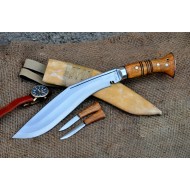
Same pattern, opposite dress. Our other chirra kukri is 13 inches with traditional furniture throughout: a solid turned black horn grip, a fitted steel bolster, a flared butt, and a laced leather sheath. It also carries a sharpened back edge over the forward section of the spine, which brings legal considerations with it in some places. This one is 12 inches with modern furniture throughout: micarta slabs, no bolster, a visible full tang, a lanyard tube and a harness sheath, and a plain spine with no back edge. Choose the 13 inch if you want the traditional article and the reach. Choose this one if you want the same blade geometry in a hilt that will not move with the weather, decoration on the flat, and the simpler legal position that comes with a plain spine.
Is this a working kukri or a display piece?
It is genuinely both, which is unusual enough to be worth explaining rather than claiming. Most decorated kukris are display pieces with soft steel, thin stock and a hilt assembled to look right in a photograph. This one carries the same 5160 steel, the same 7 millimetre spine and the same full-tang construction as our plain working blades, and the micarta grip is chosen for hard use rather than for looks. So it will hang on a wall and it will also chop firewood. What it will not do is stay pristine while doing the second one: use it and the polish will scuff and the etched panel will collect marks. That is not damage, but if you want it to look like these photographs in five years, it needs to be the piece on the wall rather than the piece in the pack.
What is the notch at the base of the blade?
That is the cho, sometimes written kaudi, and it is the diagnostic mark of a genuine kukri. Practically it terminates the edge in a rounded cut instead of letting the edge run straight into the shoulder, so a crack starting at the edge has somewhere to stop rather than running back toward the tang. Culturally it carries religious meaning that different communities in Nepal read in different ways. Ours are cut by hand on each blade, which is why no two are exactly alike. We apply the same test in both directions: a curved knife without a cho did not come from this tradition, whatever a listing calls it, and we have declined to call our own pieces kukris on that basis.
What steel is it?
5160 high-carbon spring steel, oil-quenched and tempered. It is the family of steel that vehicle leaf springs are made from, which is the origin of the Nepali practice of forging kukris from springs, and it is chosen for toughness rather than for maximum hardness. A chopper that is too hard chips when the edge meets a knot; 5160 at a working temper rolls slightly instead, and a rolled edge can be steeled or stoned back. The trade-off is that it needs sharpening a little more often than a harder, more brittle steel would, which is the right trade for a blade you swing. It is not stainless and it will rust if neglected.
Will the etching wear off in use?
Not from normal handling, because the pattern is cut into the metal rather than printed onto it — there is no coating to come away. What will change is everything around it. The polished flat scuffs, the whole blade develops a patina with age and oil, and the etched relief darkens faster than the surrounding surface because residue settles into it. Most owners find that improves the look, since the contrast between panel and flat increases. The one thing that genuinely erases an etch is abrasion: taking a wire wheel, a powered buff or a coarse abrasive to the panel will thin and eventually remove it. Clean it with a cloth and oil, not with a grinder.
How do I clean and oil an etched blade?
Work into the pattern rather than across it. A cloth drawn along a flat blade cleans it completely; the same stroke on an etched panel bridges the relief and skips the floor of every cut, leaving moisture sitting exactly where you cannot see it. Use a soft cloth or an old toothbrush with a light machine oil or camellia oil, work it into the panel in small circles, then wipe the excess off the flats. Do this whenever the blade has been handled, used or exposed to damp, and be especially careful after cutting anything green, since plant sap is acidic and will sit in the etch. None of this takes more than a minute, but skipping it on an etched blade costs more than skipping it on a plain one.
Can I have this in a different size?
Yes. We forge this pattern from belt-sized blades up to two-handed choppers, and the chirra scales with it. Tell us the blade length you want and we will tell you honestly whether the proportions hold before quoting. One caution specific to this piece: the etched panel needs a fuller wide enough to carry it, and on a short blade the fuller narrows to the point where a full foliate pattern becomes a cramped one. Below about 10 inches we will usually suggest a smaller motif or a plain blade rather than shrink the pattern into a space that cannot hold it. Grip material, finish, sheath, carry and engraving can all be specified at the same time.
| Specification | |
| Blade: | 12 inches. Hand forged from 5160 carbon steel. Single broad chirra with a flower pattern etched into the flat on both faces |
| Total Length: | 18 inches |
| Handle: | 6 inches, full tang, green micarta slabs, three pins, brass-lined lanyard hole, no bolster |
| Weight: | Approx. 740 g blade, approx. 1070 g total |
| Note: | As each piece is hand forged, ground and etched by hand, slight variation in weight, dimensions, finish and pattern registration may occur. Keep the blade lightly oiled and work the oil into the etched panel rather than across it. |