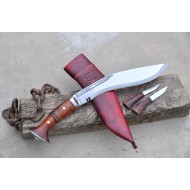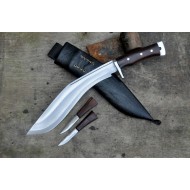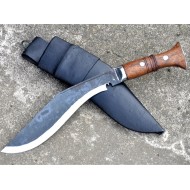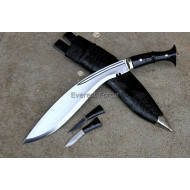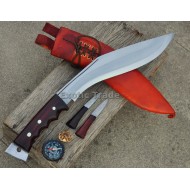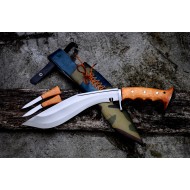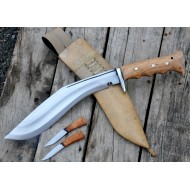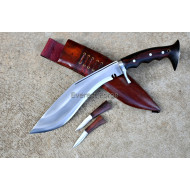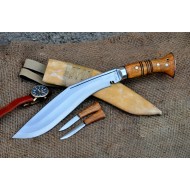
- Model: Signature Kukri/Khukuri
- Product Code: SingnatureBlade053
- Location: Kathmandu, Nepal
Available Options
Hand-Forged Battle Kukri Knife — Blackened Blade with Sculpted Steel Fittings
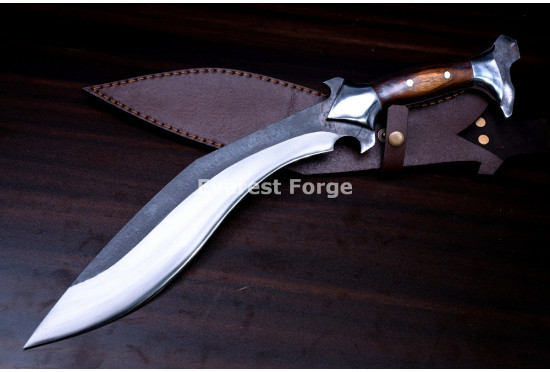
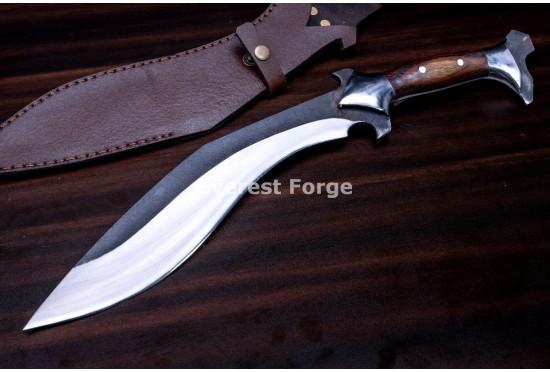
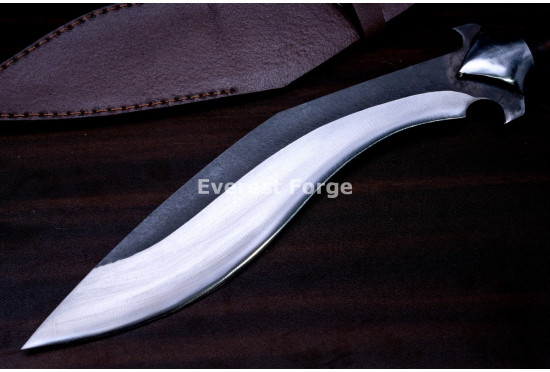
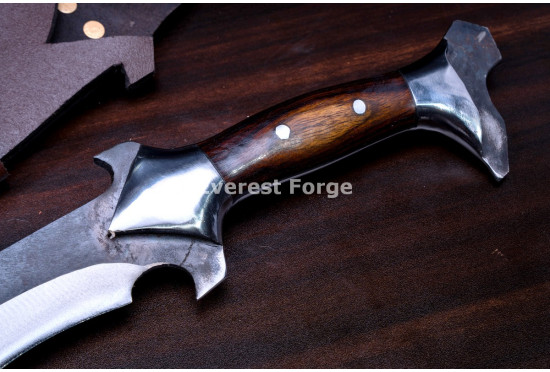
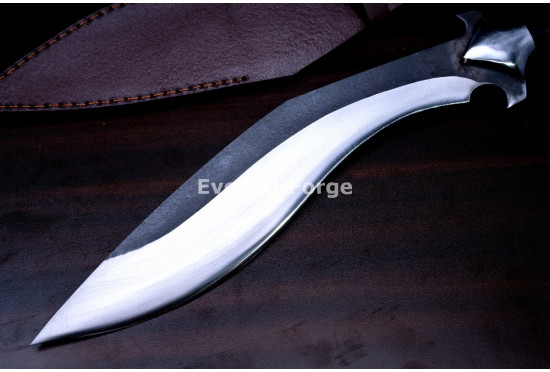
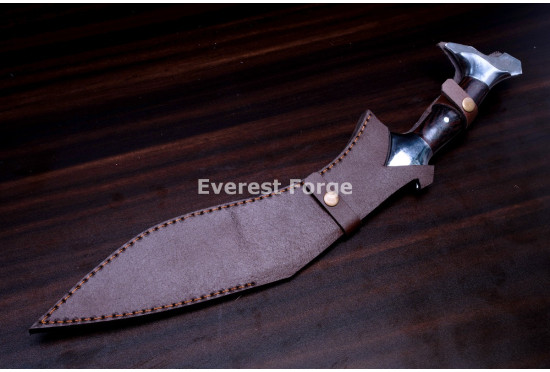
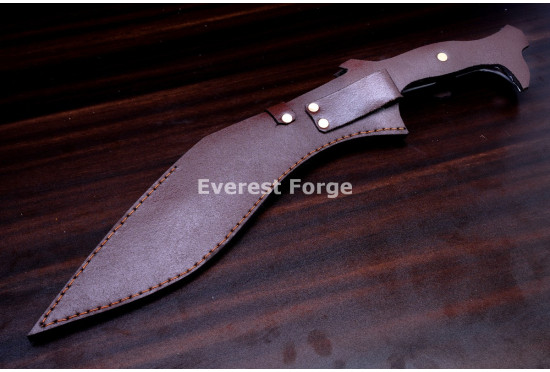
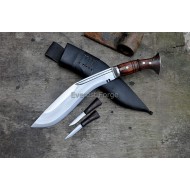
This is a hand-forged, fully functional battle kukri — the forward-curved Nepali blade built heavy and finished dark, forged at our workshop in Kathmandu from 5160 high-carbon spring steel, oil-tempered, full tang, and sharpened to a true edge. The blade carries a blackened satin finish across the flats with the edge bevel ground bright against it, and the traditional cho notch at its root. The fittings are the departure: a sculpted angular bolster with a downward projection, a notched feature at the spine, rosewood slabs pinned through the tang, and a heavy flared steel butt cap. It ships with a brown leather sheath with contrast stitching. Every kukri is made to order in your chosen size, finish, and engraving.
The standard blade is 14 inches on an 8-inch handle with a 4-inch grip, at about 1.35 kg. The number to notice is the blade weight — over 1.1 kg on a 14-inch blade makes this the thickest and heaviest kukri we build for its length, heavier in absolute terms than blades three inches longer. That mass is the point: it chops like something considerably larger. The oil-tempered 5160 steel and full tang make it a working blade rather than a display piece.
An honest note. Two things. This is a fantasy build, not a traditional Nepali kukri — the sculpted bolster, the spine feature and the flared butt cap are our own design, where a village kukri has a plain bolster and a ringed wooden grip. The blade underneath is genuine, with a proper cho and a real forward curve. Second, and more practical: this thing is heavy. Over a kilogram of blade on a fourteen-inch knife means it cuts with real authority and tires you out fast. If you want a kukri to carry and use all day, buy a lighter one — our bushcraft pattern is a better tool for that and costs less. Buy this one because you want the mass and the look.
Bespoke Service
Forge a Kukri to Your Own Design
Want plain traditional fittings, a lighter blade, a satin or polished finish, or the karda and chakmak set? Our Custom Forge service builds to your spec, by hand in Kathmandu.
Request a Custom Forge →What Makes It a Battle Kukri
The kukri earned its reputation as a fighting blade through the Gurkha regiments, and "battle kukri" has become the trade name for the heavier, more aggressive interpretations of the pattern rather than a historical designation. This one earns the label on mass rather than styling alone. The blade is forged noticeably thicker through the spine than a working kukri needs, which puts more weight behind every cut and lets a fourteen-inch blade hit like a longer one. The fittings follow: a sculpted steel bolster with a downward projection at the front of the grip, a notched feature where the spine meets the bolster, and a heavy flared butt cap that pulls some of the balance back toward the hand. It is an original Everest Forge design built around a genuine kukri blade.
Specifications
Customize Your Kukri
Every kukri is forged to order. Set your options before you add to cart:
Hand-Forged, Not a Souvenir Kukri
This Kukri
- Hand-forged 5160 high-carbon spring steel
- Oil-tempered, hard edge and flexible spine
- Full tang with scales pinned through it
- Thick forged section with a real distal taper
- Sharpened, balanced, forged in Nepal by Nepali smiths
A Souvenir Kukri
- Unhardened mild steel or stainless
- No real heat treatment, edge rolls on first use
- Stick tang glued into a hollow handle
- Thin flat stock with no section, heavy only in the fittings
- Blunt, made for a shelf
How It Is Made
Who It Is For
- Collectors who want the most aggressive-looking kukri in a range rather than the most authentic
- Buyers who specifically want mass behind the edge and do not mind carrying it
- Anyone building a display collection where the blackened finish stands out
- Heavy chopping around a camp, in short sessions rather than all day
- Gift buyers personalizing a blade with a name or engraving
- Not for all-day carry or traditional Nepali collecting — our bushcraft pattern suits the first, a traditional build the second
What Is Included
- One hand-forged battle kukri, built to your chosen spec
- Brown leather sheath with contrast stitching
- Rosewood handle pinned through a full tang, with sculpted steel bolster and flared butt cap
- Any personalization or engraving you ordered
- A blackened, sharpened blade with a traditional cho
- Everest Forge manufacturer warranty
Explore More Hand-Forged Blades
Shipping, Returns & Care
Shipping
In-stock specs dispatch within 2 to 3 business days; fully custom builds take roughly 4 to 6 weeks to forge before dispatch. We ship worldwide by DHL or FedEx in 7 to 14 business days, tracked. Import and blade laws vary by country, so please check your local rules before ordering.
Returns & Warranty
Every blade is backed by the Everest Forge warranty against forging and material defects. If something is wrong with your order, we will repair, replace, or refund it. Personalized and custom-engraved blades are made to order, so please confirm your spec carefully before purchase.
Care
Oil the blade before storage and wipe it dry after use. The blackened flats give the steel a little protection, but the bright edge bevel has none at all and that is the strip to watch — sap from green wood is acidic enough to mark it overnight. Do not attempt to polish the dark areas back to bright; the finish will not come back the same. Give the rosewood an occasional wipe with oil, and do not store the kukri inside its sheath for long periods.
From The Forge
Build a Kukri That Is Yours Alone
Beyond the options here, our Custom Forge service will build this blade with plain traditional fittings, a thinner and faster section, a different finish, or the full karda and chakmak set. Roughly 4 to 6 weeks from order.
Start a Custom Forge →Frequently Asked Questions
What is a battle kukri?
It is a trade term rather than a historical designation, and it is worth being clear about that. The kukri earned its reputation as a fighting blade through the Gurkha regiments, and sellers now use "battle kukri" for the heavier, more aggressive interpretations of the pattern — thicker sections, larger fittings, darker finishes. Historically a Nepali kukri was a farm tool that also went to war; there was no separate fighting model. This one earns the name on mass: the blade is forged considerably thicker than a working kukri needs, which is what gives it its character.
Why is the blade so heavy for its length?
Because it is forged thick through the spine and the taper is kept shallow, so there is simply more steel in it. At over 1.1 kg the blade alone weighs more than blades we make three inches longer — it is the heaviest kukri per inch in our range. That mass is the whole design intent. Weight forward of the hand is what makes a chopping blade chop, so a short heavy blade hits harder than a long light one and takes less technique to bury in green wood. What you give up is real and worth knowing: it is slower to recover between strokes, it is tiring on the forearm after a few minutes of steady work, and it is a lot to carry on a belt. Our bushcraft kukri has a longer blade that weighs less and is the better tool if you want to use it all day. Buy this one for the mass, not in spite of it.
What are the sculpted projections on the bolster and spine?
They are design features rather than functional ones, and we would rather say that than invent a purpose. The angular projection below the bolster sits where your index finger would go and does stop the hand sliding forward, which is a genuine if incidental benefit on a blade this heavy. The notched feature where the spine meets the bolster and the flared butt cap are styling. The cap does add a little weight behind the hand, which pulls the balance back very slightly from where it would otherwise sit — welcome on a blade this nose-heavy, though it does not transform the handling. A traditional kukri has none of this: a plain bolster, a plain butt cap, and nothing on the spine. If you want that, it is a custom option.
Is this a traditional kukri?
No. The blade is genuine — forward-curved with a proper cho notch at the root, forged from leaf-spring steel by Nepali smiths in Kathmandu — but the fittings are an original design. A village kukri has a plain bolster, a ringed wooden grip with a flared butt, and no sculpted features at all, and it rides in a dap with pockets for its companion blades. This has sculpted steel fittings, pinned slab scales and a flat sheath. If you are collecting Gurkha or traditional Nepali blades, ask us for a traditional build instead and we will make one properly.
How does this differ from your other kukris?
It is the shortest and by far the heaviest. At 14 inches with a 1.1 kg blade and a blackened finish, it is the only dark blade in the range and the only one built deliberately over-thick. The bushcraft kukri has a 15-inch blade at 810 g with a contoured grip and a belt sheath, and is the practical one to actually carry. The tiger-etched kukri is 16.5 inches with a traditional rosewood grip, an etched tiger and a karda. The fullered fantasy kukri is 17 inches with a single chirra fuller and a nine-inch two-hand grip. In short: buy this for mass and looks, the bushcraft for daily use, the tiger for tradition, and the fullered one for two-handed chopping.
What is the blackened finish, and how do I care for it?
The flats are finished dark and the edge bevel is then ground back to bright steel, giving a black blade with a clean bright line following the working edge. Care is straightforward but specific. Oil the whole blade, and pay particular attention to the bright bevel — it is bare carbon steel with no protection at all, and it is the first place rust will appear. Do not try to polish the dark flats back to bright: whatever you take off will not go back on evenly, and you will end up with a patchy blade. Sap from green wood is acidic enough to mark bare steel overnight, so clean the blade the same day you use it.
Is this a real, functional kukri? Can I chop with it?
Yes, and it chops extremely well — the mass does most of the work for you. It is hand-forged from 5160 high-carbon spring steel, oil-tempered, sharpened, and built on a full tang with the scales pinned straight through it. Use it on green wood, brush and limbs and it will outperform lighter blades of the same length. Do not use it on stone, metal, nails hidden in old timber, or seasoned hardwood knots. And work in short sessions: the weight that makes it cut well is the same weight that will tire your forearm and lead to sloppy, unsafe strokes if you push through fatigue.
What steel is it, and is it oil-tempered?
The blade is forged from 5160 high-carbon spring steel, the same alloy used in heavy-duty truck leaf springs, prized for toughness and edge retention. It is oil-tempered for a hard cutting edge backed by a flexible, shock-absorbent spine. On a blade this heavy that toughness matters more than usual — a thick blade delivers a great deal of energy into whatever it meets, and the steel has to absorb what comes back without chipping.
Is it full tang?
Yes, full tang with the rosewood scales pinned straight through it — the construction Nepali smiths call panawal. The handle is mechanically fastened to the steel rather than held by adhesive. The traditional alternative is a narrow stick tang set into a solid handle, which is lighter but is the first thing to fail on a hard-used knife. On a blade carrying this much mass the case for a full tang is not optional: the leverage a 1.1 kg blade exerts on the handle at the end of a swing is exactly what breaks lesser construction.
Does it come with a karda and chakmak?
Not as standard. A traditional kukri scabbard carries two small blades in a pocket — the karda, a utility knife for fine work, and the chakmak, a blunt burnisher for truing the edge. This kukri ships with a plain sheath and no companion blades. Both are available through the companion blades option and our smiths make them to match the kukri they are sold with.
Does it arrive sharpened, and can I order it lighter?
It arrives sharpened to a working edge along the belly, finished by hand; the area near the cho is traditionally left unsharpened, which is normal. Choose the display-blunt option if you need it unsharpened for display or import rules. As for weight — yes, we will forge this pattern with a thinner section, and it is worth considering. Tell us how you want it to handle rather than only what dimensions you want, and we will tell you honestly what a lighter blade costs you in chopping power and gains you in speed and endurance.
Do you ship worldwide, and how long does it take?
Yes. We ship worldwide from Nepal by DHL or FedEx in 7 to 14 business days with tracking. In-stock specs dispatch within 2 to 3 business days; fully custom builds take roughly 4 to 6 weeks to forge first. Import and blade laws vary by country, so please check your local rules before ordering.
| Specification | |
| Blade: | 14 inches. Hand forged from 5160 carbon steel |
| Total Length: | 22 inches long in total. |
| Handle: | 8 inches overall with a 4 inch grip section. Full tang panawal construction, rosewood scales pinned through the tang, with sculpted steel bolster and flared butt cap |
| Weight: | Approx 1350 grams total (blade approx 1140 grams) |
| Note: | As every piece is forged by hand, slight variation in weight, dimensions and finish may occur. Rosewood grain varies between pieces. Supplied without karda or chakmak; both available to order. Keep the blade lightly oiled when not in use. |