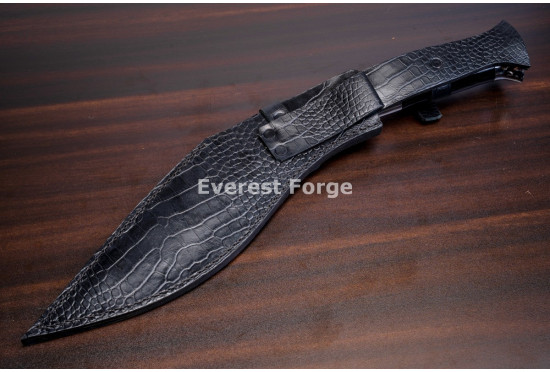
- Model: Hybrid Kukri
- Product Code: HybridKukri14
- Location: Kathmandu, Nepal
Available Options
Hand-Forged Ang Khola Kukri Knife — Hollowed Blade with Black Horn Handle
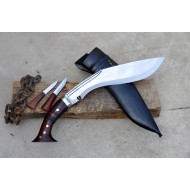
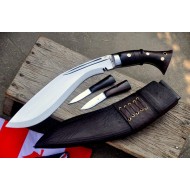
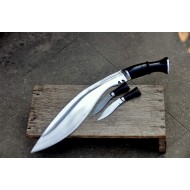
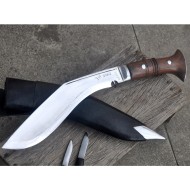
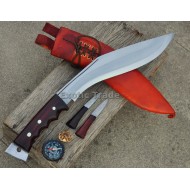
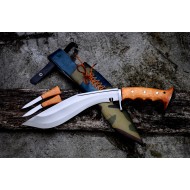
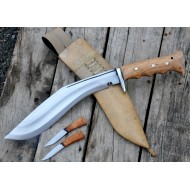
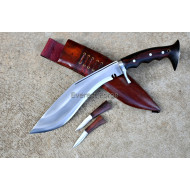
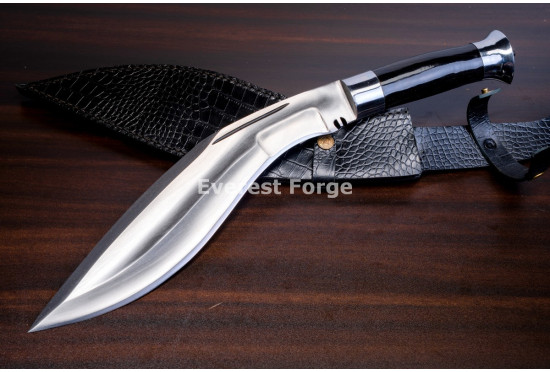
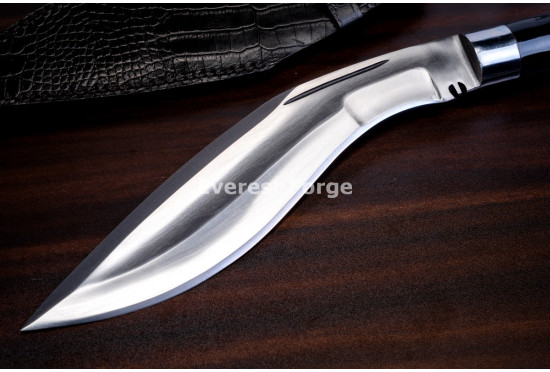
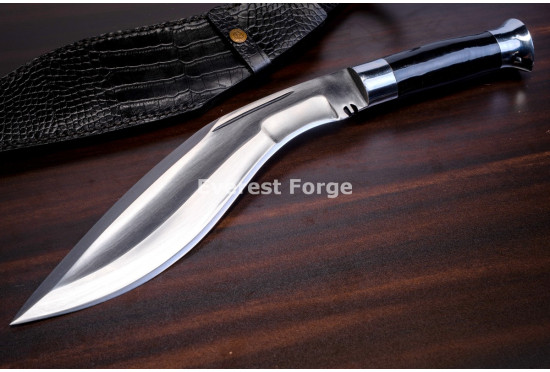
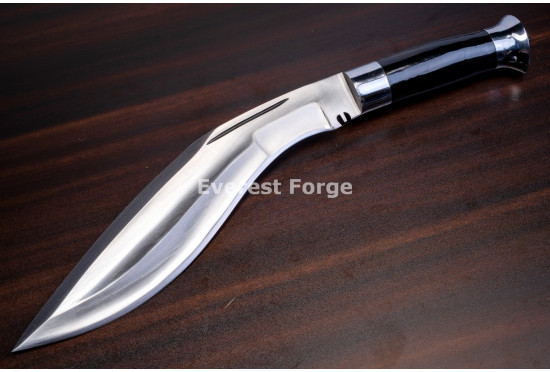
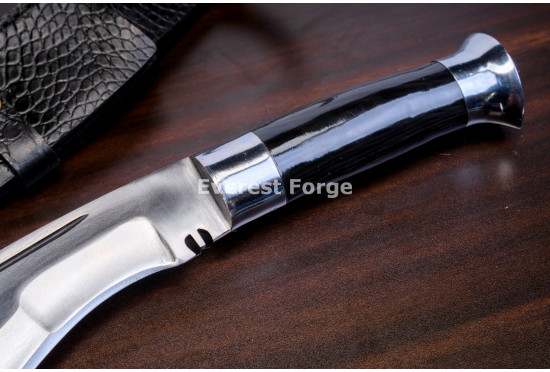
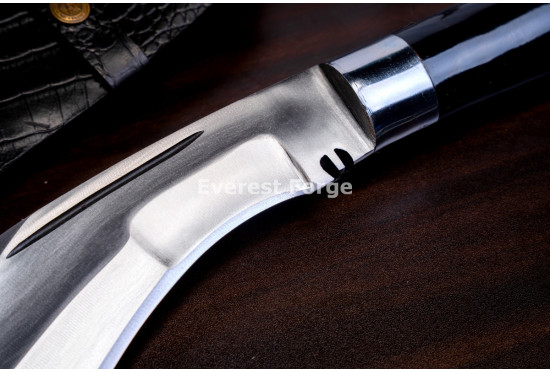
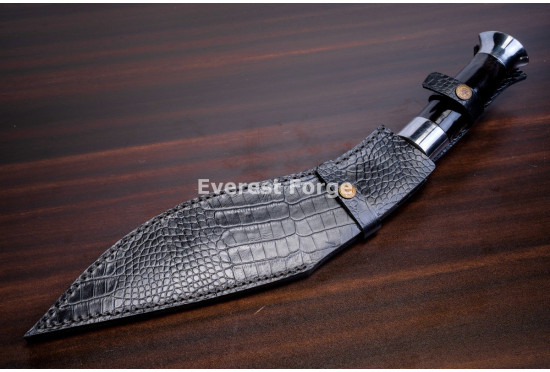
This is a hand-forged, fully functional Ang Khola kukri — the thick-spined hollowed build that Nepali smiths regard as the toughest of the traditional patterns, forged at our workshop in Kathmandu from 5160 high-carbon spring steel, oil-tempered, full tang, and sharpened to a true edge. The blade carries the hollow ground into its flats that gives the type its name, a short fuller at the forte, and the cho notch cut at the root. The handle is polished black buffalo horn with a steel ferrule and a flared steel butt cap. It ships with a black leather dap with an embossed finish.
The standard blade is 13 inches on a 6-inch handle, for an overall length around 19 inches at about 980 g. That makes it the lightest of our traditional kukris, which is not what people expect from an Ang Khola — the hollow is exactly what allows a very thick spine without the weight that would otherwise come with it. It is a carrying size, meant to be worn and used rather than displayed.
An honest note. This is a plain kukri and that is deliberate. There is no inlay, no engraving, no decorative fittings and no karda or chakmak in the scabbard — what you are buying is the blade and the build. If you want a decorated piece with the full traditional set, our Chainpure and Bhojpure patterns are the ones to look at, and they cost more because there is more handwork in them. This one puts everything into the steel. It is also worth saying that buffalo horn is a natural material: colour, grain and translucency vary from piece to piece, and the occasional pale streak or fine line in the horn is the material rather than a flaw.
Bespoke Service
Forge a Kukri to Your Own Design
Want a service size, a Bhojpure or Chainpure profile, a rosewood handle, or the karda and chakmak added? Our Custom Forge service builds to your spec, by hand in Kathmandu.
Request a Custom Forge →What Ang Khola Means
Ang khola translates roughly as body-hollowed, and it describes how the blade is made rather than what shape it takes. The smith leaves the spine unusually thick — considerably thicker than a standard kukri of the same size — and then grinds a hollow into the flats below it, removing metal from the middle of the blade where it contributes least to stiffness. What you end up with is a blade that behaves like a much heavier one under load while staying manageable in the hand, because stiffness in a beam comes from depth at the centre and that is precisely what the thick spine provides. Nepali users have long regarded the Ang Khola as the build to have if a kukri is going to be worked hard rather than carried for show, and it is the pattern most often reached for when the job involves seasoned wood or sustained chopping.
Specifications
Customize Your Kukri
Every kukri is forged to order. Set your options before you add to cart:
Hand-Forged, Not a Souvenir Kukri
This Kukri
- Hand-forged 5160 high-carbon spring steel
- Oil-tempered, hard edge and flexible spine
- Full tang, traditional Nepali construction
- Thick spine with a hollow ground in, not stamped from flat stock
- Cho cut properly at the blade root
A Souvenir Kukri
- Unhardened mild steel or stainless
- No real heat treatment, edge rolls on first use
- Stick tang glued into a hollow handle
- Thin uniform stock with a groove pressed in cold
- Cho decorative or missing entirely
How It Is Made
Who It Is For
- Anyone who wants the toughest traditional build rather than the best-looking one
- Outdoor and bushcraft users who will actually work the blade hard
- Collectors who prefer a plain kukri where the steel is the point
- Buyers who want a carrying size they can wear on a belt every day
- Anyone replacing a souvenir kukri that failed under real use
- Not for buyers wanting decoration or a full traditional set — see our Chainpure and Bhojpure
What Is Included
- One hand-forged Ang Khola kukri, built to your chosen spec
- Black leather dap with embossed finish and belt strapping
- Polished black buffalo horn handle with steel ferrule and flared butt cap
- Any personalization or engraving you ordered
- A hollow-ground blade with a traditional cho
- Everest Forge manufacturer warranty
Explore More Hand-Forged Blades
Shipping, Returns & Care
Shipping
In-stock specs dispatch within 2 to 3 business days; fully custom builds take roughly 4 to 6 weeks to forge before dispatch. We ship worldwide by DHL or FedEx in 7 to 14 business days, tracked. Import and blade laws vary by country, so please check your local rules before ordering.
Returns & Warranty
Every blade is backed by the Everest Forge warranty against forging and material defects. If something is wrong with your order, we will repair, replace, or refund it. Personalized and custom-engraved blades are made to order, so please confirm your spec carefully before purchase.
Care
Wipe the blade clean and dry after use and keep a light film of oil on it — 5160 is carbon steel and sap from green wood is acidic enough to mark it overnight. Pay attention to the hollow and the fuller, which hold moisture more readily than a flat surface and are easy to miss with a cloth. The horn handle wants a drop of mineral or neatsfoot oil every few months and should be kept away from radiators and out of prolonged direct sun, because horn dries and can crack if it loses moisture too fast. Do not store the kukri inside its dap for long periods.
From The Forge
Build a Kukri That Is Yours Alone
Beyond the options here, our Custom Forge service will build a service size, a different regional profile, additional fullers, or the full karda and chakmak set. Roughly 4 to 6 weeks from order.
Start a Custom Forge →Frequently Asked Questions
What is an Ang Khola kukri?
Ang khola means roughly body-hollowed, and it describes a method of construction rather than a blade shape. The smith leaves the spine unusually thick and then grinds a hollow into the flats below it, taking metal out of the middle of the blade where it does least for stiffness. The result is a blade that resists bending and flexing far better than its weight suggests, because stiffness comes from depth at the centre of the section and the thick spine supplies exactly that. In Nepal the Ang Khola has a long-standing reputation as the build to choose when a kukri is going to be worked hard — seasoned wood, sustained chopping, the jobs that find the weakness in a thinner blade. It is a construction term, so it can be combined with regional profiles: an Ang Khola can be built on a Bhojpure outline, for instance.
How thick is the spine, and why does that matter?
Spine thickness is the single most useful number for judging a kukri and almost nobody publishes it, which is why buyers who know what they are doing ask before they order. A light decorative kukri may be under 5 mm through the spine; a standard working blade sits somewhere in the middle; an Ang Khola is deliberately at the heavy end, and that thickness is the whole point of the build. It matters because a chopping blade fails in one of two ways — it bends, or the edge chips — and spine thickness governs the first. A thin blade will flex on a hard strike, which wastes energy and can set a permanent bend; a thick one drives straight through. The cost is weight, which is exactly what the hollow grinding is there to claw back. If you are comparing kukris across sellers, ask for spine thickness at the bolster and at the belly, and be sceptical of anyone who will not tell you.
How are kukris hardened, and what is different about the traditional method?
Both the traditional Nepali method and modern practice are after the same thing: a hard edge that holds sharpness, backed by a softer spine that absorbs shock instead of shattering. A blade hardened uniformly to the edge's hardness would be brittle enough to snap. The village method is remarkable to watch — the smith brings the blade to heat and then pours water from a kettle along the edge alone, in a controlled stream, so the edge cools fast and hardens while the spine cools slowly and stays tough. It is done entirely by eye and by the colour of the steel, and a good kami can judge it within a very narrow margin. What we do is oil-temper: the blade is quenched in oil and then drawn back to a spring temper. It achieves the same differential result more consistently across a production run, because oil quenching is less violent than water and far less dependent on the individual smith's hand on a given day. The traditional method is not worse; it is less repeatable, and consistency is what a customer buying unseen is entitled to.
How does this differ from your Bhojpure and Chainpure kukris?
All three are traditional Nepali patterns and all three are forged from the same steel by the same smiths, so the difference is what each is built to be. This Ang Khola is the plain, tough one: thick spine, hollow-ground flats, polished black horn, steel fittings, no decoration and no companion blades, and at 980 g it is the lightest of the three. The Bhojpure is the chopper — a broad heavy belly, two fullers, bone and horn with brass fittings, and it ships as a full set with karda and chakmak. The Chainpure is the finely finished one — inlaid bone and rosewood, white metal fittings, a cast brass chape, and the full set as well. Buy this one for the build, the Bhojpure for chopping mass, the Chainpure for the finish.
Why does this one not come with a karda and chakmak?
Because not every kukri does, and it is worth being clear that this is a choice rather than something missing. A traditional dap has pockets for the karda, a small utility knife, and the chakmak, a blunt burnisher for truing the edge — and our Bhojpure and Chainpure both ship complete that way. But plenty of working kukris in Nepal are carried without them, particularly by people who already own a knife for fine work and a stone for sharpening, and a plainer scabbard without the companion pockets is lighter and less bulky on a belt. This kukri is built in that spirit: the money goes into the blade rather than into three blades and a decorated scabbard. If you want the companions, they are available through the custom option and our smiths will make them to match.
Is this a real, functional kukri?
Yes, and of the kukris we make this is the one built specifically for hard use. It is hand-forged from 5160 high-carbon spring steel, oil-tempered, sharpened, and built on a full tang. The Ang Khola construction gives it more resistance to bending than any of our other patterns at the same weight. It will take down green wood, clear brush and handle sustained work. Do not use it on stone, metal, nails hidden in old timber, or seasoned hardwood knots, and check the edge and fittings after heavy use.
What steel is it, and is it oil-tempered?
The blade is forged from 5160 high-carbon spring steel, the same alloy used in heavy-duty truck leaf springs, prized for toughness and edge retention. It is oil-tempered for a hard cutting edge backed by a flexible, shock-absorbent spine. Nepali smiths have forged kukris from vehicle leaf spring for generations, long before anyone in Nepal was quoting an alloy number — it became the traditional material because it was available and because a chopping blade needs to absorb shock without chipping far more than it needs extreme hardness.
Is it full tang, and what is the handle?
Full tang, with a polished black buffalo horn grip fitted over it, a steel ferrule closing the front where the handle meets the blade, and a flared steel cap at the butt. The flare is functional as much as decorative — it stops the hand sliding off the back of the grip under a heavy pull, which matters on a kukri because the forward bend generates a twisting load with every strike. Horn is a good grip material for a working knife: dense, hard-wearing, warm in the hand, and it grips better when damp than when dry. Being natural, no two handles come out the same in colour or grain.
What is the scabbard like?
A traditional dap in black leather with an embossed finish and belt strapping, made by hand to fit the blade size you order. It has no companion pockets, because this kukri ships without the karda and chakmak — a plainer scabbard that sits closer and lighter on the belt. As with any leather scabbard, store the kukri outside it for the long term rather than in it: leather is tanned with acids and holds damp against carbon steel, and a blade left sheathed for months will show for it.
Does it arrive sharpened?
Yes, sharpened to a working edge along the belly, finished by hand. The area of the edge near the cho and back toward the ferrule is traditionally left unsharpened, which is normal and not an oversight. If you need it blunt for display or to satisfy import rules where you live, choose the display-blunt option or tell us in your order notes, at no extra charge.
Can I order a different profile, size, or the companion blades?
Yes to all three. Ang Khola is a construction rather than a profile, so it can be combined with regional shapes — a broad Bhojpure outline for more chopping mass, or a finer Chainpure line — and fuller counts run from none through ek chirra and dui chirra. Blade length goes down to a service size around eleven inches. Handle material, fittings and the karda and chakmak are all adjustable. Tell us the job you want the knife to do rather than only the dimensions, and we will say honestly which combination suits it.
Do you ship worldwide, and how long does it take?
Yes. We ship worldwide from Nepal by DHL or FedEx in 7 to 14 business days with tracking. In-stock specs dispatch within 2 to 3 business days; fully custom builds take roughly 4 to 6 weeks to forge first. Import and blade laws vary by country, so please check your local rules before ordering.
| Specification | |
| Total Length: | 19 inches |
| B Length: | 13 inches. Hand forged from 5160 carbon steel |
| H Length: | 6 inches. Full tang, polished black buffalo horn with steel ferrule and flared butt cap |
| Weight: | Approx 980 grams total (blade approx 710 grams) |
| Note: | As every piece is forged by hand, slight variation in weight, dimensions and finish may occur. Buffalo horn is a natural material, so colour, grain and translucency differ in every handle. Supplied without karda or chakmak; both available to order. Keep the blade lightly oiled when not in use. |