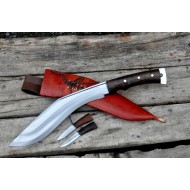
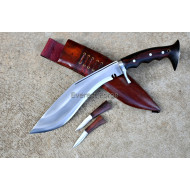
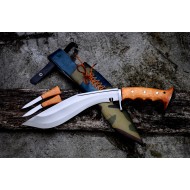
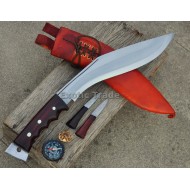
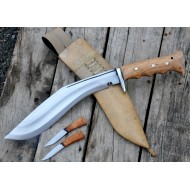
- Model: official issue kukri
- Product Code: Cermonialissue
- Location: Kathmandu, Nepal
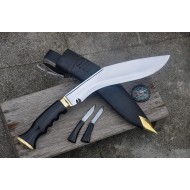
Available Options
The Gurkha Dress Knife — Mirror-Polished Ceremonial Khukuri with Patent Leather Scabbard, Carried by Brigade of Gurkhas Soldiers on Parade and Formal Occasions
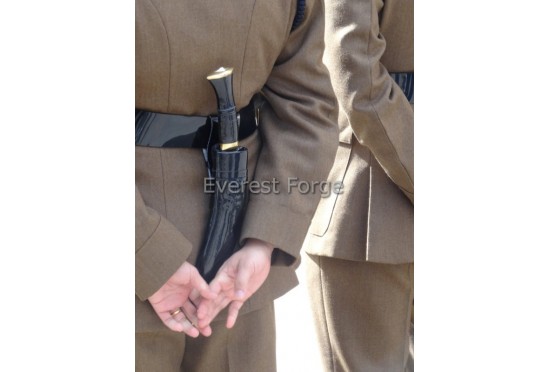
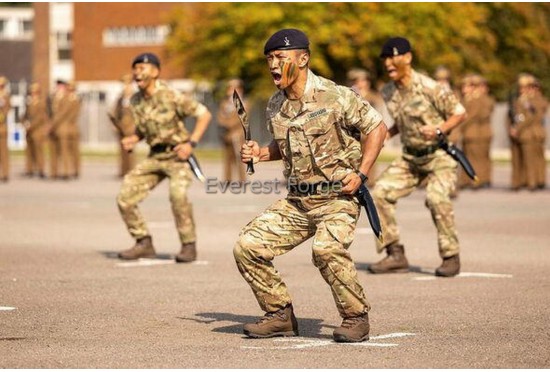
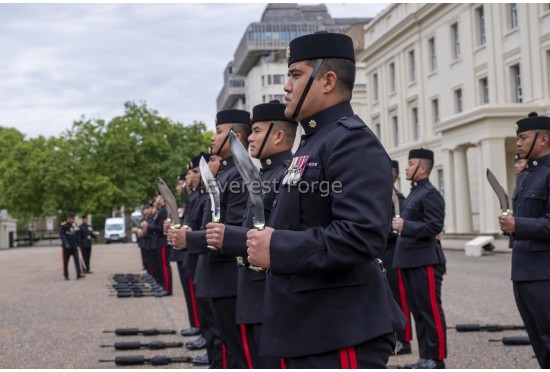
The Service Ceremonial Kukri — also called the Gurkha Dress Knife, the Ceremonial Khukuri, or in service nomenclature the No.1 Dress Issue — is the formal-presentation kukri carried by British Brigade of Gurkhas soldiers on parade, during ceremonial drill, at official army occasions, and on inspection by visiting dignitaries. Distinguished from the standard duty khukuri issue by its mirror-polished blade, high-gloss patent leather scabbard, and presentation-grade fittings — this is the kukri the Gurkha is photographed with on Remembrance Day, at Sandhurst parades, and on every formal occasion across the Brigade.
Officially introduced into Gurkha khukuri service in the early 1990s, the Ceremonial Dress Knife was developed to replace the practice of soldiers individually polishing their standard buffalo-hide issue kukri to parade standard. The Service Ceremonial gave the Brigade a single, uniform, presentation-grade kukri that was correct for ceremonial duty from day one. The pattern remains in current issue today and is the kukri retained by every soldier as a personal khukuri possession after retirement — often the single most cherished memento of their entire Brigade service.
- Blade: 10.5" mirror-polished 5160 high-carbon spring steel, water-tempered
- Handle: 5" polished water-buffalo horn with brass fittings
- Total length: 16"
- Weight: ~550g blade, ~725g overall
- Scabbard: High-gloss patent leather over wood core, brass chape, twin belt-loop frog
- Tang: Rat-tail tang through handle, peened at brass pommel (traditional ceremonial construction)
- Included: Karda (utility knife) + Chakmak (sharpener) — both mirror-polished to match
- Forged by: Kami caste smiths, Tokha-3 Kathmandu, Nepal
What Makes a Dress Knife Different from a Working Kukri
Every Brigade of Gurkhas soldier is issued multiple khukuris during their service — each one configured for a specific role:
- The BSI Service No.1 Kukri is the standard duty issue — polished blade, buffalo-hide scabbard, full-tang construction, carried on regular duty and field exercises.
- The Jungle PRI Kukri is the unpolished working blade — used for training, field operations, and combat.
- The Dress Knife (this listing) is the ceremonial presentation kukri — mirror-polished blade, patent leather scabbard, presentation-grade fittings, carried only on parade and formal occasions.
The Dress Knife is the khukuri the Gurkha presents when handing it to a visiting dignitary for inspection. It is the khukuri photographed at the soldier's enlistment, retirement, and every formal Brigade occasion in between. It is the khukuri that travels home in the soldier's personal effects after every overseas posting — kept polished, sheathed, and ready to represent the Brigade at any moment.
This is not a parade-aesthetic upgrade of a working blade. It is its own dedicated configuration with its own dedicated role.
The Origin Story — How the Dress Knife Became an Official Issue
Before the Service Ceremonial was officially adopted, Brigade soldiers were issued only the standard duty khukuri (the Sarkari Service pattern). The duty kukri uses utilitarian buffalo-hide leather for its scabbard — practical and durable, but not suited to the visual standard required for parade.
For decades, Brigade soldiers solved this themselves. They polished their duty blades to a higher finish than the issue standard, sometimes replaced the buffalo-hide scabbard with patent leather on their own initiative, and worked to maintain a parade-grade presentation despite carrying a working blade. Officers expected it. Soldiers delivered it. But the workload was significant — every Gurkha was effectively maintaining two khukuri presentations from one piece of kit.
In the early 1990s, the Brigade approved a dedicated ceremonial pattern. The Dress Knife was issued for the first time in 1993. It had the same fundamental blade geometry as the duty khukuri, but in mirror-polished finish with a high-gloss patent leather scabbard, brass fittings, and presentation-grade companion karda and chakmak. From that point, every Brigade recruit received both khukuris — duty issue for working, ceremonial dress for parade.
The Dress Knife has been in continuous issue since 1993 and remains the current ceremonial khukuri of the Brigade of Gurkhas today.
What Distinguishes a Genuine Dress Knife
Every detail of the Dress Knife is presentation-grade. The specifications matter because they are what separates a real ceremonial pattern from a working khukuri that's been polished:
Mirror-polished blade. Hand-polished to a presentation finish that reflects light evenly with no machining marks, no satin streaks, no field scratches. This is the finish standard required for officer inspection, not the semi-polished finish of working blades.
Patent leather scabbard. High-gloss black patent leather over a hardwood core — not the matte buffalo hide of working scabbards. The patent leather is laminated, wipe-clean, and maintains its presentation finish through years of formal use without the field wear that softens working leather.
Brass fittings. Brass chape (scabbard tip), brass pommel cap, brass fittings on the twin belt-loop frog. Brass was chosen for ceremonial work because it polishes to a bright finish that matches the blade and complements regimental brass on dress uniform.
Rat-tail tang, peened pommel. Traditional ceremonial construction — the tang runs through the handle and is peened (riveted) at the brass pommel cap. Different from the full-tang Western construction; this is the Gurkha ceremonial method.
Mirror-polished karda and chakmak. The companion knives are polished to match the main blade rather than left in working finish. When the kukri is drawn from the scabbard for inspection, all three blades present uniformly.
Twin belt-loop frog. The scabbard frog is designed for the standard-issue Gurkha parade belt — twin loops with brass bottoms for the belt to thread through, distinct from the single-loop working frog.
Why This Specific Dress Knife — Direct From Forge
The Service Ceremonial pattern is offered by every major Nepalese khukuri house. What separates the Everest Forge version:
Direct supply credential. Everest Forge has supplied kukris under the British Gurkha Army BSI Service No.1 contract (2008), Nepal Army (2015–2018), and Nepal Police (2016–2017). The ceremonial pattern on this page is forged by the same workshop and smiths to the same standard.
Kami caste lineage. Our smiths are Kami — the hereditary blacksmith caste of Nepal that has forged kukris for the Gurkhas since the Brigade's founding. Meet the smiths who forge every blade.
5160 spring steel, water-tempered. Differential hardness — edge 58–60 HRC for cutting performance, belly 45–46 HRC, spine 22–25 HRC for shock absorption. The Dress Knife is a presentation kukri but the blade is forged to working specification, not a decorative casting.
Free engraving — the recruiting year and country tradition. Every Dress Knife order includes free text engraving on the blade. Up to ~30 characters. The traditional Brigade format is the soldier's recruiting year and country ("2008 / UK", "1995 / NEPAL"), engraved on the left side of the blade — the same engraving location used on the Gurkha's original issue kukri. No other major Nepalese kukri house includes this engraving free; KHHI offers it only as a paid add-on, and most marketplace listings don't offer it at all.
Photo approval before dispatch. We photograph your finished Dress Knife — including the engraving — and send the images for your sign-off before shipping. If anything looks off, we re-forge. For a presentation-grade kukri being purchased as a retirement piece, a regimental gift, or a personal keepsake, this matters — you see exactly what's shipping before it leaves the workshop.
30-day refund guarantee + DDP worldwide shipping. Duties and taxes paid upfront via DHL Express / FedEx. You pay one price; nothing more on arrival. Tracked door-to-door, typically 10–14 days from order to delivery. No customs surprises, no return-shipping fights.
Who Buys the Dress Knife
Brigade of Gurkhas veterans — soldiers who carried the issue Dress Knife throughout their service and now want a higher-finish personal Dress Knife for retirement, or to replace an issue piece lost or damaged after demobilisation. Engraved with their recruiting year and country (or full service span for retirement pieces), this is the personal-keepsake version of the khukuri that defined their career.
Family members buying retirement and milestone gifts — for husbands, fathers, brothers, sons retiring from Brigade service. The Dress Knife is the most universally recognised symbol of Gurkha military service; engraved with the recipient's service span, it becomes a personal heirloom rather than a generic memento.
Regimental presentations — for outgoing officers, retiring senior NCOs, or milestone-service personnel. Engraved with the recipient's name, rank, regiment, and dates of service, the Dress Knife is the traditional military gift for formal Brigade ceremonies.
Veterans of allied forces — US, UK, Australian, Canadian service members who served alongside Brigade units. The Dress Knife is the recognised "Gurkha-tradition" presentation kukri, and is often gifted between allied units as a formal token of joint service.
Collectors of presentation-grade military edged weapons — those building a global collection of ceremonial-spec national military khukuris and blades. The Dress Knife is the modern ceremonial khukuri of one of the world's most decorated regimental traditions.
Display and heirloom buyers — kept mounted in the home or office as a representation of Gurkha tradition and personal connection. The mirror-polished blade and patent leather scabbard present beautifully under display lighting.
Full Specification
| Blade length | 10.5" (26.67 cm) |
|---|---|
| Total length | 16" (40.64 cm) — tip to pommel |
| Handle length | 5" (12.7 cm) |
| Steel | 5160 high-carbon spring steel, hand-forged |
| Heat treatment | Water-tempered for differential hardness |
| Blade hardness | Edge 58–60 HRC, Belly 45–46 HRC, Spine 22–25 HRC |
| Blade finish | Mirror-polished (presentation grade) |
| Blade thickness | ~9mm at spine |
| Tang construction | Rat-tail tang, peened at brass pommel (traditional ceremonial) |
| Handle material | Polished water-buffalo horn with brass fittings |
| Scabbard | High-gloss patent leather over hardwood core, brass chape, twin belt-loop frog |
| Companion blades | Karda + Chakmak, both mirror-polished to match |
| Weight | ~550g blade, ~725g overall |
| Origin | Tokha-3, Kathmandu, Nepal |
| Production | Hand-forged after order (5–7 days forging time) |
Each Dress Knife is individually hand-forged and hand-polished. Minor variations in horn grain, brass finish patina, and patent leather presentation are part of the craft.
What's Included
- Service Ceremonial Dress Knife — mirror-polished 10.5" blade with polished buffalo horn handle and brass fittings
- Karda — small utility knife, mirror-polished to match main blade
- Chakmak — sharpening steel, mirror-polished to match main blade
- High-gloss patent leather scabbard — over hardwood core, with brass chape and twin belt-loop frog
- Free text personalisation — up to ~30 characters, engraved on the blade (recruiting year + country tradition, name, regiment, or dedication)
- Certificate of authenticity from Everest Forge
- Photo-approval images sent before dispatch
The Soldier's Pair — Dress Knife + Standard Service No.1
For Brigade veterans and collectors building an authentic Gurkha kit, the Dress Knife is typically owned alongside the Standard Service No.1 — the two together represent the complete ceremonial-and-duty cycle of a Brigade soldier's kukri kit:
- Dress Knife (this listing) — mirror-polished ceremonial pattern with patent leather scabbard, for parade and formal occasions ($99.99)
- Standard BSI Service No.1 Kukri — polished working pattern with buffalo-hide scabbard, for duty and field ($94.99)
Many of our customers — particularly Brigade veterans — own both. Buy both together and we will engrave a matching recruiting-year and country motif on each at no extra cost.
Why Direct From Forge Beats Marketplaces and Other Kukri Houses
The Dress Knife is offered by every major Nepalese khukuri house and on Amazon, eBay, and similar marketplaces. We get asked regularly: "Why buy from Everest Forge directly?"
Honest answer — for a presentation-grade khukuri being purchased as a retirement piece, regimental gift, or personal keepsake, the direct-from-forge path is materially better:
- Free engraving included — the recruiting year and country tradition (or any text up to ~30 characters). KHHI charges extra for this. Most marketplace listings don't offer it at all. For a Dress Knife being bought as a milestone gift, engraving is the entire point of the purchase.
- Photo approval before dispatch — see the finished engraving and overall presentation before the kukri ships. If anything looks off, we re-forge. Marketplaces and most other forges ship blind.
- 30-day refund and full replacement guarantee — compared to KHHI's 14-day return policy or marketplace international return processes that can take months.
- DDP worldwide shipping — duties paid upfront via DHL Express or FedEx. No customs invoices arriving weeks after delivery. Compare to marketplace shipping where the buyer is responsible for clearing customs.
- Direct supply chain — the smiths who supplied the British Gurkha Army contract are the ones forging your blade. Marketplace inventory is bulk-purchased, sitting in warehouses, no traceable provenance.
- 10–14 days door-to-door — compared to KHHI's 2+ week estimated delivery windows.
- No aggressive upsell pressure — we offer free engraving as standard, not as a paid add-on alongside fifteen other paid extras. Clean transparent pricing.
For a khukuri that will be engraved, displayed, and possibly passed down — the direct-from-forge path is the only one that makes sense. For a generic souvenir, marketplace listings exist.
Import & Knife Law — Read Before Ordering
- UK: Curved blades over 50 cm fall under specific legislation. The Dress Knife blade is 26.67 cm — well under the limit — but carry in public requires lawful reason.
- Australia: Some states require permits for certain blade types. Check your state's edged-weapons schedule.
- USA: Federally legal for import as a knife. Carry and ownership rules vary by state and city — check local statutes.
- EU: Importable in most member states with applicable duties. We ship DDP (duties paid).
- Canada, NZ: Generally importable; carry rules vary by province/jurisdiction.
Related Khukuri Patterns
The Dress Knife sits at the centre of the ceremonial and formal Gurkha kukri family. Buyers commonly compare or commission alongside:
- Standard BSI Service No.1 Kukri — the working duty counterpart with buffalo-hide scabbard ($94.99)
- Service No.1 Gripper Handle — working variant with contoured horn grip ($99.99)
- Jungle PRI Training Kukri — the working/field counterpart of the Brigade kukri trio ($89.99)
- Kothimora Ceremonial Kukri — the silver-scabbard premium ceremonial variant, for senior officer presentations and retirement gifts
- Browse all current-issue military khukuris — the full Brigade range
Want to understand the parts of a kukri? See our Kukri / Khukuri Terminology Guide. For the heritage of the Brigade of Gurkhas across two centuries, see Origin of the Kukri.
Frequently Asked Questions
What is a Dress Knife — and how is it different from a regular kukri?
A Dress Knife is the ceremonial-presentation kukri of the British Brigade of Gurkhas. It differs from the standard duty issue (BSI Service No.1) in three ways: mirror-polished blade finish (vs working polish), high-gloss patent leather scabbard (vs matte buffalo-hide), and brass presentation fittings throughout. It is carried only on parade and formal occasions, never in the field. The duty khukuri is the working tool; the Dress Knife is the formal-presentation piece.
Is this the same Dress Knife currently issued to the Brigade of Gurkhas?
Yes — this is forged to the same Service Ceremonial specification carried by Brigade soldiers on parade today. Everest Forge has supplied kukris to the British Gurkha Army under the 2008 BSI Service No.1 contract; this Dress Knife is built by the same workshop, the same Kami caste smiths, to the same standard. The pattern has been in continuous Brigade issue since 1993.
Is the Dress Knife the same as the "No.2 Kukri" some sellers list?
Some sellers use "No.2" or "Service No.2" as an alternate designation for the Dress Knife, but the standard military and trade terminology is "Service Ceremonial," "Dress Knife," or "No.1 Khukuri" (referring to its rank in the soldier's kit as the formal-issue piece). All refer to the same pattern: mirror-polished blade, patent leather scabbard, brass fittings. We use "Dress Knife" or "Service Ceremonial" as these are the authoritative terms used by Brigade veterans and the kukri trade.
What's the difference between the Dress Knife and the BSI Service No.1?
The blade specifications are nearly identical — 10.5" polished 5160 steel, water-tempered. The differences are presentation:
• Dress Knife: mirror-polished blade, patent leather scabbard, brass fittings, mirror-polished karda/chakmak — for parade and ceremonial use
• Standard BSI Service No.1: polished blade (working grade), buffalo-hide scabbard, traditional fittings — for duty and field use
Brigade veterans typically own both during their service.
What's the traditional recruiting-year and country engraving?
By tradition, every Brigade Gurkha kukri carries an engraving on the left side of the blade: the soldier's recruiting year and country of service (e.g. "2008 / UK", "1995 / NEPAL"). The engraving dates back to a time when long-service Gurkhas — having fought in multiple wars over decades — would forget their exact enlistment year. The engraving became the soldier's record, etched onto the khukuri they would carry for the rest of their career. We replicate this traditional format free on every order.
Why is the scabbard patent leather instead of regular buffalo hide?
The Dress Knife was specifically designed for ceremonial presentation. Patent leather is high-gloss, wipe-clean, and maintains its formal appearance through years of parade use without the softening and field wear that working buffalo-hide develops. Brass fittings (chape, frog mounts) polish to match the mirror-finish blade. Everything about the Dress Knife is engineered for visual presentation, in contrast to the durable matte aesthetic of the working duty kukri.
Can I get a name, rank, regiment, or service span engraved?
Yes — free of charge. Add your engraving text at checkout. Up to approximately 30 characters. Common requests on the Dress Knife: recruiting year and country ("2008 / UK"), retirement marker ("BG 1995–2020"), regiment name or abbreviation ("RGR", "QGE", "QOGLR", "Royal Gurkha Rifles"), service number, recipient name in English or Nepali Devanagari script, or family dedication. The engraving is applied by hand on the left side of the blade — the same location as the traditional Brigade recruiting record.
Is the blade just decorative or is it a functional kukri?
Functional. The Dress Knife is hand-forged from 5160 high-carbon spring steel and water-tempered to traditional differential hardness — edge 58–60 HRC. The mirror-polished finish is cosmetic only; the underlying blade is a proper working kukri. Brigade soldiers carry Dress Knives that can be used in earnest if circumstance required — they are kept polished and unused, but they are not decorative castings.
What's the blade hardness (Rockwell)?
The blade is water-tempered for traditional differential hardness: edge 58–60 HRC for cutting performance, belly 45–46 HRC, spine 22–25 HRC for shock absorption. The Dress Knife uses the same metallurgy as our working khukuris — the difference is the polish, fittings, and scabbard, not the steel.
What's included with the Dress Knife?
You receive the Service Ceremonial Dress Knife, mirror-polished Karda (small utility knife), mirror-polished Chakmak (sharpening steel), high-gloss patent leather scabbard over hardwood core with brass chape and twin belt-loop frog, certificate of authenticity from Everest Forge, and photo-approval images sent before dispatch.
How long until it ships, and how is it sent?
Forging and polishing take 5–7 days from order. Shipping via DHL Express or FedEx International Priority, fully tracked, typically 5–7 days delivery. Total order-to-door: approximately 10–14 days. All shipments are DDP — duties and taxes paid upfront, nothing to pay on arrival.
Why is this better than buying from KHHI, Ex-Gurkha, or Amazon?
Three reasons. One: free engraving — we include the traditional recruiting-year engraving free on every order, where most other kukri houses charge extra and most marketplaces don't offer it. Two: photo approval before dispatch — you see the finished engraving and overall presentation before the kukri ships, where most other suppliers ship blind. Three: 30-day refund + DDP worldwide shipping — longer return window and no customs invoices on arrival, compared to 14-day returns and customer-cleared shipping elsewhere. For a presentation kukri being bought as a retirement piece or regimental gift, these matter.
| Specification | |
| Blade: | 10.5 inches, polished high-grade carbon steel |
| Total Length: | 16.5 inches overall |
| Handle: | 5 inches, full tang, made from buffalo horn |
| Weight: | 700 grams including blade and sheath |
| Note: | Each kukri is individually handcrafted in Dharan, East Nepal, ensuring every piece carries its own character with slight natural variations. |