Understanding Why Fullers (Chirra) Are Added to Certain Kukri/Khukuri Blades
The kukri—also spelled khukuri—is one of Nepal’s most iconic blades, known for its curved profile, forward weight, and powerful chopping ability. But if you examine different kukris, you’ll notice that some blades are smooth while others feature long grooves running along the sides.
These grooves are known as fullers, or chirra in Nepali. Fullers are a distinct part of many traditional kukri designs, yet not every blade includes them. The kukris that do incorporate chirra use them for very specific functional and structural reasons—not merely for decoration.
In this blog, we explore what fullers are, why some kukri/khukuri feature them, how they serve as an alternative to distal taper, and why traditional Nepali kukris are designed more like heavy-duty machetes than thin, tapered swords.
What Exactly Is a Fuller (Chirra)?
A fuller, or chirra, is a long, shallow groove forged or ground into the side of a blade. On a kukri, it typically follows the curvature of the blade’s spine and belly.
Common Nepali fuller styles include:
- Ek Chirra – one fuller
- Dui Chirra – two fullers
- Tin Chirra – three fullers
- Angkhola – a broad, rounded fuller
- Budhune/Bhujunge – a pronounced belly-style fuller
Although many people assume fullers are decorative, they are actually engineered with purpose. Each chirra enhances performance in different ways.
Why Some Kukri/Khukuri Have Fullers
1. Fullers Reduce Weight Without Losing Strength
A fuller removes steel from the blade strategically—similar to how an I-beam structure works in construction. This reduces weight while maintaining strength. As a result, a chirra kukri feels:
- Lighter in the hand
- More comfortable to use for long sessions
- Strong and rigid during chopping
2. Improved Balance and Smoother Handling
Removing metal from the central portion of the blade shifts weight naturally. A kukri with fullers swings more smoothly, maintains a forward cutting power, and reduces user fatigue.
3. Less Friction During Cutting
Fullers create small air channels along the blade. These help reduce sticking during deep cuts into meat, wood, or dense plant material. Many users notice smoother, more efficient chopping.
4. Added Structural Strength and Stiffness
Surprisingly, a properly made fuller can increase stiffness rather than weaken the blade. The curved groove reinforces the steel—much like ribs in a vehicle chassis—improving stability and reducing flex under impact.
5. Preserving Traditional Craftsmanship
Fullers are a signature of Nepali blade artistry. Designs like Tin Chirra and Angkhola are difficult to forge and are considered marks of a skilled kami (bladesmith). Many regions of Nepal have their own traditional fuller styles.
How Fullers (Chirra) Work as a Substitute for Distal Taper
In many swords and thin knives, the blade gradually becomes thinner towards the tip—a design known as distal taper. This makes long blades lighter and easier to maneuver.
However, most traditional kukri/khukuri blades do not have a pronounced distal taper. Instead, the spine stays thick all the way toward the tip for strength. To avoid making the blade too heavy, Nepali smiths use fullers as an alternative engineering solution.
Fullers help mimic the effects of distal taper by:
- Reducing weight in the center without thinning the spine
- Improving handling and swing speed
- Maintaining strength where it matters most
In simple words: a fuller gives the kukri the benefits of distal taper without compromising its durability.
Why Most Kukris Do Not Have a Strong Distal Taper
The kukri is not designed to behave like a sword. It is a heavy-duty working tool—closer to a machete mixed with an axe. Distal taper makes a blade thin and fast, but also less durable under impact.
Traditional kukris avoid strong distal taper because they need to:
- Withstand heavy chopping into wood and bone
- Maintain a thick spine for durability
- Deliver powerful forward-weighted cuts
- Survive harsh field and farming use
A thin, tapered tip could easily bend or crack when used for hard chopping. The kukri’s purpose demands strength, not extreme thinness. That is why fullers are used instead of tapering the blade.
The Kukri as a Heavy-Duty Machete
The kukri/khukuri is fundamentally a working machete designed for serious tasks—chopping wood, clearing brush, splitting small logs, butchering animals, and performing general field work. Like other machetes (parang, bolo, panga), traditional kukris maintain:
- A thick, durable spine
- A strong belly for impact
- Plenty of weight for chopping power
- A design focused on strength over thin slicing performance
In this context, the fuller becomes an intelligent engineering solution that refines the blade’s handling without sacrificing its identity as a powerful, heavy-duty tool.
Why Not All Kukris Have Fullers
Fullers are useful, but they are not mandatory. Some kukris are intentionally made without chirra because their purpose demands maximum steel and maximum strength.
Kukris that commonly feature fullers:
- Heavy chopping kukris
- Work-oriented blades
- Performance designs (Tin Chirra, Angkhola)
- Traditional regional patterns
Kukris that usually do not have fullers:
- Combat-focused military kukris
- Minimalist tactical kukris
- Ceremonial blades
- Ultra-heavy work kukris needing maximum steel
Final Thoughts
Fullers—chirra—play an important role in the performance and identity of many kukri/khukuri designs. They lighten the blade, improve balance, reduce friction, increase structural rigidity, and act as a practical replacement for distal taper.
Traditional kukris do not rely on distal taper because they must remain strong, thick, and ready for heavy-duty chopping. By using fullers, Nepali bladesmiths created a simple yet sophisticated engineering solution that enhances the kukri’s utility while preserving its strength.
Not every kukri needs a fuller, but the kukris that include chirra are easier to handle, smoother to swing, and beautifully connected to Nepal’s centuries-old forging heritage.
Explore Chirra Kukri/Khukuri (Fullered Blades)
Looking for kukri/khukuri with traditional chirra (fullers) for better balance, reduced weight, and classic Nepali blade design? Discover our hand-forged Chirra Kukri/Khukuri collection, built for real working use and serious collectors.
Explore NowUnderstand the Detail That Changes a Sword
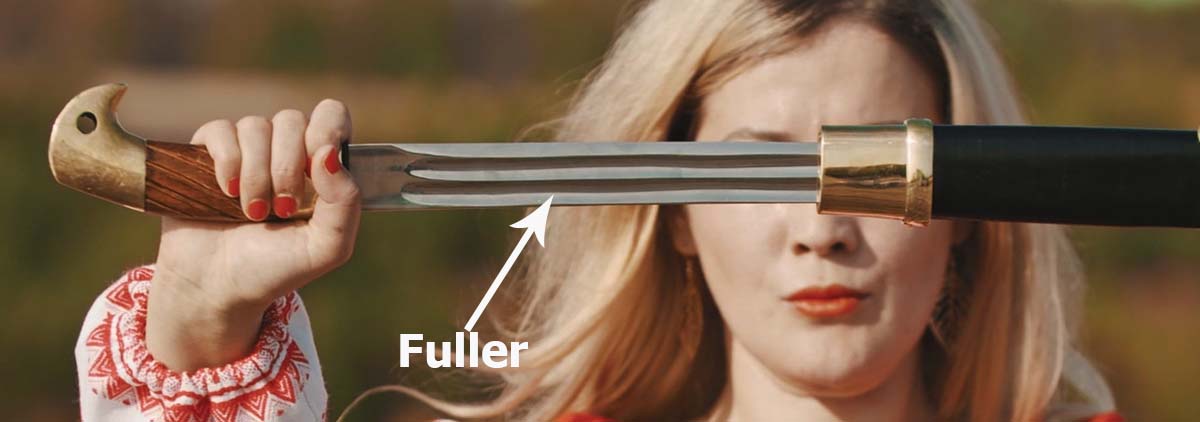
That groove running along a sword blade is more than just a design feature. It plays a key role in how the sword feels, moves, and performs in real use.
If you want to understand how blade geometry affects balance, speed, and strength, this guide breaks it down in a clear and practical way.
Read: Sword Fuller Explained