The Kukri (Khukuri): Lost Origins, Ancient Stories, and a Living Blade
The kukri—also spelled khukuri—is one of the most recognizable blades in the world. Its forward-curving shape appears simple, yet it delivers powerful chopping force and precise control, making it equally suited for work, survival, and combat.
Closely associated with Nepal and famously carried by the Gurkhas, the kukri/khukuri is far more than a knife. It is a cultural symbol, a working tool, and a living tradition. Yet one question continues to surface:
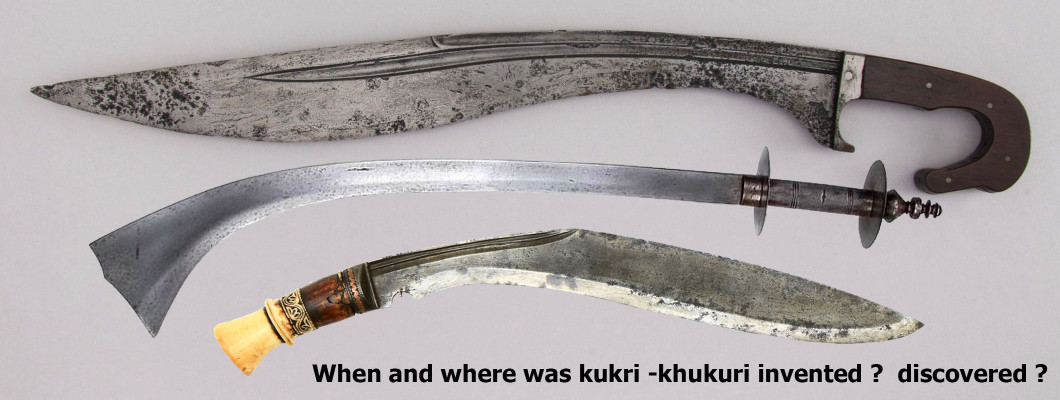
When and where was the kukri (khukuri) invented or discovered?
The honest answer is not a date or a name—but a story of evolution.
Why the Kukri Has No Recorded Invention Date
There is no surviving document, inscription, or confirmed archaeological record that tells us exactly when the first kukri was made or who made it. This absence of proof is not unusual.
For most of its existence, the kukri was not a royal or ceremonial object. It was a working blade, used daily by hunters, farmers, travelers, and warriors. Tools like these were rarely documented in early Himalayan societies, where knowledge was passed orally and practical objects were taken for granted.
Because of this, historians agree on one key point:
The kukri (khukuri) was not invented at a known moment. It evolved gradually through use.
The Kirat (Kiranti) Era: The Oldest Living Memory

The earliest cultural memory associated with kukri-like blades comes from the Kirat (Kiranti) peoples, among the oldest known inhabitants of the Himalayan region.
Ancient references and Nepalese oral traditions describe Kirat communities as forest-based hunters and warriors who relied on curved cutting tools for:
- Hunting and processing game
- Clearing dense vegetation
- Daily survival in rugged terrain
No surviving blade from this era can be definitively identified as a modern kukri. However, the function and logic of the tools described—forward-curving, chopping-focused blades—closely match the principles behind the kukri’s design.
This suggests that the concept of the kukri may be very ancient, potentially extending back more than 2,000 years, even though the refined form came later.
Ancient Influences and Early Visual Evidence
Beyond local tradition, some historians have looked further afield for influences that may have shaped the kukri’s evolution.
The Kopis and Machaira Theory
One widely discussed theory suggests that the kukri may share ancestry with ancient Greek curved blades such as the kopis and machaira. These weapons were known for their forward-weighted design and powerful chopping capability.
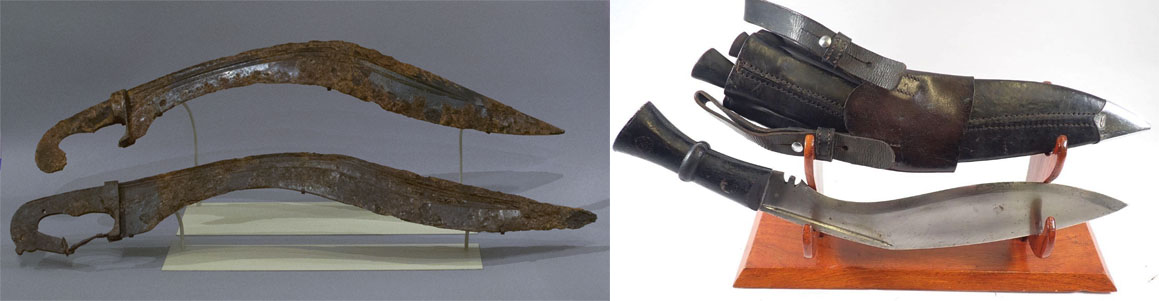
According to this interpretation, blade concepts of this type may have reached the Indian subcontinent during the campaigns of Alexander the Great in the 4th century BC. Over time, Himalayan blacksmiths could have adapted the idea into a blade better suited to local needs, terrain, and materials.
This theory is based on comparative blade geometry, not direct evidence, and should be understood as a possible influence rather than a confirmed origin.
Early Sculptural Clues

Adding to this discussion is a sculpture dated to around the 3rd century BC, which depicts a prisoner of war laying down a weapon that closely resembles the modern kukri in shape.
While this image does not conclusively prove the existence of the kukri as we know it today, it supports the idea that curved, kukri-like blades were already familiar in the region during antiquity.
The Oldest Surviving Kukri: A Physical Anchor
Although the kukri’s invention cannot be dated, there is an important physical reference point.
The oldest surviving intact kukri (khukuri) known today is housed in the National Museum of Nepal (Arsenal Museum) in Kathmandu.
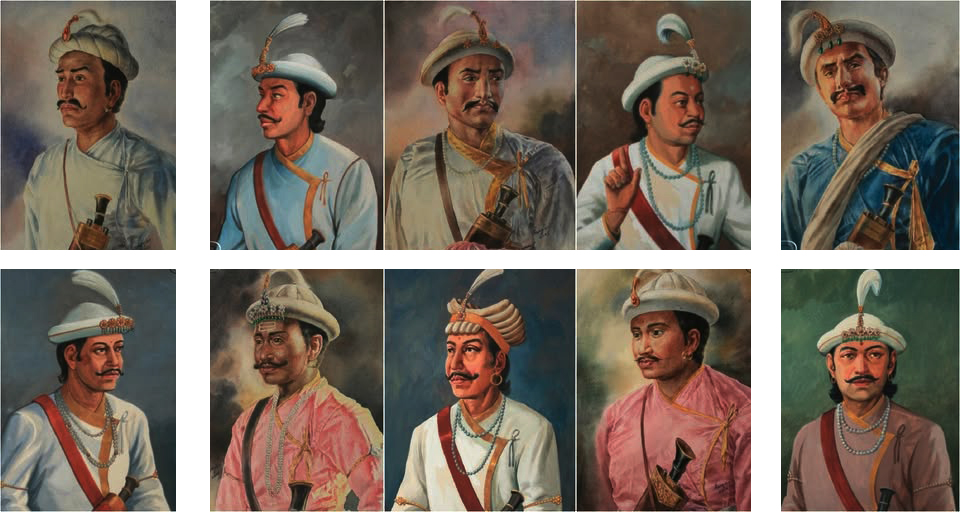
- Associated owner: Drabya Shah, King of Gorkha
- Estimated date: Approximately 1559 AD or 1627 AD (depending on museum records)
- Current location: National Museum of Nepal, Kathmandu
This blade does not represent the invention of the kukri. Instead, it confirms that the kukri was already well established by the 16th–17th century, implying a much older lineage.
Medieval Nepal: When the Kukri Becomes Recognizable
By the medieval period, Nepalese blacksmith traditions had matured. Many researchers believe this is when the kukri took on a clearly recognizable and consistent form.
Features that became standardized during this era include:
- A stable inward curve optimized for chopping
- Distinct regional handle styles
- The characteristic notch (cho or kaudi), later imbued with symbolic meanings
By this stage, the kukri was no longer just a tool. It had become part of Nepalese identity.
Prithvi Narayan Shah and the Unification of Nepal
During the 18th century unification of Nepal under King Prithvi Narayan Shah, the kukri was already an established blade. Gorkhali soldiers are traditionally described as carrying kukris during the campaigns that culminated in the capture of Kathmandu in 1768.
From this point onward, the kukri became strongly associated with state-building, military service, and national symbolism.
The Gurkhas and Global Recognition
The Gurkhas did not invent the kukri—they inherited it. What they did was carry it into global history.
During the Anglo–Nepalese War (1814–1816), British forces first encountered the kukri’s effectiveness in close combat and field utility. This marked the beginning of the kukri’s international reputation.
That reputation was cemented during World War I and World War II, when Gurkha soldiers served across Europe, Africa, and Asia, carrying the kukri as a working field blade and cultural symbol.
The Kukri Today: A Living Tradition
Today, the kukri (khukuri) remains a living blade.
For the Gurkhas, it continues to symbolize heritage, discipline, and service in a modern military context. Beyond military life, the kukri has earned renewed respect among outdoor adventurers, bushcrafters, and survivalists worldwide.
Its continued relevance proves a simple truth: the kukri still works.
Time Frame Summary (Educated Estimate)
- Possibly before 500 BCE: Kirat-era curved blade traditions
- 3rd century BCE: Sculptural depiction of kukri-like weapon
- 4th century BCE: Possible influence of kopis/machaira concepts
- 1200–1700 CE: Kukri becomes clearly recognizable in Nepal
- 1559–1627 CE: Oldest surviving kukri (Drabya Shah)
- 18th century: Kukri central to Nepal’s unification
- 19th–20th century: Global recognition through Gurkhas
- Present day: Cultural symbol and functional outdoor blade
The kukri—khukuri—does not draw its authority from a single inventor or a recorded date.
It draws its authority from endurance.
From ancient Himalayan life to modern adventure, the kukri has never disappeared. It has adapted, survived, and remained relevant.
The kukri was not discovered. It was not invented at a known moment. It endured.
Design Your Own Custom Kukri (Khukuri)
The kukri has always evolved through use, experience, and individual needs. Continue that tradition by creating a kukri or khukuri forged to your own specifications.
Through our Custom Forge process, you can request your preferred blade length, thickness, curvature, steel type, handle material, balance, and scabbard style — all hand forged by skilled craftsmen.
Request Custom Forge Kukri