The Ultimate Guide to Rambo Knife Blade Types and Grip Designs
The Rambo knife isn't a single design — it's five distinct blades across five films, each with different geometry, different grip construction, and different intended use. If you're trying to decide which Rambo knife is right for your collection, your hunting kit, your cosplay setup, or your workshop wall, the differences between them matter more than most buyers realise.
This guide breaks down the technical anatomy of every Rambo blade type, compares the grip designs across the franchise, and helps you choose the right one for your specific needs — whether that's survival, display, tactical use, or something in between. For the historical background of who designed each knife and why, see the Rambo knife history article.
The Anatomy of a Rambo Knife — Six Parts That Matter
Before comparing blades, it helps to know what you're comparing. Every fixed-blade survival knife has six core parts that determine how it performs.
- Spine — The unsharpened back of the blade. On Rambo knives, the spine often features serrated saw teeth (Lile's First Blood and Mission II) or a smooth strong spine (Hibben's Rambo III, IV, V).
- Edge — The sharpened cutting side. Rambo knives are typically single-edged with a clip-point or drop-point profile.
- Point — The tip of the blade. The Lile knives have a fine clip-point for piercing; Hibben's Rambo III emphasises a more dramatic upswept tip.
- Bevel — The angled grind from the blade flat to the cutting edge. A taller bevel cuts deeper but is more fragile; a lower bevel chops harder but cuts less precisely.
- Ricasso — The unsharpened section just above the guard. Allows finger-indexing for control. Some Rambo blades have a defined ricasso; others don't.
- Tang — The portion of steel that extends into the handle. This is the single most important difference between Lile's hollow-handle Rambo knives and Hibben's full-tang knives. We'll come back to this.
The Five Rambo Blade Types — Side by Side
Here's how the five Rambo knife designs compare on the technical specs that matter for actual use.
Type 1 — The First Blood Survival Knife (1982)
Blade profile: Clip-point Bowie, 9-inch blade, 14-inch overall length
Spine: Sawback with 12–14 forged serrations
Tang: Hollow handle — not full tang
Best for: Survival kit storage, lashing to a pole as a spear, traditional 1980s aesthetic
Compromise: Hollow handle is structurally weaker than full tang under heavy chopping or prying loads
The First Blood knife is the original survival-knife template. The hollow handle — sealed with an O-ring and packed with fishing line, matches, needles, and a compass — turned the knife itself into a survival kit. The sawback spine could cut wood, score branches for snares, or theoretically cut through aircraft fuselage. This is the most "survival-coded" of all Rambo designs.
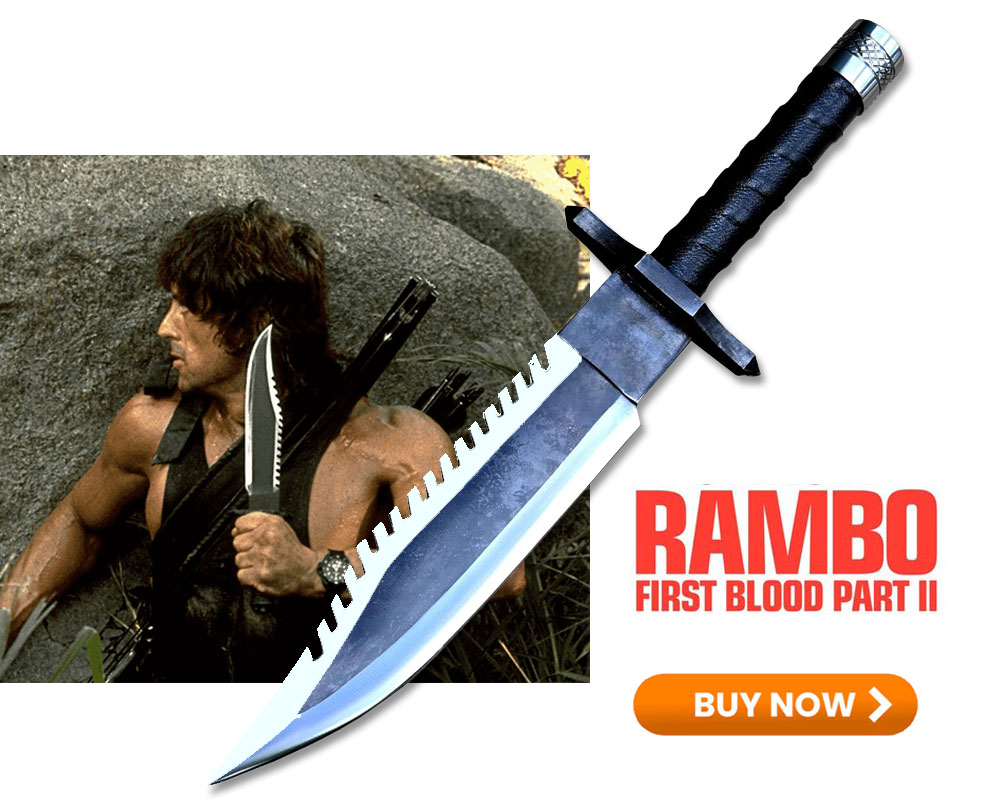
Type 2 — The Mission II / First Blood Part II (1985)
Blade profile: Refined clip-point Bowie, slightly heavier geometry
Spine: Sawback (similar tooth count to Mark I)
Tang: Hollow handle — same construction philosophy as Mark I
Best for: Collectors who want the "refined" survival aesthetic; tactical-styled display
Compromise: Same hollow-handle limitation as Mark I
Mission II is the most collectible of all Rambo knives among serious knife collectors — widely considered the finest design in the series. Visually it leans more tactical than the Mark I (often paired with darker finishes in replicas), but the underlying construction philosophy is the same. The two Lile knives together define one half of the Rambo blade lineage.
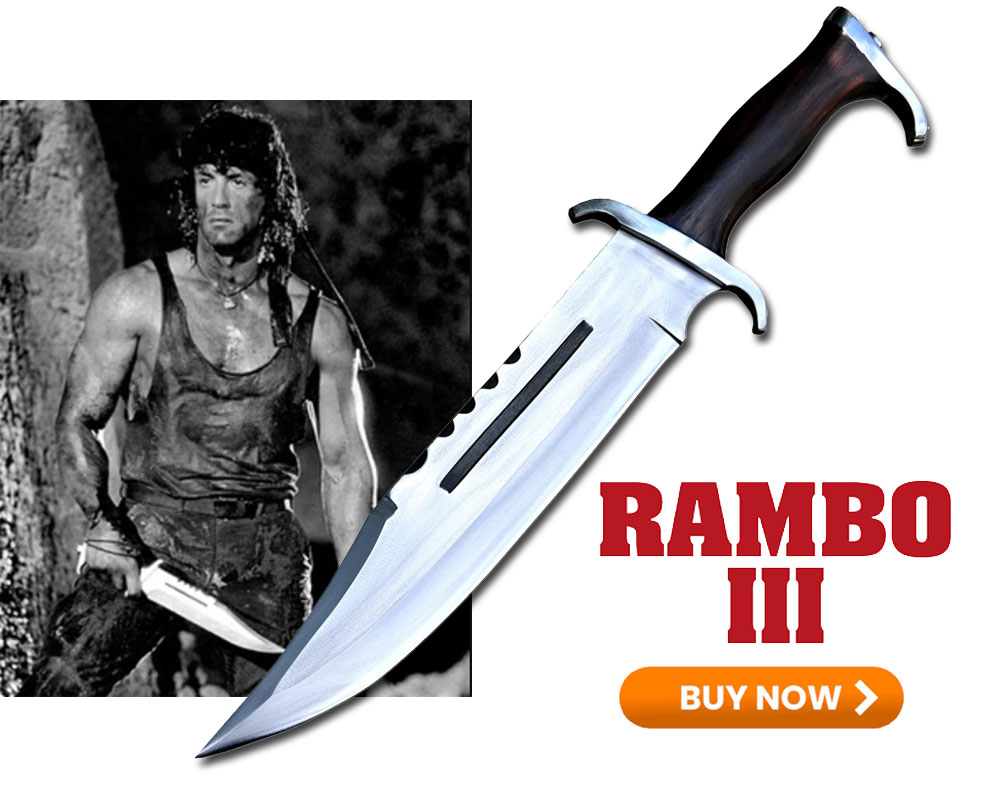
Type 3 — The Rambo III Bowie (1988)
Blade profile: Massive Bowie hunter, 12-inch blade, dramatic upswept clip-point
Spine: Smooth (no sawback) — uninterrupted strong spine
Tang: Full tang — complete redesign philosophy
Best for: Heavy chopping, bushcraft, the iconic "Rambo knife" silhouette buyers picture
Compromise: Larger and heavier than the Lile knives; less suited to fine work
The Rambo III knife is the design most casual viewers picture when they think "Rambo knife." Hibben abandoned the hollow handle entirely — his philosophy was that survival should rest on blade quality, not on stowed-away supplies. The full-tang construction makes this design dramatically stronger under chopping, prying, and heavy use than the Lile knives. It's the bestseller across most replica makers for good reason: it works hard.
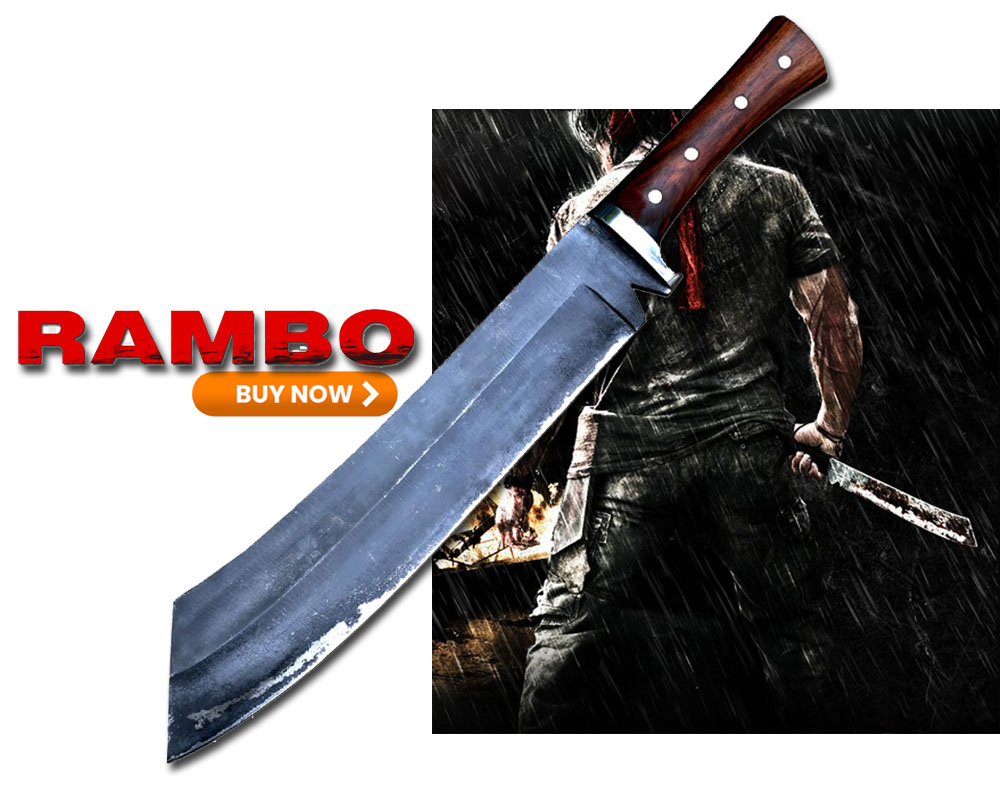
Type 4 — The Rambo IV Cleaver (2008)
Blade profile: Cleaver-style, 13-inch blade, forward weight bias
Spine: Smooth, thicker stock than Rambo III
Tang: Full tang
Best for: Heavy chopping, jungle clearing, machete-cleaver hybrid work
Compromise: Less precise; not great for fine cutting tasks
The Rambo IV cleaver is the most divisive design among collectors. Some call it the most practical (it actually chops hard); others find it too far from the survival-knife elegance of the Lile originals. The forward weight bias makes it more efficient for chopping wood or clearing brush than any of the other Rambo knives. If you actually want a knife that does heavy outdoor work, this is arguably the most functional Rambo design.
Type 5 — The "Heartstopper" Last Blood (2019)
Blade profile: Compact combat blade, 10-inch blade, drop-point geometry
Spine: Smooth, thicker mid-section
Tang: Full tang
Best for: Compact carry, close-quarters work, modern tactical aesthetic
Compromise: Smallest of the Rambo blades; less imposing than Rambo III for display
The Heartstopper reverses the size escalation of Rambo III and IV. Compact, brutally functional, designed for close-quarters work rather than oversized chopping. If you want the smallest Rambo knife that's still recognisably "Rambo" — and you want it to actually be carryable in real-world situations — the Heartstopper is the one.
Hollow Handle vs Full Tang — The Most Important Choice
Of all the technical differences between Rambo knife designs, handle construction matters the most for actual use. This is where Lile's First Blood/Mission II knives diverge fundamentally from Hibben's Rambo III/IV/V designs.
Hollow Handle Construction (Lile's First Blood and Mission II)
How it works: The blade is forged with a partial tang that extends into a hollow tube. The tube is sealed at the butt with an O-ring cap that doubles as a survival-kit storage compartment.
Pros:
- Storage for matches, fishing line, needles, thread, and a compass inside the handle
- Lighter weight than equivalent full-tang knife
- Can be lashed to a pole to make a spear or fishing gig
- The historical Rambo aesthetic — this is what makes a knife look like a "First Blood" knife
Cons:
- Structurally weaker than full tang under heavy chopping, prying, or batoning loads
- The partial tang is a stress concentrator at the blade-handle junction
- O-ring seal eventually wears and may leak
- Modern survival philosophy generally rejects hollow-handle designs for serious use
Full Tang Construction (Hibben's Rambo III, IV, V)
How it works: The blade and tang are forged from a single continuous piece of steel that runs the full length of the handle. Handle scales (rosewood, bone, micarta) are pinned or screwed onto either side of the tang.
Pros:
- Maximum structural strength — tang cannot break at the blade-handle junction
- Handles heavy chopping, batoning, and prying without flexing
- Easier to maintain — handle scales can be replaced without rebuilding the knife
- Modern survival, military, and bushcraft standard
Cons:
- No survival-kit storage in the handle
- Heavier than a hollow-handle knife of equivalent blade size
- Less of the "1980s First Blood" aesthetic
Which Is Right for You?
If you actually want to use the knife — bushcraft, hunting, batoning firewood, building shelter — full tang wins every time. The Rambo III, IV, and V designs all use full tang. This is why most modern hand-forged Rambo tribute knives, including the Everest Forge collection, are full-tang — the construction is genuinely better for working knives.
If you want the historical First Blood aesthetic for display, want the survival-kit storage as a feature, or specifically want the Lile design language — hollow handle is the choice. Just understand the structural trade-off.
The Sawback Spine — What It's Actually For
The serrated sawback spine on Lile's First Blood and Mission II knives is one of the most copied features in survival knife history. But its actual purpose is widely misunderstood.
What the sawback CAN do well:
- Cut light metal (a downed aircraft skin, wire, sheet metal)
- Score wood for snare construction or trap triggers
- Notch wood for pegs and stakes
- Scrape tinder from a fire-starting log
- Cut through rope or webbing in tight spaces
What the sawback CANNOT do well (despite the name):
- Saw through wood like a real wood saw — the tooth geometry is wrong; you'll have a frustrating slow grind, not a clean cut
- Replace a folding saw or hatchet for cutting firewood
- Make precise cuts — the sawback is a rough utility, not a precision tool
Hibben deliberately removed the sawback from Rambo III, IV, and V because he viewed it as a marketing feature rather than a functional one. Most modern bushcraft instructors agree — if you actually need to saw wood in the field, carry a folding saw. If you want the sawback for the survival aesthetic and the metal-cutting/notching utility, the Lile-style designs deliver it.
Steel Choice — What Material Each Rambo Knife Uses
The original Lile First Blood knife used 440C high-chromium stainless steel. Lile chose 440C specifically for its rust resistance in jungle and wet conditions — not for edge retention. He famously claimed the steel "could cut through the fuselage of an aircraft," which spoke to its toughness, not its sharpness.
Hibben's later Rambo knives used a mix of stainless and carbon steels depending on production run. The licensed reproductions today (Master Cutlery, United Cutlery) typically use 7Cr17 or 420J2 stainless — serviceable but not high-end.
Modern hand-forged Rambo tribute knives, including the Everest Forge Rambo Series, typically use 5160 high carbon spring steel, 1095 carbon steel, or D2 tool steel. These are working steels — tougher and better at holding an edge under heavy use than 440C stainless. The trade-off is that carbon steels will surface-rust if neglected, where 440C stainless mostly won't. Anyone who uses their knife regularly oils the blade as a matter of habit, so the rust concern is largely moot.
Steel comparison summary:
- 440C stainless — original Lile choice. Rust-resistant, decent edge, easy maintenance. Mid-tier toughness.
- 5160 spring steel — common in hand-forged tribute pieces. Highest toughness for chopping/batoning, good edge retention, requires oiling.
- 1095 carbon steel — classic survival knife steel. Excellent edge but less tough than 5160.
- D2 tool steel — premium. Excellent edge retention, harder to sharpen, semi-stainless.
- 7Cr17 / 420J2 stainless — budget licensed reproductions. Easy to sharpen, won't rust, won't hold an edge under hard use.
Which Rambo Knife Is Right for You? — Buyer Decision Matrix
Here's how to choose the right Rambo blade for your specific use case.
For Bushcraft, Hunting, and Real Outdoor Work
Best choice: Rambo III (12") or Rambo IV cleaver (13")
Both use full-tang construction in heavy 5160-style steel that handles chopping, batoning, and rough use. The Rambo III is the more balanced general-purpose choice; the Rambo IV cleaver is better if your primary task is chopping (firewood, brush, jungle clearing).
For Display and Collecting (1980s Aesthetic)
Best choice: First Blood (Part One) or Part II Bowie 17"
The Lile-style hollow-handle designs deliver the iconic 1980s survival-knife aesthetic that most collectors want on the wall. The Part II Bowie at 17 inches overall is the most cinematic for display; the Part One is closer to the actual film knife scale.
For Compact Carry and Practical Use
Best choice: Rambo V "Heartstopper" (10")
The smallest of the Rambo knives. Compact enough to carry on a belt without looking like a costume piece. Full-tang construction. Genuinely usable as a working knife in real-world settings.
For Cosplay and Stage Use
Best choice: Any Rambo design with the BLUNTED option
Most hand-forged Rambo makers, including Everest Forge, can supply a blunted version of any Rambo knife in the collection — same visual appearance, no cutting edge or point. Safer for stage, easier to import in regions that restrict sharp knives, mention "blunted" in your order notes at checkout.
For Custom or Memorial Projects
Best choice: Custom Forge bespoke build
If you want a Rambo-style knife built to your exact specifications — military unit insignia, memorial dedications, custom blade length, blends of Lile and Hibben design elements — that's the Custom Forge path. See the CTA below.
Sheath Design — What to Look for
The sheath is more than a cover. A well-designed Rambo knife sheath is a survival-kit accessory in its own right.
Quality indicators:
- Material: Top-grain leather or thick kydex. Vinyl or split leather is a budget signal.
- Stitching: Hand-stitched seams with reinforced corners. Glue-only construction fails within months.
- Belt loop: Reinforced double-stitch with a metal grommet or rivet. Single-stitch loops tear under load.
- Retention: A snap, button, or friction fit that holds the knife securely upside down. A loose sheath is a dropped knife.
- Sharpening stone pouch: The classic Lile First Blood sheath had a front pouch for an Arkansas sharpening stone. Premium hand-forged sheaths often replicate this.
Lile's original First Blood sheath included a dual-grit Arkansas stone in a front pouch. The film sheath also held a small pocket survival kit. Modern hand-forged Rambo sheaths typically include a stone pouch and reinforced belt attachment.
Hand-Forged vs Mass-Produced — What Actually Matters
The Rambo knife market today divides into three quality tiers, and understanding the differences saves money and disappointment.
Tier 1 — Original maker pieces. Surviving Lile prototype knives sell at auction for $35,000–$80,000. Numbered Lile consumer knives go for $5,000–$15,000. Signed Hibben Rambo III/IV/V limited editions sell in the $1,500–$5,000 range. These are heirloom investment pieces, not user knives.
Tier 2 — Licensed reproductions. Master Cutlery (Lile-designed knives) and Hibben Knives (Rambo III, IV, V) hold the official film licences. Their products are excellent display pieces, often signed and serialised, typically in the $200–$600 range. They are NOT hand-forged — they're machine-finished to film-prop accuracy specifications.
Tier 3a — Cheap stainless replicas. Generic Chinese-manufactured Rambo knives sold for $30–$80 under various unlicensed brand names. Hollow handles glued onto rat-tail tangs, vinyl "leather" sheaths, soft stainless that won't hold an edge. These are costume pieces, not working knives.
Tier 3b — Hand-forged tribute knives. Independent knifemakers worldwide who hand-forge Rambo-style knives in real working steel (5160, 1095, D2). Not licensed, not film-accurate to the inch, but real working blades that handle real outdoor use. The Everest Forge Rambo Series sits in this tier — hand-forged in Nepal in 5160 spring steel, full tang, water-tempered, and ranges $130–$260 depending on model.
The right tier for you depends on what you actually want from the knife. Investment piece? Tier 1. Display only? Tier 2. Costume? Tier 3a. Working knife with cinematic heritage? Tier 3b.
Hand-Forged in Kathmandu — All 5 Films
See the Complete Hand-Forged Rambo Collection
Now that you know the differences between the five Rambo blade types, see all hand-forged Rambo knives at Everest Forge. The full collection covers First Blood (Part One and Part II Bowie 17"), Rambo III (Rosewood & Bone handle), the Rambo IV cleaver, the Last Blood Heartstopper, plus the Rambo Bowie and Ranger Machete. All 5160 spring steel, full tang, water-tempered. Made to order in Nepal. Free engraving up to 30 characters. Worldwide shipping.
View the Rambo Series Collection →Want a One-Of-A-Kind Build?
Custom Forge a Rambo-Style Knife to Your Specs
Want a Rambo-inspired blade built to your design? A specific blade length, a blend of Lile and Hibben design elements, custom engraving with military insignia, a memorial dedication, or a one-of-a-kind matched set? Our master smiths in Kathmandu can build it. Custom Forge orders start at $75 above the base price and ship in 2–3 weeks.
Request a Custom Forge →Want the History of How These Designs Evolved?
This guide focused on the technical comparison of each blade type. For the historical story — how Jimmy Lile designed the original First Blood knife, why he declined Rambo III, how Gil Hibben took over for the later films, and the cultural impact of each design — read the companion article: The History of the Rambo Knife: A Hollywood Icon Turned Survival Legend.
Frequently Asked Questions About Rambo Knife Blade Types and Grip Designs
Q1. What are the different blade types of Rambo knives?
There are five distinct Rambo blade types across the film series: (1) the First Blood survival knife — 9-inch clip-point Bowie with sawback and hollow handle; (2) the Mission II / Part II refinement of the same design; (3) the Rambo III Bowie hunter — 12-inch full-tang with smooth spine; (4) the Rambo IV cleaver — 13-inch full-tang with forward weight bias; and (5) the Rambo V "Heartstopper" — compact 10-inch full-tang combat blade.
Q2. What's the difference between hollow handle and full tang Rambo knives?
Hollow-handle Rambo knives (Lile's First Blood and Mission II) have a partial tang inside a hollow tube that stores survival kit. Full-tang Rambo knives (Hibben's Rambo III, IV, V) have continuous steel running the full length of the handle. Full tang is structurally stronger for chopping and prying; hollow handle offers integrated survival storage. For real working use, full tang is the better choice.
Q3. Which Rambo knife is best for survival and bushcraft?
The Rambo III (12-inch full-tang Bowie) or Rambo IV cleaver (13-inch full-tang) are the best Rambo blades for actual outdoor use. Both have full-tang construction that handles chopping, batoning, and prying without flexing. The Rambo III is more balanced for general-purpose bushcraft; the Rambo IV is better if your primary task is heavy chopping (firewood, brush clearing).
Q4. What is the saw on the back of a Rambo knife actually for?
The sawback spine on Lile's First Blood and Mission II knives is designed for cutting light metal, scoring wood for snares, notching pegs and stakes, scraping tinder, and cutting through rope or webbing in tight spaces. It is not designed to saw through wood like a wood saw — the tooth geometry is wrong for that. If you need to saw wood, carry a folding saw. Hibben deliberately omitted the sawback from Rambo III, IV, and V.
Q5. What steel are Rambo knives made of?
The original Lile First Blood knife used 440C high-chromium stainless steel — chosen for rust resistance in jungle conditions. Hibben's later knives used various stainless and carbon steels. Licensed reproductions today typically use 7Cr17 or 420J2 stainless. Hand-forged tribute knives like the Everest Forge Rambo Series use 5160 spring steel, 1095 carbon steel, or D2 tool steel for working durability.
Q6. What size is the Rambo knife?
Sizes vary by film. The First Blood knife is 9-inch blade / 14-inch overall. The Part II Bowie is around 11.5 inches blade. The Rambo III Bowie is 12-inch blade. The Rambo IV cleaver is 13-inch blade. The Rambo V Heartstopper is 10-inch blade. The hand-forged tribute pieces from Everest Forge are made to match these film proportions while allowing custom blade length on request.
Q7. Are Rambo knives full tang?
It depends on which Rambo knife. Rambo I (First Blood) and Rambo II (Mission II) are NOT full tang — they have hollow handles with partial tangs. Rambo III, IV, and V are full tang — one continuous piece of steel from blade tip to handle butt. Modern hand-forged Rambo tribute knives typically use full tang construction across all film designs because it's structurally superior for working knives.
Q8. What grip materials are used on Rambo knives?
The original Lile First Blood handle was a hollow aluminium tube wrapped in nylon line, with a knurled aluminium butt cap. The Mission II used similar construction with a leather wrap. Hibben's full-tang knives use various scale materials: rosewood (most common), polished bone (premium variant of Rambo III), buffalo horn, micarta, or wrapped leather over a metal core. Each has different grip feel and aesthetic.
Q9. Is a hollow-handle Rambo knife better than a full-tang one?
For display, collecting, or the iconic First Blood aesthetic, hollow-handle is the choice. For actual working use, full-tang is structurally better — stronger under chopping, batoning, and prying loads. The trade-off: hollow handle gives you integrated survival storage; full tang gives you mechanical reliability. Most modern survival knife buyers prefer full tang because they actually use the knife.
Q10. What is the "Heartstopper" Rambo knife?
"The Heartstopper" is the fan nickname for the Rambo knife featured in Rambo: Last Blood (2019), designed by Gil Hibben. After three films of escalating blade size, the Last Blood knife reverses course — a compact 10-inch full-tang combat blade designed for close-quarters work rather than oversized chopping. It's the smallest of Hibben's Rambo designs.
Q11. Are licensed Rambo knives worth more than tribute pieces?
Licensed Rambo knives (Master Cutlery, Hibben Knives, United Cutlery) are worth more for collecting and display because they carry official film authentication and the maker's signature. They are typically $200–$600 and often signed/serialised. Hand-forged tribute pieces are worth more for actual use because they're built from real working steels (5160, 1095, D2) by hand, not machine-finished. The two categories serve different buyers with different priorities.
Q12. How do I choose between a Rambo III and a Rambo IV?
Choose Rambo III if you want the iconic Rambo silhouette, balanced general-purpose use, and the most "knife-like" Rambo design. Choose Rambo IV if your primary use is heavy chopping, jungle clearing, or you want the most aggressive cleaver-style profile. The Rambo III is more versatile; the Rambo IV is more specialised. Both are full tang in 5160 spring steel from hand-forged tribute makers like Everest Forge.
Q13. What is the ricasso on a Rambo knife and why does it matter?
The ricasso is the unsharpened section of blade just above the guard. It allows finger-indexing for finer point control during precision work. The Lile knives have a defined ricasso; the Hibben designs vary. A real ricasso is forged as a working feature; some cheap replicas have a "decorative ricasso" that's just a cosmetic groove. Look for a clean unsharpened transition with even bevel termination — that's a quality indicator on any Rambo blade.
Q14. Where can I see all the Rambo knife designs side by side?
The complete Rambo knife collection is at Everest Forge Rambo Series Knives — all five film designs plus the Rambo Bowie and Ranger Machete in hand-forged 5160 spring steel. For the historical story behind each design, read The History of the Rambo Knife.