
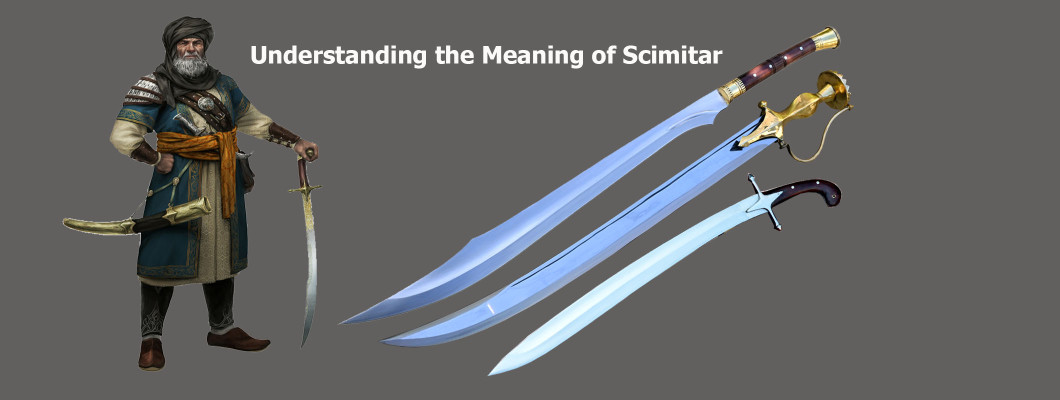
Scimitar Sword — History, Meaning, Types & Hand-Forged Blades
The scimitar is one of the most recognised swords in history — a curved, single-edged blade that shaped cavalry warfare across the Middle East, Persia, Central Asia, and North Africa for over a thousand years. Today it remains one of the most sought-after blades among collectors, martial artists, and history enthusiasts worldwide.
In this guide you will learn exactly what a scimitar is, where it came from, the main types and how they differ, and what makes a hand-forged scimitar worth owning today.
What Is a Scimitar Sword?
A scimitar is a curved, single-edged sword optimised for slashing — especially from horseback. Unlike straight European swords built for thrusting through armour, the scimitar's sweeping blade delivers fast, powerful cuts with minimal resistance. That design advantage made it the dominant cavalry weapon across the Islamic world from roughly the 9th century onward.
The word "scimitar" is not actually the name of one specific sword. It is a Western umbrella term — borrowed from the Italian scimitarra, itself derived from the Persian shamshir — used to describe a whole family of curved blades from different cultures. The Shamshir, Kilij, Talwar, and Saif are all scimitars, each shaped by the region and warriors that forged them.
What unites them is the curve. A scimitar blade angles forward, concentrating weight and cutting force toward the tip. In mounted combat, where a rider passes an opponent at speed, that geometry is devastating — far more effective than a straight blade that requires a direct thrust.
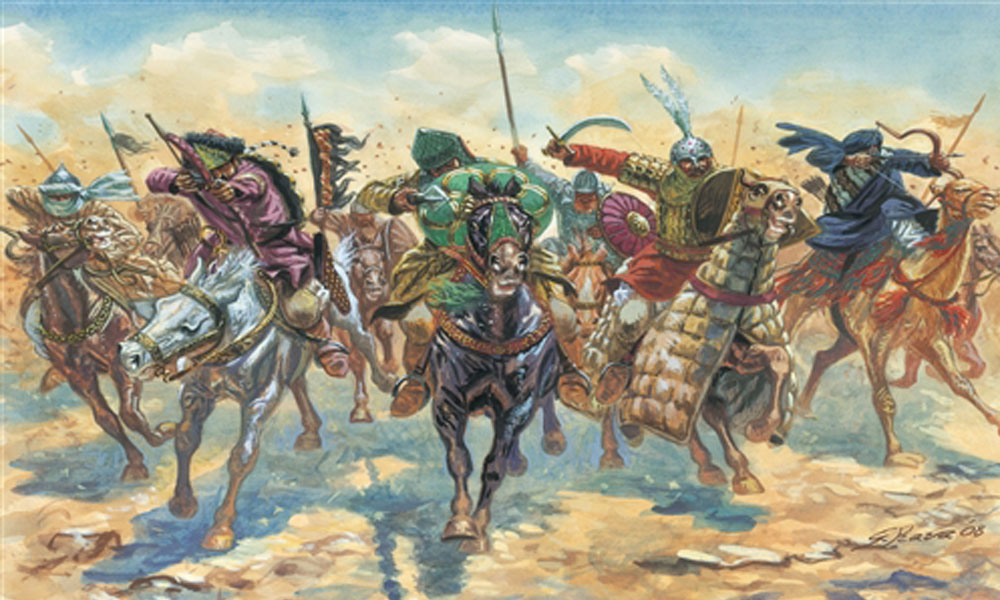
Historical depiction of a Middle Eastern warrior armed with a scimitar
Origin and Etymology of the Scimitar
The scimitar's origins trace back to ancient Persia, where the curved blade first proved its worth against the mounted nomads of the Central Asian steppes. Persian cavalry needed a weapon that could deliver a killing slash at full gallop without getting caught on armour or slowing the rider down. The curved blade solved that problem.
From Persia, the design travelled with trade, conquest, and cultural exchange — east into Central Asia, west into the Ottoman Empire, south into the Indian subcontinent, and across North Africa. Each region refined the blade to suit its own terrain, fighting style, and craftsmanship traditions. The result was a family of swords that share a philosophy but look and handle differently.
The word itself made a similar journey. Persian shamshir became Arabic saif in some regions, passed through Ottoman Turkish as kılıç, and eventually reached Europe as the Italian scimitarra — which English speakers shortened to scimitar. The word carried the weight of centuries of warfare and cultural exchange with it.
Types of Scimitar Swords
There is no single scimitar — there is a whole tradition. Here are the four most historically significant types, and what sets each one apart.
1. Shamshir — The Persian Scimitar
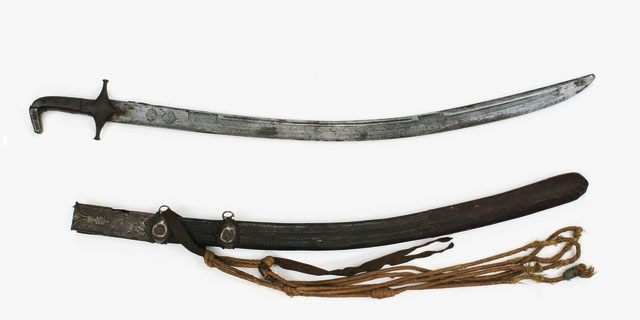
Antique Shamshir — the deeply curved Persian cavalry sword
The Shamshir is the archetypal scimitar — the blade most people picture when they hear the word. Originating in Persia (modern Iran), it features a dramatic, deep curve running almost the full length of the blade. The tip points nearly straight down, making it useless for thrusting but extraordinarily effective for draw-cutting from horseback.
Persian cavalry used the Shamshir as their primary weapon from around the 10th century. The blade's narrow profile and slim cross-section made it light and fast — a rider could slash, recover, and slash again before an opponent had time to react.
Beyond the battlefield, the Shamshir became a symbol of Persian identity. Master craftsmen adorned blades with gold inlay, Quranic inscriptions, and intricate etchings. The finest examples were gifts between rulers — objects of diplomatic power as much as military ones. Today, antique Shamshirs are among the most prized sword collectibles in the world.
2. Kilij — The Ottoman Scimitar
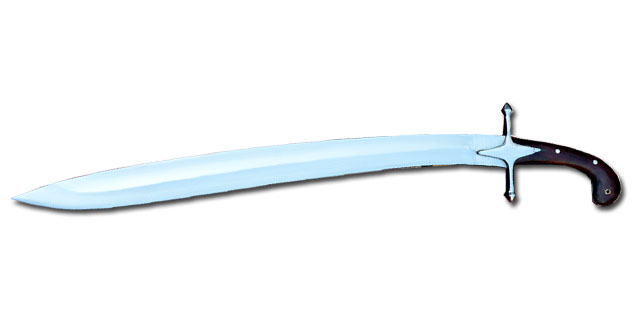
Kilij sword from our collection — note the distinctive flared yelman tip
Shop Our Scimitar CollectionThe Kilij was the sword of the Ottoman Empire — and the Ottoman Empire was one of the most powerful military forces in world history. The Kilij reflects that power in its design. Compared to the Shamshir, it has a broader blade with a distinctive flared section near the tip called the yelman. That extra width adds weight where it matters most, delivering heavier, more destructive cuts.
The T-shaped hilt gave riders a strong grip in full-gallop combat, and the slightly less extreme curve made it more versatile than the Shamshir — effective on foot as well as on horseback.
Ottoman sultans carried Kilijs as ceremonial swords at their coronation, and the blade became inseparable from the empire's identity. It was depicted in art, embedded in military insignia, and passed through generations as a mark of family honour. Its influence spread wherever the Ottoman Empire reached — from the Balkans to North Africa to the Arabian Peninsula.
3. Talwar — The Indian Scimitar
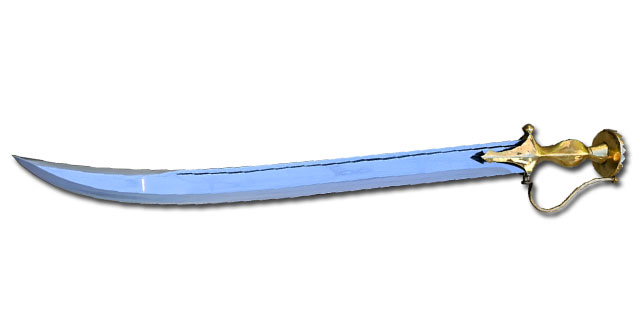
The Talwar is the South Asian answer to the scimitar — used across the Indian subcontinent by Hindu Rajput warriors, Mughal cavalry, and Sikh fighters alike. Its curve is less pronounced than the Shamshir, giving it greater versatility. It could slash effectively from horseback but also be used with precision by infantry on foot.
What distinguishes the Talwar most is its hilt. The disc-shaped pommel and wide crossguard were designed to prevent the hand from slipping forward onto the blade during a hard cut — a real danger with any curved sword. Many Talwars feature elaborately decorated hilts in brass, silver, or gold, reflecting the wealth and status of their owners.
The Talwar appears throughout Indian history and mythology. Rajput warriors were famously buried with their Talwars. Mughal emperors commissioned masterwork examples encrusted with jewels. In the Sikh tradition, the sword carries deep spiritual meaning as a symbol of justice and protection. It is one of the most culturally layered blades in the world.
4. Saif — The Arabian Scimitar
The Saif is the curved sword of the Arabian Peninsula and wider Islamic world. The word saif simply means "sword" in Arabic, but historically it refers to a curved, single-edged blade similar in profile to the Shamshir — though regional variations exist from Morocco to Oman.
Arabian Saifs were often elaborately decorated with gold and silver inlay, reflecting the artistry of Islamic metalworking traditions. Like other scimitar types, the Saif served both as a battlefield weapon and as a ceremonial object — carried by tribal leaders, displayed at celebrations, and gifted as marks of alliance and honour.
Why the Scimitar's Design Is a Masterpiece of Combat Engineering
The scimitar's curve is not an aesthetic choice — it is an engineering solution to a specific combat problem. Here is exactly why it works so well:
Draw-cutting efficiency. When a curved blade contacts a target, the cutting edge doesn't just push — it slides forward as it cuts, like a knife drawn back while pressing down. That slicing motion multiplies cutting power without requiring extra force from the wielder.
Reach from horseback. A mounted warrior swinging a curved blade extends his effective reach significantly. The tip of a scimitar travels further and faster than the tip of a straight sword of the same length, giving a cavalry rider a wider killing arc at full speed.
Weight distribution. The forward curve shifts mass toward the tip. That makes the blade feel balanced in hand but land heavier on target — the physics of a lever working in the warrior's favour.
Quick recovery. Because the blade follows a natural arc rather than a straight line, a skilled fighter can redirect a scimitar cut into a second strike faster than with most European swords. In fast cavalry combat, that speed was the difference between life and death.
Against armoured European knights, the scimitar's slashing style was less effective — which is why regions with heavily armoured infantry tended toward straighter, thicker blades. But in the open terrain of the Middle East, Central Asia, and North Africa, where mounted skirmishing dominated warfare, the scimitar's design was near-perfect.
The Scimitar as a Cultural Symbol
Across every culture that adopted it, the scimitar meant more than a weapon. It was carried by rulers as a symbol of legitimate authority. It appeared on royal seals, battle standards, and coinage. It was engraved with prayers, names, and poetry. It was the blade that heroes wielded in stories told for centuries.
In Islam, the sword holds particular spiritual significance — a symbol of justice, protection, and the duty to defend the faith. The scimitar became inseparable from that tradition, appearing in mosque architecture, calligraphic art, and religious ceremony. The crescent-and-sword motif, familiar from flags and emblems across the Muslim world, draws directly on that heritage.
In Persian poetry, the Shamshir appears as a metaphor for the lover's glance — sharp, curved, and impossible to resist. In Ottoman miniature painting, sultans are never depicted without their Kilij. In Indian epics, the Talwar is the weapon of gods and heroes.
Today that symbolism continues. The scimitar appears in films, video games, heraldry, and martial arts. Saudi Arabia features a scimitar on its national emblem. Oman's national symbol is two crossed Khanjar daggers — close cousins of the scimitar family. The blade's visual power has not faded.
Scimitar Craftsmanship — What Makes a Blade Worth Owning
Historic scimitars were judged by three things: the quality of the steel, the precision of the curve, and the artistry of the finish. The same standards apply today.
Steel. Traditional scimitars used wootz steel — a high-carbon crucible steel prized for its toughness and ability to hold a sharp edge. Modern hand-forged scimitars typically use 5160 high-carbon spring steel, which offers comparable toughness and edge retention with better consistency. It is the same steel used in truck leaf springs — forgiving under shock, hard enough to hold an edge, and resilient enough to flex rather than snap.
The curve. Getting the curve right requires skill that cannot be rushed. The blade must be hammered into shape gradually, with constant checking of the geometry, then ground to a consistent edge profile that follows the curve correctly. A poorly curved scimitar feels wrong in the hand and cuts inefficiently. A well-curved one feels natural and powerful.
Heat treatment. A scimitar blade that is too hard will be brittle — it will chip or snap under stress. Too soft and it will not hold an edge. Traditional smiths used differential hardening, quenching the edge harder than the spine, to get the best of both. Our blades are water-tempered using the same principle — a hard cutting edge backed by a tough, flexible spine.
The handle. A scimitar handle must allow a firm grip through a full swinging cut. Rosewood, buffalo horn, and wrapped leather are traditional choices — all durable, comfortable, and historically appropriate.
Own a Hand-Forged Scimitar — Made by Master Smiths in Nepal
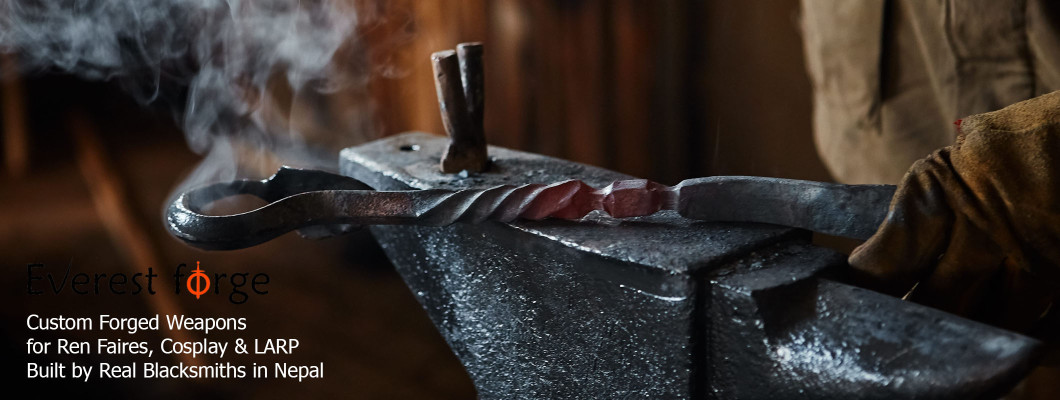
At Everest Forge, every scimitar we sell is individually hand-forged in Nepal by blacksmiths who have worked with blades their entire lives — some for over 30 years. We use 5160 high-carbon steel, water-tempered for toughness, and fit each blade with a rosewood or buffalo horn handle built to last. These are not decorative pieces — they are fully functional, sharpened swords built for collectors, martial artists, and anyone who wants a real blade with real history behind it.
Shop individual scimitar swords:
- 24" Scimitar Sword — the classic size, ideal balance of reach and control. Full tang, rosewood handle, leather scabbard.
- 24" Custom Forged Scimitar — hand-forged to order, personalised specifications available.
- 27" Scimitar Sword — longer reach, heavier cut, inspired by the Ottoman Kilij profile.
- 29" Long Custom Scimitar — maximum reach, battle-ready, full tang rosewood handle.
- 19" Arabian Scimitar Sword — inspired by legendary Middle Eastern cavalry blades.
- 21" Scimitar — Talwar Style — Indian-inspired design, 5160 steel, full tang rosewood handle.
- 27" Traditional Talwar Sword — authentic Indo-Nepalese sabre with full tang and rosewood handle.
- 18" Scimitar with D-Guard — leather-wrapped handle, full hand protection, battle-ready.
- D-Guard Scimitar Sword — compact and tactical, 5160 steel, rosewood D-guard handle.
Not sure which to choose? Browse the full scimitar collection → to compare all sizes, styles, and options in one place.
Want something made exactly to your specifications? We offer full custom scimitar forging — choose your blade length, curve, steel type, handle material, engravings, and scabbard style.
The Scimitar's Legacy in the Modern World
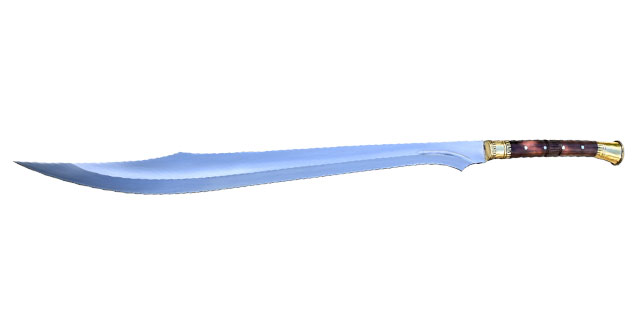
A modern hand-forged scimitar from Everest Forge — built on a thousand years of tradition
View the 29" Long Custom ScimitarThe scimitar never really left. It lives in historical reenactment communities where practitioners learn the mounted combat techniques it was built for. It lives in martial arts schools that study the flowing, draw-cutting style that defines curved blade fighting. It lives in the collections of thousands of people who appreciate the history, craftsmanship, and sheer beauty of a well-made curved blade.
It also lives in popular culture — from the scimitars in the Aladdin films to the curved blades carried by warriors across video games set in the Middle East or fantasy worlds inspired by it. The visual language of the scimitar is universal and immediately readable.
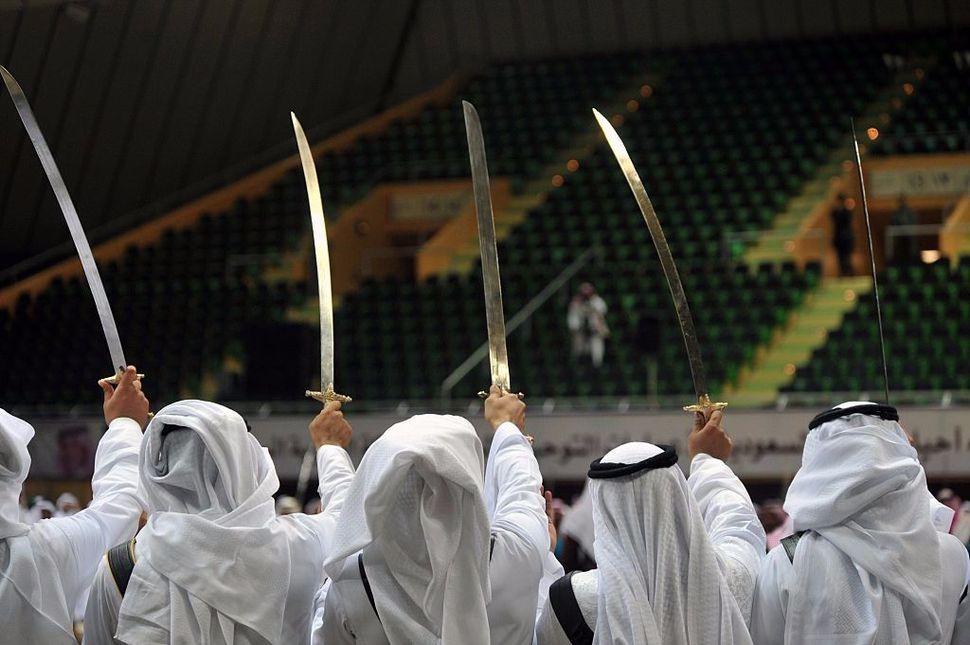
The scimitar remains a living symbol of identity and heritage across the Middle East and beyond
For collectors, the scimitar represents one of the most compelling categories in the entire world of edged weapons — a blade with a genuinely global history, extraordinary variety, and an aesthetic that is unlike anything else.
Frequently Asked Questions About Scimitar Swords
What is a scimitar sword?
A scimitar is a curved, single-edged sword designed for powerful slashing attacks, particularly from horseback. It originated in Persia and spread across the Middle East, Central Asia, South Asia, and North Africa, evolving into regional types including the Shamshir, Kilij, Talwar, and Saif.
Where did the scimitar originate?
The scimitar originated in ancient Persia, where the curved blade proved ideal for mounted cavalry warfare. From Persia, the design spread across the Islamic world through trade, conquest, and cultural exchange, giving rise to distinct regional variants over several centuries.
What are the main types of scimitar swords?
The four main types are the Persian Shamshir (deeply curved, slender), the Ottoman Kilij (broader blade with a flared yelman tip), the Indian Talwar (moderate curve, versatile for infantry and cavalry), and the Arabian Saif (similar profile to the Shamshir, common across the Arabian Peninsula and North Africa).
Why is the scimitar blade curved?
The curve allows for draw-cutting — as the blade contacts a target, the curved edge slides forward, multiplying cutting force without additional effort. This design also extends the rider's reach in mounted combat and allows for faster recovery between strikes compared to a straight blade.
Were scimitars used only in battle?
No. While the scimitar was a highly effective battlefield weapon, it also held deep ceremonial and symbolic value. Rulers carried scimitars as emblems of authority, craftsmen created elaborately decorated examples as diplomatic gifts, and the sword played a central role in religious ceremony and cultural identity across the Islamic world.
Are scimitars still made today?
Yes. Skilled blacksmiths continue to hand-forge scimitar swords for collectors, martial artists, historical reenactors, and enthusiasts. At Everest Forge, our scimitars are individually forged in Nepal using 5160 high-carbon steel and traditional techniques, then shipped worldwide.
What steel is used in a quality scimitar?
Traditional scimitars used wootz (Damascus) steel. Modern hand-forged scimitars typically use 5160 high-carbon spring steel, which offers excellent toughness, edge retention, and shock resistance — making it well-suited to the slashing demands of a curved blade.
How does a scimitar differ from a European sword?
European swords were generally straight and heavier, designed for thrusting through armour or delivering powerful hacking blows. The scimitar is curved, lighter, and optimised for fast, slashing cuts — especially in the open, mobile warfare of the Middle East and Central Asia. Each design reflects the combat environment it was built for.
Can I buy a hand-forged scimitar?
Yes. Everest Forge offers a full range of hand-forged scimitar swords — 16", 18", 19", 21", 24", 27", and 29" options — all made in Nepal and shipped worldwide. Browse the full scimitar collection here. For a custom-designed blade built to your exact specifications, visit our Custom Forge page.
Conclusion
The scimitar is more than a sword. It is a design solution refined over centuries by some of history's most capable warriors and craftsmen. It is a cultural symbol that carried the identity of empires. And it is one of the most beautiful blade forms ever created — a shape that has not needed to change in a thousand years because it was right from the beginning.
Whether you are drawn to the history, the craftsmanship, or simply the look of a great curved blade, the scimitar deserves a place in any serious collection.

Leave a Comment