
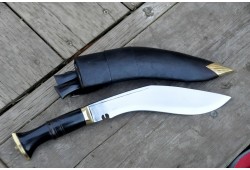
-250x170w.jpg "Official Issue BSI Service No.1 Kukri / Khukuri – British Gurkha Standard Issue")


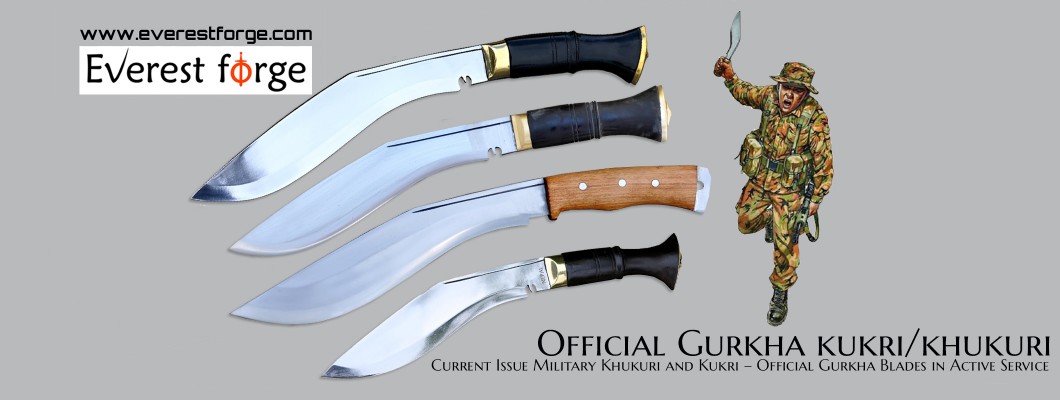
The Official Issue Kukri — Every Blade Carried by Every Gurkha, from Enlistment to Deployment
The kukri — also spelled khukuri — is the single blade that defines the Gurkha soldier. Not a sidearm. Not a backup. The primary edged weapon issued at enlistment, carried through training, deployed to combat, and retained through retirement. Every Gurkha who has served in the British Brigade of Gurkhas, the Nepalese Army, or the Nepal Police has carried an official-issue kukri forged to a specific pattern for a specific purpose.
At Everest Forge, we don't make generic "Gurkha-style" kukris. We forge the actual official-issue patterns — the same blade specifications carried by serving soldiers — hand-forged by Kami caste smiths in our workshop in Tokha-3, Kathmandu. Our forge has supplied the Nepalese Army and Nepal Police under contract. The BSI Service No.1 blade on our product pages is forged to the specification supplied under the 2008 British Gurkha Army contract.
This guide covers every current-issue military kukri pattern we forge — organised by the service and deployment that defines each blade. If you already know which pattern you want, browse the full Current Issue Military Kukri collection here.
The BSI Service No.1 Family — The Duty-Issue Blade of the British Brigade of Gurkhas
The Service No.1 is the foundational kukri of the British Brigade of Gurkhas. Every Gurkha soldier receives one at enlistment. It is the blade carried at parade, presented at inspection, and kept through the soldier's entire career. The specification — 10.5-inch polished 5160 high-carbon spring steel blade, water-tempered, with the differential hardness profile that defines Nepalese military kukri forging — has been the standard since the 1980s.
Everest Forge offers the most comprehensive Service No.1 range available from any single forge — seven configurations of the same 10.5-inch BSI blade, each serving a different role:
Standard BSI Service No.1 — buffalo horn handle, rat-tail tang, brown buffalo leather scabbard. The duty and parade issue, as carried since enlistment. The anchor of the family. ($94.99)
Service No.1 Gripper Handle — contoured buffalo horn with finger indexing, rat-tail tang. The working/duty variant preferred by long-service Gurkhas who want grip security without changing the blade. ($99.99)
Service Ceremonial Dress Knife — mirror-polished blade, patent leather scabbard, brass fittings. The formal-parade variant carried at ceremonial events, regimental dinners, and state occasions. ($99.99)
Service No.1 Peace Keeper — whitewood handle, white buffalo leather scabbard. The UN peacekeeping deployment variant, carried by Gurkha soldiers on international peacekeeping missions. ($94.99)
Service No.1 Camouflage Issue — whitewood handle, camouflage cotton scabbard. The field-operational patrol variant, designed to break the visual signature of the carry. ($94.99)
Service No.1 Yak Bone Handle — yak bone handle with white metal bolster. The Himalayan heritage premium variant. ($114.99)
Service No.1 Rosewood Working — full-tang rosewood with steel rivets. The working-construction variant for buyers who plan to use the kukri rather than display it. Same blade, upgraded handle construction. ($89.99)
All seven share the same 10.5-inch polished BSI blade specification. Every Service No.1 ships with Karda (small utility knife) and Chakmak (sharpener) — the traditional companion-tool complement that defines the duty-issue configuration. Free engraving is included on every blade — recruiting year, regiment marker, or name.
The Afghan Issue Family — Operation Enduring Freedom (AEOF) Deployment Kukri
When the Royal Gurkha Rifles deployed to Afghanistan as part of Operation Enduring Freedom, the kukri pattern they carried was re-evaluated in the field. The older Service No.1 polished blade was not optimised for the high-altitude, dust-heavy, dry-rock terrain of the Hindu Kush. The AEOF specification was the result: an 11-inch semi-polished blade with double fullers (Chirra) to lighten the blade without compromising chopping mass, and a finish that reduced dust adhesion and visual signature.
Everest Forge offers five configurations of the Afghan Issue — the most comprehensive AEOF range available from any single forge:
Canonical Afghan Issue Kukri — the reference page for the AEOF blade. Start here if you are researching the pattern. ($114.99)
Afghan Issue — White Sadha Wood (smooth handle) — the operational heritage variant. White scabbard, smooth handle. ($114.99)
Afghan Issue — Red Rosewood (smooth handle) — the heritage keepsake variant. Rosewood handle, red leather scabbard. ($114.99)
Afghan Issue — White Sadha Wood Gripper Handle — carved Sadha wood finger grooves, white scabbard. The tactical-operator's choice. ($124.99)
Afghan Issue — Red Rosewood Gripper Handle — rosewood gripper, red scabbard, lanyard hole. The heritage-finish tactical variant. ($119.99)
All five share the same 11-inch double-chirra blade. The smooth-handle variants are for heritage and display; the gripper-handle variants are for buyers who plan to actually swing the blade. The Red Rosewood Gripper is the only Afghan variant with a lanyard hole for wrist cord attachment.
The Iraqi / Op Telic Family — Operation Telic Deployment Kukri
The British Brigade of Gurkhas deployed to Iraq under Operation Telic — the British military operation name for the Iraq theatre, March 2003 to May 2011. Royal Gurkha Rifles, Queen's Gurkha Engineers, and Queen's Gurkha Signals served across multiple Telic rotations alongside Coalition forces, who operated under the American Operation Iraqi Freedom (OIF) name.
The blade pattern carried was the WWII-era Gurkha Angkhola — the deep-fullered, central-spine-reinforced profile originally used as a private-purchase carry blade during the Second World War, reintroduced for desert deployment because the weight-to-chop ratio was excellent for long operational carry. Most competing "Iraqi Freedom Kukri" listings from other Nepalese forges use the American operation name; the historically correct British name is Op Telic.
Everest Forge offers four Iraqi / Op Telic configurations:
Operational Iraqi Freedom Kukri — 11" Angkhola blade, smooth Panawal Sadha wood handle (no gripper, no guard), cream/desert scabbard. The heritage Op Telic carry pattern. ($119.99)
Iraqi Gripper — Sadha Wood / Standard Scabbard — 10" Angkhola with steel guard + carved gripper grooves, Sadha wood Panawal handle. The tactical-construction variant — the only Op Telic kukri with a forged steel cross-guard for hand protection. ($119.99)
Iraqi Gripper — Rosewood / Red Sheath — 10" Angkhola with steel guard + gripper, rosewood handle, red buffalo leather scabbard. The heritage-finish tactical variant. ($119.99)
Iraqi Camouflage Kukri — 10" Angkhola with steel guard + gripper, Sadha wood handle, camouflage cotton scabbard. The field-patrol variant for visual-signature concealment. ($124.99)
The smooth 11" Iraqi Freedom is the heritage carry pattern. The three 10" Gripper variants all carry a steel guard — a feature unique to the Op Telic family. No competing commercial Iraq-operation kukri from KHHI, EGKH, or any other Nepalese forge includes a guard. This is the differentiator that makes the Everest Forge Op Telic range unique in the market.
The Nepal-Issue Family — Nepalese Army and Nepal Police Service Blades
The Brigade of Gurkhas serves the British Crown. The Nepalese Army and Nepal Police serve the Nepalese state. The blades are different — shorter, lighter, tuned for the specific operational requirements of the Nepalese services. Everest Forge has supplied kukris to both the Nepalese Army and Nepal Police under contract, and the blade patterns on our product pages are forged to those same specifications.
Official Issue Nepal Army Kukri — 9" polished 5160 blade, horn handle, rat-tail tang. The duty-issue blade supplied to soldiers of the Nepalese Army. Includes Karda and Chakmak. ($89.99)
Official Issue Nepal Police Kukri — 9" blade, full tang, rosewood handle, cross-pommel insignia. The Nepal Police service blade with the distinctive cross emblem. ($84.99)
Nepal Army Ranger Kukri — 9" polished 5160 blade, full-tang rosewood handle. The working-construction variant of the Nepal Army duty blade — same role to the duty issue that the Rosewood Working Service No.1 plays to the standard BSI. ($99.99)
The Nepal Army duty issue and the Ranger share the same 9-inch blade. The difference is handle construction: the duty issue uses rat-tail tang with horn (traditional, lighter, for ceremonial and standard carry); the Ranger uses full-tang rosewood (stronger, heavier, for hard working use). Many Nepalese Army veterans buy both as a matched display-and-use pair.
The Training Issue — Jungle PRI Kukri
The Jungle PRI Kukri is the working and training counterpart to the polished Service No.1. Where the Service No.1 is the parade blade, the Jungle PRI is the blade that gets beaten in the field — jungle training, field exercises, and hard combat deployment. Unpolished 10.25-inch blade, horn handle, built to take abuse without concern for cosmetic finish. ($89.99)
The Jungle PRI is the blade a Gurkha soldier uses when the job is more important than the inspection. It pairs naturally with the Service No.1 as the working-and-display complement — many Brigade veterans own both.
How to Choose — Which Official Issue Kukri Is Right for You
With 21 products across five families, choosing the right official-issue kukri depends on your use case, your connection to a specific deployment or regiment, and whether you intend to display or use the blade.
For display, commemoration, and heritage: Start with the Standard BSI Service No.1. It is the single most recognised Gurkha kukri in the world — the blade every Gurkha soldier receives at enlistment, polished, horn handle, brown leather scabbard. If you are buying one kukri to represent the Gurkha tradition, this is the one.
For actual field use and hard working: Choose a full-tang rosewood or gripper variant. The Iraqi Gripper with steel guard is the safest option for buyers new to kukri handling. For experienced users, the Afghan Issue White Gripper is the tactical-operator's choice at the AEOF 11-inch blade length.
For a specific deployment connection: Match the blade to the operation. BSI Service No.1 for general Brigade service. Afghan Issue for Operation Enduring Freedom (Afghanistan). Iraqi Freedom or Iraqi Gripper for Operation Telic (Iraq). Nepal Army duty issue or Ranger for Nepalese Army service. Nepal Police for Nepal Police service.
For building a complete Brigade collection: The three-blade deployment set covers the modern Brigade combat-carry record: Service No.1 (duty issue) + Afghan Issue AEOF (Afghanistan) + Iraqi Freedom or Gripper (Iraq, Op Telic). Add the Jungle PRI for the training counterpart and the Nepal Army duty issue for the Nepalese national-service connection, and you have the most comprehensive modern Gurkha blade collection possible from a single forge.
For gift-giving and presentation: The Service Ceremonial Dress Knife (mirror-polished, patent leather scabbard) or the Afghan Issue Red Rosewood Gripper (heritage finish, striking red scabbard) photograph and display most impressively.
Every Official Issue Kukri — Free Engraving, DDP Shipping, Forge Maker's Warranty
Every official-issue kukri from Everest Forge ships with three things that no marketplace listing or competing forge matches:
Free personalisation on every blade. Engrave a recruiting year, regiment marker, deployment year, name, or dedication. Up to ~30 characters. Free on every order — not an upsell, not "on request." Common requests include traditional Brigade recruiting-year format ("2008 / UK", "1995 / NEPAL"), regiment markers ("RGR" Royal Gurkha Rifles, "QGE" Queen's Gurkha Engineers, "QOGLR" Queen's Own Gurkha Logistic Regiment), Op Telic deployment markers ("IRQ 2007", "TELIC 5"), and names in English or Nepali Devanagari script.
DDP worldwide shipping via DHL Express / FedEx. Duties and taxes paid upfront. You pay one price; nothing more on arrival. Tracked door-to-door, typically 10–14 days from order to delivery. Shipped to 26 countries with no customs issues to date in countries where blade ownership is legal.
30-day refund guarantee + photo approval before dispatch. We photograph your finished khukuri — including the engraving — and send the images for your sign-off before shipping. If anything looks off, we re-forge. Full replacement or refund if the blade fails in normal use or arrives damaged.
Frequently Asked Questions
What is an official issue kukri?
An official issue kukri is the standard military knife provided to a Gurkha soldier upon enlistment or issued for a specific deployment. It is not a decorative replica — it is a functional, battle-ready blade forged to military specifications for combat, survival, and everyday field tasks. Different services (British Brigade of Gurkhas, Nepalese Army, Nepal Police) and different deployments (Afghanistan, Iraq) have their own issue patterns.
How many official issue kukri patterns does Everest Forge offer?
We currently offer 21 official-issue kukri configurations across five families: the BSI Service No.1 family (7 variants), the Afghan Issue AEOF family (5 variants), the Iraqi / Op Telic family (4 variants), the Nepal-Issue family (3 products — Nepal Army duty, Nepal Police, Nepal Army Ranger), and the Jungle PRI Training Issue (1 product). All 21 share the same forge, the same Kami caste smiths, and the same 5160 high-carbon spring steel.
What is the difference between the Service No.1 and the Afghan Issue?
The Service No.1 is the duty-issue blade carried from enlistment — 10.5-inch polished blade, typically horn handle, rat-tail tang. It is the parade and ceremonial blade. The Afghan Issue (AEOF) is the deployment-specific blade for Operation Enduring Freedom — 11-inch semi-polished blade with double chirra fullers, designed for the dust-heavy terrain of the Hindu Kush. Different blade length, different finish, different deployment context. A Gurkha soldier may carry both — Service No.1 for duty, Afghan Issue for deployment.
What is Op Telic and why do you use that name for the Iraqi kukris?
Operation Telic is the British military operation name for the Iraq deployment, March 2003 to May 2011. The Brigade of Gurkhas served under that operational name — Royal Gurkha Rifles, Queen's Gurkha Engineers, Queen's Gurkha Signals among them. The American operation name for the same theatre was Operation Iraqi Freedom (OIF). Most competing "Iraqi Freedom Kukri" listings from other Nepalese forges use the American name; we use Op Telic because it is the correct British Brigade-of-Gurkhas operational name. Veterans of the deployment know the difference.
What is the steel guard on the Iraqi Gripper kukris?
The Iraqi Gripper family (Sadha Wood, Rosewood Red Sheath, and Camouflage variants) includes a forged steel cross-guard between the blade and handle. The guard physically stops the hand from sliding forward onto the cutting edge during heavy use. No other official-issue kukri family — and no competing commercial Iraq-operation kukri from other Nepalese forges — includes a guard. It is the most actively hand-protective kukri configuration in the entire Everest Forge range.
What is the difference between a gripper handle and a smooth handle?
A smooth handle is the traditional Nepalese kukri grip — unfingered, historically correct, well-suited to parade, display, and light use. A gripper handle has carved finger grooves cut into the wood by hand, locking the hand into a consistent grip position and preventing rotation under sweat, oil, or rain. Both the Afghan Issue and Iraqi Gripper families offer gripper variants for buyers who plan to use the kukri for sustained chopping work.
What steel are the blades made from?
All Everest Forge official-issue kukris are forged from 5160 high-carbon spring steel — the same alloy family historically used for vehicle leaf springs and military-grade chopping blades. Water-tempered for traditional Nepalese differential hardness: edge 58–60 HRC for cutting performance, belly 45–46 HRC, spine 22–25 HRC for shock absorption. This is harder than many commodity kukris from larger production forges, which typically run 55–57 HRC at the edge.
Do all kukris include Karda and Chakmak?
Most do. The BSI Service No.1 family, the Afghan Issue family, the Iraqi Gripper family, the Nepal Police, and the Nepal Army duty issue all ship with Karda (small utility knife) and Chakmak (sharpener). The Nepal Army Ranger is the exception — it ships as a blade-only working configuration without Karda or Chakmak. If you want the Nepal Army blade with the side-tool complement, choose the duty-issue variant.
Can I get any kukri engraved?
Yes. Free engraving is included on every blade across the entire current-issue range — not an upsell, not "on request." Up to approximately 30 characters. Common requests include recruiting year and country, regiment marker, deployment year, service span, and name in English or Nepali Devanagari script.
Who forges these kukris?
Every official-issue kukri in our range is hand-forged by Kami caste smiths in our workshop in Tokha-3, Kathmandu, Nepal. The Kami are the hereditary blacksmith caste of Nepal, forging kukris for Gurkha soldiers since the regiment's founding in 1815. Our forge has supplied the Nepalese Army and Nepal Police under contract, and the BSI Service No.1 blade is forged to the specification supplied under the 2008 British Gurkha Army contract.
How are the kukris shipped?
All shipments are DDP (Delivered Duty Paid) via DHL Express or FedEx International Priority with full tracking. Duties and taxes are paid upfront — nothing to pay on arrival. Forging time is 5–7 days; shipping is typically 5–9 business days. Total order-to-door is approximately 10–14 days.
Which kukri should I buy first?
If you want the single most recognised Gurkha kukri in the world, start with the Standard BSI Service No.1 — the blade every Gurkha soldier receives at enlistment. If you want a working blade for actual field use, the Iraqi Gripper with steel guard is the safest choice for buyers new to kukri handling. If you want a deployment-specific commemorative piece, match the blade to the operation: Afghan Issue for Afghanistan, Iraqi Freedom or Gripper for Iraq (Op Telic), Nepal Army for Nepalese service.
This guide covers the official-issue kukri patterns currently forged by Everest Forge. For historical replica kukris (WWII MK1, MK2, MK3, Sirupate, and older regimental patterns), see our Historical Replica Kukri collection. For working and bushcraft kukris not based on military-issue patterns, see our Working Khukuri collection. For the complete kukri reference, see our Complete Kukri Guide.
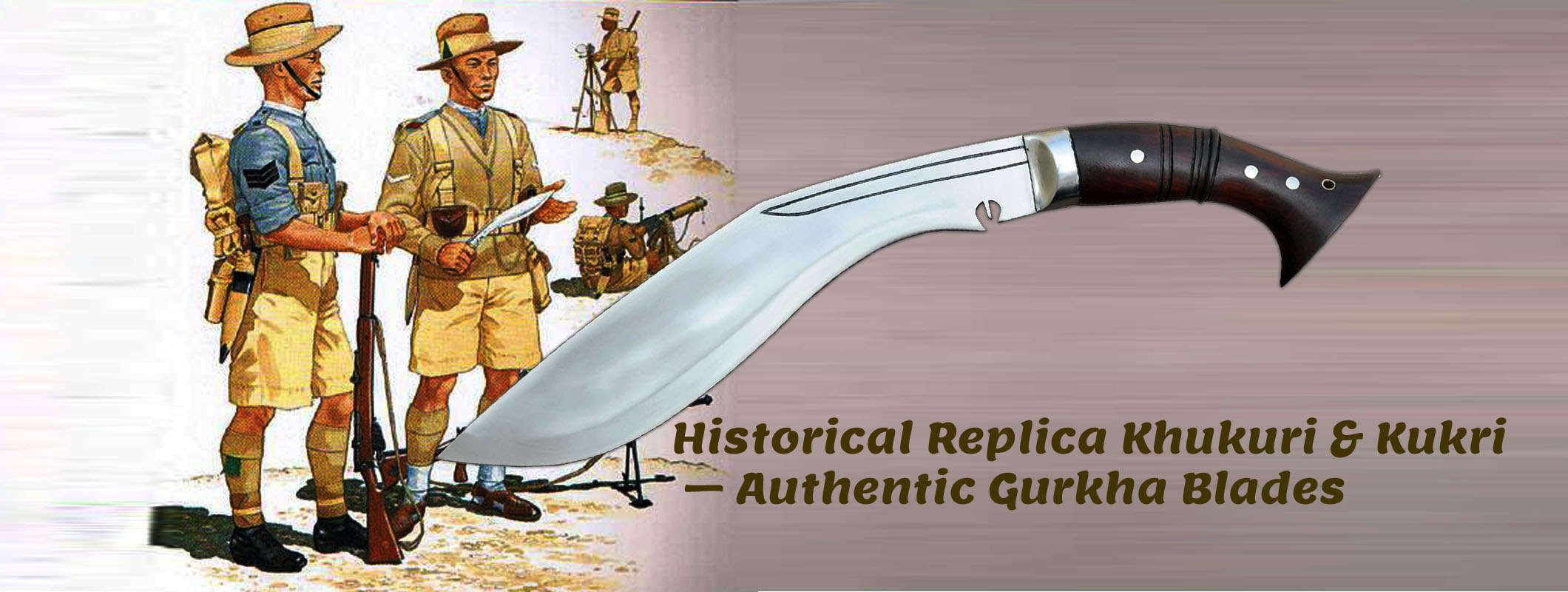
Read next: Historical Kukri & Khukuri Replicas — The Blades That Built the Legend →
Leave a Comment