
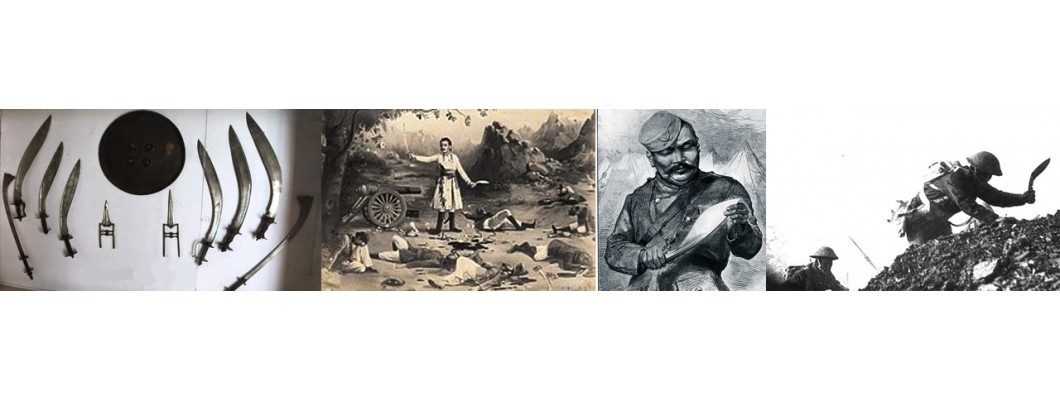
The Kukri in Service: A Gurkha Military History
The kukri (Nepali: khukuri) is the longest-serving frontline military blade in the modern era. It was carried by Gurkha soldiers at the Treaty of Sugauli in 1816, on the Western Front in 1914, through the jungles of Burma in 1944, across the Falklands in 1982, and remains the standard-issue personal blade of every Gurkha soldier serving in the British Army today. No other knife has stayed in continuous frontline military service across more than two centuries and the better part of every major modern conflict.
This is the kukri's military history — campaign by campaign, blade by blade, from the Anglo-Nepalese War to the current BSI 2008 Service No. 1 specification. Each historical period evolved its own kukri pattern, and many of those patterns are still hand-forged in Kathmandu today as faithful collector replicas. For the broader cultural and origin history of the kukri before military service, see our origin of the kukri reference. For the current-issue military blade itself, see our current-issue military kukri collection.
Before the British: The Household Kukri of Nepal's Hill People
The kukri did not begin as a military blade. Before British recruitment of Gurkha soldiers in the 19th century, the kukri was the everyday working tool of Nepali hill households — used for everything from chopping firewood to harvesting crops to ritual sacrifice during Dashain. The blade's military reputation came later. Its working use is older by centuries.
The kukri's design lineage traces back through Indian regional blades to the ancient Greek kopis — a forward-curved chopping sword that travelled to South Asia with Alexander the Great's armies in the 4th century BC. The kopis design evolved across the subcontinent over the following millennium, eventually becoming the kukri shape that has been continuously made in Nepal for over 2,500 years. By the time the British encountered the kukri in 1814, it was already an ancient and refined working tool — the British did not invent the kukri; they recruited the men who already carried it. See our blog on curved blades — kukri, talwar, scimitar, and khopesh for the broader design lineage, and the kopis sword collection for the ancient Greek blade that started the lineage.
The kukri pattern most associated with this pre-military household and farming use is the Chainpure Farmer Khukuri — the village working kukri carried by Nepali hill farmers for centuries, balanced for chopping and slicing rather than for ceremonial or combat use. It is the pattern that introduces most Nepali users to the kukri in childhood, and the pattern that connects every modern Nepali household to the deeper agricultural tradition behind the blade.
Chainpure Farmer Khukuri
The traditional village-pattern Nepali working kukri — the kind of blade Nepali hill farmers carried for centuries before British recruitment. Hand-forged from 5160 high-carbon spring steel with water-buffalo horn handle and hand-stitched leather scabbard. $114.99
1814–1816: The Anglo-Nepalese War and the Gurkha Bargain
The kukri entered global military history through a war Nepal arguably lost. Between 1814 and 1816, the British East India Company fought a series of campaigns against the Kingdom of Nepal over disputed border territory in the foothills of the Himalayas. The Nepali forces — much smaller in numbers and outgunned in artillery — fought the British to a strategic standstill across difficult mountain terrain. Battles like Kalanga, Jaithak, and Malaun left British commanders with deep respect for Nepali soldiers carrying the kukri.
The war ended with the Treaty of Sugauli in 1816. Nepal ceded territory and accepted British political influence, but a unique clause emerged from the British admiration for their opponents: the Company was permitted to recruit Nepali soldiers into its own military service. The first Gurkha recruits joined the East India Company's army within months of the treaty. They brought their kukris with them. The blade has been in continuous British military service ever since — over 200 unbroken years.
This is the founding moment of every later chapter in the kukri's military story. Every Mark I, WWI, WWII, Falklands, and modern Service No. 1 blade traces back to the Treaty of Sugauli and the bargain it produced.
1857: The Indian Rebellion and the Gurkha Reputation
The Indian Rebellion of 1857 — variously called the Sepoy Mutiny or India's First War of Independence depending on perspective — was the conflict in which the Gurkhas first demonstrated, on a global stage, the quality of soldiering the British had bargained for in 1816. Gurkha regiments served alongside British forces throughout the rebellion, and their performance cemented the Gurkha reputation that would carry through every subsequent campaign. The kukri was the symbol of that performance — the personal blade every Gurkha carried, and the visible marker of who was Gurkha and who was not.
By the end of the 19th century, the British Army formally adopted standardised Gurkha kukri specifications. Before this point, kukris had been individually procured in Nepal or carried from home; after this point, the kukri became a regulated military blade with documented patterns and quality requirements. The Mark I pattern, introduced in 1903, was the first product of this standardisation.
1903: The Mark I — First Official British Military Pattern
The Mark I (MKI) kukri was the first officially-specified British Indian Army Gurkha service kukri, formalised in 1903. It established the standard from which every later British military kukri descends: 13-inch blade, water-buffalo horn handle, hand-stitched water-buffalo leather scabbard, traditional Nepali workshop forging. The Mark I was the kukri carried by Gurkha soldiers through the campaigns of the early 20th century — and into WWI in 1914.
For collectors of British military history, the Mark I is the foundational reference pattern. Owning a hand-forged Mark I replica is owning a piece of the documented specification that started British Gurkha kukri standardisation.
13" MKI Mark I Kukri — Historical Replica
Hand-forged reproduction of the original 1903 British Indian Army Mark I Gurkha service pattern. 13-inch blade in 5160 high-carbon spring steel, water-tempered, water-buffalo horn handle, hand-stitched water-buffalo leather scabbard with karda and chakmak. $139.99
1914–1918: The Kukri on the Western Front
Gurkha regiments served in significant numbers throughout the First World War — on the Western Front in France and Flanders, at Gallipoli, in Mesopotamia (modern Iraq), in Egypt, and in Palestine. Every Gurkha soldier carried his kukri through every campaign. The blade saw active service in trench warfare, in the difficult conditions of the Mesopotamian campaign, and across the various Middle Eastern fronts.
The WWI-era kukri pattern was a refinement of the Mark I — generally a 10–13 inch blade, similar overall specification, with regional variations between batches sourced from different Nepali workshops. Two patterns are particularly associated with WWI Gurkha service:
The WWI Gurkha Angkhola Kukri — featuring the single fuller (groove) along the blade that defines the Angkhola pattern — was widely carried by Gurkha soldiers throughout the war. The fuller reduced overall blade weight without compromising strength, an advantage for soldiers carrying heavy field kits over long distances. Surviving WWI Angkhola kukris in collections today document the pattern in detail.
13" Gurkha Angkhola Kukri — WWI Issue Replica
Hand-forged reproduction of the WWI-era Gurkha Angkhola pattern. 13-inch blade with single fuller, 5160 high-carbon spring steel, water-tempered edge, water-buffalo horn handle, traditional leather scabbard. $154.99
For collectors wanting a more compact WWI-era pattern, the 10-inch Historical Kukri reproduces the smaller-blade WWI variants carried by some units. The shorter blade was favoured by soldiers prioritising portability and ease of handling in trench conditions.
10" Historical Kukri — WWI Gurkha Reproduction
Hand-forged 10-inch WWI Gurkha kukri reproduction — the compact-blade variant favoured by soldiers prioritising portability. 5160 spring steel, water-buffalo horn handle, traditional leather scabbard. $139.99
Interwar Period: The Chirra Pattern and Mark II
The two decades between the World Wars saw further refinement of the British Gurkha service kukri. The Mark II (MKII) pattern formalised additional specifications around the late 1920s, and the Chirra (multi-fullered) pattern gained wider military use during this period. The Chirra design — featuring two or three fullers along the blade rather than the single Angkhola fuller — reduced weight further while preserving the structural rigidity Gurkha soldiers needed for sustained field use.
The 15-inch 2-Chirra MKI Issue Kukri represents this pattern — a longer-bladed Mark I variant with the two-fuller Chirra configuration that combines the increased blade reach favoured for some service contexts with the reduced weight of multi-fuller construction. Surviving examples document the pattern's use through the interwar period and into WWII.
15" 2-Chirra MKI Issue Kukri — Hand-Forged Replica
Hand-forged 15-inch 2-Chirra Mark I issue kukri reproduction — extended blade length with double-fuller construction for reduced weight. 5160 high-carbon spring steel, water-buffalo horn handle, traditional leather scabbard. $164.99
1939–1945: Burma, Italy, North Africa, and the WWII Kukri
The Second World War was the kukri's most extensive deployment. Gurkha regiments served across every major Allied theatre — North Africa, Italy, Greece, the Middle East, and most famously in Burma, where the 14th Army's campaign against Japanese forces relied heavily on Gurkha units operating in jungle and mountain conditions. Every Gurkha soldier carried his kukri through every campaign. The blade became one of the most documented military knives of the war, photographed extensively in regimental records and surviving in collections worldwide.
The WWII-era Gurkha kukri pattern continued the broad specification of the Mark I and Mark II patterns, with most WWII-issue blades in the 12–13 inch range. The 12-inch WWII Issue Kukri reproduces the most common WWII service pattern — the blade length that most photographic and museum evidence shows in active service across the Burma campaign and the European theatres. The hand-forged construction, 5160 spring steel, water-buffalo horn handle, and hand-stitched leather scabbard reproduce the specification documented in surviving WWII-era examples.
12" WWII Issue Kukri — Hand-Forged Historical Replica
Hand-forged reproduction of the WWII-era Gurkha service kukri. 12-inch blade in 5160 high-carbon spring steel, water-tempered, water-buffalo horn handle, hand-stitched leather scabbard with karda and chakmak. The pattern most associated with Gurkha service through the Burma campaign and the European theatres. $139.99
Among the most famous Gurkha actions of the Second World War were the campaigns in Italy (Monte Cassino, the Gothic Line), in Greece, and across the entirety of the Burma campaign — where Gurkha units served with the 14th Army under Field Marshal Slim. The Burma campaign is particularly associated in popular memory with Gurkha kukri service, partly because of the difficult terrain that suited Gurkha mountain-soldier capabilities and partly because of extensive wartime reporting that documented Gurkha units in detail.
1945–1982: From Imperial Service to British Brigade of Gurkhas
The end of WWII and the independence of India in 1947 split the historical Gurkha forces between the British Brigade of Gurkhas (transferred to direct British service) and the Indian Army's Gorkha Regiments (continuing in independent India's military). Both armies retained the kukri as standard service kit; both continued recruiting from Nepal under treaty arrangements; both continued the regimental tradition of presenting the kukri to every new recruit. The post-war Gurkha service kukri continued through Malaya, Borneo, Cyprus, and various other British post-imperial deployments.
Throughout this period the kukri specification continued to evolve in small ways — handle materials, scabbard construction details, the karda and chakmak companion blades — but the essential 10.5 to 13 inch blade in water-tempered 5160 spring steel remained the constant. The Brigade of Gurkhas and the Indian Gorkha Regiments both retained their distinctive crossed-kukris regimental emblem, worn on cap badges, shoulder flashes, and unit colours.
1982: The Falklands and the Kukri in the Modern Era
The Falklands War in 1982 was the conflict that brought the Gurkha kukri back into international public consciousness. The 1st Battalion, 7th Duke of Edinburgh's Own Gurkha Rifles served in the British task force that retook the Falkland Islands from Argentine forces, deployed alongside other British units and seeing combat across the difficult ground of East Falkland. The Gurkha kukri received extensive media coverage during and after the campaign — partly because of contemporary press fascination with the regimental tradition, and partly because the conflict was the first major Gurkha deployment that British and global audiences saw closely covered in modern media.
The Falklands period kukri was essentially the established late-20th-century service pattern: a 10.5–11 inch blade, water-buffalo horn handle, hand-stitched leather scabbard with karda and chakmak, hand-forged in Kathmandu workshops contracted to British Ministry of Defence specifications. This pattern remained essentially stable through the post-Falklands period and into the current 2008 specification.
2008–Present: The Service No. 1 (BSI 2008)
In 2008, the British Ministry of Defence formalised the current Gurkha service kukri under the BSI Service No. 1 specification. The Service No. 1 is the kukri carried by every Gurkha soldier currently serving in the British Brigade of Gurkhas. The specification standardises a 10.5-inch blade in 5160 high-carbon spring steel, water-tempered cutting edge, water-buffalo horn handle, hand-stitched water-buffalo leather scabbard with karda and chakmak. The forging is contracted to traditional Nepali workshops — Everest Forge has been one of the workshops supplying blades to this specification.
The Service No. 1 represents the convergence of over two centuries of Gurkha service experience into a single documented blade. Every refinement from Mark I through WWI, WWII, Falklands, and the post-imperial period has informed the current specification. For civilian collectors wanting the current British military pattern, the Service No. 1 is available from us to the same specification supplied to the regiment.
Current Issue Military Kukri Collection
The BSI Service No. 1 specification — the kukri currently issued to every serving Gurkha soldier in the British Brigade of Gurkhas. Hand-forged in Kathmandu by Kami-caste smiths to the same specification supplied to the regiment.
Collecting Gurkha Military Kukri Replicas Today
Hand-forged historical replica kukris occupy a distinctive niche in the world of military collectibles. Unlike most antique military arms — which are scarce, expensive, and often non-functional — Gurkha kukri historical replicas are still being made today by the same workshops, in the same way, using the same materials as their historical originals. Owning a hand-forged Mark I, WWI Angkhola, or WWII Issue replica is owning a working blade that reproduces the documented specification of its period, not a sanitised modern interpretation.
What to look for in an authentic historical replica kukri:
- Hand-forged construction. Mass-produced "replicas" stamped from sheet steel by machine miss the entire point. Authentic replicas are hammered into shape by Kami-caste smiths working at traditional Nepali forges.
- 5160 high-carbon spring steel. The actual military specification — not stainless, not unspecified "carbon steel" of unknown grade.
- Water-tempered cutting edge. The differential temper that makes the kukri's edge hard while keeping the spine soft. Should be visible as a faint temper line along the blade.
- Water-buffalo horn handle. The traditional military handle material — not plastic, not modern composite.
- Hand-stitched water-buffalo leather scabbard with karda and chakmak. Every authentic Gurkha military kukri ships with the two small companion blades in scabbard pockets.
- The cho (kaudi) notch. Every authentic Nepali kukri carries the distinctive notch at the base of the cutting edge — the marker of genuine Nepali workmanship.
- Period-appropriate specifications. Mark I = 13 inch blade. WWI Angkhola = 13 inch blade with single fuller. WWII = typically 12 inch blade. 2-Chirra MKI = 15 inch blade with double fuller. The blade length should match the historical pattern claimed.
For the full Everest Forge battle-ready testing standard that every blade we ship passes, see our battle-ready standard page. For our complete craftsmanship process, see our craftsmanship page.
Continue Learning About the Kukri
- Origin of the Kukri — The pre-military history: ancient origins, the kopis lineage, the 2,500-year design evolution.
- Honor of the Kukri — The cultural and ceremonial meaning of the blade in Nepali tradition.
- Kukri (Khukuri) Guide — Complete buyer's reference for patterns, construction, and military heritage.
- How a Kukri Is Forged — Inside our Kathmandu workshop.
- Kukri Terminology Guide — Every part, pattern, and term explained.
- Kukri Handling Guide — Safe drawing, grips, carry positions.
- Kukri Maintenance Guide — Sharpening, oiling, scabbard care.
- The Kukri: A Buyer's Introduction — Discovery-stage introduction for newer readers.
Frequently Asked Questions
How long has the kukri been in military service?
The kukri has been in continuous British military service since 1816, when the Treaty of Sugauli ending the Anglo-Nepalese War permitted the British East India Company to recruit Nepali soldiers — the original Gurkhas. The blade is older than that as a Nepali household and household-defence tool; archaeological evidence suggests the design has been in continuous Nepali use for over 2,500 years. As a frontline military service blade, the kukri's 200-plus years of unbroken issue make it the longest-serving knife in modern military history.
When was the Mark I kukri introduced?
The Mark I (MKI) pattern was formalised in 1903 as the first officially-specified British Indian Army Gurkha service kukri. It established the standard 13-inch blade, water-buffalo horn handle, and hand-stitched leather scabbard configuration that every later British military kukri pattern descends from. Before the Mark I, kukris were individually procured in Nepal rather than centrally specified; after 1903, the kukri became a regulated military blade with documented specifications and quality requirements.
What kukri did Gurkha soldiers carry in WWI?
WWI-era Gurkha kukris were variations of the Mark I pattern formalised in 1903 — generally 10 to 13 inch blades, with regional variations between batches sourced from different Nepali workshops. Two patterns are particularly associated with WWI service: the WWI Gurkha Angkhola (13-inch blade with single fuller along the spine, reducing weight) and the 10-inch compact variant favoured by soldiers prioritising portability in trench conditions. Both patterns are widely documented in surviving wartime examples and museum collections.
What kukri did Gurkha soldiers carry in WWII?
WWII-era Gurkha kukris continued the broad Mark I and Mark II specifications, with most issue blades in the 12 to 13 inch range, water-buffalo horn handles, and hand-stitched leather scabbards. The 12-inch blade is the pattern most commonly associated with WWII service in photographic records, museum examples, and surviving regimental documentation — the blade carried through the Burma campaign, the Italian theatre, North Africa, and the various other Allied fronts where Gurkha regiments served.
What is the difference between Mark I, WWI, and WWII kukris?
The Mark I (1903) was the foundational pattern — 13-inch blade, the first formal British specification. The WWI service kukri was effectively a Mark I or Mark I variant in service through 1914-1918, including the Angkhola (single-fuller) and compact 10-inch variants. The WWII service kukri (1939-1945) was typically 12 inches — slightly shorter than the original Mark I — reflecting incremental refinement through the interwar period and the Mark II specification updates. All three share the same essential construction: hand-forged Nepali workshop production, water-tempered 5160 (or period-equivalent) high-carbon steel, water-buffalo horn handles, traditional leather scabbards.
What is the Service No. 1 kukri?
The Service No. 1 is the current British Army Gurkha service kukri, specified under BSI 2008. It is issued to every serving soldier in the British Brigade of Gurkhas during basic training and accompanies the soldier through their entire career. The specification: 10.5-inch blade in 5160 high-carbon spring steel, water-tempered cutting edge, water-buffalo horn handle, hand-stitched water-buffalo leather scabbard with karda and chakmak. The forging is contracted to traditional Nepali workshops. Everest Forge has been one of the workshops supplying blades to this specification. See our current-issue military kukri collection.
Did Gurkhas use the kukri in the Falklands War?
Yes. The 1st Battalion, 7th Duke of Edinburgh's Own Gurkha Rifles served in the British task force that retook the Falkland Islands in 1982. Every soldier carried the standard late-20th-century Gurkha service kukri — a 10.5 to 11 inch blade, water-buffalo horn handle, hand-stitched leather scabbard. The Falklands War is often credited with bringing the kukri back into international public consciousness, as it was the first major Gurkha deployment that received extensive modern media coverage.
What is the Chirra pattern kukri?
The Chirra pattern is a kukri with multiple fullers (grooves) along the blade — typically two or three fullers, sometimes more. The fullers reduce blade weight without compromising structural rigidity, producing a lighter blade that retains chopping geometry. The Chirra pattern gained wider military use during the interwar period (1918-1939) and continued into WWII service. The 2-Chirra MKI Issue kukri represents this pattern in 15-inch military configuration, combining the increased reach favoured for some service contexts with reduced weight through double-fuller construction. See our Chirra fullered kukri collection.
Are historical replica kukris functional or display-only?
Functional. Hand-forged Gurkha historical replica kukris are made from the same 5160 high-carbon spring steel, by the same Kami-caste smiths, using the same techniques as their historical originals. They are working blades that happen to reproduce documented historical specifications — not display reproductions that look like the original but cannot be used. A hand-forged WWII Issue replica can chop firewood as effectively as a WWII Issue kukri did in 1944. Most collectors display rather than use them, but the option is there.
What is the crossed-kukris regimental emblem?
The crossed-kukris is two kukris crossed at the blade with points outward, forming an X-shape. It is the central regimental symbol of the British Army's Brigade of Gurkhas and of multiple Gorkha regiments in the Indian Army, dating to the 19th century. The emblem appears on cap badges, shoulder flashes, regimental colours, and unit headquarters insignia. It is one of the most recognisable military regimental symbols globally and is the visual shorthand for "Gurkha" in any military or civilian context.
Has the kukri always been associated with the Gurkhas?
No. The kukri was a Nepali working tool and household blade for centuries before any Gurkha military association existed. The Gurkha connection began in 1816 with the Treaty of Sugauli — over 2,000 years after the kukri shape first emerged in the Nepali highlands. The blade's long association with the Gurkhas reflects 200 years of military service, but the kukri's broader Nepali history is much older. See our origin of the kukri reference for the full pre-military history.
Where can I buy an authentic hand-forged Gurkha kukri replica?
Everest Forge produces hand-forged historical replicas of every major Gurkha military pattern — Mark I, WWI Angkhola, 10-inch WWI compact, 12-inch WWII Issue, 15-inch 2-Chirra MKI, Chainpure Farmer, and the current Service No. 1. Each blade is hand-forged in Kathmandu by Kami-caste smiths using the same 5160 high-carbon spring steel, water-tempering process, and traditional construction methods as the original historical patterns. Photo approval before shipping. 30-day refund guarantee. DDP shipping with all duties included. See our historical replica kukri collection.
Own a piece of Gurkha military history
Every Everest Forge historical replica kukri is hand-forged in Kathmandu by Kami-caste blacksmiths to documented period specifications. Mark I (1903), WWI Angkhola, WWII Issue, 2-Chirra MKI, Chainpure Farmer, and current Service No. 1. Photo approval before shipping. 30-day refund guarantee. DDP shipping with all duties included.
Browse all historical replica kukris → Current-issue military kukris → Ceremonial Kothimora →

Leave a Comment