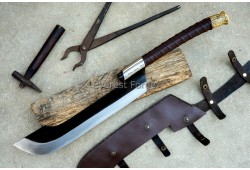
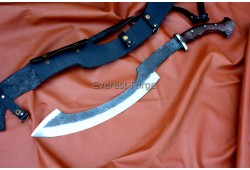
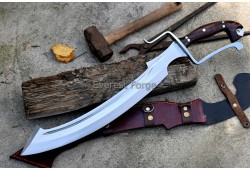
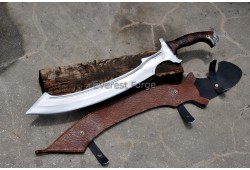
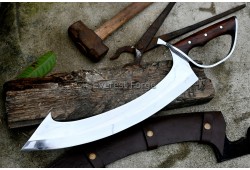
-250x170w.jpg "Egyptian Khopesh Sword — Hand-Forged Sickle-Sword, 5160 Spring Steel, Rosewood & Leather-Wrapped Handle, Customizable")
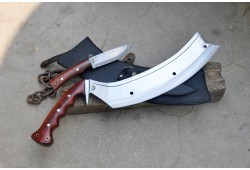

Khopesh Sword vs Shotel Sword: Ancient Curved Blades Difference
The Khopesh and the Shotel are two of the most fascinating curved swords in world history. They come from completely different civilizations, serve very different combat roles, and demonstrate how ancient weapon makers solved battlefield challenges using innovative blade geometry. Although both weapons share a curved silhouette, their design philosophy, cultural importance, and real-world functionality are drastically different.
1. Origin and Cultural Importance
Khopesh (Egypt):
The Khopesh emerged in Ancient Egypt around 2500–2000 BCE, at a time when Egyptian armies were transitioning from simple axes to more sophisticated weapons.
Its unique sickle-like curve likely evolved from battle axes, retaining the chopping power but adding greater versatility.
More than just a weapon, the Khopesh became a royal symbol of authority—Pharaohs such as Ramses II are often depicted wielding one in temple carvings, demonstrating its importance in both warfare and ceremony.
Shotel (Ethiopia):
The Shotel originated much later, around 900–1000 CE, in the powerful Aksumite and Ethiopian empires.
It was a practical battlefield weapon used by elite warriors trained to face enemies equipped with large shields.
The Shotel’s deep, dramatic curve was specifically designed to counter shield walls—a common military formation across Africa and the Middle East.
While the Khopesh was often ceremonial, the Shotel remained a dedicated war blade.
2. Blade Shape and Geometry
Khopesh:
The Khopesh features a forward-curving crescent shape, almost like a hybrid between a sword and a sickle.
The cutting edge lies on the outer curve, giving it tremendous chopping and hooking strength.
This geometry allowed Egyptian soldiers to manipulate shields, grab limbs, or deliver heavy blows that penetrated light armor.
Most Khopesh blades are short, compact, and weight-forward, making them perfect for chariot combat where swift, powerful strikes were essential.
Shotel:
The Shotel has one of the most extreme and unique curves of any sword in history.
Its elongated S-shape or question-mark profile gives it exceptional reach, allowing the user to thrust around or behind shields with surprising accuracy.
Unlike the Khopesh, which focuses on power, the Shotel’s geometry is optimized for precision, angle manipulation, and bypassing defenses.
Its slim, flexible profile also made it effective against mounted opponents.
3. Combat Role and Technique

Khopesh Techniques:
Egyptian soldiers used the Khopesh primarily for:
- Powerful chopping strikes
- Hooking shields or weapons
- Pulling opponents off balance
- Close-range slashing
- Disarming movements
Shotel Techniques:
Ethiopian warriors used the Shotel for:
- Reaching behind or around shields
- Stabbing through defensive gaps
- Hooking enemies or limbs
- Attacking mounted opponents
- Striking from unusual angles
4. Materials and Construction
Khopesh:
Early Khopesh weapons were cast from bronze and later crafted from iron. Many ceremonial versions were heavily decorated, and some were cast in a single piece including the handle.
Shotel:
Shotels were forged from iron and later high-carbon steel. Their full tang construction, paired with wooden or horn handles, ensured strength during thrusting and hooking strikes.
5. Fighting Distance and Handling
Khopesh:
Short, weight-forward, ideal for close combat, chariot fighting, and powerful chopping blows.
Shotel:
Longer reach, spear-like thrusting ability, ideal for bypassing shields and attacking from distance.
6. Overall Performance Comparison Table
| Feature | Khopesh | Shotel |
|---|---|---|
| Origin | Ancient Egypt (2500–2000 BCE) | Ethiopian Empire (900–1000 CE) |
| Blade Length | 18–24 inches | 30–40 inches |
| Blade Shape | Sickle-shaped forward curve | Deep double curve (S-shaped) |
| Primary Combat Style | Chopping, slashing, hooking | Shield bypass thrusting |
| Best Use Against | Light infantry, unarmored targets | Shielded infantry, cavalry |
| Ease of Use | Simple and intuitive | Requires expert technique |
| Construction | Bronze/Iron, sometimes ceremonial | Iron/Steel, full-tang battlefield blade |
The Khopesh and the Shotel represent two completely different approaches to curved sword design. The Khopesh is a powerful, axe-like Egyptian weapon built for slashing and hooking at close range, while the Shotel is a long, deeply curved Ethiopian blade engineered to bypass shields and strike from unexpected angles.
Both swords are masterpieces of ancient weaponsmithing and continue to fascinate collectors, historians, and martial artists today.
Frequently Asked Questions
1. Which sword is older, the Khopesh or the Shotel?
The Khopesh is much older, dating back to around 2500–2000 BCE in Ancient Egypt. The Shotel emerged around 900–1000 CE in Ethiopia.
2. What was the main advantage of the Shotel?
The Shotel’s deep curve allowed warriors to reach around shields, stab from unusual angles, and strike protected opponents.
3. Was the Khopesh mainly ceremonial?
The Khopesh was both a functional battlefield weapon and a ceremonial symbol of royal authority, especially for Pharaohs.
4. Which sword has more reach?
The Shotel has significantly more reach due to its long, deeply curved blade.
5. Are Khopesh and Shotel swords still made today?
Modern replicas are forged by specialized smiths and companies such as Everest Forge , often using high-carbon steel for functional performance.