The Jian Sword – China’s Legendary Double-Edged Blade
The Jian sword stands as one of the most graceful and spiritually rich weapons in human history. Known as the “Gentleman of Weapons,” the Jian has symbolized wisdom, balance, and nobility in Chinese culture for over two thousand years. Its straight, double-edged blade distinguishes it from the curved Dao sword, representing precision and harmony over raw power. For centuries, the Jian sword has embodied the perfect union between martial skill and philosophical depth.
Origins of the Jian Sword
The Jian sword dates back to ancient China, with examples discovered from the Spring and Autumn Period (770–476 BCE) and the Warring States Period (475–221 BCE). These early Jian were cast from bronze and carried by nobles and warriors as symbols of status and honor. As Chinese metallurgy advanced during the Qin and Han Dynasties, blacksmiths began forging Jian from iron and steel, creating stronger and sharper blades that transformed this elegant weapon into an enduring martial icon.
By the Tang and Song Dynasties, the Jian was no longer just a battlefield weapon — it had become a symbol of virtue and refinement. Scholars, monks, and warriors alike studied its movements, seeing in the Jian not only a weapon but also a path to self-discipline and inner peace.

The Meaning Behind the Jian Sword
In Chinese tradition, the Jian sword is called Junzi Zhi Bing (君子之兵), meaning “The Sword of the Gentleman.” It embodies restraint, righteousness, and clarity of thought. Its two sharpened edges symbolize yin and yang — the cosmic balance of opposites that defines Taoist philosophy.
To master the Jian sword was to master oneself. It demanded calm focus, controlled breath, and graceful precision. Wielding it required intellect and awareness rather than brute strength. That’s why the Jian became the weapon of philosophers, sages, and heroes who valued wisdom above violence.
Design and Structure of the Jian Sword
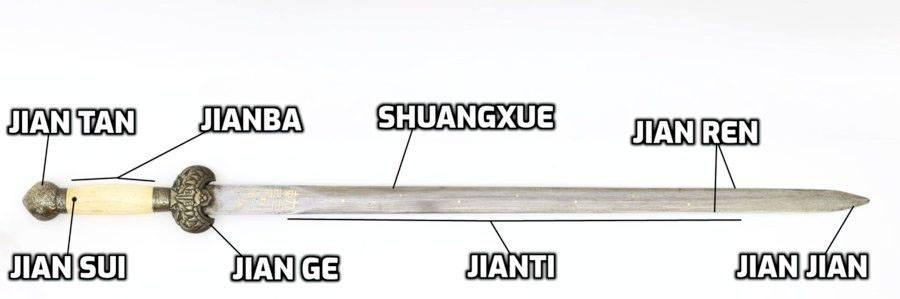
The Jian sword is a masterpiece of symmetry. Typically between 70 and 80 centimeters (28–32 inches) in blade length and weighing less than 1.2 kilograms, it’s perfectly balanced for swift, flowing movement. Every part of the Jian contributes to its harmony of form and function:
Jian Sword: Parts and Functions
1. Jian Tan (劍鞘) – Pommel
The pommel at the end of the handle helps balance the sword and secure the tang. It can also be used as a striking point in close combat. Jian pommels are often decorated and made of metal.
2. Jian Sui (劍穗) – Tassel
The tassel attached to the pommel serves both decorative and functional purposes. In traditional swordsmanship, it helps with balance and indicates the sword’s motion during practice or performance.
3. Jian Ba (劍把) – Handle / Grip
The handle or grip is where the sword is held. It is usually made of wood, wrapped in silk, leather, or cord for comfort and control. The tang runs through it to provide strength.
4. Jian Ge (劍格) – Guard / Crosspiece
The guard protects the wielder’s hand from sliding onto the blade and from an opponent’s strikes. Jian guards are typically small and elegant, unlike the larger guards on European swords.
5. Jianti (劍體) – Blade
The blade is the main body of the sword, running from the guard to the tip. Jian blades are double-edged, straight, and taper gradually toward the tip for both cutting and thrusting.
6. Shuangxue (雙血) – Fullers / Blood Grooves
These are the grooves that run along the blade’s flat sides. Their purpose is to reduce weight while maintaining strength and flexibility. They also help channel fluids away when cutting.
7. Jian Ren (劍刃) – Cutting Edge
The edges of the Jian are sharpened on both sides, allowing the sword to cut in both directions. The blade’s geometry gives it excellent balance and precision.
8. Jian Jian (劍尖) – Tip / Point
The tip is the sharpened end of the blade designed for thrusting and piercing. It is usually symmetrical and finely tapered, making the Jian effective in both slashing and stabbing attacks.
Forging the Jian Sword
Forging a Jian sword is an act of artistry and devotion. Early smiths began with bronze, but as technology advanced, they mastered iron and steel. By the Han Dynasty, blades were forged using differential hardening and layered folding — techniques that produced edges both strong and flexible.
The sword-making center of Longquan became famous for crafting exceptional Jian swords. Smiths there folded and hammered steel hundreds of times, removing impurities and producing the beautiful “watered” pattern seen on fine blades. Each Jian was individually heat-treated, polished, and balanced by hand. To the smiths, creating a Jian was a spiritual act — they believed the sword carried the energy and intention of its maker.
Martial Arts and Jian Swordsmanship
The Jian sword is revered in Chinese martial arts for its elegance and precision. Unlike heavier weapons, it relies on fluid, controlled motion. Every strike flows into the next like a continuous breath. In combat, the Jian is used for cutting, thrusting, deflecting, and redirecting energy rather than meeting force with force.

There are several famous styles of Jian practice:
• Tai Chi Jian (Taijijian): Emphasizes balance, awareness, and energy flow. Each movement is graceful yet purposeful.
• Wudang Jian: Rooted in Taoist internal martial arts, combining breath control and circular motion.
• Shaolin Jian: A more direct, combat-oriented approach practiced by warrior monks, known for speed and precision.
In all traditions, training with the Jian sword cultivates patience and mindfulness. To master it is to understand that the sword is not a tool of destruction, but a mirror of one’s inner state.
The Jian Sword in Chinese Mythology
The Jian sword holds a sacred place in Chinese mythology. Stories tell of legendary swords forged by master smiths such as Gan Jiang and Mo Ye, whose devotion and sacrifice infused their creations with spirit. The divine sword of the Yellow Emperor, Xuanyuan Jian, was said to command the forces of heaven and earth, symbolizing justice and moral authority.

In Taoist tradition, the Jian also serves as a spiritual instrument used in rituals to repel negativity and summon clarity. Its blade symbolizes truth cutting through illusion — a weapon not of violence, but of enlightenment.
Artistry and Aesthetics
Every Jian sword tells a story. Some are simple and functional, while others are elaborately decorated with jade fittings, gold inlays, or engraved dragons. The best examples achieve perfect balance between art and utility. The Jian is admired not for brutality, but for its calm precision — a reflection of the mind that wields it.
Its elegance has inspired artists, poets, and modern bladesmiths worldwide. Even today, craftsmen continue to replicate ancient Jian using traditional methods, preserving the same sense of harmony and craftsmanship that defined their ancestors’ work.
The Jian Sword Today
In the modern world, the Jian sword remains a powerful cultural symbol. It is practiced in Tai Chi and Wushu, displayed in museums, and collected by enthusiasts who value both its function and philosophy. Modern forges in China, Nepal, and around the world still produce hand-forged Jian blades, keeping this ancient tradition alive.
For martial artists, the Jian continues to serve as a bridge between body and spirit. For collectors, it represents the height of craftsmanship — a piece of living history that carries thousands of years of wisdom within its blade.
Legacy of the Jian Sword

The Jian sword is more than a weapon — it is a teacher. It teaches control, humility, and focus. It reminds its wielder that strength must always be guided by wisdom. This timeless blade captures the essence of Chinese philosophy: balance between opposites, mastery through harmony.
Over two millennia since its creation, the Jian sword remains a masterpiece of design and spirit — a living symbol of China’s cultural and martial legacy, and one of the most revered swords in human history.
Jian Sword from Everest Forge
The Jian Sword, often called the “Gentleman of Weapons,” is a traditional Chinese double-edged straight sword revered for its balance, precision, and elegance. This 28-inch hand-forged Jian pays homage to centuries of martial heritage, symbolizing wisdom, courage, and honor. Designed for both collectors and practitioners, it offers perfect harmony between artistry and functionality.
Each Jian is meticulously hand-forged from 5160 high carbon spring steel and oil-tempered to achieve exceptional strength, flexibility, and edge retention. The sharpened blade provides smooth handling and balanced weight for both display and real practice. The polished rosewood handle complements the long, graceful blade, and the handmade leather scabbard ensures safe storage and an authentic appearance.

Specifications
Blade Length: 28 inches
Handle Length: 10 inches
Total Length: 38 inches
Blade Weight: Approx. 1.4 kg
Blade Material: 5160 High Carbon Spring Steel
Heat Treatment: Oil-Tempered for Strength and Flexibility
Edge: Sharpened and Ready to Use
Handle Material: Rosewood
Scabbard: Handmade Leather Scabbard Included
Type: Jian Sword / Chinese Straight Sword / Double-Edged Blade
Origin: Hand-Forged by Everest Forge, Nepal
Note:
Each Jian Sword is individually hand-forged, ensuring that no two pieces are exactly the same. Minor variations in shape, finish, and balance reflect its authentic handmade nature. Custom handle designs and engraving options are available upon request.
For those seeking a personalized touch, a custom Jian sword can be crafted to your specifications through our Custom Forge service.
Conclusion
The Jian sword represents far more than ancient weaponry — it is the living soul of Chinese civilization. Every line of its blade, every polished surface, and every subtle movement speaks of harmony between art and discipline. At Everest Forge, we honor that legacy through blades that are not only beautiful to behold but forged to perform. Whether you are a martial artist, a collector, or simply a lover of history, the Jian stands as a reminder that true strength lies in balance, wisdom, and mastery of the self.
Frequently Asked Questions (FAQ)
1. What is a Jian sword used for?
The Jian sword was traditionally used for both combat and martial arts training. In modern times, it is practiced in Tai Chi and Wushu as a weapon of balance, focus, and meditation. It is also a prized collector’s item for its elegance and craftsmanship.
2. What makes the Jian sword different from the Dao?
The Dao is a single-edged, curved saber primarily designed for cutting and slashing, while the Jian is a straight, double-edged sword ideal for precision thrusts and quick defensive movements. The Jian demands more control and finesse.
3. How is the Jian sword forged at Everest Forge?
Each Jian sword at Everest Forge is hand-forged from 5160 high carbon spring steel, oil-tempered for flexibility and edge strength. Every blade is shaped, balanced, and sharpened by skilled smiths to ensure exceptional performance and durability.
4. Can I order a custom Jian sword?
Yes. Everest Forge offers complete customization options for Jian swords, including blade length, handle design, engraving, and materials. You can create your own unique sword through our Custom Forge service.
5. Is the Jian sword functional or decorative?
All Jian swords produced by Everest Forge are fully functional and oil-tempered for real use. They are suitable for martial arts practice, stage performance, or display, combining authenticity with practical durability.