Inspired by one of the blades below? Everest Forge hand-forges movie sword replicas from 5160 spring steel in Kathmandu, Nepal — and we forge custom film blades from your own reference. Request a custom film blade.
Cinema has given us some of the most recognisable blades in modern storytelling. A sword in a film is rarely just a weapon — it carries a character, a moment, a piece of the world it belongs to. The blade Aragorn lifts from the ashes of his ancestors does not feel the same as the curved Egyptian sword carried by the Medjai, or the elven spear wielded by Prince Nuada in the closing fight of Hellboy II. Each one is shaped by its film, and each one stays with the audience long after the credits roll.
This is a round-up of ten of the most iconic movie swords in modern film — what they look like, where they came from, and why they have endured as some of the most loved blades in cinema. From Tolkien's Middle-earth to the post-apocalyptic landscape of The Book of Eli, these are the swords that audiences ask about, search for, and never forget.
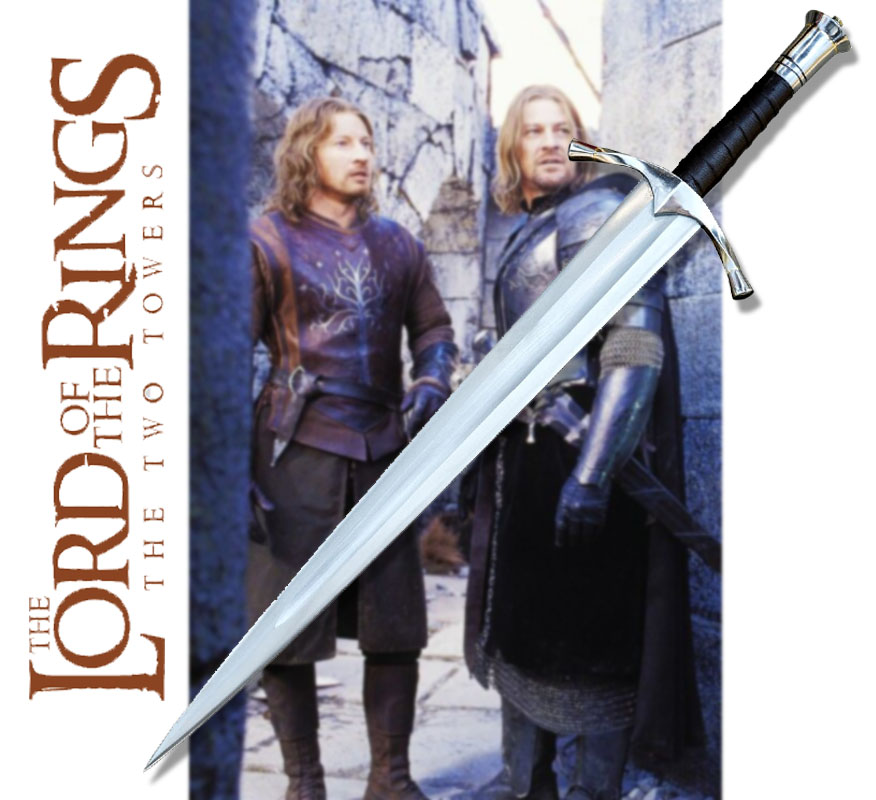
1. Sword of Boromir — The Lord of the Rings
Boromir's sword is one of the most quietly powerful blades in The Lord of the Rings trilogy. Carried by the eldest son of Denethor, Steward of Gondor, it is a leaf-shaped, double-edged arming sword built for both slashing and thrusting. The crossguard curves gently toward the blade — a small detail that gives the weapon both elegance and aggression, mirroring Boromir's own dual nature as a noble warrior weighed down by the burden of Gondor's failing strength.
Historically, the design draws from the European arming swords of the 12th and 13th centuries — balanced, symmetrical, practical, and worthy of a knight. When Boromir falls defending Merry and Pippin from the Uruk-hai at Amon Hen, his sword becomes a symbol of redemption: a blade that began as a sign of pride and ended as a sign of sacrifice.
2. The Barrow-Blades — Sam, Merry & Pippin Swords
Discovered by chance in the misty hills of the Barrow-downs, the three Barrow-blades carried by Sam, Merry, and Pippin are among the most quietly significant weapons in all of The Lord of the Rings. Forged in long-vanished Westernesse for the wars against the Witch-king of Angmar, these blades are small enough to serve as swords for hobbits — yet enchanted with a power capable of unmaking the dark spells that protect the Nazgûl.
Merry's blade earns the most famous moment of the three: at the Battle of Pelennor Fields, his strike breaks the binding on the Witch-king and allows Éowyn to deliver the killing blow. The blade reduces to ash from the energy released — Tolkien's quiet message that the smallest hands can carry the greatest power.
Sam's blade wounds Shelob in the Pass of Cirith Ungol. Pippin's, raised in the courtyard of Minas Tirith, marks his transformation from a careless hobbit into a knight of Gondor.
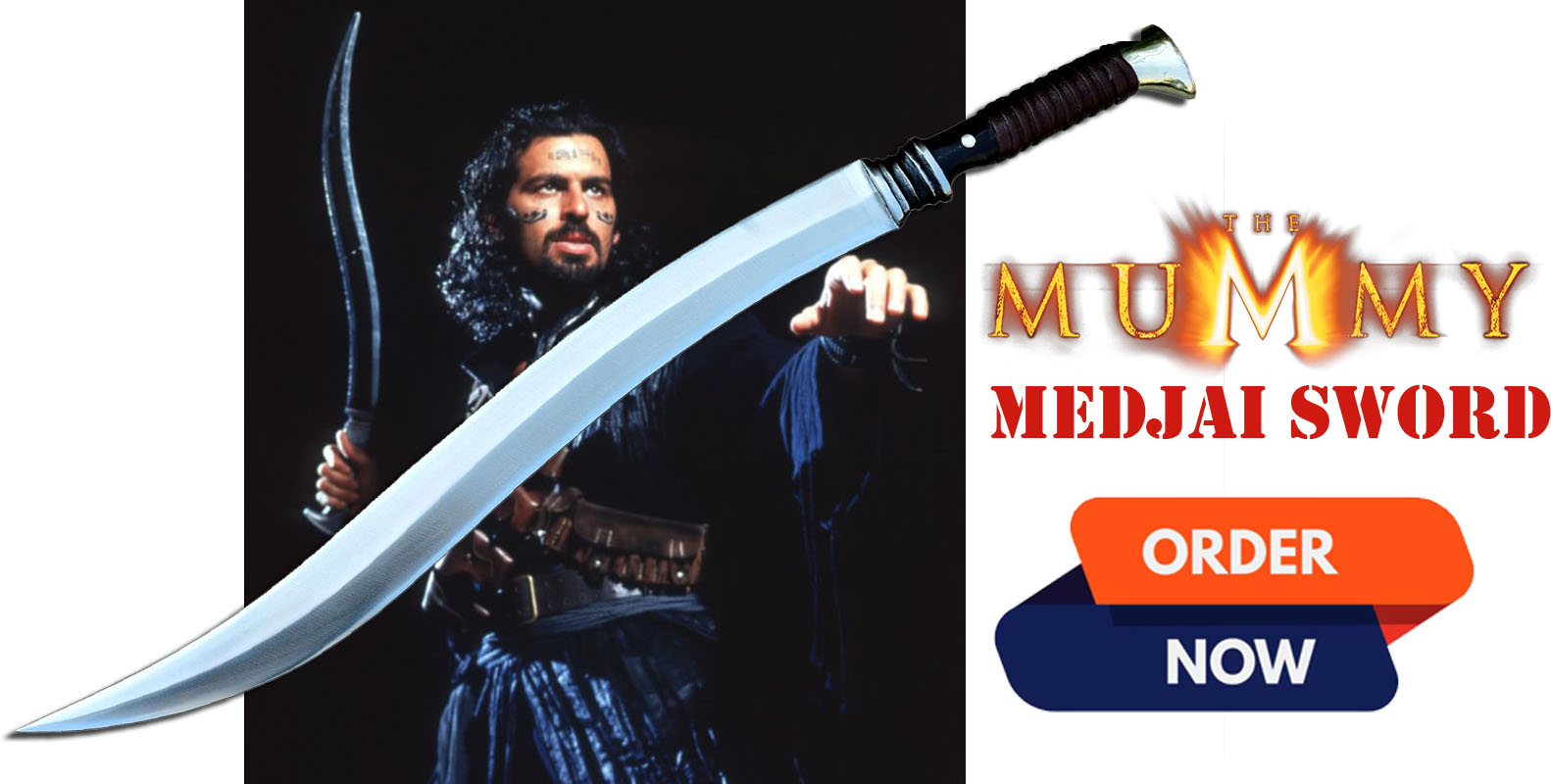
3. Medjai Sword — The Mummy
The curved blade carried by Ardeth Bay and the Medjai warriors in Stephen Sommers' The Mummy (1999) is one of cinema's most recognisable Egyptian-inspired weapons. Its design draws directly from the historical khopesh — the sickle-sword of the New Kingdom pharaohs, used for both warfare and ceremonial purpose between roughly 1550 and 1300 BC.
On screen, the Medjai sword is a guardian's weapon. The descendants of the Pharaoh's bodyguards have spent three thousand years protecting the world from what lies beneath Hamunaptra. The curved profile, the hieroglyph-style detailing, and the broad belly of the blade all signal that this is not a knight's sword — it is a desert blade, shaped by sun, sand, and millennia of duty.
4. Prince Nuada's Spear — Hellboy II: The Golden Army
Guillermo del Toro's Hellboy II: The Golden Army (2008) gave us one of the most distinctive bladed weapons in modern fantasy film. Prince Nuada's spear is short, fast, and used as much like a staff as a thrown weapon — perfectly suited to the prince's swift, flowing fighting style. The leather-wrapped rosewood handle and the slim, elven-style spearhead mark it as a weapon of an old, fading royal line: graceful, lethal, and deliberately archaic.
Del Toro's design language across the film leans heavily on a fusion of Celtic and East Asian motifs, and the spear is no exception. It belongs to a world where elves once ruled the earth and where memory of that rule is preserved in carefully chosen objects. The spear is one of those objects.

5. Killmonger's Sword — Black Panther
Erik Killmonger's blades from Ryan Coogler's Black Panther (2018) are some of the most thoughtfully designed weapons in the Marvel Cinematic Universe. The film's costume and prop design team, led by Ruth Carter and Hannah Beachler, drew from a wide range of African weapon traditions — Maasai, Zulu, Tuareg, and others — and fused them with Wakandan vibranium aesthetics.
Killmonger's sword reads as both ancestral and futuristic at once. The blade geometry is rooted in real African forging traditions, but the surface treatment, the panel work, and the handle design all signal vibranium technology. The result is a weapon that visually anchors Killmonger's character: a man caught between two worlds, claiming both and belonging fully to neither.
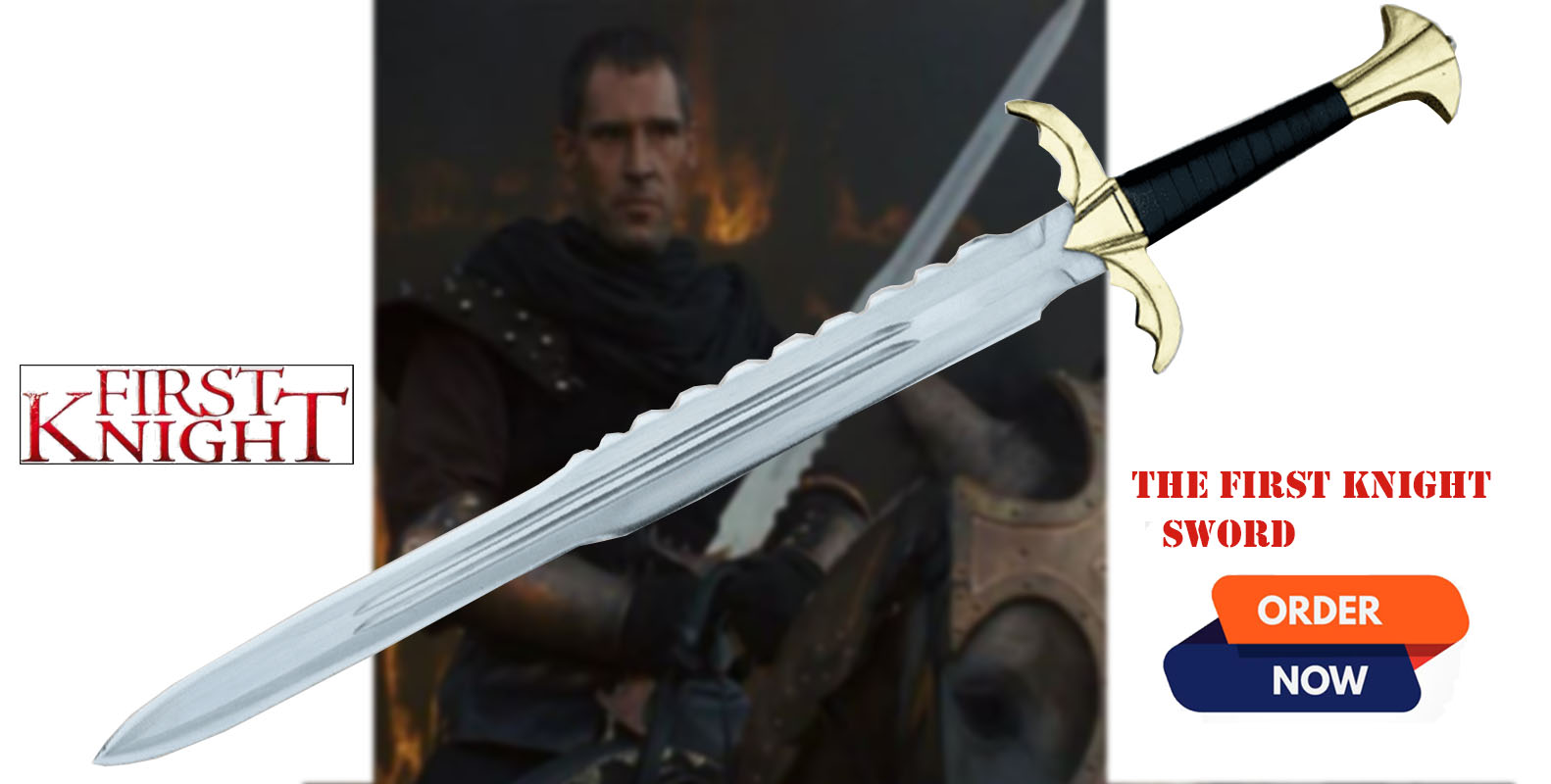
6. Sir Malagant's Sword — First Knight
The 1995 Jerry Zucker film First Knight retold the legend of Lancelot, Guinevere and Arthur with a heightened, almost operatic tone. Sir Malagant's sword — wielded by Ben Cross's villain — is the visual centrepiece of the film's combat sequences: a 24-inch arming sword with a stout, slightly tapered blade and a heavy crossguard built for power rather than finesse.
The design is rooted in late medieval European tradition, the kind of blade a knight of the early 14th century might have carried into a tournament or onto a real battlefield. Malagant himself fights as a man who has forgotten honour and remembers only the cut — and the sword reflects that. There is no romance in it. Only weight, edge, and the readiness to use both.
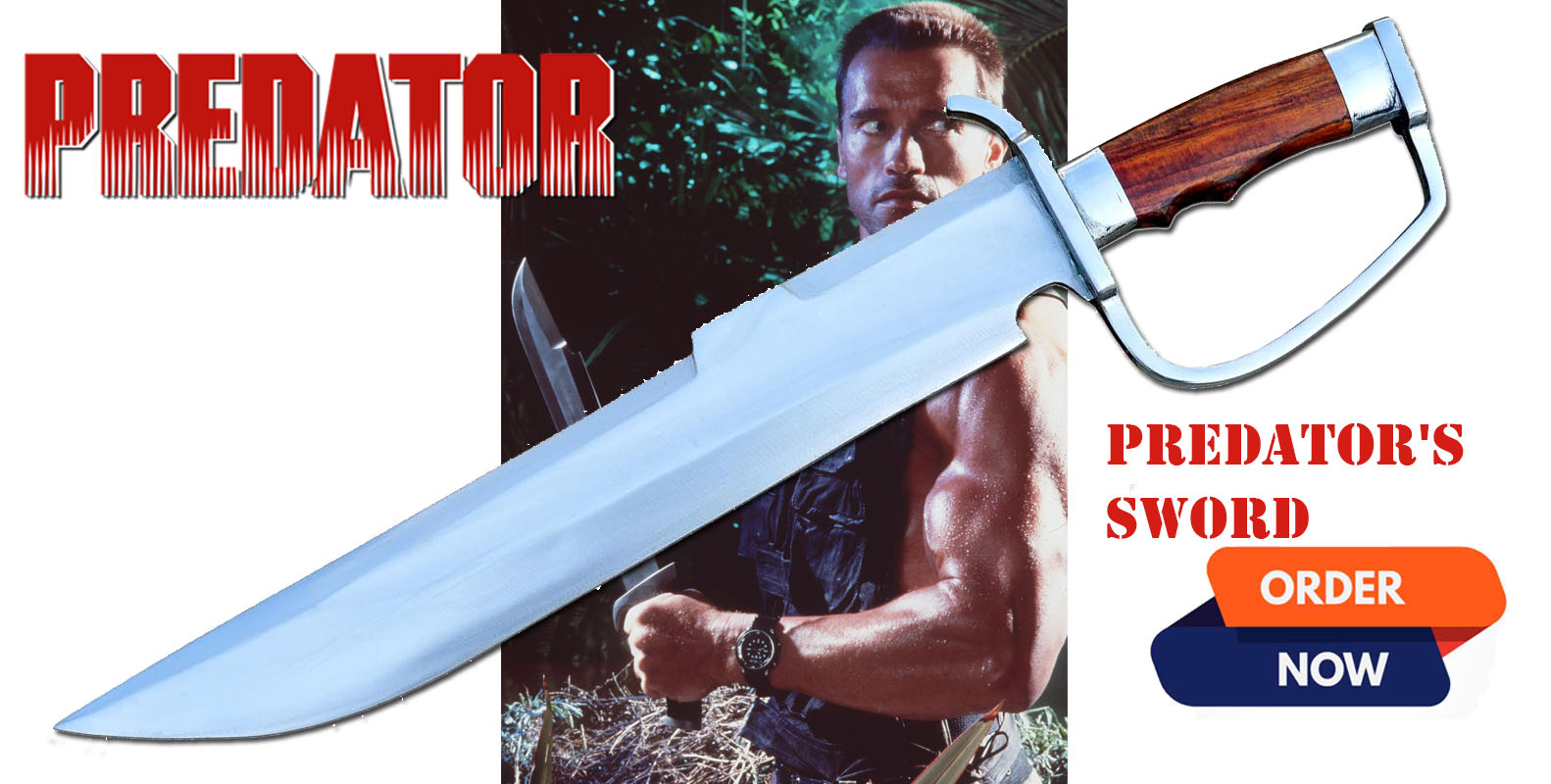
7. Predator D-Guard Bowie — The Predator Franchise
The Yautja hunters of the Predator films carry a small armoury of bladed weapons — wrist blades, combi-sticks, throwing discs — but the D-guard bowie remains the most grounded and most replicable of them all. It is the blade closest to a real, working knife: a heavy bowie profile with a knuckle-guard hilt, designed for close-quarters combat where the user expects to receive blows as well as deliver them.
The D-guard bowie has its own deep history outside the films. Originally an American Civil War design, it was carried by both Union and Confederate soldiers as a brutally effective close-combat weapon. The Predator franchise's adoption of the form makes a quiet point — that even an interstellar hunter recognises a knife built for serious work.
For a deeper look at the design history of the Predator blade, read Predator Movie Knife — History, Design & Modern Replicas.
8. Krauser's Knife — Resident Evil
Jack Krauser's combat knife is one of the most visually distinctive blades in the Resident Evil series. Introduced in Resident Evil 4 (2005) and carried into the live-action and animated adaptations of the franchise, it is a long, broad, full-tang fighting blade — closer to a short sword than a typical combat knife — designed for a former special forces operator who wants reach as well as cut.
Krauser uses the knife as the centrepiece of one of the most memorable boss fights in the entire Resident Evil series — a duel that demands timing, distance and respect for the blade. Its prominence in that fight is what carried the design from a minor prop into a piece of video game history.
9. The Eli Machete — The Book of Eli
The Hughes Brothers' 2010 post-apocalyptic film The Book of Eli centres on a lone wanderer, played by Denzel Washington, who carries a single blade across a ruined American landscape. The Eli machete — sometimes called the "kukri-style" Eli blade — is one of the most influential post-apocalyptic blade designs of the early 2010s.
The film's prop team drew on the kukri tradition: a forward-curving blade with the weight concentrated toward the tip, ideal for both chopping and clean cutting. The result is a weapon that does not look out of place in a wasteland of dust and rubble. There is no flourish in it. Only function. The blade quietly tells you everything you need to know about Eli's life and the world he is walking through.
10. Dark Sister — Game of Thrones & House of the Dragon
Among all the Valyrian steel blades in George R. R. Martin's world, Dark Sister occupies a special place. Smaller, lighter and faster than its sister blade Blackfyre, it was forged for a quicker, more elegant fighting style — the kind suited to Visenya Targaryen, who carried it during the Conquest, and later to Daemon Targaryen, who wields it through the events of House of the Dragon.
Visually, Dark Sister is defined by its slim profile, its slight curve, and the dark, smoky pattern that runs along every Valyrian steel blade. The design draws from real-world Damascus and pattern-welded steels — the kind of blade where the metal itself carries a history. In Westeros, Valyrian steel is one of the few materials capable of killing a White Walker, which gives Dark Sister a significance that reaches far beyond its size.
What These Ten Swords Share
Across centuries of history, dozens of franchises, and ten very different stories, these ten cinematic blades share a single quality — they are all designed to mean something. The Barrow-blades carry the weight of Westernesse. The Medjai sword carries three thousand years of duty. Killmonger's blade carries the contradiction at the heart of his character. Dark Sister carries the legacy of a dynasty.
This is what separates a great movie sword from a forgettable one. The blade has to belong to the world it appears in. It has to belong to the character carrying it. And it has to feel — even in a single shot — like something forged by hands, in a particular place, by people who knew what they were doing. The best film blades are the ones that look like they could exist outside the screen.
Frequently Asked Questions
What is the most famous movie sword of all time?
There is no single answer, but the most frequently cited candidates are Andúril and Sting from The Lord of the Rings, the Bride's katana from Kill Bill, the Medjai sword from The Mummy, and Conan's Atlantean sword. Among Everest Forge's own collection, the Sword of Boromir, the Medjai Sword and the three Barrow-blades are the most frequently asked about.
Which iconic movie swords are based on real historical weapons?
Several. The Sword of Boromir is rooted in the European arming sword tradition of the 12th–13th centuries. The Medjai sword draws directly from the Egyptian khopesh of roughly 1550–1300 BC. Sir Malagant's sword from First Knight is a late-medieval European arming sword in design. The Predator D-guard bowie has its origins in American Civil War knife designs. The Eli machete in The Book of Eli draws from the Nepalese kukri tradition.
Are Lord of the Rings the most-replicated movie swords?
Tolkien's blades have generated more replica designs than any other single franchise in cinema. Andúril, Glamdring, Sting, the Sword of Boromir, the Barrow-blades and the elven knives of Legolas have all been produced by multiple foundries since the trilogy's release. The depth of in-world history Tolkien wrote for each weapon is part of why these blades have endured.
Why do some movie swords look more "real" than others?
Two reasons: design language and craft. A blade designed with reference to real historical weapons — proper proportions, believable balance, period-correct construction — will read as real even on screen. A blade made by hand from real steel will read as real because it is real. Stamped stainless display blades read as flat because the proportions are usually wrong and the steel has no life in it.
What steel are real movie sword replicas made from?
The most common materials in serious replica forging are 1060, 1075, 1095, 5160 spring steel, and pattern-welded Damascus. Stainless steel (420, 440) is widely used for display-only blades but is generally not suitable for functional cutting. Everest Forge uses 5160 high-carbon spring steel across all functional blades — the same steel used in our battle-ready historical swords.
Want a Hand-Forged Movie Sword?
Every Everest Forge movie sword is hand-forged from 5160 spring steel in Kathmandu, Nepal. Browse the full collection or commission a custom film blade from your own reference image.
Browse the Movie Swords Collection Request a Custom ForgeIP & Trademark Disclaimer: This article discusses bladed weapons appearing in copyrighted film, television, and video game franchises for educational, informational, and design-history purposes. Everest Forge produces hand-forged interpretations inspired by these designs for collectors, cosplayers, and enthusiasts. We are not affiliated with, endorsed by, or licensed by Warner Bros. Discovery, New Line Cinema, MGM, the Saul Zaentz Company, or the Tolkien Estate (Lord of the Rings); HBO (Game of Thrones, House of the Dragon); Universal Pictures (The Mummy, Hellboy II); Marvel Studios / The Walt Disney Company (Black Panther); Sony Pictures (First Knight); Lionsgate / Alcon Entertainment (The Book of Eli); 20th Century Studios / The Walt Disney Company (Predator franchise); or Capcom (Resident Evil). All character names, film titles, and franchise references are used for descriptive identification only. All trademarks are the property of their respective owners.