
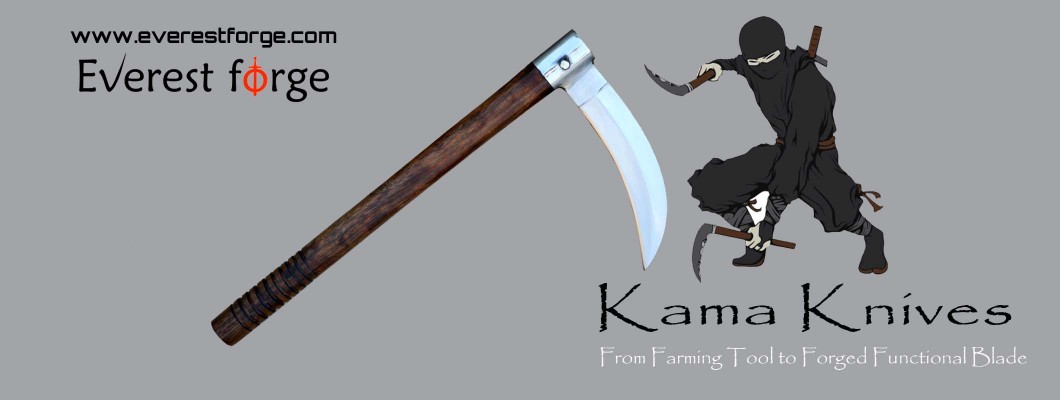
Looking for a Hand-Forged Anime Kama?
Real 5160 spring steel kama sickles inspired by Akali, Madara, Sasori, Black Star & Kohaku — hand-forged in Nepal, available as singles or matched pairs. Browse the Anime Kama Collection →
The kama knife — sometimes called the Japanese sickle — is one of the most quietly influential blades in martial history. It started life as a humble grass-cutting tool in the rice paddies of Okinawa, became a battlefield weapon during a 16th-century weapons ban, evolved into a martial arts staple through the kobudō tradition, and finally exploded into modern pop culture as the signature weapon of Akali in League of Legends, Madara Uchiha and Sasori in Naruto, Black Star in Soul Eater, and Kohaku in Inuyasha. This is the complete history of the kama — from rice paddy to anime icon.
What Is a Kama Knife?
A kama is a curved single-edged blade mounted at a roughly 90-degree angle to a handle, forming a sickle silhouette. Traditional kama have a blade length between 6 and 10 inches and a handle ranging from 8 inches (compact, dual-wield) up to 17 inches (extended-reach polearm). The blade's inward curve is the defining feature — it allows the user to hook, trap, slice, and pull in a single motion, which is exactly what makes it so effective both for harvesting rice and for disarming an opponent.
Before the kama became a popular weapon, it was used primarily as an agricultural tool — cutting rice stalks, wheat, grass, and brush. Okinawan farmers used it to harvest crops close to the ground with quick, sweeping motions. The transition from farm tool to fighting weapon is what makes the kama's history so distinctive: it is one of the few blades in the world to be repurposed rather than purpose-built for combat.
The Kama Timeline — From Heian Japan to Modern Anime
Pre-1600s — Agricultural Origins
The kama appears across rural Japan and the Ryukyu Islands as a standard farming sickle. Used to harvest rice, wheat, and grass. No martial application yet — purely a tool of subsistence agriculture.
1609 — The Satsuma Invasion
The Satsuma clan invades the Ryukyu Kingdom (modern Okinawa) and imposes a strict weapons ban on the local population. Swords, spears, and bladed military weapons are confiscated. Peasants are left with only their farming tools.
1600s–1800s — The Birth of Kobudō
Okinawan farmers begin training their everyday tools as combat weapons. The kama, the bo staff, the nunchaku, the sai, and the tonfa all emerge from this period as the founding weapons of kobudō, the Okinawan martial art of "ancient weapons." Paired kama become a signature kobudō technique.
Edo Period — The Kusarigama Develops
Mainland Japanese martial artists chain a kama to a weighted ball, creating the kusarigama — a sickle and chain weapon used to entangle opponents before striking. The kusarigama becomes associated with the shinobi (ninja) and travelling warrior monks.
20th Century — Karate & Modern Martial Arts
As karate spreads from Okinawa across Japan and globally in the 1900s, kobudō weapons travel with it. The kama becomes a recognised weapon in karate weapons training, ninjutsu schools, and Japanese martial arts demonstrations worldwide.
2000s–Today — The Kama in Anime & Gaming
The kama enters global pop culture through anime (Naruto's Madara Uchiha and Sasori, Soul Eater's Black Star, Inuyasha's Kohaku) and gaming (League of Legends' Akali, Mortal Kombat, Smite, Ninja Gaiden). A new generation discovers the weapon through dual-wielding shinobi and assassin characters.
The Kama in Martial Arts — Kobudō, Karate & Ninjutsu
In martial application, the kama is rarely used solo. Practitioners almost always train with paired kama — one in each hand — using the inward curve of the blades to hook an opponent's weapon, trap their limbs, or sweep their stance before striking. The spinning techniques unique to kama kobudō exploit the offset weight of the blade, generating momentum that a straight blade cannot match.
The kama is a recognised weapon in three major traditions:
- Okinawan Kobudō — the original martial home of the kama. Schools like Matayoshi Kobudō and Ryukyu Kobudō continue to teach paired kama techniques today.
- Karate Weapons Training — most modern karate schools that teach weapons (kobujutsu) include the kama alongside the bo, sai, and nunchaku.
- Ninjutsu & Ninpo — the kusarigama (chain-and-sickle) variant features prominently in shinobi tradition, where the chain entangles before the blade strikes.
For practitioners ordering training kama, the key consideration is full-tang construction — the blade's metal extending through the entire length of the handle. Decorative replicas with welded or glued joints will fail under training stress. Functional training kama like those forged at Everest Forge use 5160 spring steel with full-tang construction specifically to handle the impact loads of paired training.
Kama vs Kusarigama vs Scythe vs Sickle — What's the Difference?
These four blades all share the curved-cutting-edge silhouette but serve different purposes and have distinct histories. Here's how they compare:
| Weapon | Origin | Blade Style | Primary Use | Handle Length |
|---|---|---|---|---|
| Kama | Okinawa, Japan | Short curved blade, ~90° to handle | Originally farming, now martial arts & cosplay | 8–17 inches |
| Kusarigama | Mainland Japan | Kama blade + weighted chain | Entangling combat, ninjutsu | 8–14 inches + 6–10 ft chain |
| Scythe | Europe / global | Long curved blade, ~30–60° to handle | Mowing grass and grain across wide fields | Up to 6 feet (snath) |
| Sickle | Global (10,000+ BCE) | Short curved blade, parallel to handle | Single-handed grain harvesting | 4–6 inches |
The kama is essentially a refined fighting variant of the agricultural sickle — same silhouette family, but optimised for combat through better balance, longer reach, and martial-grade construction. The kusarigama is a kama with a chain attached. A scythe is a different beast entirely, designed for mowing whole fields rather than precision cutting.
The Kama in Anime & Gaming — Why Pop Culture Loves the Sickle
The kama has become one of the signature weapons of the anime and gaming worlds, and the reason is its narrative archetype: a humble tool turned deadly in the hands of a fighter who shouldn't have a weapon at all. That story shape — the underdog assassin, the peasant warrior, the shinobi making do — fits the kama perfectly. Here are the most iconic kama wielders in modern pop culture:
- Akali (League of Legends) — the Rogue Assassin, known across her Classic, K/DA, True Damage, PROJECT, Blood Moon, and Stinger skins. Akali wields paired kama in shadow-style fast-strike combat. With over 100 million active League players, Akali is the single most influential kama-wielder in modern gaming.
- Madara Uchiha (Naruto) — the Ghost of the Uchiha clan carries a massive scythe-kama through his iconic battles in Naruto Shippuden. His weapon is a long-handled, dramatically curved kama-scythe hybrid, used for extended-reach combat.
- Sasori (Naruto) — the Akasuna no Sasori, master of poison and puppetry, fights with smaller, surgical-precision kama. His weapons reflect his character: compact, fast, deadly.
- Black Star (Soul Eater) — the loud-mouth assassin of Soul Eater wields chained kama through the weapon transformations of his partner Tsubaki. Black Star's style is the modern televised version of the traditional kusarigama.
- Kohaku (Inuyasha & Yashahime) — the young demon slayer carries a chain-kama (kusarigama) through both anime series, becoming one of the most recognisable kusarigama wielders in mainstream anime.
- Other notable wielders — Tenten and Fū Yamanaka (Naruto), Michelangelo's kama-style sai variants (TMNT season 3), Izanami (Smite), Ryu Hayabusa's Vigoorian Flails (Ninja Gaiden), and the trainee reapers of Black Butler.
What unites all these characters is the kama's distinctive silhouette — instantly recognisable, visually dramatic, and deeply tied to the shinobi/ninja archetype. Cosplayers and collectors searching for an authentic kama replica increasingly bypass foam and 3D-printed props in favour of real hand-forged steel kama that can be paired for true dual-wield builds.
Modern Kama — Why Hand-Forged Steel Still Matters
Most kama on the market today fall into one of three categories: foam or aluminum training pairs (sold for kobudō practice and convention compliance), 3D-printed or painted cosplay props (visually accurate but structurally fragile), or hand-forged steel kama (the smallest segment, but the only category that produces a real working blade).
At Everest Forge, every kama is hand-forged from 5160 spring steel reclaimed from truck leaf springs in our Kathmandu workshop. The steel is oil or water tempered, the construction is full-tang, and every blade is finished to a working edge. The same forging techniques our smiths use for traditional Nepali kukri are applied to the kama silhouette — translating Okinawan martial proportions through Himalayan craftsmanship.
Every kama in our collection is also available as a matched pair via our customisation option. This is essential for authentic kobudō training, kusarigama configurations, and anime cosplay builds (Akali's dual blades, Black Star's twin kama, Kohaku's chain-and-sickle setup).
Frequently Asked Questions
Before the kama became a popular weapon, what were they typically used for?
The kama was used as an agricultural tool — primarily for harvesting rice, wheat, and grass in the rice paddies of Okinawa and rural Japan. Its curved blade and short-to-medium handle made it ideal for cutting crops close to the ground with quick, sweeping motions. The transition to weapon happened during the 16th-century Satsuma weapons ban, when Okinawan farmers were forced to repurpose their everyday tools for self-defence.
What is the difference between a kama and a kusarigama?
A kama is a single sickle weapon — a curved blade mounted at a 90-degree angle to a short or medium handle. A kusarigama is a kama with a weighted chain attached, used in mainland Japanese martial arts and ninjutsu. The chain entangles an opponent or their weapon before the kama blade strikes. Any standard kama can be configured as a kusarigama by attaching a chain to the handle.
What is a kama in martial arts?
In martial arts the kama is a paired weapon — one in each hand — used in Okinawan kobudō, karate weapons training, and ninjutsu. The inward-curving blade allows practitioners to hook, trap, sweep, and slash in a single motion. Paired kama techniques include spinning attacks, opponent disarms, and stance-breaking sweeps.
Are anime kama (Akali, Naruto, Soul Eater) based on real weapons?
Yes — the kama wielded by Akali in League of Legends, Madara and Sasori in Naruto, Black Star in Soul Eater, and Kohaku in Inuyasha are stylised but accurate representations of the real Japanese kama. Each character's weapon proportions, dual-wield style, and chain configurations all draw from authentic kobudō and kusarigama traditions. This is why hand-forged steel kama work as both functional weapons and cosplay replicas.
What steel are traditional and modern kama made from?
Historically, kama were forged from whatever steel was available locally — often tamahagane (the same steel used for katana) for higher-grade kobudō weapons, and recycled tool steel for working farm kama. Modern functional kama like those forged at Everest Forge use 5160 spring steel, a high-carbon working-blade steel valued for toughness, edge retention, and the ability to flex without breaking under impact.
Can a kama be used for bushcraft and outdoor work today?
Yes — the kama remains one of the most effective brush-clearing and grass-cutting tools you can carry. The 90-degree blade angle is uniquely suited to single-stroke cuts close to the ground, which is why it survived as an agricultural tool for centuries. A modern hand-forged kama works equally well for camp clearing, light bushcraft, and harvesting tasks.
Is the kama the same as a Japanese sickle?
Yes — "kama" is the Japanese word for sickle. The two terms are used interchangeably in English-speaking contexts. When people search for "Japanese sickle weapon," they are referring to the kama as it appears in kobudō and martial arts. When they search for the agricultural tool, they are still referring to the same blade silhouette.
Ready to Forge Your Own Piece of Kama History?
From Akali's dual-wield to Kohaku's kusarigama, every Everest Forge anime kama is hand-forged in 5160 spring steel and available as a matched pair via our customisation option. Worldwide DHL Express shipping, 30-day satisfaction guarantee, 6-month craftsmanship warranty.
Browse the Anime Kama Collection Request a Custom Forge
Leave a Comment