Bowie Knife History, Evolution & Hand-Forged Blades — The Complete Guide
Few knives have achieved the cultural weight of the Bowie knife. Born on the American frontier, tested in one of the most famous knife fights in history, carried through the Civil War, and immortalised in Western film and survival culture — the Bowie is not just a knife. It is an American icon that has been in continuous use and continuous evolution for nearly two centuries.
This guide covers the full story — where the Bowie knife came from, who made it famous, how its design works and why, how it has evolved from frontier weapon to modern tactical tool, and what to look for when buying one today.
Hand-Forged Bowie Knives — Made in Nepal, Ships Worldwide
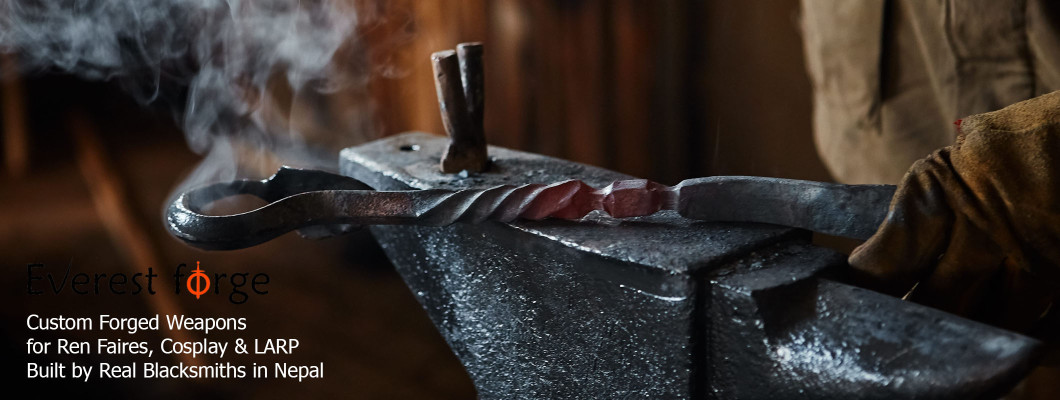
Every Bowie knife at Everest Forge is individually hand-forged from 5160 high-carbon steel by traditional Nepali blacksmiths. Full tang construction, water-tempered edge, rosewood or horn handle — built for real use, not just display.
Origins of the Bowie Knife
The Bowie knife traces its roots to the early 1800s — a period when large rugged blades were not optional equipment on the American frontier. They were survival tools. Men carried them for hunting, skinning, camp work, and self-defence in territory where law enforcement was non-existent and threats were real.

The knife gained its name from Colonel James "Jim" Bowie, a Texan frontiersman and folk hero. The turning point for the knife's fame was the infamous Sandbar Fight of September 1827 — a confrontation near Natchez, Mississippi, where Bowie was shot, stabbed, and beaten yet still managed to kill his primary attacker with a large knife. Witnesses described the blade in extraordinary terms. Within weeks, word had spread across the frontier. Knife-makers began receiving orders for "a knife like Jim Bowie's."
While historians continue to debate the exact origins, it is widely accepted that blacksmith James Black of Washington, Arkansas refined the design into the form we recognise today — combining a large clip-point blade with a crossguard, a false edge along the top of the blade near the tip, and a handle sized for a firm combat grip. For the full historical record, see the Bowie Knife — Wikipedia.
The Jim Bowie Legend

Jim Bowie was more than a skilled knife fighter — he was a genuine American folk hero at a time when the country was still defining what that meant. Born in Kentucky in 1796, he became a land speculator, slave trader, and eventually a Texas revolutionary. His reputation for fearlessness and his skill with a blade made him a larger-than-life figure even before his death.
His heroic last stand at the Battle of the Alamo in March 1836 — where he died fighting alongside Davy Crockett and William Travis against Santa Anna's Mexican army — cemented his place in American legend permanently. Bowie reportedly fought from his sickbed until the end. The knife he carried became inseparable from that story of defiance, courage, and frontier grit.
Over the decades that followed, the Bowie knife evolved from a weapon of personal defence into a cultural symbol of the rugged, self-reliant American spirit. Every generation has found new meaning in it — from Civil War soldiers to Western film heroes to modern survivalists.
The Original Bowie Knife — Design and Construction
The earliest Bowie knives were large, heavy, and purpose-built for frontier conditions. Here is what defined them:

Blade length. Historical Bowie knives typically featured blades between 8 and 12 inches — long enough to be effective in close combat, versatile enough for camp utility work. Some examples pushed to 15 inches, bordering on short sword territory.
Clip point. The defining feature. A concave cut near the tip removes metal from the spine, sharpening the tip for piercing while keeping the main cutting edge intact. The result is a blade that can thrust like a dagger and slash like a hunter's knife simultaneously.
Thick spine. Unlike a dagger, the Bowie has a thick, strong spine. This allows heavy chopping work — wood splitting, bone cutting — without the blade flexing or snapping under force.
Crossguard. A metal guard between blade and handle prevents the hand from sliding forward onto the edge during a thrust — critical in combat conditions where grip control can be lost.
Full tang construction. The finest historical Bowies were full tang — the blade steel extending the full length through the handle and secured with pins. This creates a single piece of steel from tip to pommel, eliminating the weakest point in any knife: the junction between blade and handle.
Full Tang vs. Partial Tang — Why It Matters

This is the single most important construction decision in any Bowie knife. A full tang blade passes the full width and length of the blade steel through the handle, usually visible as a metal strip along the handle edge. Handle scales are attached to either side and pinned or riveted in place.
A partial tang — sometimes called a rat-tail tang — narrows significantly as it enters the handle. It is lighter, which makes it feel more nimble, but under real stress — chopping, prying, hard camp work — the tang can snap at the narrowing point or pull free from the handle entirely.
For any Bowie knife intended for actual use rather than display, full tang is not optional. Every Everest Forge Bowie knife is built with full tang construction as standard.
Bowie Knife Sizes — Choosing the Right Blade
The right size depends entirely on what you need it for. Here is a practical breakdown:
6–9 inch blade — compact and fast. Ideal for hunting, skinning, and everyday carry. Easy to control for precise work. The 8 inch Bowie sits in this range — the most versatile option for most users.
10–12 inch blade — the classic Bowie size. Balances chopping power with handling agility. Effective for camp work, bushcraft, and survival situations. This is the size Jim Bowie himself would have recognised.
13–15+ inch blade — serious chopping territory. Approaches short sword functionality. The large tactical Bowie and the Bowie sword models sit here — powerful collectors' pieces and functional field tools for demanding environments.
Not sure which size suits you? Browse the full collection — each product listing includes blade length, weight, and intended use to help you decide.
The Bowie Knife in American History
After the Sandbar Fight made Jim Bowie famous, demand for large clip-point knives spread rapidly across the American South and West. By the 1830s and 1840s, knife-makers throughout the frontier were producing Bowie-style blades. English cutlers in Sheffield began exporting Bowie knives to America by the thousands — the design had gone international within a decade of becoming famous.
During the American Civil War, Bowie knives were carried by soldiers on both sides — Confederate and Union alike. They served as both weapons of last resort in close combat and practical utility tools for camp life. Officers carried them as sidearms. Enlisted men used them for everything from preparing food to cutting rope.
Through the westward expansion, the Bowie knife became the definitive blade of the American frontier. Cowboys, mountain men, scouts, and settlers all carried some variation of the large clip-point knife. It was functional, durable, and carried the psychological weight of Jim Bowie's legend — a blade that said something about the person who carried it.
The Bowie Knife in Pop Culture
The Bowie knife never left the cultural conversation. Western films of the 20th century kept it alive — carried by frontier heroes, outlaws, and lawmen alike. John Wayne, Clint Eastwood, and countless screen legends wielded Bowie-style blades in films that defined American mythology for generations.
Then came Rambo. The 1982 film First Blood introduced a new generation to the survival Bowie — a large, purpose-built wilderness blade with a hollow handle, serrated spine, and compass pommel. The knife became as famous as the film itself, spawning decades of Rambo knife replicas and establishing the survival Bowie as a genre of its own.
Today, Bowie knives appear in video games, survival television, tactical gear culture, and knife collecting communities worldwide. They remain the most searched and most collected fixed-blade knife category in the world — two centuries after Jim Bowie made one famous in a Louisiana sandbar fight.
Evolution of the Bowie Knife — Traditional to Tactical
The original Bowie was hand-forged from high-carbon steel with a natural handle of wood, horn, or bone. That tradition is very much alive — but alongside it has grown an entire parallel tradition of tactical and modern Bowie variants.
Traditional Bowie. High-carbon or stainless steel, natural handle materials, polished blade finish. Built to honour the original design while delivering real performance. Favoured by hunters, collectors, and those who appreciate the historical connection.
Tactical Bowie. Black powder-coated blade for non-reflective stealth, D-guard handle for knuckle protection, ergonomic synthetic grip. Designed for military and law enforcement applications where discretion and combat readiness matter. The Predator D-Guard Bowie and Trench Raider Bowie represent this lineage.
Survival Bowie. Medium size, versatile blade profile, comfortable handle for extended grip. Built to do everything — chop, slice, skin, carve, pry — reliably over extended wilderness use. The Hunter Bowie and Classic Regent Bowie represent this category.
Collector Bowie. Historically accurate proportions, premium handle materials, fine finish. Some feature engraving, brass fittings, or ornate guards. Built to be displayed and admired as much as used. The Hunter Bowie with hand-engraved brass fittings exemplifies this.
Own a Hand-Forged Bowie Knife — Built in Nepal, Ships Worldwide
At Everest Forge, every Bowie knife is individually hand-forged in Nepal by blacksmiths using 5160 high-carbon steel and traditional techniques. Full tang construction. Water-tempered edge. Handle materials from rosewood to horn to antler. Leather scabbard included. These are working knives, not display pieces — though they look good enough to display.
Shop by type:
- Full Bowie knife collection — hunting, survival, tactical, collector, and movie-inspired designs.
- Classic Regent Bowie — 12-inch blade, horn handle, timeless frontier design.
- Predator D-Guard Bowie — 16-inch tactical blade, D-guard handle, heavy-duty field knife.
- Trench Raider Bowie — combat-inspired, raw finish, D-guard knuckle protection.
- Rambo Part One Knife — 10.5-inch survival blade, hand-forged Rambo replica.
- Bowie Style Sword — large clip-point blade approaching short sword dimensions. For collectors and serious users.
- Frontier Bowie — traditional survival design, raw forged finish, built for the field.
Want a Bowie knife built to your exact specifications? Blade length, blade shape, handle material, guard style, finish, engraving — we can customise everything.
What to Look for When Buying a Bowie Knife
Whether you are buying your first Bowie or adding to a serious collection, these are the factors that actually matter:
Steel quality. High-carbon steel outperforms stainless for edge retention and toughness under hard use. 5160 spring steel — the material used in Everest Forge Bowies — is one of the best choices available. It takes a sharp edge, holds it well, and flexes rather than snaps under shock loading.
Tang construction. Full tang only for any knife intended for real use. If the tang is hidden and you cannot verify it is full width, be cautious. Partial tang knives can and do fail under hard use.
Heat treatment. A blade that is not properly heat-treated will either be too soft (loses edge quickly) or too hard (chips or snaps). Water tempering — the traditional method used by Nepali blacksmiths — creates a hard edge backed by a tough, flexible spine. This differential hardness is what gives a working knife its longevity.
Handle fit. The handle should fill your hand without gaps, feel secure when wet, and not cause hotspots during extended use. Natural materials like rosewood and horn have been used for centuries because they work — warm to the touch, grippy when wet, durable over years of use.
Balance. A well-made Bowie should feel balanced — neither blade-heavy nor handle-heavy. Pick it up and it should feel like a natural extension of the hand, not a weight you are fighting against.
Frequently Asked Questions About Bowie Knives
What is a Bowie knife?
A Bowie knife is a large fixed-blade knife with a distinctive clip-point blade, thick spine, and crossguard. Originally designed for frontier survival and combat in 19th-century America, it has evolved into one of the most versatile and iconic knives ever made — used today for hunting, survival, bushcraft, collecting, and tactical work.
Who invented the Bowie knife?
The knife is named after Colonel James "Jim" Bowie, who became famous for using a large knife in the Sandbar Fight of 1827. Blacksmith James Black is widely credited with refining the design. The knife became a national symbol through Bowie's legendary stand at the Alamo in 1836.
What makes a Bowie knife different from other knives?
The combination of a large clip-point blade, thick chopping spine, and protective crossguard sets the Bowie apart. It can thrust like a dagger, slash like a hunter's knife, and chop like a light axe — three functions in one blade. No other fixed-blade design achieves this versatility at this size.
What is full tang construction?
Full tang means the blade steel extends the full length through the handle, secured with pins or rivets. It is the strongest possible construction — no weak junction between blade and handle. For any Bowie intended for real use, full tang is essential. All Everest Forge Bowies are full tang as standard.
What size Bowie knife should I choose?
6–9 inch blades suit hunting and everyday carry. 10–12 inch blades are the classic all-purpose Bowie size. 13+ inch blades are for serious chopping tasks and collectors. If you are unsure, the 12-inch range is the most versatile starting point. Custom sizes are available from Everest Forge.
What steel is best for a Bowie knife?
5160 high-carbon spring steel is one of the best choices — tough, flexible, and capable of holding a sharp edge under hard use. Everest Forge uses 5160 steel water-tempered for a hard cutting edge backed by a tough spine. This is the same steel used in truck leaf springs — built to absorb shock without breaking.
What is the difference between a survival Bowie and a tactical Bowie?
A survival Bowie prioritises versatility for wilderness use — chopping, skinning, carving. A tactical Bowie prioritises stealth and combat readiness — black coating, D-guard handle, serrated sections. Both are valid; the right choice depends on your intended use.
Can I get a custom Bowie knife made to my specifications?
Yes. Everest Forge accepts full custom orders — blade length, shape, steel, handle material, guard style, finish, and engraving. Submit your custom forge request here.
Where can I buy a hand-forged Bowie knife?
Everest Forge offers a full range of hand-forged Bowie knives forged in Nepal and shipped worldwide. Browse the full Bowie knife collection here.
Conclusion
The Bowie knife has outlasted empires, survived the transition from frontier weapon to modern tactical tool, and never once lost its cultural relevance. That endurance is not an accident. It is the result of a design so well-suited to human needs — versatile, powerful, balanced, and visually compelling — that two centuries of innovation have failed to improve on its fundamentals.
Whether you are drawn to the history of Jim Bowie and the American frontier, the tactical performance of a modern combat blade, or simply the satisfaction of owning something made by hand from real steel — the Bowie knife delivers on all of it.
Shop Hand-Forged Bowie Knives → Request a Custom Bowie →