Filipino Swords and Machetes: History, Culture, and Legendary Blades of the Philippines
The Philippines is a nation forged not only by its people but also by the blades they carried. Across its 7,000 islands, the art of blacksmithing—perfected by the local panday—gave rise to an incredible variety of swords and machetes. These blades served multiple purposes: tools of agriculture, instruments of survival, weapons of war, and symbols of power and honor. Today, Filipino edged weapons stand as living links to a warrior culture that valued precision, resilience, and beauty in every strike.

Historical Background
Precolonial Origins: Long before foreign contact, early Filipinos forged blades from native iron deposits and traded materials with neighboring islands. A well-crafted sword was both a weapon and a badge of prestige. Chiefs and warriors carried ornate swords, often decorated with carvings and inlays, while farmers relied on simpler, utilitarian machetes for clearing fields and protecting villages.

Cross-Cultural Influence: Trade routes connecting the Philippines with Borneo, Sumatra, and Siam brought new shapes and forging ideas. The Kris, Barong, and Parang evolved through centuries of cultural exchange. Filipino smiths, however, gave each form a distinctive local identity—more curved, heavier at the front, or sharper in the belly for cutting through dense jungle and bamboo.
Colonial Resistance: When Spanish colonizers arrived, these blades became weapons of revolution. Farmers rose with their bolos, warriors defended their lands with krises and kampilans, and freedom fighters adapted traditional tools into instruments of defiance. The Filipino blade thus became a symbol of liberty, ingenuity, and strength.
Iconic Filipino Swords and Machetes
Banayal Sword-Machete
The Banayal Sword-Machete represents the dual spirit of Filipino blades—equal parts tool and weapon. Originating from Mindanao, it was carried by both warriors and farmers. Its long, slightly curved blade provides a perfect balance between slashing and thrusting power, allowing the user to adapt instantly from cutting vegetation to defending against an enemy. The traditional Banayal was often worn across the back for quick draw in combat. The Everest Forge Banayal keeps that heritage alive with a full-tang, oil-tempered 5160 carbon steel blade, handcrafted to endure the harshest conditions while retaining its razor edge. It’s a practical reminder that in the Philippines, every tool has the potential to become a weapon when survival demands it.
Kris – The Flame Sword
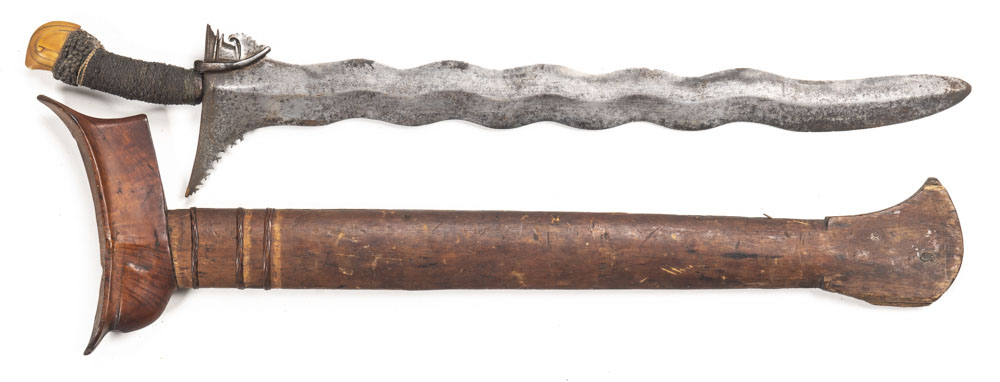 The Kris, or Kalis, is one of Southeast Asia’s most revered weapons. Its iconic wavy blade symbolizes both fire and life force, while its construction reflects spiritual artistry. Among the Moro warriors of Mindanao, the Kris was a sacred object—believed to possess a spirit of its own. It was passed from father to son as an heirloom, sometimes blessed or consecrated before battle. The Kris’s rippled edge was designed to tear through flesh efficiently, while the thick spine gave it strength for parrying. The Everest Forge Kris is a faithful reimagining of this blade, forged by hand to produce the elegant flame pattern, balanced for both ceremonial display and functional use. Its craftsmanship celebrates the ancient belief that a blade could be both divine and deadly.
Moro Laring Sword
The Laring Sword is known for its sleek profile and lightning-fast performance. Used primarily by the Moro peoples of Sulu and Mindanao, it was built for agility and precision. Its slender blade and sharp point made it ideal for thrusting attacks, while the minimal crossguard allowed for versatile handling in close quarters. Warriors favored the Laring for ambushes and naval skirmishes, where speed and precision were crucial. The Everest Forge Laring replicates this elegant lethality—lightweight, razor-edged, and balanced to perfection. Forged from 5160 spring steel, it embodies both grace and power, echoing the disciplined combat style of its Moro ancestors.
Filipino Espada Sword
The Espada is a blade of transformation, born during the Spanish colonial era when European swordsmanship met indigenous Filipino martial arts. The resulting weapon—used in the famous Espada y Daga (sword and dagger) style—was both refined and deadly. Its wide blade was effective in blocking and slashing, while the pointed tip enabled thrusting techniques. The Everest Forge Espada honors this legacy with a broad, hand-forged carbon steel blade, a polished rosewood handle, and traditional weight distribution. More than a weapon, the Espada symbolizes adaptability—the Filipino ability to merge foreign influences into something uniquely their own.
Ginunting Sword
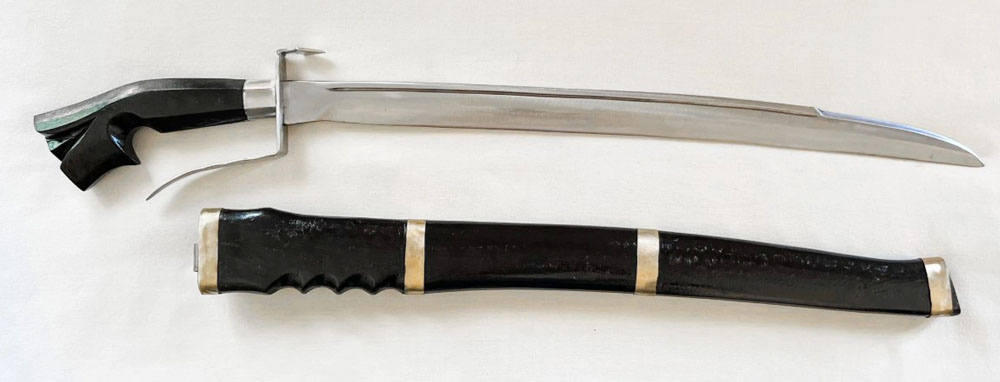 The Ginunting is the modern warrior’s blade, now recognized as the official sword of the Philippine Marine Corps. Its distinct forward curve channels momentum toward the tip, giving it remarkable chopping power while remaining fast in hand. Historically, it evolved from sugarcane-cutting tools used in the Visayas region, adapted for warfare. Its design allows the user to perform fluid transitions between hacking, blocking, and thrusting—making it ideal for jungle combat. The Everest Forge Ginunting is hand-forged, full-tang, and oil-tempered for unmatched durability. It stands as a living continuation of the Filipino martial tradition—a blade that bridges past and present.
Garab Sword
 The Garab is an agricultural blade reborn as a weapon. Originally a curved sickle used for harvesting rice and sugarcane, it was adopted by insurgents during uprisings for its natural efficiency in cutting. Its inner curve allows devastating pull cuts and hooking motions, capable of disarming opponents or inflicting fatal wounds with a single swing. The Everest Forge Garab pays homage to this dual-purpose legacy. Its oil-tempered steel blade and ergonomic handle preserve the same utility-driven design, equally effective in the field or in combat. The Garab embodies the resourcefulness of the Filipino spirit—turning a farmer’s blade into a defender’s weapon.
Bolo Machete
Few weapons carry as much historical weight as the Bolo. It was the blade of the common people—used for farming, woodcutting, and, eventually, revolution. During the late 19th century, the Katipunan revolutionaries wielded bolos in their fight against Spanish rule, and later, guerrilla fighters carried them through the jungles in World War II. The Bolo’s simple design—a slightly curved, single-edged blade—makes it easy to forge and maintain. The Everest Forge Bolo continues this proud tradition, hand-forged with a copper guard and full tang for strength. It stands as a timeless symbol of labor, rebellion, and national pride.
Barong Machete (Leaf Blade)
 The Barong is a heavy, leaf-shaped sword that reflects both artistry and ferocity. Its broad belly and pointed tip give it immense chopping power, while its short length makes it ideal for close combat. Carried by the Tausug and Yakan tribes of Mindanao, the Barong was often richly decorated with carved hilts and ornate sheaths, symbolizing rank and bravery. It was also used in ritual duels and ceremonies, blending spirituality with warfare. The Everest Forge Barong retains that combination of elegance and brutality, featuring a full-tang, oil-tempered blade and polished wooden handle—a perfect tribute to one of the most iconic tribal weapons in the archipelago.
Parang Machete
The Parang is a broad-bladed machete that shares ancestry with the Malay and Indonesian versions but has found a distinct role in the Philippines. It is primarily a jungle survival blade, capable of cutting wood, clearing paths, and even processing game. During times of conflict, the same tool became a fearsome weapon in guerrilla warfare. The Everest Forge Parang maintains the traditional curve that concentrates power at the front of the blade, hand-forged and oil-tempered for endurance. It exemplifies how Filipino ingenuity turns practicality into power.
Daab Sword (Thai Influence)
Although the Daab originated in Thailand, its influence extended across Southeast Asia. It shares a cultural bond with Filipino swords through centuries of trade and migration. The Daab’s long, straight, single-edged blade is favored for fluid combat techniques in traditional Thai martial arts such as Krabi Krabong. In the Philippines, similar sword forms inspired many regional fighting blades. The Everest Forge Daab celebrates that shared heritage, crafted for both grace and cutting efficiency. It’s a weapon of rhythm and control, symbolizing the unity of Southeast Asian blade culture.
Legacy of the Filipino Blade
Filipino swords and machetes are more than historical artifacts—they are expressions of a living culture. Each forged edge carries stories of survival, artistry, and honor. From the practical Bolo to the sacred Kris, these weapons remind us that craftsmanship can reflect both necessity and spirit. Modern artisans at Everest Forge continue this tradition, hand-forging functional masterpieces that preserve the essence of Filipino heritage for future generations.
Frequently Asked Questions
1. What makes Filipino swords unique?
Filipino swords combine artistry, functionality, and adaptability. Each blade is designed for both work and combat, with regional variations that reflect the local environment and way of life. They are practical yet symbolic—representing honor, survival, and skill.
2. Are these blades still made today?
Yes. Many blacksmiths in the Philippines continue to forge traditional swords and machetes using age-old techniques. Modern makers like Everest Forge preserve this legacy by crafting fully functional blades with contemporary steel and oil-tempering methods for superior strength.
3. Which Filipino sword was most used in warfare?
The Bolo and the Kris were the most widely used. The Bolo was a farmer’s blade that became a weapon of revolution, while the Kris was a noble warrior’s sword symbolizing valor and spiritual power.
4. What is the main difference between the Kris and the Barong?
The Kris is long, slender, and often features a wavy blade designed for thrusting and slashing. The Barong, in contrast, is shorter and broader, delivering powerful chopping blows. Both were weapons of prestige and skill, but they reflect different regional fighting styles.
5. Are the swords from Everest Forge functional?
Yes. Every sword and machete at Everest Forge is hand-forged from high-grade 5160 carbon steel, oil-tempered for strength, and constructed with a full tang. These are not decorative pieces—they are real, battle-ready blades that carry forward centuries of Filipino craftsmanship.
Custom Forge: Bring Your Filipino Blade Idea to Life
Have a traditional or modern Filipino edged weapon in mind? Whether it’s a Kris, Barong, Ginunting, Bolo, Banayal, or a fully original design, our smiths can hand-forge it to your specs.
Share blade length, steel preference, handle material, fittings, engraving, sheath style, and any reference photos. We’ll review and reply with a quote and timeline.
Secure form • Upload images • Fast response