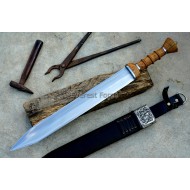
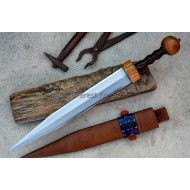
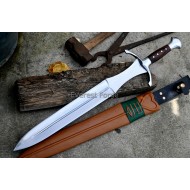
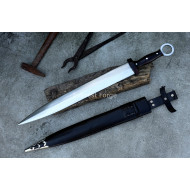
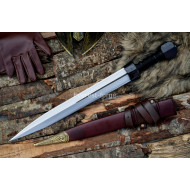
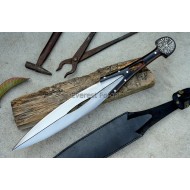
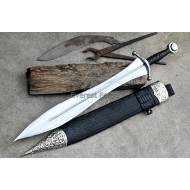
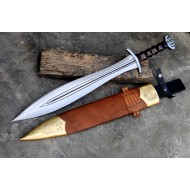
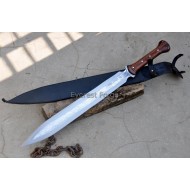
- Model: Leaf Sword
- Product Code: Shortleafsword017
- Location: Kathmandu,Nepal
Available Options
A Hand-Forged Leaf-Blade Sword With Ball Quillons
This is a hand-forged leaf-blade short sword: 17 inches of double-edged blade swelling to its widest point past the middle and drawing in to an acute tip, on a 5.5 inch hilt with a gently arched steel cross finishing in ball terminals, a leather-wrapped grip and a capped steel pommel. It comes with a leather scabbard shaped to the leaf with a cross-laced throat. Forged from 5160 high-carbon spring steel in our workshop in Tokha-3, Kathmandu, after your order arrives — so the dimensions, the stock thickness, the grip and the guard are all yours to set at no extra cost.
The leaf is one of the oldest blade shapes there is, and it was arrived at independently by Bronze Age Europe, by Greece, by the Celtic world and by others who had no contact with each other. That is usually a sign a shape is solving a real problem rather than following a fashion, and in this case the problem is how to put width and weight forward of your hand on a weapon that has no length to spare.
The proportions here are worth noting: 43 centimetres of blade on a sword of 57 overall is almost exactly where the Greek xiphos sat. The blade belongs to that family. The hilt furniture does not, and the questions below are clear about which is which.
An honest note. Two things. The hilt is ours rather than documented — the arched cross with ball terminals and the capped cylindrical pommel are a modern design, where Greek and Celtic hilts of this period looked quite different. The blade and the proportions are right for the type; the furniture is not a reconstruction and we will not describe it as one. Second, it is heavier than the original would have been: 1,010 grams against a historical range of roughly 600 to 900, which per inch of blade puts it in the band we use for heavy kukris. That makes it very hard to damage and slower in the hand than the article it is modelled on. Thinner stock with more distal taper is free, and it is the build we would suggest to anyone buying this as a piece of ancient arms.
Why It Is Built This Way
Full Specifications
Figures are taken from the sword shown and describe the standard build. Hand-forged work varies a little from piece to piece, so read these as close rather than exact. If a dimension matters, tell us before we start and we will build to it and measure the finished sword for you.
Build It Your Way
None of this costs extra, because none of it is made before you ask for it. Work down these six and put what you want in the order note.
We build this shape three ways
This one is a leaf short sword built our way, with a hilt that is modern and proportions that are not. Our xiphos range is the Greek reconstruction, and our Celtic leaf swords are the northern branch of the same idea, generally longer and with quite different furniture. They look more alike in photographs than they are in the hand. If you are choosing between them, tell us what you want it for.
See the Xiphos Range →What It Does Well, and What It Does Not
What it does well
- Genuinely right proportions for the type. 43 centimetres of blade on a 57 centimetre sword is where the historical leaf short swords actually sat.
- A blade shape that does real work on a short weapon, putting section and weight forward where there is no length to generate speed.
- A cross that terminates in knobs rather than points, which is a small thing until you have handled a short sword with a pointed guard.
- Forged cross, terminals and pommel rather than castings.
- A scabbard whose laced throat actually solves the leaf-blade problem instead of ignoring it.
- Everything configurable at no extra cost, including the thinner period-weight build and a knuckle bow.
What it does not do
- It is heavier than the historical article, at roughly 59 grams per inch of blade — a figure we otherwise see on heavy kukris. Order thinner stock if you want period weight.
- The hilt furniture is not documented Greek. The proportions and the blade are right; the arched cross, the ball terminals and the capped pommel are ours.
- It is a simple cross with no hand protection beyond the guard itself. Order a side ring or knuckle bow if you want more.
- The 4.2 inch grip is a single hand with nothing spare. Five inches is free and most people prefer it.
- A double-edged symmetrical blade is regulated more tightly than a single-edged knife in many places, often with no length threshold.
- It is not stainless. 5160 rusts if left damp and wants an occasional wipe of oil.
How to Order
Who It Is For
- Collectors of ancient arms who want the leaf short sword at the right proportions — and who should order the thinner period-weight build.
- Buyers who want a sword that fits a shelf and a hand rather than a wall and a room.
- Anyone assembling a hoplite or Celtic kit who needs the sidearm rather than another spear.
- Stage combat and theatrical armourers, who can order this rebated and round-tipped at no extra cost.
- Buyers who like the leaf shape and want to understand why it keeps reappearing across unconnected cultures.
- Anyone who would rather be told which parts of a sword are documented and which are the maker's than have the two blurred.
What Is Included
- The sword, hand-forged in Tokha-3, Kathmandu, Nepal.
- A leather scabbard shaped to the leaf, with a cross-laced throat, brass eyelets and a belt fitting.
- A protective coat of oil on the blade for transit, wiped off before handling.
- Care instructions, and the Everest Forge manufacturer warranty against defects in materials and workmanship.
Want the documented version?
A xiphos built from a museum reference with the right guard and pommel forms, at period weight, with a scabbard on a baldric rather than a belt. Or the Celtic version, which is a different sword again. Send us the reference and we will quote against it, and tell you honestly where the surviving evidence runs out and interpretation begins.
Start a Custom Forge Request →Related Blades and Reading
Shipping, Returns and Care
Dispatch and transit. Standard builds leave the workshop in 2 to 3 business days. Genuinely custom work — thinner stock, a longer grip, a knuckle bow or a different guard — runs 4 to 6 weeks depending on the queue. We ship by DHL or FedEx with tracking, typically 7 to 14 business days from Kathmandu, sheathed and braced in a rigid carton.
Duties, import and the law. Import duty and local taxes are the buyer's responsibility and vary by country. A double-edged symmetrically tapering blade is restricted in many jurisdictions where a single-edged knife of the same size is not, frequently with no length threshold, and in some places the classification follows the shape whether or not it is sharpened. Please check what applies where you live before ordering, and ask us if a specification change would help.
Returns and warranty. Because every sword is forged after the order, a custom build cannot be restocked, so please make sure the specification is right before you confirm. Anything damaged in transit, or showing a defect in materials or workmanship, is covered by the Everest Forge manufacturer warranty and we will repair or replace it. Photograph the packaging as well as the sword if something has gone wrong on the way.
Care. 5160 is a high-carbon steel and it is not stainless. Wipe the transit oil off before handling and put a light film back on before the sword goes away. Fingerprints are acidic and will etch a polished blade if left for weeks. Pay attention to where the blade meets the cross and to the underside of the ball terminals, which a cloth drawn along the flat never reaches. Do not store the sword in the scabbard for long periods, since leather holds moisture against steel, and take particular care with a laced throat, which holds damp longer than a plain one.
Questions About the Leaf-Blade Sword
What is a leaf-blade sword?
A sword whose blade swells to its widest point somewhere past the middle and then draws in to the tip, rather than tapering steadily from the shoulder. It is one of the oldest blade shapes there is — Bronze Age Europe, Greece, the Celtic world and half a dozen other traditions arrived at it independently, because it solves a real problem: it puts width and weight forward of the hand without adding length.
This one is 17 inches of double-edged leaf blade on a 5.5 inch hilt, 22.5 inches overall, with a gently arched steel cross finishing in ball terminals, a leather-wrapped grip and a capped steel pommel. It comes with a laced leather scabbard shaped to the blade.
Why is it so short?
Because a short sword is a different weapon rather than a small one, and the distinction is worth having. At 22.5 inches overall this is not a sword you fence with at distance. It is the weapon for when distance has already closed — the press, the boarding action, the moment the spear has broken and there is a man inside your reach.
In that situation a long blade is a liability: you cannot bring the point round, you cannot draw it cleanly, and the man in front of you is too close to cut. A short broad blade with its mass forward does the one thing that matters there, which is deliver a decisive blow inside arm's length. That is why nearly every culture that fought in formation with a spear also carried something like this, and why the shape kept reappearing for two thousand years.
Is this a xiphos?
The blade is, near enough. The Greek xiphos was a leaf-bladed short sword with a blade of roughly 45 to 50 centimetres on a weapon of 55 to 65 overall, carried as the sidearm to the spear. This blade is 43 centimetres on a sword of 57. Those are xiphos proportions and the leaf profile belongs to the same family.
The hilt furniture is not. The arched cross with ball terminals and the capped cylindrical pommel are our design rather than anything documented from Greece, where the guard and pommel forms were quite different. So: a xiphos-proportioned leaf sword built our way. If you want a closer reconstruction, see our xiphos range, and our Celtic leaf swords cover the other main branch of the same shape.
What does the leaf shape actually do?
It moves mass forward without moving the balance point as far as you would expect, because the widest section sits past the middle rather than out at the tip. The cut lands with weight behind it and the sword still comes back on line. We cover the mechanics properly on our fantasy leaf-blade sword page rather than repeating the whole argument here.
What is worth adding on a short blade specifically: the leaf gives you a broad section to cut with on a weapon that has very little length to generate speed. On a 17 inch blade you cannot rely on tip velocity, so the shape does the work instead. That is the reason the leaf appears on short swords far more often than on long ones.
How heavy is it?
1,010 grams. Historical leaf short swords of this size ran somewhere in the region of 600 to 900 grams, so this is above that — by roughly 12 per cent at the top of the range and about 68 per cent at the bottom.
Per inch of blade it works out at about 59 grams, which is inside the band we use for heavy kukris — thick-stock chopping tools. So this is a robust build rather than a period-weight one: very hard to damage, slower in the hand than the original would have been. Thinner stock with more distal taper is free on request and it is the build we would suggest to anyone buying this as a historical piece rather than as an object.
What size is it, and can I change it?
The standard build gives a 17 inch blade and a 5.5 inch hilt with a 4.2 inch grip, 22.5 inches overall. That is a default rather than a fixed specification — every blade we make is forged after the order, so the dimensions are yours to set.
Seventeen inches is already right for the type and we would not lengthen it far without changing what the sword is. The grip is the more useful variable: 4.2 inches is a genuine single-hand grip with nothing spare, and going to five gives the hand somewhere to move. It costs nothing.
What do the ball quillons do?
Mostly they stop things sliding off the end. A quillon that finishes in a knob gives the cross a positive termination, so a blade running down your edge meets something rather than skating past the tip of the guard. They also keep the guard from being a pair of points aimed at your own forearm, which matters more than it sounds on a short weapon where the hand and the blade are close together.
They are not a substitute for real hand protection and we are not going to claim otherwise — this is a simple cross, not a basket or a knuckle bow. If you want more, a side ring or a knuckle bow can be forged onto this hilt at no extra cost.
Does it arrive sharp?
Yes, both edges sharpened and the point finished, ready to use, unless you tell us otherwise. On a leaf blade the widest section does most of the cutting and that is where the edge is worked most carefully.
Unsharpened builds are free for display or for an awkward import. A stage combat build — rebated edge, rounded tip — is also available at the same price, and on a short broad blade it is a sensible request if the sword will be handled by more than one person.
What steel is it, and how is it heat treated?
5160 high-carbon spring steel, which we use across the whole range. The blade is forged to shape, quenched, and then tempered back by hand as a separate operation afterwards. Those two steps are distinct and the second is what matters: quenching alone leaves a blade hard and brittle, and tempering trades a little hardness for the toughness a broad blade needs when it meets something solid.
5160 is not stainless and is not meant to be. It rusts if left damp, and in exchange it takes and keeps an edge far better than any stainless we could sensibly forge. We do not make pattern-welded or laminated blades at all, by choice.
What are the grip and furniture made of?
A leather-wrapped grip, a gently arched polished steel cross with ball terminals, and a capped steel pommel. The metal is forged and hand-finished rather than cast.
Grip material and colour are both selectable at no extra cost — rosewood, horn, bone, micarta and other leather colours are all available, and the scabbard is matched to whatever you choose. A cord or wire wrap over the leather is also possible and is closer to most ancient practice.
What does the scabbard include?
A leather scabbard shaped to the leaf, with a cross-laced panel over the throat through brass eyelets, brass studs and a belt fitting. It is built to this blade rather than to a pattern, which on a leaf profile is not optional.
The reason is geometry: a leaf blade is at its widest well down its length, so it cannot be drawn through a throat cut to the width of the shoulder. The scabbard has to open to the blade's widest point and then hold it, which is what the lacing does — it draws the throat closed around the blade after it is in. Colour, lacing and carry arrangement are all yours to specify.
How long does it take, and how is it shipped?
Nothing is held in stock. Every blade is forged after the order arrives, which is why the dimensions, the stock thickness, the grip and the furniture are all free to change — there is no standard version already made. Standard builds dispatch in 2 to 3 business days; genuinely custom work runs 4 to 6 weeks depending on the queue.
It ships sheathed and braced in a rigid carton, by DHL or FedEx with tracking, typically 7 to 14 business days from Kathmandu. Import duty and local taxes are the buyer's responsibility and vary by country. Note that a double-edged symmetrical blade is regulated more tightly than a single-edged knife in many places — please check what applies where you live before ordering.
| Specification | |
| Blade: | 17 inches. Hand forged from 5160 carbon steel |
| Total Length: | 22.5 inches |
| Handle: | 5.5 inches. Full tang, 4.2 inch leather-wrapped grip, steel cross and capped pommel |
| Weight: | 1010 grams the sword, 1340 grams with the scabbard |
| Note: | Handmade variation in weight, dimensions and finish may occur. Keep blade lightly oiled when not in use. |