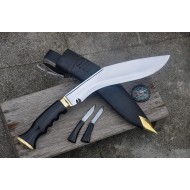
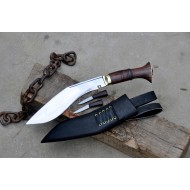
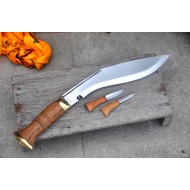
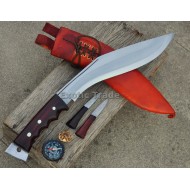
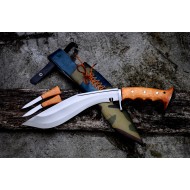
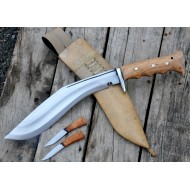
- Model: official issue kukri
- Product Code: Camouflageissue
- Location: Kathmandu, Nepal
Available Options
The Service No.1 Camouflage Issue Khukuri — Whitewood-Handle Field-Operational Variant of the BSI Service Kukri, Built for Active Patrol and Deployment Use
The Service No.1 Camouflage Issue Kukri — also called the Camouflage Issue Khukuri or the Field Service Kukri — is the camouflage-scabbard variant of the British Brigade of Gurkhas Service No.1 issue khukuri, configured for active field deployment and operational patrol use. Same 10.5-inch polished BSI Service No.1 blade as the standard duty issue, same whitewood handle as the Peace Keeper UN variant — but with the distinctive camouflage cotton cover scabbard that signals genuine field-operational kit rather than presentation or duty issue.
Where the Peace Keeper khukuri sits in the soldier's kit for diplomatic, observer, and protocol roles (clean white scabbard, ceremonial-grade presentation), the Camouflage Issue takes its place for active patrol, field exercise, and operational use. Many UN-deployed and field-active Gurkhas carry both — white scabbard for inspection and parade, camouflage scabbard for actual patrol. This is the working-field companion to the Peace Keeper presentation variant.
- Blade: 10.5" polished 5160 high-carbon spring steel, water-tempered (same as standard Service No.1)
- Handle: 5" full-tang polished whitewood with finger grip (same as Peace Keeper)
- Total length: 16.5"
- Weight: ~700g with scabbard
- Scabbard: Cotton-wood core wrapped in camouflage-pattern cotton cloth, hand-stitched
- Included: Karda (utility knife) + Chakmak (sharpener)
- Forged by: Kami caste smiths, Tokha-3 Kathmandu, Nepal
Why a Camouflage Scabbard Configuration Exists
Across military forces worldwide, soldiers carry the same edged weapon in different sheath configurations depending on the role being performed. Parade and inspection require clean, polished, presentation-grade carrying gear. Active patrol and field deployment require gear that blends with terrain and tactical uniform.
For the Brigade of Gurkhas and allied forces, the Service No.1 Camouflage Issue serves this field-operational role:
- Field deployment patrol — Gurkha units deployed on active patrols (UN peacekeeping, COIN operations, jungle deployments) carry the camouflage variant rather than the brown buffalo-hide standard issue. The camouflage cotton blends with combat uniform and terrain.
- Training exercises in operational kit — soldiers training in tactical configuration carry kit that matches what they'd take on actual deployment. Camouflage scabbard matches camouflage uniform.
- Field-use kit for veterans and outdoor users — bushcrafters, hunters, overland travellers, survival-kit builders who want a working kukri in genuine operational-aesthetic gear rather than parade-aesthetic leather.
- Distinguishing operational role from duty role — the same soldier might carry the standard horn-handle Service No.1 for parade, the Dress Knife for ceremonial inspection, the Peace Keeper for UN protocol duties, and the Camouflage Issue for actual field patrol. Four khukuris, four roles, one Brigade kit.
The blade itself is unchanged — same 10.5" polished BSI khukuri specification, same metallurgy, same forge. The Camouflage Issue is a configuration choice for buyers whose use case is active field carry, not display or presentation.
How the Camouflage Issue Fits in the Service No.1 Family
The Service No.1 pattern is the foundational Brigade of Gurkhas khukuri. Everest Forge offers five configurations of the Service No.1, each for a different role in the soldier's kit:
- Standard BSI Service No.1 — traditional buffalo horn handle, brown buffalo leather scabbard. The duty and parade issue, as carried since enlistment. $94.99
- Service No.1 Gripper Handle — contoured buffalo horn with finger indexing, traditional scabbard. The working/duty variant preferred by long-service Gurkhas. $99.99
- Service Ceremonial Dress Knife — mirror-polished blade, patent leather scabbard, brass fittings. The formal ceremonial parade issue. $99.99
- Service No.1 Peace Keeper — polished whitewood handle, white buffalo leather scabbard. The UN peacekeeping diplomatic/protocol variant. $99.99
- Service No.1 Camouflage Issue (this listing) — polished whitewood handle, camouflage cotton scabbard. The field-operational patrol variant. $99.99
All five khukuris share the same 10.5" BSI Service No.1 blade specification. Each differs in handle material, scabbard, and intended role. Many serving Gurkhas accumulate multiple configurations across their career; collectors aiming for the complete Brigade khukuri kit usually target the full five.
Camouflage Issue vs Peace Keeper — How to Choose Between the Two Whitewood Variants
The Camouflage Issue and the Peace Keeper khukuri share the same handle (whitewood) and the same blade (10.5" BSI Service No.1). The only difference is the scabbard, which reflects two different soldier use cases:
Service No.1 Peace Keeper (white buffalo leather scabbard):
- UN peacekeeping diplomatic, observer, and protocol roles
- Inspection, parade, ceremonial duties on deployment
- The "clean" presentation variant — photographed alongside UN officials, visiting dignitaries
- Veteran retirement and commemorative pieces
- Display-grade aesthetic suitable for diplomatic gift presentation
Service No.1 Camouflage Issue (camouflage cotton scabbard — this listing):
- Active field patrol, operational deployment, tactical training
- Bushcraft, hunting, overland travel, survival kit configuration
- The "working" companion variant — carried on actual operations
- Veterans of active field service who want a kukri that reflects how it was actually carried, not how it was displayed
- Operational aesthetic suitable for hard-use ownership
For UN peacekeeping veterans specifically: many soldiers carry both. The Peace Keeper for inspection, protocol, and presentation; the Camouflage Issue for actual patrol and field use. Buy both together and we will engrave a matching motif on each at no extra cost.
Why This Specific Camouflage Issue Khukuri
What separates the Everest Forge Camouflage Issue from generic Service No.1 listings with a camouflage scabbard:
Direct supply credential. Everest Forge supplied the BSI Service No.1 specification under the 2008 British Gurkha Army contract. The blade on this page is forged to that exact specification — by the same workshop and smiths who supplied the contract. The Camouflage Issue handle and scabbard configuration is built on that BSI foundation, not a separate inferior pattern.
Kami caste lineage. Our smiths are Kami — the hereditary blacksmith caste of Nepal that has forged kukris for the Gurkhas since the regiment's founding in 1815. Meet the smiths who forge every blade.
5160 spring steel, water-tempered. Differential hardness — edge 58–60 HRC, belly 45–46 HRC, spine 22–25 HRC. Identical metallurgy to the standard Service No.1 — the camouflage scabbard is the differentiator, not a downgraded blade.
Authentic whitewood handle. Hand-shaped from polished whitewood with the traditional Service No.1 finger-grip profile. Full-tang construction. Same handle as the Peace Keeper variant — interchangeable hand-feel between the two products for buyers who own both.
Genuine camouflage cotton scabbard. Cotton-wood core wrapped in camouflage-pattern cotton cloth (not painted leather, not printed plastic). Hand-stitched. The cotton wrap is the same material category used on field-operational scabbards across our range (including the Afghan Issue Kukri) — genuine field gear, not a decorative finish.
Free personalisation. Engrave a deployment year, mission marker, regiment, name, or family dedication. Up to ~30 characters. Free on every order. Common requests on the Camouflage Issue: deployment year and theatre, regiment marker ("RGR", "QGE", "QOGLR"), field exercise name, retirement marker, service span, name in English or Nepali Devanagari script.
Photo approval before dispatch. We photograph your finished khukuri — including the engraving — and send the images for your sign-off before shipping. If anything looks off, we re-forge.
30-day refund guarantee + DDP worldwide shipping. Duties and taxes paid upfront via DHL Express / FedEx. You pay one price; nothing more on arrival. Tracked door-to-door, typically 10–14 days from order to delivery.
Who Buys the Camouflage Issue Kukri
Veterans of active field deployment — Gurkhas, US, UK, Australian, Canadian, NATO service members who carried the kukri on actual patrol rather than parade. The camouflage scabbard reflects how the kukri was carried during operational service, not how it was displayed afterward.
UN peacekeeping veterans (field-operational use) — those who served on active patrols in Sierra Leone, East Timor, Cyprus, Lebanon, Bosnia, Kosovo. The Camouflage Issue is the field-companion khukuri to the Peace Keeper protocol variant. Many veterans own both, engraved with the same mission marker.
Working buyers and field users — bushcrafters, hunters, overland travellers, survival-kit builders who want a working khukuri with authentic Brigade lineage. The camouflage scabbard reads as "I use this kukri" rather than "I display this kukri."
Tactical and outdoor collectors — those building collections of field-operational edged weapons. The Camouflage Issue is the most overtly tactical-aesthetic khukuri in our current-issue range.
Veterans who served alongside Gurkhas — coalition forces, allied units, multinational deployments. The Camouflage Issue, engraved with the soldier's own service marker, becomes a personal khukuri commemoration of joint Gurkha service.
Buyers building the Service No.1 family — collectors aiming for the complete five-piece Brigade khukuri khukuri kit (Standard, Gripper Handle, Dress Knife, Peace Keeper, Camouflage Issue). The Camouflage Issue completes the field-operational corner of the family.
Full Specification
| Blade length | 10.5" (26.67 cm) |
|---|---|
| Total length | 16.5" (41.91 cm) — tip to pommel |
| Handle length | 5" (12.7 cm) — full tang |
| Steel | 5160 high-carbon spring steel, hand-forged |
| Heat treatment | Water-tempered for differential hardness |
| Blade hardness | Edge 58–60 HRC, Belly 45–46 HRC, Spine 22–25 HRC |
| Blade finish | Polished (identical to standard Service No.1 BSI specification) |
| Handle material | Polished whitewood, full-tang construction, finger-grip shaping |
| Scabbard | Cotton-wood core wrapped in camouflage-pattern cotton cloth, hand-stitched |
| Weight | ~700g (1.54 lb) with scabbard |
| Origin | Tokha-3, Kathmandu, Nepal |
| Production | Hand-forged after order (5–7 days forging time) |
Each kukri is individually hand-forged and hand-finished. Minor variations in whitewood grain, scabbard pattern alignment, and finish are part of the craft.
What's Included
- Service No.1 Camouflage Issue Kukri — polished 10.5" blade with full-tang whitewood handle
- Karda — small utility knife (traditional companion blade)
- Chakmak — sharpening steel / fire striker (traditional companion tool)
- Camouflage cotton scabbard — hand-stitched over cotton-wood core, with karda + chakmak pockets
- Free text personalisation — up to ~30 characters, engraved on the blade
- Certificate of authenticity from Everest Forge
- Photo-approval images sent before dispatch
Import & Knife Law — Read Before Ordering
- UK: Curved blades over 50 cm fall under specific legislation. The Camouflage Issue blade is 26.67 cm — well under the limit — but carry in public requires lawful reason.
- Australia: Some states require permits for certain blade types. Check your state's edged-weapons schedule.
- USA: Federally legal for import as a knife. Carry and ownership rules vary by state and city — check local statutes.
- EU: Importable in most member states with applicable duties. We ship DDP (duties paid).
- Canada, NZ: Generally importable; carry rules vary by province/jurisdiction.
Related Khukuri Patterns
The Camouflage Issue sits within the Service No.1 family alongside the Standard, Gripper Handle, Dress Knife, and Peace Keeper variants. Buyers commonly compare or commission alongside:
- Service No.1 Peace Keeper — sister whitewood variant with white buffalo leather scabbard for UN protocol/inspection roles ($99.99)
- Standard BSI Service No.1 Kukri — traditional horn-handle duty issue ($94.99)
- Service No.1 Gripper Handle — working-grip variant with contoured horn ($99.99)
- Service Ceremonial Dress Knife — mirror-polished ceremonial parade variant ($99.99)
- Official Afghan Issue Kukri — the AEOF combat variant with camouflage cotton scabbard (sister field-operational variant) ($119.99)
- Jungle PRI Training Kukri — the working/field training counterpart ($89.99)
- Browse all current-issue military khukuris
Want to understand the parts of a kukri? See our Kukri / Khukuri Terminology Guide.
Frequently Asked Questions
What is the Service No.1 Camouflage Issue Kukri?
The Camouflage Issue is the field-operational variant of the Brigade of Gurkhas Service No.1 issue kukri. Same 10.5-inch polished BSI Service No.1 blade as the standard duty issue, same whitewood handle as the Peace Keeper UN variant — but with a camouflage cotton cover scabbard configured for active field patrol, tactical training, and operational deployment use rather than parade or protocol. The camouflage cotton scabbard blends with combat uniform and terrain, where the standard brown buffalo hide stands out.
How is this different from the Peace Keeper variant?
Same handle (whitewood) and same blade (10.5" BSI Service No.1). The only difference is the scabbard. The Peace Keeper has a white buffalo leather scabbard — the UN protocol/diplomatic variant for inspection, parade, and ceremonial use. This Camouflage Issue has a camouflage cotton scabbard — the field/operational variant for active patrol, tactical training, and combat use. Many UN-deployed Gurkhas carry both khukuris: Peace Keeper for inspection and protocol, Camouflage Issue for actual patrol.
How is this different from the Standard Service No.1?
Same blade specification (10.5" polished 5160 steel, water-tempered, BSI lineage), same forge, same Kami caste smiths. The differences are handle and scabbard. The standard Service No.1 uses traditional buffalo horn handle and brown buffalo leather scabbard (parade and duty issue). The Camouflage Issue uses polished whitewood handle and camouflage cotton scabbard (field-operational issue). Same blade DNA, different role in the soldier's kit.
What is the scabbard made of?
The scabbard has a traditional cotton-wood inner core (a wooden skeleton wrapped around the blade for rigidity and protection), wrapped externally in camouflage-pattern cotton cloth. This is genuine field-operational scabbard construction — not painted leather, not printed plastic. The same material category used on our Afghan Issue Kukri (the AEOF combat variant). Authentic field gear configured for active carry.
Is this an official BSI Service No.1?
Yes — the blade is forged to the BSI Service No.1 specification, the same standard supplied to the British Gurkha Army under our 2008 contract. The Camouflage Issue handle and scabbard configuration is built on that BSI foundation. The kukri carries the same Brigade lineage as the standard Service No.1; it differs only in handle material and scabbard.
Why is the handle whitewood rather than buffalo horn?
Whitewood is the light-coloured hardwood used historically by Gurkha soldiers as an alternative handle material when buffalo horn was unavailable or impractical. It's also the handle material used on the Peace Keeper UN variant — the two whitewood-handle products form a paired set within the Service No.1 family. Whitewood is lighter than buffalo horn, hand-comfortable for extended carry, and visually distinctive against camouflage scabbard cotton.
Can I get a deployment year, regiment, or name engraved?
Yes — free of charge. Add your engraving text at checkout. Up to approximately 30 characters. Common requests on the Camouflage Issue: deployment year and country ("BG 2010 / AFG"), regiment marker ("RGR" Royal Gurkha Rifles, "QGE" Queen's Gurkha Engineers, "QOGLR" Queen's Own Gurkha Logistic Regiment), unit designation, field exercise name, service span, retirement marker, name in English or Nepali Devanagari script.
What is the blade hardness (Rockwell)?
The blade is water-tempered for traditional differential hardness: edge 58–60 HRC for cutting performance, belly 45–46 HRC, spine 22–25 HRC for shock absorption. Identical zone hardening to the standard Service No.1 — the Camouflage Issue configuration changes the handle and scabbard, not the blade metallurgy.
Is this kukri suitable for bushcraft and outdoor use?
Yes — this is one of the most suitable Service No.1 variants for active outdoor and field use. The 10.5" polished blade handles chopping, batoning, and clearing work. The full-tang whitewood handle takes hard use without loosening. The camouflage cotton scabbard is genuine field-operational gear that handles weather and wear in ways patent leather and polished buffalo hide don't. For buyers who want a working khukuri with authentic Brigade lineage, this is the configuration that fits.
Should I buy this or the Peace Keeper if I'm choosing one?
Depends on your intended use. If you're buying for display, gift presentation, ceremonial use, UN protocol commemoration, or "the kukri I keep" — choose the Peace Keeper (white buffalo leather scabbard). If you're buying for active outdoor carry, bushcraft, hunting, field exercise, deployment commemoration where the kukri reflects "how I actually carried it" — choose this Camouflage Issue (camouflage cotton scabbard). Many serving and retired Gurkhas own both.
What's included with the khukuri?
You receive the Service No.1 Camouflage Issue Kukri, traditional Karda (small utility knife), Chakmak (sharpening steel), hand-stitched camouflage cotton scabbard over cotton-wood core with karda/chakmak pockets, certificate of authenticity, and photo-approval images sent before dispatch.
How long until it ships, and how is it sent?
Forging takes 5–7 days from order. Shipping via DHL Express or FedEx International Priority, fully tracked, typically 5–7 days delivery. Total order-to-door: approximately 10–14 days. All shipments are DDP — duties and taxes paid upfront, nothing to pay on arrival.
| Specification | |
| Blade: | 10.5 inches, hand-forged from 5160 high-carbon steel |
| Total Length: | 16.5 inches overall |
| Handle: | 5-inch full tang handle crafted from buffalo horn |
| Weight: | 700 grams including blade and sheath |
| Note: | Each kukri is individually handcrafted in Nepal; minor variations in size, weight, and finish enhance the authenticity and uniqueness of each piece. |