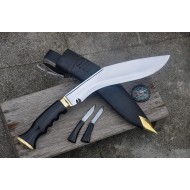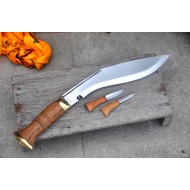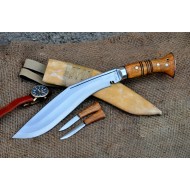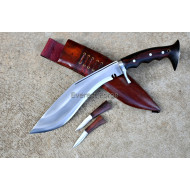


- Model: official issue kukri
- Product Code: Iraqigripper
- Location: Kathmandu, Nepal
Available Options
Iraqi Gripper Kukri — The Op Telic Tactical Variant | 10" Angkhola Blade with Steel Guard, Carved Gripper Handle, Sadha Wood Panawal Construction
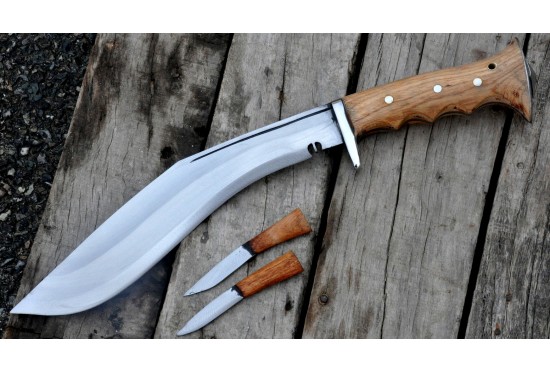
The Iraqi Gripper Kukri is the most actively hand-protective khukuri in our Op Telic Iraq-deployment range. It carries the same hand-forged Angkhola blade pattern that Gurkhas adapted for desert carry during Operation Telic — but pairs it with two distinct tactical hand-protection upgrades not found on any sister product: a steel guard between blade and handle, and carved finger grooves in the Sadha wood grip face. The result is the Iraq-pattern kukri configured for sustained hard use, where blade retention and hand protection are non-negotiable.
Where the 11-inch Operational Iraqi Freedom Kukri is the smooth-handle heritage Op Telic variant, this Iraqi Gripper is the tactical-construction variant — same WWII-era blade DNA, restructured for the buyer who plans to swing this kukri hard in the field. Steel guard prevents the hand sliding forward onto the cutting edge under impact. Finger grooves lock the grip against rotation under sweat, oil, or rain. Together they make this the safest Iraqi-pattern kukri in active use.
- Blade: 10" semi-polished hand-forged Angkhola, high-carbon spring steel, water-tempered edge
- Steel Guard: Forged steel cross-guard between blade and handle for hand protection under impact
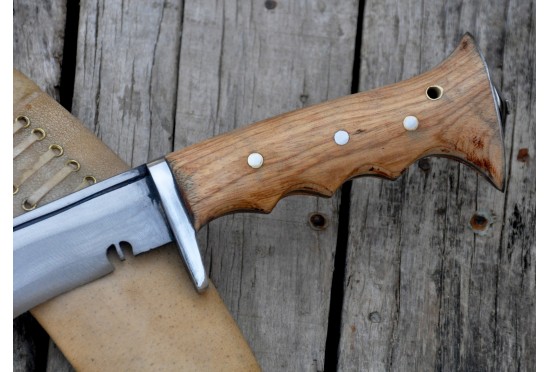
- Handle: 5" full-tang Sadha wood, Panawal pattern with aluminium rivets, carved finger grooves
- Tang: Panawal full flat tang — visible on both sides of the handle
- Blade profile: Angkhola (fullered, central spine reinforced)
- Total length: 15"
- Weight: ~900g including Karda and Chakmak
- Scabbard: Cotton-covered buffalo leather over wood core, hand-stitched
- Included: Karda (utility knife) + Chakmak (sharpener)
- Forged by: Kami caste smiths, Tokha-3 Kathmandu, Nepal
Why the Guard Matters — The Tactical Upgrade No Other Iraq Kukri Has
Most kukris — including the entire Op Telic Iraqi Freedom family, the Afghan Issue AEOF family, and every Service No.1 variant — have no guard. The handle transitions directly from the blade. This is the traditional Nepalese pattern, and for ceremonial carry, parade, and light use it is correct.
Under hard combat or working use, the absence of a guard creates one specific risk: the hand sliding forward onto the cutting edge. This happens when a blade lodges in heavy material and the user drives forward on the swing follow-through, or when the grip becomes wet, sweaty, or oiled under sustained chopping. A finger meeting the inside curve of a sharpened kukri edge is a serious injury.
The Iraqi Gripper resolves this with two compounding upgrades:
- Steel guard. A forged steel cross-piece sits between the blade ricasso and the handle. The guard physically stops the hand from advancing onto the edge regardless of grip condition. This is the same protection principle as a Western combat knife guard — applied to the kukri pattern.
- Carved gripper grooves. Three finger grooves cut into the Sadha wood grip face. The grooves lock the hand into a consistent grip position. Even before the guard becomes structurally necessary, the grooves prevent the hand from migrating forward under impact.
For the buyer who actually intends to use this kukri — bushcraft, hunting camp utility, batoning, sustained clearing, hard chopping — the guard and gripper combination is the meaningful tactical upgrade. For ceremonial display or parade carry, the smooth-handle Operational Iraqi Freedom is the correct choice. The Iraqi Gripper is the working tool.
How the Iraqi Gripper Fits in the Op Telic Family
The British Brigade of Gurkhas deployed to Iraq under Operation Telic — the British military operation name covering the Iraq theatre, March 2003 to May 2011. The Brigade served alongside Coalition forces, who operated under the American Operation Iraqi Freedom (OIF) name across the same theatre. Everest Forge offers the Iraq-deployment kukri in two configurations:
- Operational Iraqi Freedom Kukri — 11" Angkhola blade, smooth Panawal Sadha handle (no gripper, no guard), cream/desert scabbard. The heritage Op Telic carry pattern. ($119.99)
- Iraqi Gripper Kukri — Sadha Wood / Standard Scabbard (this listing) — 10" Angkhola blade with steel guard + carved gripper grooves, Sadha wood Panawal handle. The tactical-construction Op Telic variant. ($119.99)
- Iraqi Gripper Kukri — Rosewood / Red Sheath — 10" Angkhola gripper with rosewood handle and red buffalo leather scabbard. The heritage-finish gripper variant. ($119.99)
This Iraqi Gripper (Sadha wood / standard scabbard) is unique in the family for one reason that matters: it is the only Op Telic kukri with a steel guard. Both the smooth Iraqi Freedom and the Red Sheath sister are guardless. The combination of operational-finish Sadha wood + carved gripper + steel guard makes this the full-tactical-construction Iraq carry — the configuration for the buyer who wants every available hand-protection upgrade.
The 10-inch blade length is slightly shorter than the 11-inch smooth Iraqi Freedom. This is intentional — a shorter blade is easier to wield in confined chopping work, accepts the steel guard cleanly, and balances better in the hand with the added weight of the guard fitting. The blade is otherwise the same Angkhola pattern, same 5160 steel, same water-tempered edge.
The Angkhola Blade — WWII Pattern, Iraq Deployment Trim
The Angkhola blade profile is the WWII-era Gurkha pattern, returned to active service for the Iraq deployment. The defining feature is the long central fuller running along each side of the blade — reinforcing the central spine while removing weight from the panels. The structural principle is the same as an I-beam: strength from geometry, not from mass.
For the Iraq deployment, the Angkhola was chosen because the weight-to-chop ratio is excellent for long operational carry, and the semi-polished finish reduces dust adhesion and visual signature. This Iraqi Gripper carries the 10-inch version of the same Angkhola pattern that the 11-inch Iraqi Freedom uses — same blade DNA, same forge, same Kami caste smiths. The shorter length pairs cleanly with the added guard and gripper construction.
5160 high-carbon spring steel, water-tempered for traditional Nepalese differential hardness: edge 58–60 HRC, belly 45–46 HRC, spine 22–25 HRC. The hard cutting edge delivers chopping performance and edge retention under hard use; the softer spine absorbs shock without fracturing.
The Panawal Handle — Built for Tactical Carry
The handle is Panawal — the full flat tang construction where the steel of the blade runs the full length and width of the grip. Sadha wood scales are mechanically locked to the tang with aluminium rivets, visible on both sides of the handle. This is structurally stronger than the rat-tail tang pattern used on civilian and parade kukris, where the tang runs as a narrow rod through a drilled handle.
The grip face is hand-carved with three finger grooves cut into the Sadha wood. The grooves are not moulded or glued overlays — they are carved into the solid wood, then sealed and oiled. The spacing matches the natural splay of the working hand at the moment of impact.
Sadha wood is a Nepalese hardwood with pale honey-to-cream grain — lighter in colour and weight than rosewood, historically the wood chosen for operational and desert deployments. The lighter colour blends to desert combat uniform; the lighter weight balances the additional mass of the steel guard without making the whole kukri front-heavy.
Steel bolster and steel pommel cap the grip assembly. With the steel guard at the blade end, the entire grip is reinforced with metal fittings at three points — bolster, guard, and pommel — making this the most structurally hand-secured kukri in our Op Telic range.
Why This Specific Iraqi Gripper
What separates the Everest Forge Iraqi Gripper from generic "Iraqi operation gripper kukri" listings:
Steel guard. The forged steel cross-guard between blade and handle is unique to this configuration. No competing commercial Iraq-operation kukri from the major Nepalese forges (KHHI, EGKH) includes a guard. Buyers searching for a tactical kukri with hand protection — comparable to Western combat-knife construction — end up at this product.
Op Telic Brigade framing. Most "Iraqi Operation Freedom" kukri listings sold from Nepal use the American operation name. The British Brigade of Gurkhas deployed under Operation Telic. The Op Telic framing matters to veterans, to Royal Gurkha Rifles collectors, and to anyone who actually knows the deployment history.
Kami caste lineage. Our smiths are Kami — the hereditary blacksmith caste of Nepal that has forged kukris for the Gurkhas since the regiment's founding in 1815. Meet the smiths who forge every blade.
5160 spring steel, water-tempered, 58–60 HRC edge. Many commodity Iraq-pattern kukris from larger production forges run an edge hardness around 55–57 HRC. The 3-point Rockwell advantage means longer edge retention between sharpenings.
Genuine Panawal full-tang construction. The blade tang extends the full length and width of the handle. Sadha wood scales are mechanically locked with aluminium rivets, visible on both sides. Not a friction-fit rat-tail tang, not a glued overlay.
Carved gripper, not moulded. The three finger grooves are cut into solid Sadha wood by hand, one at a time, then sealed and oiled. No synthetic insert, no rubber grip wrap.
Karda and Chakmak included. Traditional companion tools — a small utility knife for skinning and fine work, and a steel for sharpening and fire-striking. Housed in dedicated pockets on the scabbard back.
Free personalisation. Engrave a deployment year, regiment marker, name, or dedication. Up to ~30 characters. Free on every order — not an upsell, not "on request." Common Op Telic requests: deployment year and country ("IRQ 2007", "TELIC 5"), regiment marker ("RGR" Royal Gurkha Rifles, "QGE" Queen's Gurkha Engineers, "QG SIG" Queen's Gurkha Signals), name in English or Nepali Devanagari script.
Photo approval before dispatch. We photograph your finished khukuri — including any engraving — and send the images for your sign-off before shipping. If anything looks off, we re-forge.
30-day refund guarantee + DDP worldwide shipping. Duties and taxes paid upfront via DHL Express / FedEx. You pay one price; nothing more on arrival. Tracked door-to-door, typically 10–14 days from order to delivery.
Who Buys the Iraqi Gripper
Op Telic veterans wanting the tactical-construction Iraq pattern — soldiers who served in Iraq with Royal Gurkha Rifles, Queen's Gurkha Engineers, Queen's Gurkha Signals, or attached Brigade units. The Iraqi Gripper carries the Op Telic blade in the working-construction configuration — the variant for the veteran who plans to use the kukri rather than display it.
Working kukri users and bushcrafters — the steel guard prevents the hand sliding onto the edge under sustained chopping. The carved gripper grooves prevent rotation under wet or oiled grip. The full-tang Panawal construction handles batoning load. For active use in field conditions, this is the safest configuration in our Op Telic range.
Hunters and game-processing users — the 10-inch blade length is sized for game-processing tasks where a longer 11–14" chopping blade is unwieldy. The steel guard adds safety margin during the precise edge work that game-dressing requires.
Buyers comparing tactical kukris to Western combat knives — full-tang construction, carved finger grooves, steel guard. The Iraqi Gripper offers the construction standard of Western tactical knives (Cold Steel, KA-BAR, similar) with genuine Op Telic deployment lineage behind it.
Buyers building the complete Op Telic family — collectors aiming for all three Iraqi configurations (smooth Iraqi Freedom, Sadha Gripper, Red Sheath Gripper). The Sadha Gripper completes the family as the full-tactical-construction operational corner.
First-time buyers wanting maximum hand-protection — those new to the kukri who are uncertain about handling a curved chopping blade. The guard is the safety feature that makes the kukri less intimidating to handle for buyers without prior experience.
Full Specification
| Blade length | 10" (25.4 cm) |
|---|---|
| Total length | 15" (38.1 cm) — tip to pommel |
| Handle length | 5" (12.7 cm) — full Panawal tang, carved gripper |
| Guard | Forged steel cross-guard between blade and handle |
| Steel | 5160 high-carbon spring steel, hand-forged |
| Heat treatment | Water-tempered for differential hardness |
| Blade hardness | Edge 58–60 HRC, Belly 45–46 HRC, Spine 22–25 HRC |
| Blade finish | Semi-polished (Op Telic operational specification) |
| Blade profile | Angkhola (fullered, central spine reinforced) |
| Tang construction | Panawal full flat tang with aluminium rivets |
| Handle material | Nepalese Sadha wood, hand-carved finger grooves, aluminium-riveted scales |
| Bolster / Pommel | Steel fittings for tactical-carry durability |
| Scabbard | Cotton-covered buffalo leather over wood core, hand-stitched |
| Weight | ~900g (1.98 lb) including blade, sheath, Karda, and Chakmak |
| Origin | Tokha-3, Kathmandu, Nepal |
| Production | Hand-forged after order (5–7 days forging time) |
Each khukuri is individually hand-forged and hand-finished. Minor variations in Sadha wood grain, guard finish, rivet alignment, and dimension are part of the craft.
What's Included
- Iraqi Gripper Kukri — semi-polished 10" Angkhola blade with steel guard, carved Sadha wood gripper handle
- Karda — small utility knife (traditional companion blade)
- Chakmak — sharpening steel / fire striker (traditional companion tool)
- Cotton-covered buffalo leather scabbard over wood core — hand-stitched, with Karda + Chakmak pockets
- Free text personalisation — up to ~30 characters, engraved on the blade
- Certificate of authenticity from Everest Forge
- Photo-approval images sent before dispatch
The Op Telic Tactical Pair — Iraqi Gripper Sadha + Red Sheath
For Op Telic veterans, collectors, and serious users building a complete tactical Iraq kit, the Sadha Gripper pairs naturally with the rosewood Red Sheath sister as the operational-finish vs heritage-finish pair. Both share the same 10" Angkhola blade, same steel guard, same carved gripper, same Panawal construction. They differ only in wood and scabbard:
- Iraqi Gripper — Sadha Wood / Standard Scabbard (this listing) — operational/desert finish ($119.99)
- Iraqi Gripper — Rosewood / Red Sheath — heritage/keepsake finish ($119.99)
Buy both together and we will engrave a matching deployment marker (year, regiment, name) on each at no extra cost — same Op Telic marker on the operational kukri and the heritage kukri.
Import & Knife Law — Read Before Ordering
- UK: Curved blades over 50 cm fall under specific legislation. The Iraqi Gripper blade is 25.4 cm — well under the limit — but carry in public requires lawful reason.
- Australia: Some states require permits for certain blade types. Check your state's edged-weapons schedule.
- USA: Federally legal for import as a knife. Carry and ownership rules vary by state and city — check local statutes.
- EU: Importable in most member states with applicable duties. We ship DDP (duties paid).
- Canada, NZ: Generally importable; carry rules vary by province/jurisdiction.
Related Khukuri Patterns
The Iraqi Gripper sits within the Op Telic Iraq-theatre family and the wider tactical-construction line for buyers comparing across deployment ranges. Buyers commonly compare or commission alongside:
- Operational Iraqi Freedom Kukri — 11" smooth-handle Op Telic carry, no gripper, no guard ($119.99)
- Iraqi Gripper — Rosewood / Red Sheath — heritage-finish tactical variant ($119.99)
- Afghan Issue — White Sadha Gripper — Op Enduring Freedom tactical-operator gripper, no guard ($124.99)
- Afghan Issue — Red Rosewood Gripper — Op Enduring Freedom heritage-finish gripper, no guard ($119.99)
- Tactical Defender Kukri — 11" combat-purpose blade with full guard, sister tactical product
- Service No.1 Gripper Handle — British Brigade duty-issue gripper variant ($99.99)
- Browse all current-issue military khukuris
Want to understand the parts of a kukri? See our Kukri / Khukuri Terminology Guide.
Frequently Asked Questions
What makes the Iraqi Gripper different from the smooth Iraqi Freedom kukri?
Two distinct tactical upgrades. The Iraqi Gripper has a steel guard between the blade and handle (the smooth Iraqi Freedom has none) and carved finger grooves in the Sadha wood grip face. Both upgrades protect the hand under sustained chopping and prevent the grip from migrating onto the cutting edge. The blade is also 10 inches on the Gripper vs 11 inches on the Iraqi Freedom — the shorter length pairs cleanly with the added guard and balances better in the hand. Same Angkhola pattern, same 5160 steel, same forge. Different configuration for different use cases.
What does the steel guard actually do?
The guard is a forged steel cross-piece that sits between the blade ricasso and the handle. Its function is to physically stop the hand from sliding forward onto the cutting edge during heavy use. This matters in three specific situations: when a blade lodges in heavy material and the user drives forward on the swing follow-through; when the grip becomes wet, sweaty, or oiled under sustained chopping; and when the user is unfamiliar with handling a curved chopping blade. Most kukris have no guard — the traditional Nepalese pattern is a smooth handle-to-blade transition. The guard is a tactical upgrade applied here for the buyers who actually plan to use the kukri hard.
Is this kukri actually issued to Gurkhas or is it a commercial product?
The blade pattern is forged on the WWII-era Gurkha Angkhola specification, which was the private-purchase carry blade adopted for Iraq deployment use. It is not a standard-issue kukri — the British Brigade of Gurkhas does not issue gripper-handle or guarded kukris as standard. Soldiers who carried this pattern in Iraq did so as personal-carry equipment. We forge it commercially using the same Angkhola pattern and the same Kami caste smiths. The Op Telic framing reflects the deployment context of the pattern, not a claim of official issue.
Why Op Telic framing instead of "Operation Iraqi Freedom"?
Operation Telic is the British military operation name for the Iraq deployment (2003–2011). The Brigade of Gurkhas served under that operational name across multiple rotations — Royal Gurkha Rifles, Queen's Gurkha Engineers, Queen's Gurkha Signals among them. The American operation name was Operation Iraqi Freedom (OIF). Both are correct for the same theatre, depending on national context. We use both names — Op Telic for the Brigade-of-Gurkhas framing, Iraqi Freedom for buyers searching the American operation name. Same blade, two operational names.
What is an Angkhola blade?
Angkhola refers to the deep-fullered blade profile where a long groove is cut along each side of the blade, reinforcing the central spine while removing weight from the panels. The structural principle is the same as an I-beam: strength comes from geometry, not from mass. The Angkhola pattern is the WWII-era Gurkha private-purchase blade, reintroduced for desert deployment because the weight-to-chop ratio is excellent for long operational carry.
What is a Panawal handle?
Panawal is the full flat tang construction — the steel of the blade extends the full length and width of the handle, with handle scales (Sadha wood in this case) mechanically fastened to either side of the tang with aluminium rivets. The metal is visible on both sides of the grip. Panawal is structurally stronger than the traditional rat-tail tang construction used on civilian and parade kukris. For tactical and combat carry, Panawal is the construction that survives.
How does the blade hardness compare to competing Iraq-issue kukris?
The Iraqi Gripper blade is water-tempered for traditional Nepalese differential hardness: edge 58–60 HRC for cutting performance, belly 45–46 HRC, spine 22–25 HRC for shock absorption. Many commodity Iraq-pattern kukris from larger production forges run an edge hardness around 55–57 HRC — softer steel that's faster to forge but loses edge retention under hard use. The 3-point Rockwell difference is the difference between resharpening once a season and resharpening every weekend.
Is the gripper handle a separate piece or carved from the same wood?
It is carved from the same solid block of Nepalese Sadha wood. There is no insert, no overlay, no synthetic grip material, no rubber wrap. The finger grooves are cut into the wood itself by hand, one at a time, then sealed and oiled. This is one piece of wood, shaped by hand to the natural splay of the working grip.
Is this kukri sharpened and ready to use on arrival?
Yes. Every Iraqi Gripper Kukri ships with a working field edge — sharp enough to chop hardwood and carry out clearing work straight from the box. The Angkhola pattern is built for chopping rather than slicing, so we don't over-polish the edge into a razor finish — but the included Chakmak sharpener will bring it to your preferred edge.
Can I get this kukri with custom engraving?
Yes. Free engraving is included on every blade — not an upsell, not on request. You can request a deployment year, regiment, name, or dedication. Up to ~30 characters. Common Op Telic requests: deployment year and country ("IRQ 2007", "TELIC 5"), regiment marker ("RGR" Royal Gurkha Rifles, "QGE" Queen's Gurkha Engineers, "QG SIG" Queen's Gurkha Signals), service span, name in English or Nepali Devanagari script. The engraving is applied by hand on the left side of the blade before dispatch.
Where is this kukri made?
Every Iraqi Gripper Kukri is hand-forged in our workshop in Tokha-3, Kathmandu, Nepal, by Kami caste smiths — the hereditary blacksmith caste that has forged kukris for the Gurkhas since the regiment's founding in 1815. The 5160 spring steel is sourced locally, the Sadha wood is Nepalese, and the buffalo leather is tanned in Nepal. The blade does not pass through any other country before it reaches you.
How is the kukri shipped internationally and what about customs?
We ship worldwide via DHL Express or FedEx International Priority with full tracking. Most destinations arrive in 5–9 business days; forging time before dispatch is 5–7 days, so total order-to-door is approximately 10–14 days. All shipments are DDP — duties and taxes paid upfront. Nothing to pay on arrival.
Should I buy this Iraqi Gripper or the smooth Iraqi Freedom?
Depends on your use case. If you plan to actually use the kukri hard — bushcraft, batoning, sustained chopping, hunting camp utility — choose this Iraqi Gripper. The guard and gripper combination provide the hand protection that matters in active use. If you want the kukri for display, ceremonial carry, or commemorative ownership, choose the smooth-handle Operational Iraqi Freedom — heritage Op Telic pattern, no guard or gripper modifications, longer 11" blade. Many Op Telic veterans buy both as a use-and-display pair.
| Specification | |
| Blade: | 10 inches long, hand-forged from high-grade carbon steel |
| Total Length: | 15 inches overall |
| Handle: | 5-inch full tang handle made from Sadhan wood with finger grooves |
| Weight: | 900 grams including blade, sheath, Karda, and Chakmak |
| Note: | Each Iraqi Gripper Kukri is individually hand-forged using traditional methods, leading to slight variations in finish, weight, and dimensions. These natural differences add to the blade’s authenticity and unique craftsmanship, making every piece one-of-a-kind. |
-190x190w.jpg "Official Issue BSI Service No.1 Kukri / Khukuri – British Gurkha Standard Issue")