




- Model: official issue kukri
- Product Code: Afghanred
- Location: Kathmandu, Nepal
Available Options
The Heritage AEOF Khukuri — Rosewood Handle, Red Scabbard, the Variant Veterans Keep and Engrave
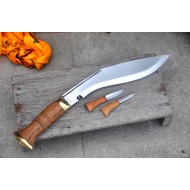
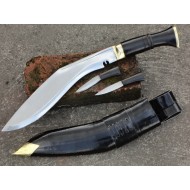
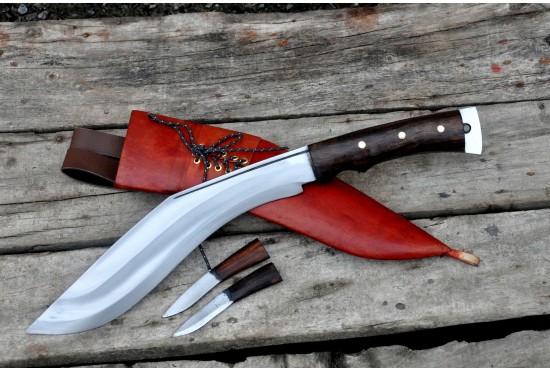
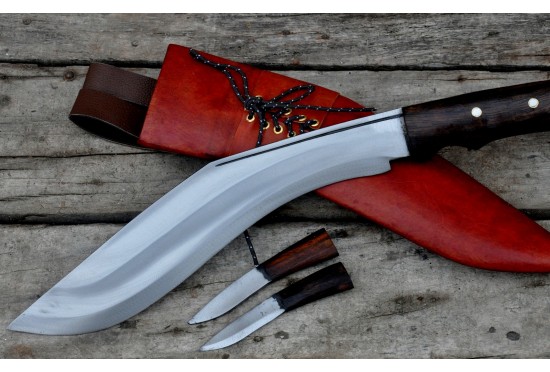
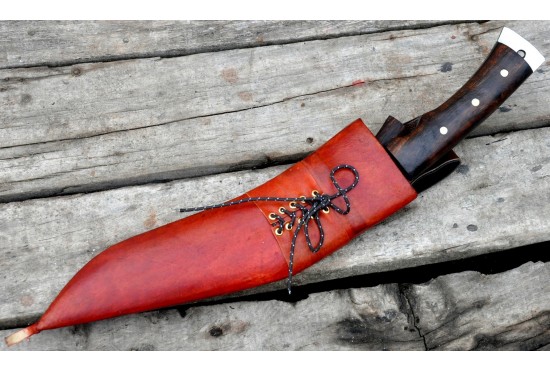
The Afghan Issue Kukri — Red, also called the Red AEOF Khukuri or Rosewood Afghan Kukri, is the heritage-collector variant of the modernised Gurkha combat blade designed for Operation Enduring Freedom. Same 11-inch chirra-fullered combat blade as the operational white-scabbard issue — but with the traditional rosewood handle that has defined Gurkha working kukris for generations, and a distinctive red buffalo leather scabbard that is the visually striking, ceremonial-leaning counterpart to the operational desert-camo white version.
Where the white-scabbard Afghan Issue is the desert-operational tool, the red rosewood khukuri is the variant Gurkha veterans keep, engrave with their deployment year, photograph, and pass to family. It's the configuration most often chosen for keepsake, display, and personalised commemorative pieces — the version buyers want when the kukri is meant to mean something, not just be used hard.
- Blade: 11" semi-polished 5160 high-carbon spring steel with chirra (double fuller), water-tempered
- Handle: 5.5" full-tang polished rosewood with lanyard hole, ergonomic finger grips
- Total length: 16.5"
- Weight: ~800g with scabbard
- Scabbard: Cotton-wood core wrapped in red buffalo leather, dual frogs, leather loops
- Included: Karda (utility knife) + Chakmak (sharpener) + lanyard cord
- Forged by: Kami caste smiths, Tokha-3 Kathmandu, Nepal
Why the Rosewood + Red Variant Exists
The AEOF (Afghanistan Enduring Operation Freedom) pattern was originally designed for desert deployment — white buffalo leather scabbard for terrain camouflage, lightweight Sadha wood handle for hot-climate operation. That's the operational issue. But not every buyer of an Afghan Issue khukuri is buying it for desert operations.
Over the years, demand emerged for the same modernised AEOF design in a more traditional, visually striking, keepsake-grade presentation. The result was the rosewood-handle red-scabbard variant — same blade, same combat engineering, but configured for buyers whose use case is different:
- Veteran retirement and commemoration — engraved with deployment year, regiment marker, or service dedication. The red scabbard makes the kukri visually distinctive when displayed alongside other military mementos.
- Heritage collection — modern Gurkha operational khukuris owned alongside Iraqi Freedom, BSI Service No.1, and historical replicas. The red scabbard distinguishes this piece visually in a multi-kukri collection.
- Gift and presentation — for serving Gurkhas, family members of Afghanistan veterans, or military historians. The rosewood + red presentation is more traditional and less utilitarian than the white desert configuration.
- Personal display piece — kept mounted in the home as a representation of modern Gurkha military service. The red scabbard reads as a deliberate ceremonial choice rather than operational equipment.
- Hard-use ownership with traditional aesthetics — for buyers who want the modern combat engineering (full tang, chirra blade, lanyard hole) but the warm rosewood feel of a traditional working khukuri.
This is the "keep and personalise" variant of the AEOF pattern. The operational performance is identical to the white-scabbard issue. The presentation is different.
Rosewood vs Sadha Wood Handle — How to Choose
If you're choosing between this rosewood-handle Red Afghan Issue and the Sadha-wood White Afghan Issue, the handle material is the most important difference. Honest breakdown:
Rosewood (this listing):
- Denser, heavier in the hand — better feel for buyers who want a substantial-feeling grip
- Warmer visual character — deep reddish-brown grain that polishes beautifully
- Ages with character — develops patina over time, especially with hand oils from regular handling
- Traditional working khukuri handle material — used across most heritage Gurkha patterns
- Better for keepsake and display — looks like an heirloom piece
Sadha wood (white scabbard version):
- Lighter, less dense — better for hot climate and extended carry
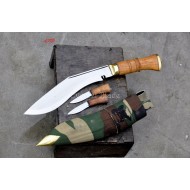
- Lighter colour — matches the desert-operational aesthetic of the white scabbard
- Easier to refinish if scratched
- Original operational handle of the AEOF pattern
- Better for buyers prioritising weight savings during use
Neither is "better" — they serve different buyer use cases. Rosewood for keepsake, display, and traditional hand feel. Sadha wood for operational lightness and desert-environment matching.
Why This Specific Red AEOF Khukuri
The Afghan Issue red-rosewood variant has been one of the best-selling kukris in the global market for over a decade — listed on Amazon, eBay, and major marketplaces by every Nepalese kukri house. What separates the Everest Forge version:
Direct-from-forge supply chain. No middleman, no marketplace inventory, no third-party reseller mark-up. The khukuri is forged in our Kathmandu workshop after you place your order. You're buying directly from the smiths who make it.
Kami caste lineage. Our smiths are Kami — the hereditary blacksmith caste of Nepal that has forged kukris for the Gurkhas since the regiment's founding. Meet the smiths who forge every blade.
Military supply credentials. Everest Forge has supplied kukris to the British Gurkha Army (BSI Service No.1 contract, 2008), Nepal Army (2015–2018), and Nepal Police (2016–2017). Verifiable contract history, not branding language.
5160 spring steel, water-tempered for differential hardness. Edge 58–60 HRC for cutting performance, belly 45–46 HRC, spine 22–25 HRC for shock absorption. Same metallurgy across our entire current-issue military range.
Authentic rosewood handle. Real Indian rosewood, hand-shaped to the AEOF gripper pattern with finger indexing. Full-tang construction with lanyard hole at the pommel for wrist-cord attachment.
Free personalisation — the key reason buyers choose direct over Amazon. Engrave a deployment year, regiment marker, service number, name, or family dedication on the blade. Up to ~30 characters. Free on every order. The single biggest reason this khukuri is bought as a keepsake from us rather than as a generic from a marketplace.
Photo approval before dispatch. We photograph your finished khukuri — including the engraving — and send the images for your sign-off before shipping. If anything looks off, we re-forge. Amazon and marketplaces ship blind.
30-day refund guarantee + DDP worldwide shipping. Duties and taxes paid upfront via DHL Express / FedEx. You pay one price; nothing more on arrival. Tracked door-to-door, typically 10–14 days from order to delivery. No customs surprises.
Who Buys the Red Rosewood AEOF
Veterans of Afghanistan operations — British Gurkhas, US, UK, Australian, Canadian, NATO. The personalised, keepsake-grade variant of the kukri carried in their service. Often engraved with deployment year and theatre marker, then mounted or kept in their personal effects.
Family members and gift buyers — for serving or veteran Gurkhas. The rosewood + red presentation reads as "intentional, thoughtful gift" in a way the operational white version doesn't. Engraving with the recipient's service marker turns it into a personalised heirloom.
Modern military collectors — building a 21st-century operational Gurkha kukri collection. The red rosewood AEOF is the visually distinctive piece in a multi-kukri display alongside the white desert version, Iraqi Freedom variants, BSI Service No.1, and historical patterns.
Traditional-aesthetic buyers — those who want the modern combat engineering (chirra blade, full tang, lanyard hole) but the warm rosewood feel and traditional red leather presentation of a heritage Gurkha khukuri. The bridge between "modern operational kukri" and "traditional working khukuri."
Working buyers who want premium aesthetics — bushcrafters, outdoor users, kukri enthusiasts. The rosewood handle handles outdoor use just as well as Sadha wood, and the red scabbard ages beautifully with field use.
Full Specification
| Blade length | 11" (27.94 cm) |
|---|---|
| Total length | 16.5" (41.91 cm) — tip to pommel |
| Handle length | 5.5" (13.97 cm) — full tang with lanyard hole |
| Steel | 5160 high-carbon spring steel, hand-forged |
| Heat treatment | Water-tempered for differential hardness |
| Blade hardness | Edge 58–60 HRC, Belly 45–46 HRC, Spine 22–25 HRC |
| Blade finish | Semi-polished (operational matte) |
| Blade design | Chirra (double fuller) for weight reduction + structural strength |
| Tang construction | Full tang with extended tang and lanyard hole at pommel |
| Handle material | Polished Indian rosewood, full-tang construction, finger-grip indexing |
| Scabbard | Cotton-wood core wrapped in red buffalo leather, dual frogs, leather loops |
| Weight | ~800g (1.76 lb) with scabbard |
| Origin | Tokha-3, Kathmandu, Nepal |
| Production | Hand-forged after order (5–7 days forging time) |
Each kukri is individually hand-forged. Minor variations in finish, rosewood grain, and dimension are part of the craft — and contribute to the heirloom character of the rosewood-handled variant.
What's Included
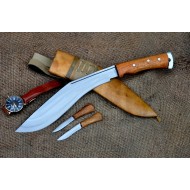
- Afghan Issue Red Khukuri — semi-polished 11" chirra blade with full-tang rosewood handle and lanyard hole
- Karda — small utility knife (traditional companion blade)
- Chakmak — sharpening steel / fire striker (traditional companion tool)
- Red buffalo leather scabbard — hand-stitched over cotton-wood core, with dual frogs and leather loops
- Lanyard cord (wrist cord) for the pommel lanyard hole
- Free text personalisation — up to ~30 characters, engraved on the blade
- Certificate of authenticity from Everest Forge
- Photo-approval images sent before dispatch
Why Direct From Forge vs Amazon or Marketplace
The red rosewood AEOF has been listed on Amazon and major marketplaces for years. We get asked regularly: "Why buy from Everest Forge directly instead of from a marketplace seller?"
Honest answer — for a kukri that's going to be engraved, kept, and possibly passed down, the direct-from-forge path is fundamentally better:
- Free personalisation — engrave deployment year, regiment, name, or dedication. No marketplace listing offers this on the AEOF pattern. An unengraved kukri is a souvenir; an engraved one is a keepsake. For the red rosewood variant specifically, engraving is the whole point.
- Photo approval before dispatch — we send finished photos (including the engraving) for your sign-off before the khukuri ships. If anything looks off, we re-forge. Amazon and marketplaces ship blind.
- Direct supply chain — when you order here, the smiths who supplied the British Gurkha Army contract are the ones forging your blade. Marketplace inventory is bulk-purchased, sitting in a warehouse, no traceable provenance.
- DDP worldwide — duties paid upfront. You pay one price. No customs charges on arrival. Compare to marketplace international orders where customs invoices arrive weeks after delivery.
- 30-day refund + replacement — direct from forge, full guarantee. Compare to marketplace return processes for $115+ knives shipped internationally.
- Support real craft — your purchase goes directly to a Kathmandu forge employing 10 Kami caste smiths. Marketplace purchases route through middlemen who take 30–50% of every sale.
If you're buying this khukuri to keep, engrave, and possibly gift — direct from the forge is honestly the only path that makes sense. For a low-cost generic you don't plan to personalise, marketplace listings exist.
Import & Knife Law — Read Before Ordering
- UK: Curved blades over 50 cm fall under specific legislation. The Afghan Issue blade is 27.94 cm — well under the limit — but carry in public requires lawful reason.
- Australia: Some states require permits for certain blade types. Check your state's edged-weapons schedule.
- USA: Federally legal for import as a knife. Carry and ownership rules vary by state and city — check local statutes.
- EU: Importable in most member states with applicable duties. We ship DDP (duties paid).
- Canada, NZ: Generally importable; carry rules vary by province/jurisdiction.
Related Afghan + Operational Khukuri Patterns
The Afghan Issue Red sits at the centre of the modern operational AEOF family. Buyers commonly compare or commission alongside:
- Afghan Issue Kukri — White Sadha Wood — desert-operational variant with Sadha wood handle and white scabbard ($119.99)
- Afghan Issue Kukri — Red with Gripper Handle — same red rosewood with more contoured gripper handle profile ($119.99)
- Afghan Issue Kukri — White with Gripper Handle — desert-operational with contoured gripper handle ($119.99)
- Iraqi Freedom Kukri — the operational sister blade designed for the Iraq theatre
- BSI Service No.1 Kukri — the traditional ceremonial counterpart for comparison ($94.99)
- Browse all current-issue military khukuris
For heavier chirra-fullered working blades, see our Chirra Kukri (Fullered Blade) range. For other modern operational patterns, see the Hybrid Combat-Utility-Survival range. Want to understand the parts of a kukri? See our Kukri / Khukuri Terminology Guide.
Frequently Asked Questions
What's the difference between the Red and White Afghan Issue Kukris?
Same blade and engineering — 11" chirra-fullered 5160 steel, full-tang with lanyard hole. The differences are handle material and scabbard colour. The Red variant uses polished rosewood handle and red buffalo leather scabbard — heritage-collector configuration, better for keepsake and display. The White variant uses lighter Sadha wood handle and natural white buffalo leather scabbard — desert-operational configuration, better for hot-climate use and matching military aesthetic.
What does AEOF mean?
AEOF stands for "Afghanistan Enduring Operation Freedom" — the British military operational designation for the Afghanistan campaign that began in 2001. The kukri designed for Gurkha soldiers deployed under that operation took the AEOF name. Some sellers shorten it to "OEF" or call it the "Afghan Kukri." All refer to the same modernised operational pattern.
Why is the scabbard red instead of the standard desert white?
The white scabbard is the desert-operational issue. The red scabbard is a heritage and keepsake variant — a more visually distinctive presentation chosen by buyers who want the AEOF design configured for display, gift, or commemoration rather than active desert deployment. Red leather is also more traditional in Nepalese craft and pairs naturally with the warm tones of rosewood. It's not a "second-tier" version — it's the same blade in a different presentation.
What is a chirra (double fuller) blade?
Chirra is the Nepali term for a fuller — a long groove cut into the flat of the blade to remove weight without weakening structure. A double-chirra blade has two parallel grooves on each side. The Afghan Issue uses chirra to reduce blade weight by approximately 15% while keeping the chopping mass at the spine and edge intact. It's visually distinctive — chirra khukuris are easy to identify at a glance.
Why rosewood instead of buffalo horn?
The Afghan Issue is a modernised combat kukri — the traditional Service No.1 buffalo horn handle was replaced because horn doesn't tolerate the impact-and-twist forces of close-quarters combat, and becomes slippery under sweat or gloved use. Rosewood (or Sadha wood on the White variant) is denser, grippier, and shaped with finger indexing for tactical grip security. Rosewood specifically is the heritage hardwood choice — used across most traditional Gurkha working khukuris.
How is this different from the BSI Service No.1?
The Service No.1 is the traditional polished parade-and-issue khukuri — buffalo horn handle, rat-tail tang, mirror finish, traditional brown scabbard. The Afghan Issue (this listing) is the operational combat redesign — rosewood handle, full tang with lanyard hole, semi-polished finish, chirra-fullered blade, red leather scabbard. Service No.1 is for parade and ceremony; the Afghan Issue is the modern combat blade. Many serving Gurkhas own both.
Can I get a deployment year, regiment, or name engraved?
Yes — free of charge. Add your engraving text at checkout. Up to approximately 30 characters. The engraving is applied by hand on the left side of the blade. Common requests on this product specifically (the red rosewood is the most-engraved variant in our range): deployment year and theatre ("AFG 2011", "OEF 09"), regiment marker ("RGR", "QGE", "QOGLR", "Royal Gurkha Rifles"), service number, retirement marker, name in English or Nepali Devanagari script, or family dedication.
What is the lanyard hole for?
The lanyard hole at the pommel takes a wrist cord. In combat operations, a wrist cord stops the kukri from being lost if it's dropped or knocked from the hand. The lanyard is standard on the AEOF pattern — the Afghan Issue Red ships with a cotton lanyard cord ready to thread through the hole. On the keepsake-display use case, the lanyard cord can also be left attached as a visual accent or removed for cleaner presentation.
What is the blade hardness?
The blade is water-tempered for traditional differential hardness: edge 58–60 HRC for cutting performance, belly 45–46 HRC, spine 22–25 HRC for shock absorption. This zoned tempering allows a working khukuri to chop hard material — including bone, hardwood, and dense vegetation — without the spine cracking under impact.
Is this kukri suitable for bushcraft and outdoor use?
Yes — the operational performance is identical to the white-scabbard issue. The rosewood handle handles outdoor use just as well as Sadha wood (some buyers prefer rosewood for outdoor work because of the denser grip feel). The red scabbard will accumulate field-use character over time — many buyers consider this part of the heirloom appeal. If you're choosing primarily for hard outdoor use and don't care about presentation, the white version's lighter Sadha wood handle is marginally better for hot-climate carry. For anything else, the red rosewood works equally well.
What's included with the khukuri?
You receive the Afghan Issue Red Kukri, traditional Karda (small utility knife), Chakmak (sharpening steel), hand-stitched red buffalo leather scabbard over cotton-wood core with dual frogs and leather loops, cotton lanyard cord, certificate of authenticity, and photo-approval images sent before dispatch.
Why buy from Everest Forge instead of Amazon or another marketplace?
Free engraving on every order (no marketplace offers this on the AEOF pattern — and the red rosewood variant is specifically designed for engraving), photo approval before dispatch, direct-from-forge supply chain (the kukri is forged after you order — not pulled from generic warehouse inventory), DDP worldwide shipping (duties paid upfront), 30-day refund guarantee, and verifiable military supply credentials (British Gurkha BSI 2008, Nepal Army 2015–2018, Nepal Police 2016–2017). For a $115 kukri you plan to keep, engrave, and possibly gift, direct from the forge is the better path.
| Specification | |
| Blade: | 11 inches long, hand-forged from 5160 high carbon steel |
| Total Length: | 16.5 inches overall |
| Handle: | 5.5-inch full tang handle made from polished rosewood |
| Weight: | 800 grams including blade and sheath |
| Note: | Each kukri is handmade by skilled artisans in Nepal, meaning slight variations in size, weight, and finish are normal and add to the authenticity and uniqueness of each piece. |