
Types of Southeast Asian & African Swords – Island Warriors & Tribal Blades
Across the tropical islands of Southeast Asia and the vast tribal kingdoms of Africa, swordmaking developed unique expressions of art and identity. Each of these types of Southeast Asian and African swords was more than a weapon — it was a living symbol of ancestry, faith, and craftsmanship. Forged in sacred rituals or tribal forges, these blades carried the essence of their people and their land.
From the wavy Kris of Indonesia to the regal Konda of the Congo, these swords tell stories of survival, ceremony, and spirit — crafted by cultures that saw no boundary between art and warfare.
Kris (Keris) Sword – Indonesia / Malaysia

The Kris, or Keris, stands among the most spiritual types of Southeast Asian swords. Its undulating, flame-shaped blade and patterned steel (Pamor) were created by an Empu through ritualized forging, fasting, and prayer. The Kris was believed to contain protective power, acting as a talisman for its owner and sometimes an heirloom linking generations.
Many Kris blades were customized in profile, length, and number of waves to suit the owner’s status or purpose. Fittings could include carved hilts of wood, horn, or ivory and sheaths clad in precious metals, making the Kris both sacred object and high art.
Barong Sword – Philippines
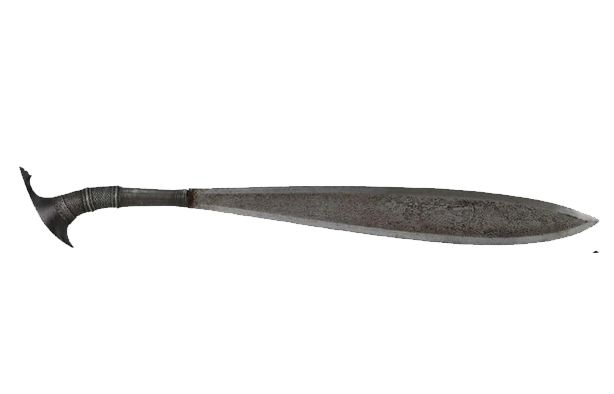
The Barong is a leaf-shaped sword of the Moro peoples, prized for dense chopping cuts in jungle warfare. Its thick spine, acute point, and broad belly deliver tremendous momentum, while the short length allows quick hand transitions in close quarters.
Handles are often carved with ancestor or guardian motifs and bound for grip, with scabbards wrapped in rattan or silver. Beyond combat, the Barong appears in ceremonies and dances, a living emblem of courage and harmony.
Kampilan Sword – Philippines
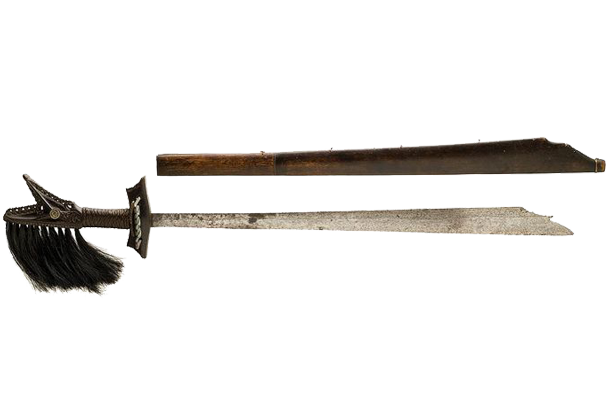
The Kampilan is a long, two-handed island blade recognizable by its flared tip and crocodile-inspired guard. It balances reach with cutting authority, historically linked to leaders and famed warriors. Its long tang and extended grip enable strong leverage and decisive downward cuts.
Many Kampilan feature hair or fiber tassels to distract opponents and shed blood from the grip. Elaborate hilts and scabbards announce rank, turning a battlefield weapon into a symbol of leadership and independence.
Ginunting Sword – Philippines
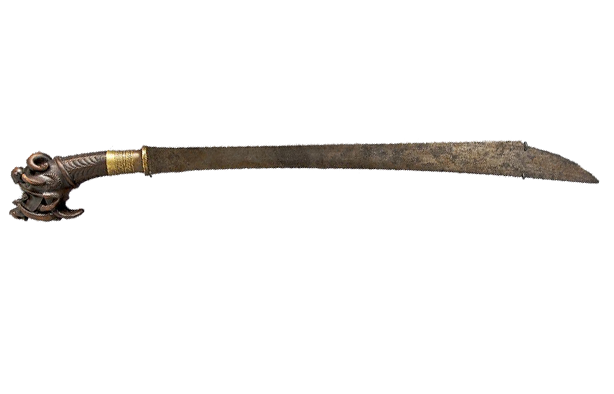
The Ginunting is a forward-weighted, compact blade designed for fast, powerful chopping and precise tip work. Its geometry excels at clearing vegetation and at rapid, angle-driven strikes used in Filipino martial systems.
As the current sword of the Philippine Marines, the Ginunting proves how indigenous design adapts to modern use — rugged, maintainable, and purpose-built for amphibious and jungle environments.
Parang Sword – Malaysia / Indonesia
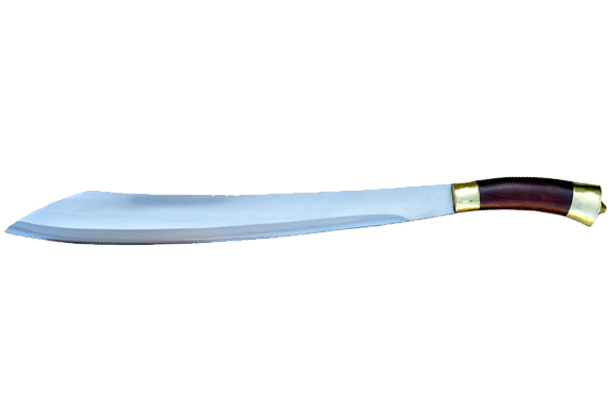
The Parang is the islander’s multi-tool: a stout, curved blade for cutting bamboo, crafting shelters, and defense. Its forward bias and thick spine transfer power efficiently into wood and fiber — a perfect fit for rainforest life.
Parang blade shapes vary by region (length, curvature, tip), and handles are often simple, durable hardwood. Its practicality influenced later machete families across Asia, Africa, and the Pacific.
Golok Sword – Indonesia
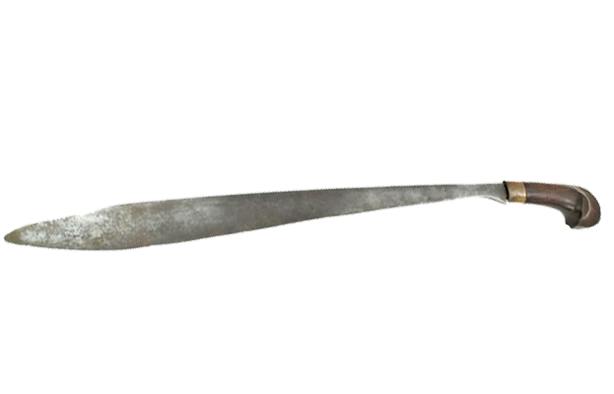
The Golok is a short, heavy working blade that blurs the line between tool and sword. Farmers, hunters, and soldiers favored it for endurance, easy sharpening, and reliable chopping in dense terrain.
Countless regional Golok patterns exist, each tuned to local wood, climate, and carry style. It is the archetype of “functional beauty” — austere, efficient, and persistent.
Banayal Sword – Philippines
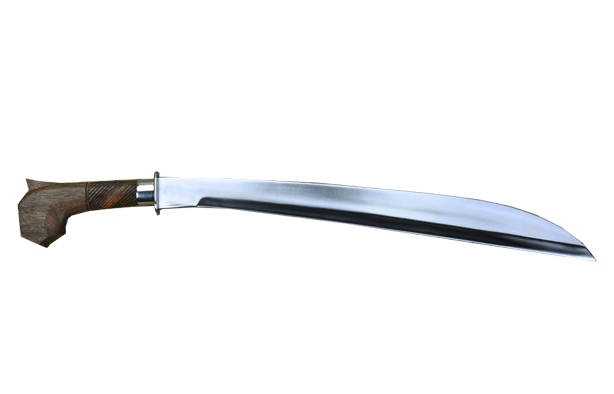
The Banayal is a wide-bellied, full-tang sword-machete hybrid designed for versatility. The weight forward of center enhances bite in cuts, while the straight section near the grip gives control for carving and camp tasks.
Often forged to the user’s hand, Banayal blades reflect intensely personal ergonomics — a companion as much as a weapon, passed along as families migrate across the islands.
Talibong Sword – Visayas, Philippines
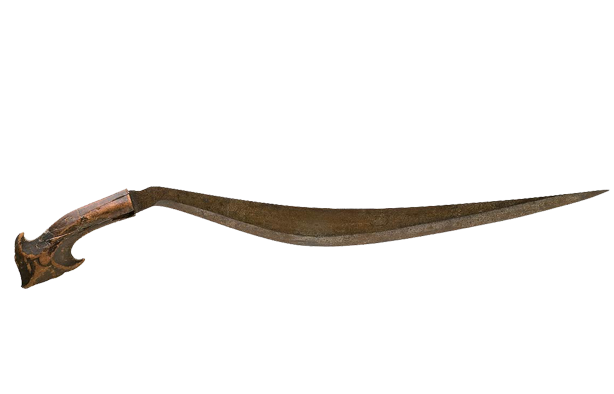
The Talibong is a slimmer, longer Visayan cousin to the Barong. Its balanced profile supports both draw cuts and thrusts, well-suited to riverine and coastal skirmishing where quick footwork and varied angles decide the exchange.
Engraved talismans and tribal marks on blades and scabbards invoke protection, underscoring the Talibong’s role in ritual as well as defense.
Mandau (Parang Iban) – Borneo, Dayak
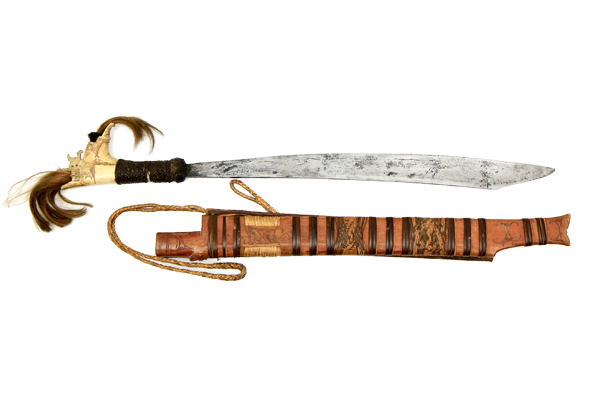
The Mandau is the ceremonial and war sword of the Dayak peoples of Borneo. Slightly curved with a distinctive clipped tip and inlaid motifs, it was carried alongside a utility knife (Piso Raut) for carving and craft.
Hilts of antler, bone, or wood are intricately carved and often adorned with hair and beads. The Mandau embodies headhunter lore, ancestor veneration, and the Dayak ideal of harmony between forest and forge.
Panabas – Southern Philippines
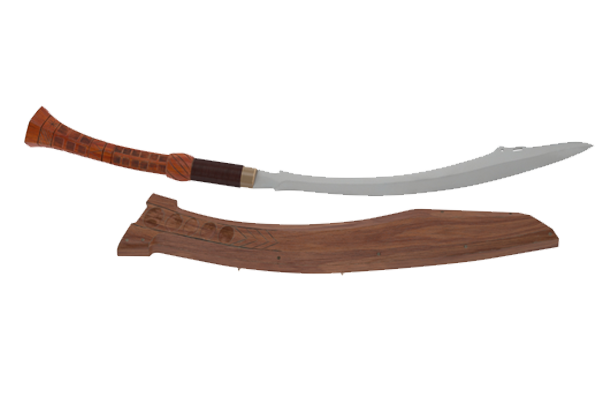
The Panabas is a massive, rear-curved chopping sword used historically for village defense and justice. Its long handle and heavy blade deliver devastating, cleaver-like cuts with surprising control.
Panabas scabbards were utilitarian, and blades varied from broad cleaver styles to slimmer cutters. The design’s authority made it both a practical deterrent and a symbol of rule.
Sundang (Moro Kris Sword) – Sulu Archipelago
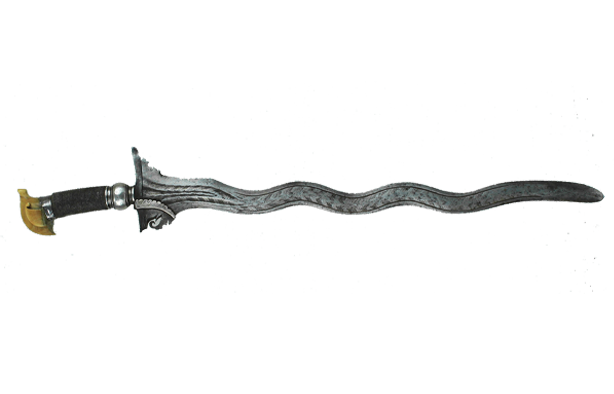
The Sundang is the Moro double-edged Kris sword, longer than many Keris daggers and built for combat. It may be straight or waved, with a flaring guard and cockatoo-style hilt common in Sulu pieces.
Scabbards and hilts feature shell, silver, and hardwood, while blades carry patterned steel. The Sundang represents the warrior prestige of the southern seas.
Dha (Daab/Da) – Myanmar, Thailand, Laos
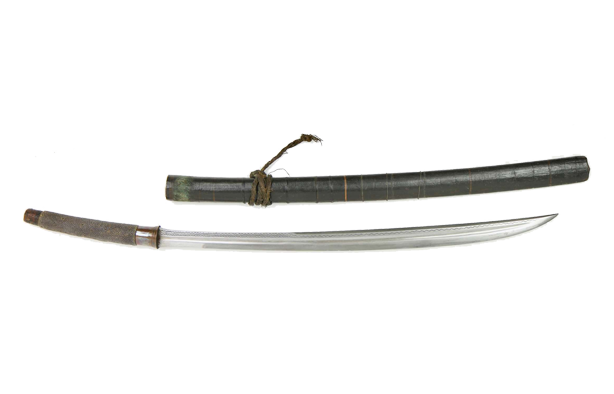
The Dha is a long, cylindrical-handled saber used across mainland Southeast Asia. Its straight or slightly curved blade favors flowing cuts, paired with a long grip that enables leverage and fine tip control.
Simple, unguarded hilts and lacquered scabbards emphasize lightness and speed. Military, monastic, and village traditions all left distinct Dha styles, making it a unifying blade of the region.
Kaskara Sword – Sudan / Nile Region
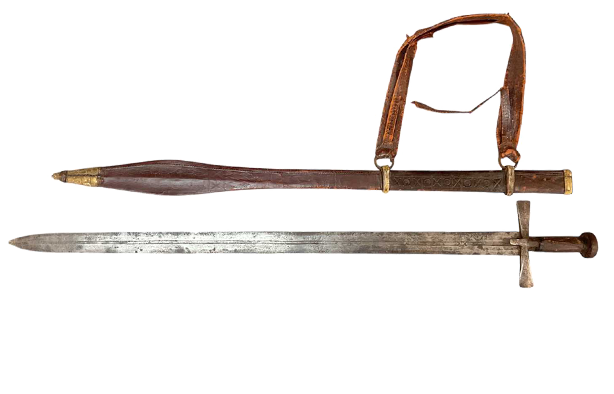
The Kaskara is a long, straight, double-edged sword with a cruciform guard, worn across the back by warriors and chiefs. Its lineage shows North African, Islamic, and late-medieval European influences converging along the caravan routes.
Many Kaskara blades reused older steel and bore Qur’anic inscriptions. As both badge of office and weapon, it symbolized bravery and righteous rule.
Takoba Sword – Tuareg Tribes (Sahara)
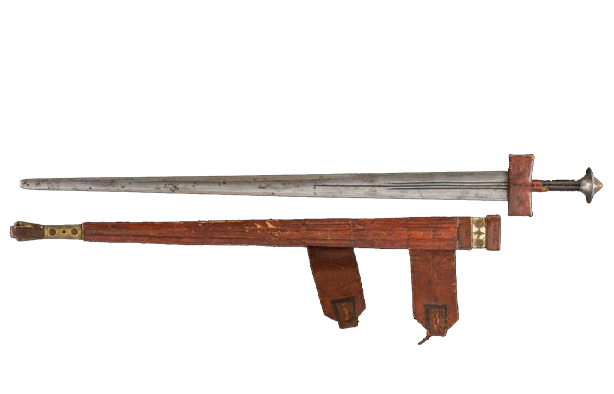
The Takoba is the noble sword of Tuareg and related Saharan peoples — straight, double-edged, leather-sheathed, and often guard-wrapped to hide the hand. Blades show local or imported steel; fittings carry geometric and talismanic designs.
Forged and maintained by hereditary smiths (Inadan), the Takoba protects caravans and communities, a desert counterpart to the knightly sword of the West.
Konda Sword – Congo (Central Africa)

The Konda is a wide, sculptural sword used in ceremony, justice, and warfare. Pierced blades, incised lines, and sculpted grips transform steel into authority, while weight distribution still supports cutting when required.
Borne by chiefs and judges, the Konda communicates status and order — a masterpiece where metalwork and governance meet.
Boa Zande Sword – Central Africa
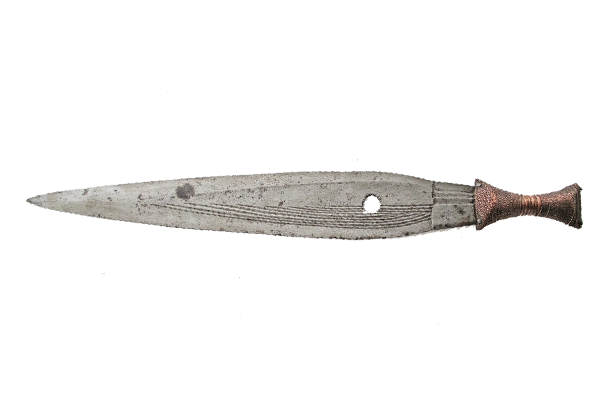
The Boa Zande sword features a leaf-shaped profile with flared tip and decorative cutouts. It functioned as both a prestigious arm and a ritual signifier, carried in dances and audiences.
Its aesthetics reflect Central African cosmology: symmetry, lineage marks, and the protective power of crafted iron.
Khopesh Sword – Ancient Egypt / Nubia
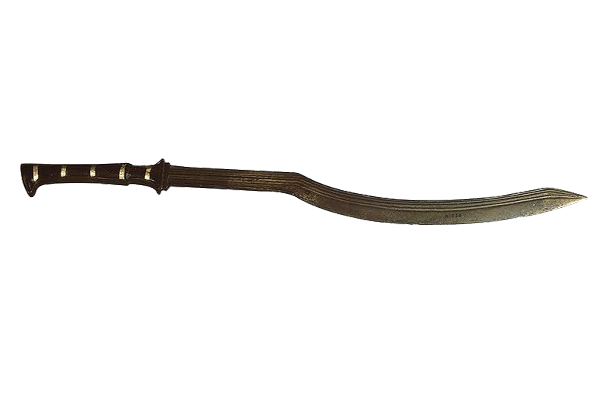
The Khopesh is a Bronze Age icon with a C-shaped, forward-hooking blade for binding shields and hacking armor. As metallurgy advanced, iron Khopesh remained emblems of pharaonic power and divine favor.
Reliefs, tomb finds, and votive pieces attest to its dual role: battlefield technology and sacred symbol of kingship.
Yaka Sword – Congo Basin
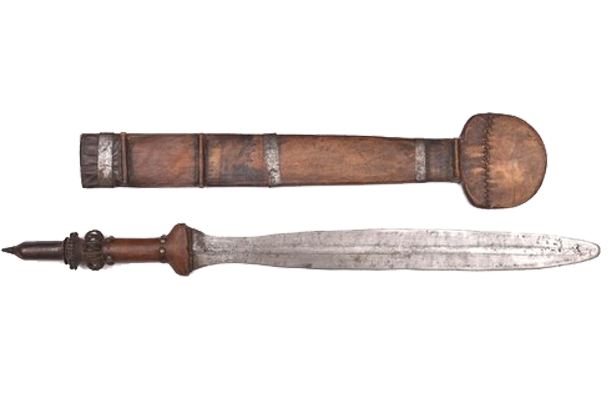
The Yaka Sword bears a short, flared blade with bold geometric decoration. Often used in initiation and adjudication, it embodied the moral authority of elders and the continuity of tradition.
Carved wooden grips and fiber bindings connect the blade to the living materials of the forest, uniting iron with earth.
Ngombe Execution Sword – Congo / Equatorial Africa
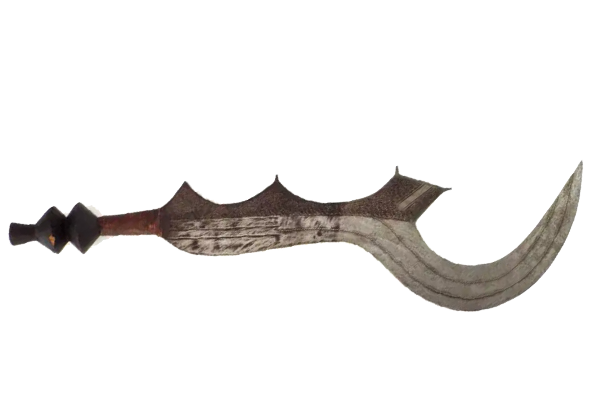
The Ngombe Sword is a broad ceremonial blade used historically in ritual executions that represented purification and law. Etched symbols invoked deities and ancestral witnesses to solemn acts of justice.
Today it is preserved as art and testimony — a complex artifact where aesthetics and authority converge.
Ida Sword – Yoruba (West Africa)
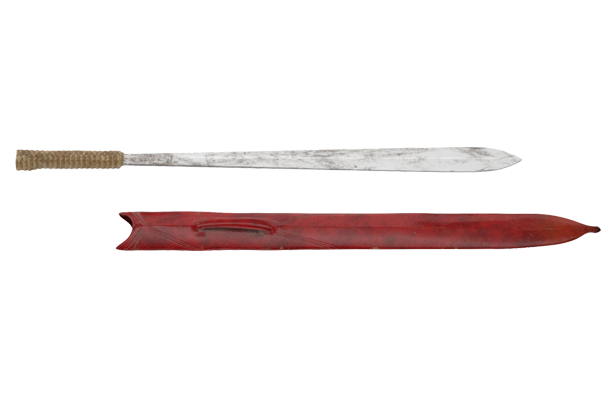
The Ida Sword is a straight, double-edged Yoruba blade with a leaf-like swell that balances thrust and cut. Ironworking guilds produced Ida for warriors and hunters, tailoring weight and profile to the user.
Its ritual presence endures in festivals and courtly displays, signifying courage, protection, and ancestral continuity.
Shotel Sword – Ethiopia
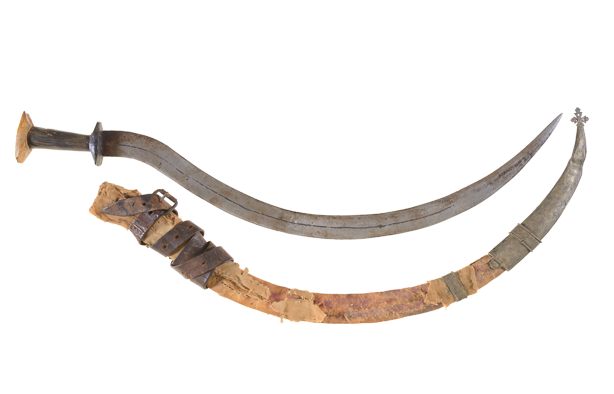
The Shotel is Ethiopia’s inward-curving sword for reaching around shields. Paired with large hide shields, it excelled at hooking armor seams and hamstringing mounts in tight formations.
Its distinctive crescent silhouette became a national emblem of resilience and divine justice in imperial chronicles.
Mambele – Central & West Africa
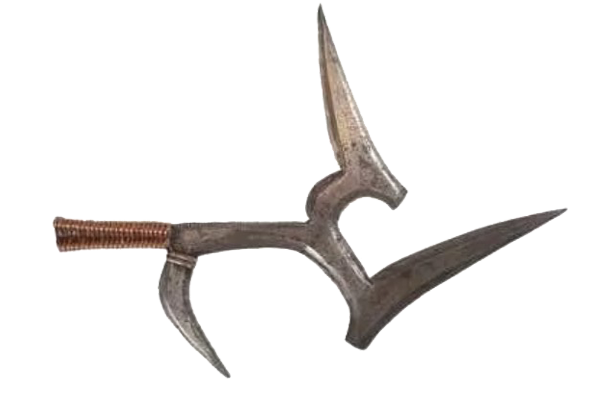
The Mambele is a multi-bladed throwing and cutting weapon used by Azande, Mangbetu, and neighbors. Its hooked wings stabilize flight and create tearing wounds on return arcs.
Carried by nobles and elite warriors, Mambele designs displayed skill and intimidation — practical aerodynamics meeting ritual theater.
Flyssa – Algeria / Kabyle Berbers
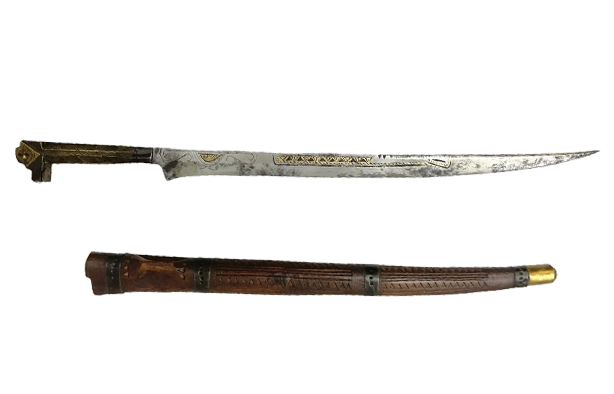
The Flyssa is a slim, single-edged Berber sword with a long, tapering point and animal-headed grip. Its narrow blade excels at deep thrusts and precise cuts, influenced by Mediterranean trade and cavalry styles.
Rich engraving and brasswork turn the Flyssa into wearable sculpture, a North African synthesis of art and arms.
Assegai Short Sword (Iklwa) – Zulu
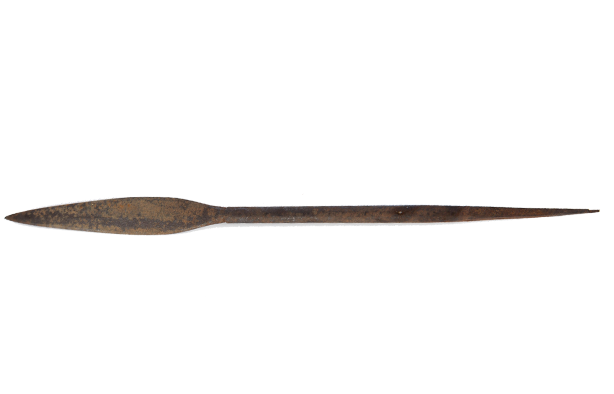
The Assegai in its Iklwa short form is a cut-down stabbing spear for shock tactics. Short haft, broad leaf blade, and shield work enabled close-in formations that broke larger forces through speed and ferocity.
As military innovation and national symbol, the Iklwa transformed Zulu warfare — austere design channeling disciplined power.
Kastane – Sri Lanka (South Asia)
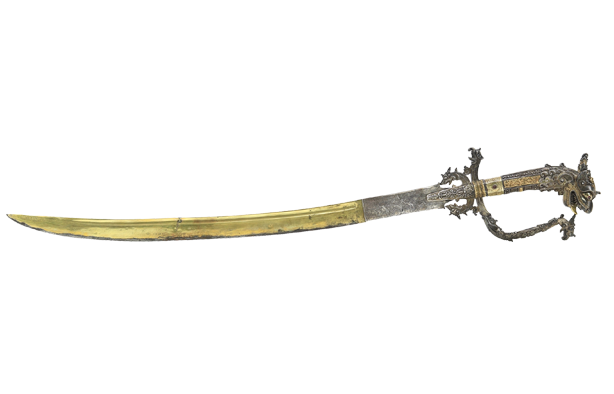
The Kastane is a South Asian court sword with a short, slightly curved blade and lavish zoomorphic hilt — lions, makara sea-dragons, and floral scrolls in gilt bronze or silver. It served as an officer’s and ceremonial weapon under Kandyan and colonial periods.
While not a jungle chopper, the Kastane signaled rank, diplomacy, and island identity. Its artistry links South Asia to the Indian Ocean trading world, complementing Southeast Asian and African prestige blades.
Forged by Land and Spirit
The types of Southeast Asian and African swords — now joined by key South Asian court and hill blades — reflect a world where metal met mysticism. From Indonesia’s sacred Kris to Africa’s powerful Konda and Sri Lanka’s ornate Kastane, each blade carried faith, art, and purpose. Forged by tribes and island forges, these swords united human ingenuity with divine inspiration.
At Everest Forge, we honor these traditions through hand-forged creations that capture the same balance of beauty, strength, and spirit — where every edge tells the story of a people and a purpose.
Request a Custom Southeast Asian or African-Inspired Sword
If blades like the wavy Kris, the powerful Barong, the long-handled Kampilan, or the ceremonial Konda inspire you, our smiths at Everest Forge can create a custom-forged sword that reflects the spirit of Southeast Asian island warriors or Africa’s tribal heritage. Whether you seek a functional warrior blade or a symbolic tribal piece, we craft each sword with respect for the cultural identity and traditional craftsmanship behind these legendary weapons.