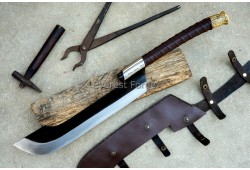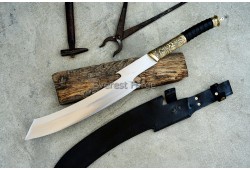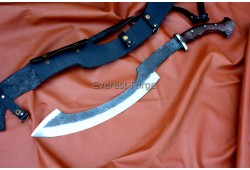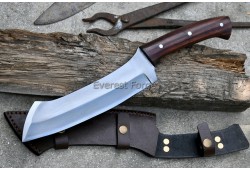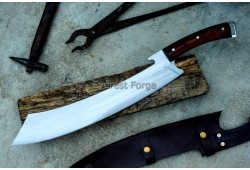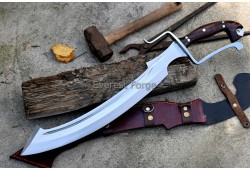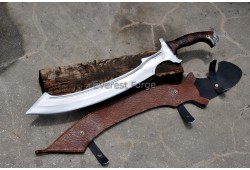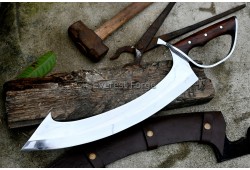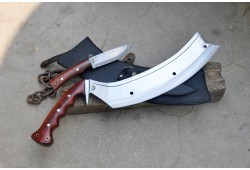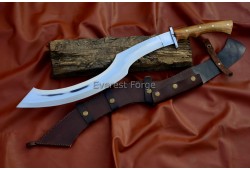
Ancient Egyptian Sickle-Swords · Bronze Age to New Kingdom
Khopesh Swords — Hand-Forged Egyptian Blades from 9" to 20"
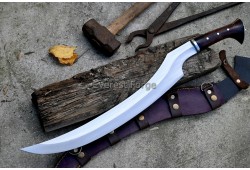
The Khopesh is the iconic forward-curving sickle-sword of ancient Egypt — wielded by pharaohs, painted onto temple walls, and buried in the tomb of Tutankhamun. Every Khopesh in our collection is hand-forged in Nepal from 5160 leaf-spring steel, full-tang, heat-treated, and finished with traditional hardwood or bone fittings. Real metal. Real edges. Built the way the originals were built — by hand, at the anvil.
What Makes Our Khopesh Range Different
Forged the Old Way
Coal-fire forge, hammer and anvil, water quench, hand-finishing. No CNC, no laser-cut blanks. Every Khopesh is shaped by a Nepali master smith from a single billet of 5160 spring steel — the same high-carbon stock used in heavy-duty leaf springs.
Historically Faithful Geometry
The forward curve, the inside hook, the wedge-section spine — every line of the blade is referenced from museum khopesh examples and New Kingdom temple reliefs. Authentic profile, not a generic curved sword in Egyptian dress.
Customisation & Engraving
Free custom engraving on every blade — names, dedications, hieroglyph-style motifs, or your own design. Custom handle materials and full bespoke commissions available through our Request Custom Forge service.
Who Buys a Khopesh Sword
Historical Collectors & Bronze Age Enthusiasts
If you collect ancient weapons, study Bronze Age military history, or build out a museum-style wall display, the Khopesh is one of the few pre-1000 BCE swords still made today by hand. Pair with our Bronze Age Swords and Celtic Leaf Swords for a chronological display.
Egyptian Heritage & Mythology Buyers
Egyptian descendants, Egyptology students, and buyers drawn to the symbolism of Sekhmet, Anubis, and the pharaonic dynasties. Our Sekhmet's Claw and ceremonial-finish variants honour the divine-authority symbolism the original khopesh carried.
Working-Blade & Machete Buyers
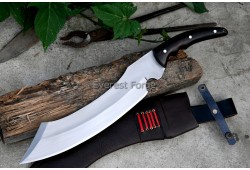
The Khopesh's forward weight and inside-curve cut geometry make it a genuinely effective chopper — that's why our khopesh machete is one of our highest-rated working blades. If you want something that performs in the field and looks like nothing else in your kit, this is the family.
Fantasy, Film & Tabletop Collectors
The Khopesh has appeared in Moon Knight, Hellboy II, Stargate, The Mummy, and Assassin's Creed Origins. Our Hellboy II Khopesh — built with a Prince Nuada-inspired handle — is the centrepiece for fantasy and film collectors.
The Complete Khopesh Range
Fifteen hand-forged Khopesh variants across four tiers — from a 9-inch hunting khopesh knife to a 20-inch flagship Egyptian sword. All full-tang, all 5160 spring steel, all forged at our Nepal workshop.
Authentic Egyptian Khopesh — 19" to 20"
Faithful, full-length reproductions of the New Kingdom battle khopesh. The flagship pieces of the range — built for display, study, and serious collection.
- Egyptian Khopesh Sword — 20" 5160 leaf spring blade, full tang, the flagship reproduction
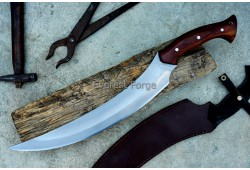
- Egyptian Khopesh Sword/Machete — 20" full tang with rosewood handle, hybrid sword-machete profile
- Egyptian Khopesh — 20" classic profile, our entry-level full-size khopesh
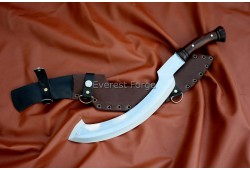
- Sekhmet's Claw Khopesh — 19" tribute to the Egyptian goddess of war
- Sekhmet's Claw Khopesh — D-Guard — 19" with full hand-protection D-guard
Khopesh Machetes & Working Blades — 14" to 16"
For buyers who want a Khopesh that earns its place outdoors. Forward-weighted, deep-edge geometry, built to chop and clear. The most distinctive machete shape we make.
- Khopesh Machete 14" — full tang 5160 with rosewood handle
- Kopesh Cleaver Machete 14" — includes a free MUK knife
- Khopesh Machete 16" (Leaf Spring) — heavy leaf-spring stock, premium working build
- Khopesh Machete 16" (Rosewood) — sharpened, tempered, balanced for chopping
- Hybrid Khopesh Chopper — 15" hybrid axe/chopper, the heaviest in the working tier
- Short Khopesh Sword — 14" with leather scabbard, the bridge piece between sword and machete
Compact Khopesh — 9" to 12"
Knife-scale Khopesh blades for EDC, hunting, or buyers who want the iconic curve in a smaller, more carry-friendly format.
- Hunting Khopesh Knife — 9" full tang 5160, the smallest in the range
- Little Khopesh — 12" full tang with leather sheath, our most popular EDC khopesh
Fantasy & Crossover
One-of-one builds where the Khopesh meets film, fantasy, and pop-culture lineage.
- Hellboy II Khopesh — 19" hand-forged Egyptian blade with a Prince Nuada-inspired ornate handle. Our flagship fantasy-crossover Khopesh.
- Sekhmet's Claw Khopesh (Original) — 19" tribute build, mid-range price
Customise Your Khopesh
Every Khopesh in our range can be personalised. Most options are free; bespoke commissions are quoted individually.
- Free engraving — names, dedications, dates, or short phrases engraved into the blade ricasso
- Hieroglyph-style motifs — Egyptian-inspired decorative engraving (rendered in Latin script for technical accuracy)
- Handle wood — rosewood (standard), buffalo bone, or custom hardwood on request
- Blade finish — mirror polish, satin, antiqued, or hammered scale finish
- Bespoke khopesh — full custom forge from sketch via our Request Custom Forge service
The Khopesh in History
The Khopesh is one of the longest-serving battlefield weapons in human history — in continuous Egyptian military use for over a thousand years.
Origins (c. 2500 BCE): The Khopesh evolved from the Mesopotamian sappara — a sickle-shaped axe — and entered Egypt during the Middle Bronze Age. Early versions were cast in bronze and combined cutting edge with hooking action, useful both for slashing and for catching an opponent's shield or weapon.
The New Kingdom Peak (c. 1550–1070 BCE): By the New Kingdom the Khopesh had become the signature sidearm of Egyptian elite infantry and pharaohs. Ramses II is depicted wielding one at the Battle of Kadesh. Thutmose III campaigned with one across Canaan and Syria. The blade became a symbol of pharaonic authority — gods are shown handing a Khopesh to the king in temple reliefs.
Tutankhamun's Tomb (c. 1323 BCE): When Howard Carter opened the tomb of Tutankhamun, two Khopesh swords were found among the burial goods — one a full-size battle blade, the other a smaller ceremonial piece. The Khopesh wasn't just a weapon for the boy king; it was an emblem of his right to rule.
Decline (c. 1300 BCE onward): As iron metallurgy spread and straight-bladed swords proved easier to manufacture in iron, the Khopesh gradually disappeared from frontline use. By 1000 BCE it had become primarily ceremonial. It never fully returned — which is part of why an authentic, hand-forged Khopesh today is so distinctive.
Khopesh vs Kopis — A Quick Note
The Khopesh is Egyptian, dates from c. 2500 BCE, and has a forward-curving sickle profile with a hooked inside edge. The Kopis is Greek, dates from c. 600 BCE, and has a forward-curving recurve profile with a wider belly toward the tip. They are different swords, from different cultures, separated by nearly 2,000 years — but buyers often research them together because both belong to the wider forward-curving sword tradition.
If you're after the Greek version, our Kopis Sword collection covers eleven hand-forged Kopis variants. For broader context on forward-curving swords, see our Scimitar Swords and Bronze Age Swords collections.
The Khopesh in Modern Culture
The Khopesh has had a quiet renaissance on screen and in games over the past two decades — partly because its silhouette is unlike anything else, and partly because it carries instant Egyptian and mythological weight.
- Moon Knight (Marvel comics & Disney+ series) — the avatar of Khonshu carries crescent-edged Khopesh-style blades
- Hellboy II: The Golden Army — Prince Nuada's ornate Khopesh-influenced blade inspired our Hellboy II Khopesh build
- Stargate SG-1 — Goa'uld Jaffa warriors carry ceremonial Khopesh swords
- The Mummy film series — temple guards and priests are shown with curved Egyptian blades
- Assassin's Creed Origins — set in Ptolemaic Egypt, the Khopesh appears as a wielded weapon class
Khopesh Sword — Buyer FAQ
How do you pronounce "Khopesh"?
KHO-pesh, with the "kh" as a soft guttural — closer to the "ch" in the Scottish "loch" than the "k" in "kite". You'll also see it spelled Khepesh, Kopesh, or Kopash; all refer to the same ancient Egyptian sickle-sword.
Is the Khopesh a real historical sword or a fantasy weapon?
Real. The Khopesh is one of the most thoroughly documented Bronze Age weapons in existence — surviving examples sit in the British Museum, the Cairo Museum, and the Metropolitan Museum of Art. Two Khopesh swords were recovered from the tomb of Tutankhamun in 1922.
What is the difference between a Khopesh and a Kopis?
The Khopesh is Egyptian and dates from around 2500 BCE, with a hooked sickle-shaped blade. The Kopis is Greek, dates from around 600 BCE, and has a forward-curving recurve blade with a wider belly. Different cultures, different eras, different geometry. Buyers often confuse them because both curve forward.
Are your Khopesh swords battle-ready or display only?
Battle-ready. Every Khopesh we forge is built from 5160 spring steel, full-tang, heat-treated, and sharpened. They are functional cutting blades that meet our published Battle Ready Standard — not wall-hangers. You can absolutely display one, but it is structurally a working sword.
What steel do you use?
5160 high-carbon spring steel, sourced from leaf-spring stock. It's the same steel used in heavy-duty automotive suspension — tough, shock-absorbing, and forgiving under impact. Hardened to a working temper that takes and holds a usable edge without going brittle.
What sizes are available?
Our Khopesh range runs from 9 inches (compact hunting knife) to 20 inches (full-size battle reproductions). Most full-size khopesh swords sit in the 19–20 inch range; working machete-style khopesh blades are typically 14–16 inches; and EDC-scale khopesh blades are 9–12 inches.
Can a Khopesh actually cut?
Yes — and that forward curve is the reason. The inside-curve geometry concentrates energy toward the tip on impact, making the Khopesh exceptionally good at slashing and chopping cuts. Our machete-style khopesh blades are routinely used for clearing brush and light wood.
Was the Khopesh really used by Tutankhamun?
Yes. When Howard Carter excavated Tutankhamun's tomb in 1922, two Khopesh swords were among the burial goods — one a full-size functional bronze blade and the other a smaller ceremonial piece. Both are now in the Egyptian Museum in Cairo.
Do you offer engraving or customisation?
Yes. Free engraving is offered on every Khopesh — names, dates, dedications, or short phrases in Latin script. Full bespoke commissions, custom handles, and special finishes are available through our Request Custom Forge service.
Is the Khopesh a good first sword to collect?
It's an excellent first piece if you want something visually distinctive and historically significant. The shape is unmistakable, the history is deep, and the price entry-point (starting at our 9-inch hunting khopesh knife) is accessible. It is also a strong gift sword.
How long does it take to make a Khopesh?
Each Khopesh is hand-forged to order. Standard pieces typically take 2–4 weeks from order to ship; bespoke commissions through Custom Forge can take 6–8 weeks depending on complexity. We update you with progress photos at key forging stages.
Do you ship internationally?
Yes. We ship Khopesh swords worldwide from Kathmandu, Nepal — with the largest customer bases in the United States, United Kingdom, Australia, and Canada. Full details are on our Shipping & Returns page.