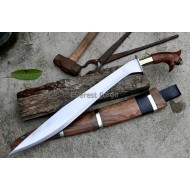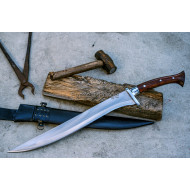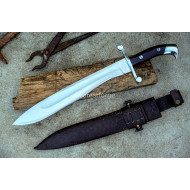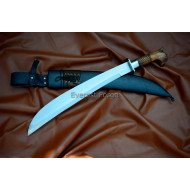
- Model: KHOPESH SWORD
- Product Code: DCK16
- Location: Kathmandu, Nepal
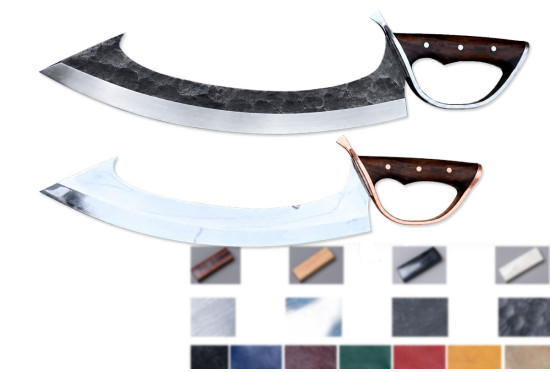
A Hand-Forged Khopesh Machete With a Steel D-Guard, Built the Way You Want It
Choose the blade finish, the handle, the fittings and the scabbard colour, then add your engraving — and we forge that exact blade. Every selection updates the preview on screen. There are 1,080 possible builds before personalisation, the widest handle choice in our khopesh range, and each one is forged to order in Kathmandu.
Underneath every combination is the same blade: 16 inches of forward-curving khopesh in hand-forged 5160 spring steel, on a single-billet full tang, with a forged steel D-guard closing over the grip and a hand-stitched leather scabbard. At around 22 inches overall and 980 grams it is the working end of the khopesh range — short enough to swing in cover, heavy enough to clear it, with the hand enclosed.
Your Choices
Blade length and construction are fixed on this pattern. For another size, a different guard style or a design of your own, use our custom forge service.
A Khopesh Built to Work
Most khopesh swords are bought to hang on a wall, and that is a perfectly good reason to own one. This is the version for the other buyer.
Sixteen inches is the machete length: long enough to clear brush and chop green wood, short enough to swing in cover without catching the blade on everything behind you. The forward curve does the rest — the sharpened edge runs along the outside of the curve, so the blade lands with the force concentrated through the belly and bites instead of glancing, and the hook at the front will pull a cut branch clear rather than leaving it hanging.
Then the guard. Clearing work is exactly where hand protection earns its keep: thorns, whip-back from springy stems, a blade that skids off wet bark, and the odd miss. The closed steel bow covers the back of the hand for all of it, and it keeps the grip locked when your hands are wet. No ancient khopesh had one, and if you are swinging the blade rather than displaying it, you will not care.
Ancient Blade, European Guard — Said Plainly
The blade is Egyptian. The forward-curving sickle profile follows the khopesh, which reached Egypt around 1800 BC from the sickle-swords of Mesopotamia and the Levant, and became the standard sidearm from about 1550 BC. It appears on temple walls, in royal insignia, and in the hands of gods and pharaohs alike. Two khopesh swords, one larger and one smaller, were recovered from Tutankhamun's tomb.
The D-guard is not. The closed knuckle bow is a European development of the 16th and 17th centuries, carried on cavalry sabres, naval cutlasses and backswords, and most famously on the Confederate D-guard Bowies of the American Civil War.
The combination is ours, and it is deliberate. If you want the clean historical line, our standard 16-inch Khopesh Machete has no guard. If you want the one you can take into brush, build this.
Which Blade Finish Suits a Working Khopesh?
Handle, Fittings and Scabbard
Nine grips are fitted inside the guard on the same full tang — the widest choice of any build in our khopesh range. Rosewood is our standard and the best under hard use: dense, stable and sure in a wet hand. Whitewood is the pale timber and stands out most inside a dark guard. Buffalo horn is glossy black with a deep polish, and bone is close to ivory; both are materials Bronze Age craftsmen genuinely used on hilts. The five two-material grips — rosewood with whitewood, bone or horn, whitewood + horn, and horn + bone — band contrasting sections along the grip, framed by the bow.
The fittings cover the D-guard and the butt, so the metal you pick changes the silhouette rather than a detail: brass reads closest to ancient bronze, silver-tone is the cleanest and stays brightest, copper darkens fastest into a deep brown, and black makes the guard recede against a coated blade for the most workmanlike build. The scabbard is hand-stitched leather cut to take a guarded hilt, in six colours, with a belt loop.
Engraving and the Udjat
The personalisation field takes a name, initials, a date, a dedication or a short line, and you can upload a crest, a unit badge, a logo or a photograph for us to reproduce. The motif most requested on this blade is the Udjat, the Eye of Horus, the Egyptian sign of protection and healing — ancient khopesh blades were sometimes marked with protective symbols, and it sits naturally at the base of the blade where the curve begins.
Want a Different Guard or Size?
An S-guard, a half-basket, a brass bow instead of steel, a longer or shorter blade, a deeper curve or a design from your own sketch — anything outside this option list goes through our custom forge service, where we quote your build individually.
Request a Custom Forge →Why This Khopesh Works
Standard Build Specification
Blade, handle and overall length are fixed in this configurator and do not change with your selections. Because every piece is hand-forged, small variation in weight, dimensions, grain and finish is normal.
An Honest Note on This Khopesh
An honest note. Three things worth saying plainly. First, this is a hybrid: Egyptian blade, European guard, modern steel. Real khopesh swords were cast bronze and had no knuckle bow, and anyone selling a steel D-guard khopesh as a historical reproduction is inventing it. Second, a guard is a trade. You gain protection and a grip that will not be knocked loose; you lose the ability to choke up on the blade, you get one hand position, and the scabbard has to be cut for it, so it will not ride flat on a belt. Third, 5160 is not stainless. Sap, damp and green wood will all mark it; wipe it dry, oil it, and pay attention to the inside of the guard where a cloth does not reach.
This Build Suits
- Clearing, brush work and camp chopping where the hand needs covering
- Cutting practice and drills, where the guard keeps the blade in your hand
- Collectors of knuckle-bow hilts who want an Egyptian blade under the bow
- Pharaonic and warrior costume builds, where the guard photographs well
Look Elsewhere If
- You want the clean historical line — see the standard 16-inch Khopesh Machete
- You want a longer sword-scale khopesh — see the 20-inch builder
- You want something light and compact — see the Little Khopesh builder
- You want a stainless blade that tolerates neglect
How Your Order Is Made
Caring for a Guarded Working Blade
Wipe the blade dry after every session and keep a light film of oil on it; sap is acidic and marks carbon steel quickly. Two places need attention that a cloth drawn along the flat never reaches: the inside of the blade's curve, and the inside of the knuckle bow where it meets the grip, which is where moisture collects on any guarded hilt. Do not store the blade in its scabbard for long periods, because the leather holds damp against steel. Sharpen along the outer curve at the angle it came with rather than thinning the edge, since a blade that chops needs a durable edge more than a keen one. Brass and copper fittings patina with handling and polish back with any metal polish.
Shipping, Returns and Warranty
Every piece is prepared at the forge in seven to ten days, and shipping adds a further seven to ten days. Orders to the USA and Canada travel with FedEx; everywhere else ships on a DDP service, which means duties and taxes are settled before the parcel moves so there is nothing to pay on delivery. Every piece carries the Everest Forge manufacturer warranty against defects in forging and heat treatment. Because a configured and engraved blade is made to your specification, it falls outside our standard returns window except where the blade is faulty — full terms are on our shipping and returns page. Import rules on large edged blades vary by country and are the buyer's responsibility to check before ordering.
Explore More Everest Forge Blades
Questions About the Khopesh Machete
What is the difference between this and the standard Khopesh Machete?
The guard, and only the guard. Same 16-inch blade, same 5160 steel, same forge. This build adds a forged steel knuckle bow over the grip, which protects the hand in clearing and cutting work and keeps the blade in your grip when your hands are wet. The standard version has an open hilt: lighter, faster, and closer to the ancient line for display.
Which edge is sharpened?
The outside of the curve. That is what makes a khopesh a khopesh: the force lands through the belly of the curve on a downward hooking stroke, and the hook at the front pulls a cut branch clear instead of leaving it hanging. The point is not the business end; on surviving originals it is usually blunt.
Is the D-guard historically Egyptian?
No, and we do not claim it is. The closed knuckle bow is a European development of the 16th and 17th centuries, used on cavalry sabres, naval cutlasses and backswords, and most famously on Confederate D-guard Bowies. The blade is the Egyptian part. The combination is a deliberate modern hybrid.
Can I really use it for clearing and chopping?
That is what this one is built for. Sixteen inches of 5160 with the weight forward handles brush, saplings, green wood and camp work, and the guard covers your knuckles against thorns and whip-back. Keep it off stone, soil and metal, and leave felling to an axe.
Does the fitting choice change the guard?
Yes, which is why this build looks so different between combinations: the fitting option sets the colour of the D-guard and the butt, not just a small detail. Brass reads closest to ancient bronze, silver-tone is cleanest, copper ages fastest, and black makes the guard recede against a coated blade.
Will the guard fit my hand?
It is built for a full-hand grip in one position, as any closed guard is. If you have large hands or expect to wear work gloves, say so in the order note and we will allow for it. A guard that is slightly tight is the one complaint a guarded blade genuinely earns, and it costs nothing to avoid at order time.
Which handle should I choose?
Rosewood is our standard and the best for hard outdoor use. Whitewood stands out most inside a dark guard. Horn and bone are the most striking and the most traditional as hilt materials. The five two-material grips give a two-tone look framed by the bow. Nine options in all, the widest choice of any build in our khopesh range.
What is the Udjat, and can I have it engraved?
The Udjat is the Eye of Horus, the Egyptian symbol of protection and healing. Ancient blades were sometimes marked with protective symbols, and it sits naturally at the base of the blade where the curve begins. Ask for it in the personalisation field, or upload your own artwork — a crest, a badge, a sigil or a photograph.
Were real khopesh swords made of steel?
No, they were cast in bronze, and the type faded from military use once iron reached Egypt. Ours is hammer-forged from 5160 spring steel on a single billet, which makes it tougher than any original and able to hold a real working edge. It is an interpretation, not a reproduction.
How does it compare with your other khopesh builders?
By length and job. This is the 16-inch working blade with a guard. The Sekhmet's Claw is 19 inches, also guarded, and handles as a sword. The 20-inch Egyptian Khopesh is the full display-scale sword with an open hilt, and the Little Khopesh is the 12-inch companion blade.
Will 5160 steel rust?
Yes, if you let it, and a working blade sees more sap and damp than a display piece. Wipe it dry after every session, oil it including the inside of the guard, and do not leave it in the scabbard for months. The trade is worth it: 5160 absorbs impact instead of chipping, which is what you want in a blade that meets wood.
Can I order a different blade length or guard style?
Not through this configurator, which keeps the blade at 16 inches with the closed steel bow. A longer or shorter blade, an S-guard, a half-basket, a brass bow or a design from your own sketch are all quoted individually through our custom forge service.

-190x190w.jpg "Egyptian Khopesh Sword — Hand-Forged Sickle-Sword, 5160 Spring Steel, Rosewood & Leather-Wrapped Handle, Customizable")