- Model: Roman Gladius Sword
- Product Code: OWNGLADIUS
- Location: Kathmandu,Nepal
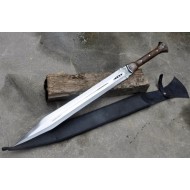
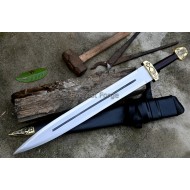
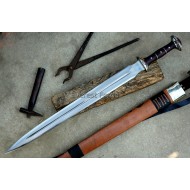
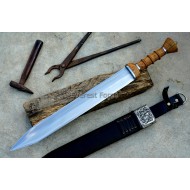
A Hand-Forged Pompeii Gladius, Built the Way You Want It
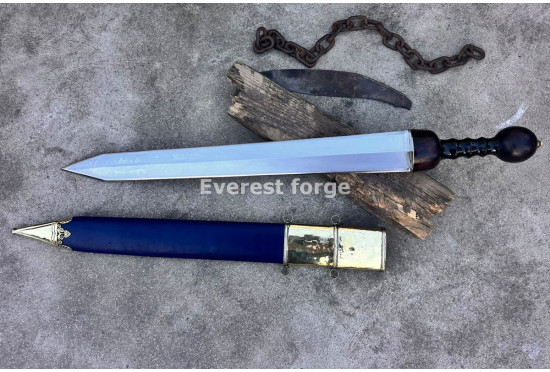
Choose the blade finish, the two-material hilt, the scabbard and its metal fittings — then we forge that exact gladius. Every selection updates the preview on screen. There are 252 possible builds of the sword, each one a piece our smiths in Kathmandu make routinely, and you can add a matching display stand.
Underneath every combination is the same sword: a 24-inch double-edged blade with straight parallel edges and a short triangular point — the Pompeii pattern, the last and most familiar of the Roman gladius types — hand-forged from 5160 spring steel on a four-part Roman hilt. It ships sharp on both edges, with a scabbard carrying metal binding plates and twin suspension rings in the Roman manner.
Your Choices
What Is a Pompeii Gladius?
The Romans simply called it a gladius. Archaeologists name the four patterns after the places the best examples were found, and they show two centuries of development. The Hispaniensis, from around 200 BC, is the longest, with a waisted blade and a long tapering point. The Mainz keeps the waist on a shorter blade. The Fulham loses the waist and runs straight edges into a longer triangular point. The Pompeii, in use from about the middle of the first century AD, is the simplest of all: parallel edges the whole length and a short, abrupt point. Four were recovered from the ruins of Pompeii itself, sealed by Vesuvius in 79 AD.
The short point gives up a little reach and gains a great deal of strength at the tip, which mattered on a sword used above all to thrust in a crowded shield line. The gladius could cut perfectly well — surviving blades are sharpened along their full length — but in close formation the thrust was the move there was room for.
Which Blade Finish Suits a Gladius?
The Four-Part Hilt in Two Materials
A Roman hilt is built in four parts threaded onto the tang: a guard block against the shoulders of the blade, a grip turned with finger grooves, a large rounded pommel, and the tang secured at the end. Roman makers used wood, bone and ivory for these parts, often in combination, so a two-material hilt is true to the originals. Each of our four options pairs one material for the grip with a contrasting material for the guard and pommel: rosewood + whitewood for a dark-and-pale timber hilt, rosewood + horn and horn + rosewood for the two ways of combining rich timber with glossy black horn, and horn + whitewood for the strongest contrast. The large pommel is not decoration: it counterweights the blade and gives the heel of the hand something to drive against on a thrust.
Scabbard, Fittings and Stand
The leather scabbards carry metal binding plates, twin suspension rings and a decorated chape, which is the Roman arrangement for a sword worn on a baldric at the right hip. Blue and red are the most striking with brass fittings; black and brown are the most restrained; green and white suit a display theme. The rosewood scabbard is a solid timber alternative that shows off the grain and pairs beautifully with a rosewood hilt; it is a display choice rather than a Roman one. The fittings come in brass, the classic Roman gold tone; silver-tone, a bright white metal; or copper, the warmest of the three. Add a rosewood or black display stand if the gladius will live on a shelf rather than a wall.
Want It Built to the Documented Size?
Surviving Pompeii blades run about 16.5 to 20 inches. We can build this gladius at 18 or 20 inches with the distal taper taken down, which brings it into the range of the finds and transforms how it handles. We also forge the Mainz, Fulham and Hispaniensis patterns, and blunt trainers to your group's standard.
Request a Custom Forge →Why This Gladius Works
Standard Build Specification
Blade, handle and overall length are fixed in this configurator and do not change with your selections. Weight varies slightly with hilt materials and scabbard choice. Because every piece is hand-forged, small variation in weight, dimensions and finish is normal.
An Honest Note on This Gladius
An honest note. Two things matter more than any option on this page. First, the length: surviving Pompeii blades measure roughly 42 to 50 centimetres, about 16.5 to 20 inches. At 24 inches this blade is longer than any documented Pompeii example and closer to the earlier Hispaniensis — a Pompeii profile at a Hispaniensis length, built as a display sword rather than a reproduction of a find. Second, the weight: Roman gladii weigh roughly 700 to 1000 grams, and this one is 1380 grams without its scabbard, partly from the extra length and mostly because the blade keeps more steel toward the point. It is slower to recover and more tiring to hold in guard than the original was. For display that does not matter. If you want a gladius that handles like one, choose our historically sized Pompeian Gladius, or ask for an 18 or 20 inch build with the taper taken down through custom forge. The silver-tone fittings are a bright white metal, not sterling silver, and 5160 is not stainless, so keep it lightly oiled.
This Gladius Suits
- Display buyers who want the classic Roman silhouette scaled to suit a wall
- Costume and film work set anywhere in the Roman world
- Collectors who want to choose every material and metal themselves
- Gift buyers — a coloured, ringed scabbard presents extremely well
Look Elsewhere If
- You need a documented reproduction for inspected reenactment — see the Pompeian Gladius
- You want it to handle like a Roman gladius — order the historical build
- You spar or drill — order a blunt trainer through custom forge
- You want low maintenance — polished carbon steel marks easily
How Your Order Is Made
Caring for Your Gladius
Wipe the blade after every handling and keep a light film of oil on it; polished carbon steel takes a fingerprint mark within days. Pay attention to the joint where the blade meets the guard, which a cloth drawn along the flat never reaches, and to the inside faces of the scabbard binding plates. Oil the timber and horn parts of the hilt once or twice a year. Store the sword out of the scabbard, ideally on its stand, because a close-fitting scabbard holds damp against steel and dries slowly.
Shipping, Returns and Warranty
Every piece is prepared at the forge in seven to ten days, and shipping adds a further seven to ten days. Orders to the USA and Canada travel with FedEx; everywhere else ships on a DDP service, which means duties and taxes are settled before the parcel moves so there is nothing to pay on delivery. Every piece carries the Everest Forge manufacturer warranty against defects in forging and heat treatment. Because a configured sword is made to your specification, it falls outside our standard returns window except where the blade is faulty — full terms are on our shipping and returns page. Sword laws on owning, carrying and importing are three separate questions; check all three for your own address before ordering.
Explore More Everest Forge Blades
Questions About the Pompeii Gladius
What makes this a Pompeii and not another gladius?
The blade profile, which is how the four Roman patterns are told apart. The Hispaniensis and Mainz have waisted blades and long points; the Fulham has straight edges and a longer triangular point; the Pompeii has parallel edges the whole length and a short, abrupt point. This blade has parallel edges and a short point, so it is a Pompeii. The names are modern and come from where the best examples were found.
Why is it longer than a real Pompeii?
Because it is built as a display sword rather than a reproduction. Surviving Pompeii blades measure about 16.5 to 20 inches; this one is 24, closer to the earlier Hispaniensis. The Romans went short on purpose: the gladius was used in close formation behind a large shield, where a short blade can be worked in a space barely wider than a man's shoulders. For the historical size, choose our Pompeian Gladius or ask for an 18 or 20 inch build through custom forge.
Why is it heavier than a Roman gladius?
Roman gladii weigh roughly 700 to 1000 grams; this one is 1380 without its scabbard. Part of that is the extra length, but most is the distal taper: a historical blade thins in thickness as well as width toward the point, so the last third carries far less steel. Ours keeps more mass forward, which is felt in how quickly it recovers after a thrust. Ask for the historical weighting through custom forge if you want it to handle like the original.
Why are all the hilts two materials?
Because Roman hilts were. The four-part hilt — guard, grip, pommel and the secured tang — was often made from different materials, with wood, bone and ivory combined on one sword. Our options pair one material for the grip with a contrasting one for the guard and pommel, which is both authentic in principle and the best way to show off the four-part construction.
What is the difference between rosewood + horn and horn + rosewood?
The same two materials used the other way round: one puts the rosewood on the grip with horn on the guard and pommel, and the other reverses it. The preview shows exactly which is which, so you can pick the balance of dark wood and black horn you prefer.
Should I choose the rosewood scabbard?
Choose it for display. A solid rosewood scabbard shows off the grain and pairs beautifully with a rosewood hilt, but it is not a Roman arrangement — Roman scabbards were wood covered in leather, with metal binding. For the most Roman look, choose a leather scabbard with brass fittings.
Are the silver fittings real silver?
No. The silver-tone option is a bright white metal. It stays bright longer than brass or copper and needs no special care. Brass is the classic Roman tone.
How was a gladius carried?
On a baldric over the shoulder, at the right hip rather than the left. A legionary with a large shield on his left arm could not easily reach across his body, and a short blade draws cleanly from the right hip with the hand that will use it. The twin rings on this scabbard's binding plates are the Roman arrangement for that carry.
Can I use it for reenactment or sparring?
Not as it ships. It is sharp on both edges, and no reenactment group or fencing club will allow that. Do not blunt it yourself: a training sword is a different build from the forge up, with thick edges and a rolled tip. Send us your group's standard through our custom forge service and we will build a trainer to it.
What steel is it, and how does it compare with Roman steel?
5160 high-carbon spring steel, hardened and tempered by hand. Roman smiths worked bloomery iron of variable carbon content, sometimes combining harder and softer strips to get a usable blade. They achieved remarkable results with difficult material, but modern spring steel is more consistent in every measurable respect. This blade is better than a Roman one, and it is not made the way a Roman one was.
Which Roman pattern should I buy?
Choose on the blade. The Pompeii, this one, gives the classic legionary silhouette and the strongest point. The Fulham is the transitional form with a longer point. The Mainz has the waisted blade and long point often seen in older books. The Hispaniensis is the earliest and longest. We forge all four; ask through custom forge for the others.
Is a sword legal where I live?
We cannot answer that for you, and you should be wary of any seller who claims they can. Owning, carrying and importing a sword are three separate legal questions with different answers in many countries. Check all three for your own address before ordering, and contact us if import is the concern.