- Model: Machete
- Product Code: OWNBARANG
- Location: Kathmandu,Nepal
A Hand-Forged Barong Machete, Built the Way You Want It
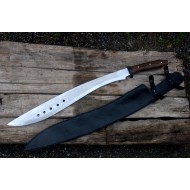
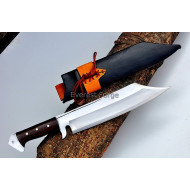
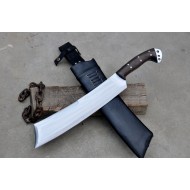
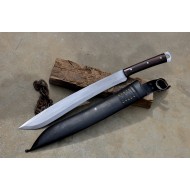
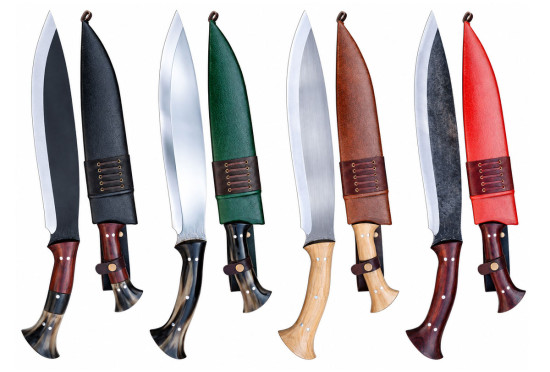
Choose the blade finish, the handle material and the scabbard colour — then we forge that exact barong. Every selection updates the preview on screen. There are 144 possible combinations, and each one is a build our smiths in Kathmandu make routinely.
Underneath every combination is the same blade: 14 inches of hand-forged 5160 spring steel in the broad leaf shape of the barong, on a full tang, sharpened and ready for use. The belly swells toward the front of the blade and carries the weight where the cut lands, so this compact machete chops well beyond its size. At 20 inches overall it is short enough to swing in tight cover and to carry all day.
Your Three Choices
What Is a Barong?
The barong is the leaf-shaped blade of the Tausug and other Moro peoples of the Sulu Archipelago and Mindanao in the southern Philippines. Its shape is its signature: a single-edged blade with a thick spine that swells into a broad belly before narrowing to the point, so the blade is widest where it strikes. In Sulu it served as both a working tool and a weapon, and it became widely known outside the Philippines through accounts of the Moro fighters who carried it against Spanish and later American forces.
A traditional barong is usually fitted with a hilt ending in a flared, stylised bird-head pommel, often with a metal or lacquered-cord ferrule, and it rides in a wooden sheath of two halves bound with rattan. Ours keeps the barong blade and gives it our own working construction: slab scales riveted through a full tang, and a wood-core scabbard wrapped in leather. We say that plainly because a collector should know it before ordering.
Which Blade Finish Suits a Barong?
For a barong that will be used outdoors, black coated or raw forge age best. For a gift or a display piece, polished shows the leaf shape most clearly.
Handle Material: Six Grips on One Full Tang
Every handle is shaped as slab scales riveted through the full tang. The material changes the look, the feel and how the grip ages, but never the strength of the construction underneath.
Scabbard: Six Colours, One Wood-Core Build
Every scabbard is built the same way: a carved wooden core shaped to the blade, wrapped in leather. The wooden core is what holds a broad leaf blade safely — a soft leather sheath alone would let the wide belly work its edge through over time. Choose the leather colour: black and brown hide field dirt best, red and blue make the boldest statement, green suits a jungle kit, and white is the most striking and the one that shows wear soonest.
Want a Barong We Do Not List Here?
A longer or shorter blade, a traditional bird-head pommel, a rattan-bound wooden sheath, an engraved name or a specific pattern — anything outside this option list goes through our custom forge service, where we quote your design individually.
Request a Custom Forge →Why This Barong Works
Standard Build Specification
Blade, handle and overall length are fixed on this pattern and do not change with your selections. Weight varies slightly with handle material. Because every piece is hand-forged, small variation in weight, dimensions, grain and finish is normal.
An Honest Note on This Barong
An honest note. Three things worth saying plainly. First, 5160 is not stainless. It will rust if left wet or stored in a damp scabbard; keep it lightly oiled and it will last generations. Second, this is a barong-style blade on our own construction, not a reproduction of a Moro barong: the leaf blade is true to the type, but the riveted slab handle and leather-wrapped scabbard are how our forge builds for hard use. A traditional barong has a carved bird-head pommel and a rattan-bound wooden sheath, and we can make both through custom forge. Third, the leaf shape puts weight forward, which is what makes it chop — but it also means the barong is less nimble for fine carving than a straight-backed knife. Carry a small knife for detailed work.
This Barong Suits
- Hikers and campers who want a compact chopper that still bites into wood
- Anyone clearing growth in tight cover where a long machete catches
- Collectors drawn to the leaf-blade form who also want a working tool
- Buyers who want to see their exact combination before it is forged
Look Elsewhere If
- You need reach for clearing brush at arm's length — the parang suits better
- You want a museum-accurate Moro barong — use custom forge
- You want a stainless blade that tolerates neglect
- Your main job is fine carving rather than chopping
How Your Order Is Made
Caring for a Carbon Steel Barong
Wipe the blade dry after use and after handling — skin acid marks carbon steel quickly. Keep a light film of oil on the steel in storage; any mineral or machine oil works. Do not keep the barong in its scabbard for long periods, because the leather and wooden core hold moisture against the steel. If the scabbard feels tight after the blade has been in and out many times, it is usually wood fibres shaved from the core — tip the scabbard out and clear them rather than forcing the blade. A dark patina on the blade is protective, not damage; only bright orange rust needs attention. See our machete size guide if you are still deciding on length.
Shipping, Returns and Warranty
Every piece is prepared at the forge in seven to ten days, and shipping adds a further seven to ten days. Orders to the USA and Canada travel with FedEx; everywhere else ships on a DDP service, which means duties and taxes are settled before the parcel moves so there is nothing to pay on delivery. Every piece carries the Everest Forge manufacturer warranty against defects in forging and heat treatment. Because a configured barong is made to your specification, it falls outside our standard returns window except where the blade is faulty — full terms are on our shipping and returns page. Import rules on edged blades vary by country and are the buyer's responsibility to check before ordering.
Explore More Everest Forge Blades
Questions About the Barong Machete
What is a barong?
A barong is a leaf-shaped, single-edged blade from the Sulu Archipelago and Mindanao in the southern Philippines, traditionally made and carried by the Tausug and other Moro peoples. It has a thick spine and a broad belly that swells toward the front of the blade, which makes it a powerful chopper for its length. It was used both as an everyday tool and as a weapon.
Is this a traditional Moro barong?
The blade is: a broad, single-edged leaf shape that swells toward the point, true to the type. The handle and scabbard are not. A traditional barong has a carved hilt ending in a flared bird-head pommel and a wooden sheath of two halves bound with rattan. Ours has slab scales riveted through a full tang and a wood-core scabbard wrapped in leather, which is how our forge builds for hard use. A traditional hilt and sheath can be made through custom forge.
What is the difference between a barong and a kris?
Both come from the southern Philippines and the wider Malay world, but they are different blades. The kris, or kalis in its Philippine sword form, is double-edged and often has a waved section near the hilt, and it is primarily a weapon. The barong is single-edged with a broad leaf-shaped belly, and it works as a chopping tool as well as a weapon. If you want to chop wood, the barong is the one.
Should I choose the barong or the parang?
Choose by reach and size. The barong is compact at 20 inches overall, with its weight concentrated in a broad leaf belly — ideal for tight cover and all-day carry. Our configurable parang is longer at 22.5 inches, giving more reach for clearing brush at arm's length. For a handy chopper, the barong; for clearing, the parang.
Which blade finish is best for jungle or wet-climate use?
Black coated. The coating shields the flats from moisture, so only the bare edge needs regular oiling. Raw forge is the next best, because the surface is already dark and hides marks. Satin sits between them. Polished performs exactly the same, but shows every scratch and needs the most attention in humid conditions.
Which handle material should I choose?
Rosewood is our standard and the safest choice for a blade used outdoors: dense, stable and comfortable when wet. Whitewood gives the strongest contrast against a dark blade. Buffalo horn is the most striking and takes a deep polish, but it can develop fine checks over years in very dry heated rooms. The two-material grips give a two-tone look on the same full tang; because the two materials wear at slightly different rates, the softer section shows handling marks first.
Why does the scabbard have a wooden core?
A broad leaf blade presses its edge against the sheath along the whole belly. In soft leather alone, that edge slowly cuts through. A carved wooden core shaped to the blade holds it clear of the leather, protects the edge and protects the person carrying it. The leather wrap gives the colour, the grip and a finished look.
How heavy is it?
Around 726 grams. That is light for how hard it chops, because the leaf shape puts the mass where the cut lands rather than spreading it evenly along the blade. It is comfortable to carry all day and easy to control in tight cover.
Will 5160 steel rust?
Yes, if you let it. 5160 is a high-carbon spring steel, not stainless, and that is a deliberate trade: it is far tougher and takes a better working edge than stainless steels in this class, at the cost of needing care. Wipe it dry after use, keep a light film of oil on it, and do not leave it in the scabbard for months. The black coated finish reduces the upkeep.
Is it sharp on arrival, and can it chop wood?
Yes to both. Every Everest Forge blade ships sharpened and ready to use, so handle it with care on unboxing, especially around the wide belly. Chopping is what the barong does best: limbing, clearing saplings, splitting kindling and camp work. It is not an axe, though — for felling or splitting large seasoned rounds, use the right tool.
Can I order it left-handed?
Yes. Write "Left Handed" in the order note and the forge will take care of the rest.
Can I order a different blade length or a traditional pommel?
Not through this configurator, which keeps the blade at 14 inches with the riveted slab handle. Anything outside the listed options — a longer or shorter blade, a carved bird-head pommel, a rattan-bound sheath or an engraved name — goes through our custom forge service, where we quote your design individually.
| Specification | |
| Blade: | 14 inches long Blade is forged from Carbon steel, 5160. |
| Total Length: | 20 inches long in total. |
| Handle: | 6 inches full tang Handle is crafted from Rosewood. |
| Weight: | 800 Grams approx. |
| Note: | Each Barong Machete is hand-forged in Nepal by skilled artisans. Minor differences in finish and grip grain reflect the authenticity of handmade craftsmanship. This machete is built for hard field use—steeped in tradition, designed for performance. |