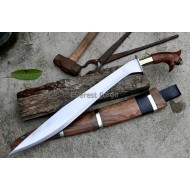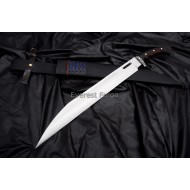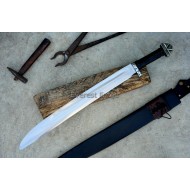
- Model: KHOPESH SWORD
- Product Code: KCS18
- Location: Kathmandu, Nepal
A Hand-Forged Sekhmet's Claw D-Guard Khopesh, Built the Way You Want It
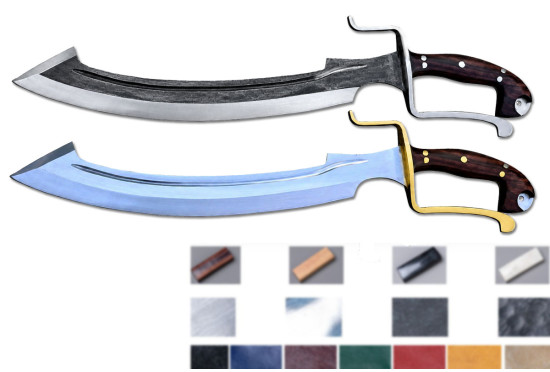
Choose the blade finish, the handle, the fittings and the scabbard colour, then add your engraving — and we forge that exact sword. Every selection updates the preview on screen. There are 960 possible builds before personalisation, and each one is forged to order in Kathmandu.
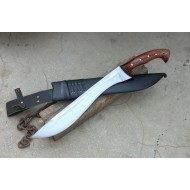
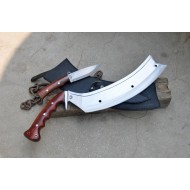
Underneath every combination is the same sword: a 19-inch forward-curving khopesh blade, hand-forged from 5160 spring steel on a single-billet full tang, with a steel D-guard knuckle bow closing over the grip and a hand-stitched leather scabbard. At around 25 inches overall and 1.2 kilograms it is the version of the khopesh built to be swung rather than only hung — an ancient Egyptian blade with the hand protection the originals never had.
Your Choices
Blade length and construction are fixed on this pattern. For another size, a different guard style or a design of your own, use our custom forge service.
Why Sekhmet, and Why a Claw
Sekhmet is the lion-headed goddess of war in the Egyptian pantheon — "She Who Is Powerful", daughter of Ra, protector of the pharaoh, and in the same breath the bringer and the curer of plague. Her priesthood was closely associated with medicine, which is the part people forget: the goddess who destroys is the goddess you petition to be healed.
In the myth of the destruction of mankind, Ra sends his burning eye to earth as a lioness to punish humanity, and she kills until even Ra wants her stopped. He has beer dyed red — with red ochre in the oldest version of the story, though later retellings often say pomegranate — poured out across the fields. She drinks it, sleeps, and wakes without her rage. Amenhotep III had hundreds of statues of her set up at his mortuary temple in Thebes, and she was wife to Ptah, the god of craftsmen, which makes her a reasonable patron for a forge.
The name fits the blade because a lion's claw is forward-curving and hooked, which is exactly the geometry of the khopesh. That is the whole idea behind the piece.
Ancient Blade, European Guard — Said Plainly
This is a hybrid and we will not pretend otherwise.
The blade is Egyptian. The forward-curving sickle profile follows the khopesh, which reached Egypt around 1800 BC and became the standard sidearm from about 1550 BC. The sharpened edge runs along the outside of the curve, so the sword lands on a hooking downward stroke with the force through the belly, and the hook can catch a shield rim or a weapon arm. The point is not the business end.
The D-guard is not. The closed knuckle bow is a European development of the 16th and 17th centuries, carried on cavalry sabres, naval cutlasses and backswords, and most famously on the Confederate D-guard Bowies of the American Civil War. No ancient Egyptian khopesh had one.
The combination is ours. It gives you what no historical khopesh offered: the hand enclosed. If you want the clean historical line for display, choose our standard Sekhmet's Claw. If you intend to handle, drill or cut with it, this is the one to build.
What the D-Guard Does, and What It Costs
The bow runs from the guard back to the butt and closes around the fingers. Three things follow. The hand is the most exposed target in any close exchange, and the guard covers it — which is why every cavalry sabre from 1700 onward had one. The closed loop also gives you a structure to bind and control an opposing blade. And it adds a second mechanical contact between hand and hilt, so sweat, impact or a glancing blow will not take the sword out of your grip.
The cost is the same as on any guarded blade: one fixed hand position, no choking up on the blade, a scabbard that has to be cut for it, and extra weight behind the hand. On a 1.2-kilogram sword that weight actually helps the balance, but it is weight that does no cutting.
Which Blade Finish Suits It?
Handle, Fittings and Scabbard
Eight grips are fitted inside the guard on the same full tang. Rosewood is our standard: dense, dark and the most durable under real handling. Whitewood is the pale timber and stands out most inside a dark guard. Buffalo horn is glossy black with a deep polish, and bone is close to ivory; both are materials Bronze Age craftsmen genuinely used on hilts. The four two-material grips — rosewood + whitewood, rosewood + horn, rosewood + bone and bone + horn — band contrasting sections along the grip, and the guard frames them, so they read more clearly here than on an open hilt.
The fittings cover the D-guard itself and the metal at the butt, which means the fitting choice changes the silhouette of this sword rather than a detail. Silver-tone is a bright white metal that stays bright longest; brass is warm gold and closest to the look of ancient bronze fittings; copper darkens fastest into a deep brown; black makes the guard recede instead of announcing itself. The scabbard is hand-stitched leather over a shaped wooden core, cut to take a guarded hilt, in six colours.
Engraving
The personalisation field takes a name, initials, a date, a dedication or a short line — Sekhmet epithets such as "She Who Is Powerful" or "Eye of Ra" are the most requested on this build — and you can upload a lion sigil, an ankh, a crest, a unit badge, a logo or a photograph for us to reproduce. The 19-inch blade leaves a long flat panel for artwork.
Want a Different Guard or Size?
An S-guard, a half-basket, a brass bow instead of steel, a longer or shorter blade, a deeper recurve or a design from your own sketch — anything outside this option list goes through our custom forge service, where we quote your build individually.
Request a Custom Forge →Why This Khopesh Works
Standard Build Specification
Blade, handle and overall length are fixed in this configurator and do not change with your selections. Because every piece is hand-forged, small variation in weight, dimensions, grain and finish is normal.
An Honest Note on This Khopesh
An honest note. Three things worth saying plainly. First, this is a deliberate hybrid, not a reproduction: Egyptian blade, European guard, modern steel. Real khopesh swords were cast bronze and had no knuckle bow, and anyone selling a steel D-guard khopesh as historically accurate is inventing it. Second, a guard is a commitment — you gain hand protection and a grip that cannot be knocked loose, and you give up choking up on the blade, a flat-riding scabbard and a free hand position. Third, 5160 is not stainless. It will rust if left wet or stored damp, so wipe it dry, oil it, and pay attention to the inside of the guard where a cloth will not reach.
This Build Suits
- Buyers who intend to handle, drill or cut with the sword rather than only display it
- Collectors of knuckle-bow and D-guard hilts who want an Egyptian blade under the bow
- Warrior-goddess and pharaonic-guard costume builds, where the guard photographs well
- Engraved gifts, with Sekhmet epithets or a lion sigil on a long blade panel
Look Elsewhere If
- You want the clean historical line — see the standard Sekhmet's Claw
- You want strict Bronze Age accuracy — that means cast bronze and no guard
- You want something lighter or more compact — see the Little Khopesh builder
- You want a stainless blade that tolerates neglect
How Your Order Is Made
Caring for a Guarded Sword
Wipe the blade dry after handling and keep a light film of oil on it; mineral or camellia oil both work. Two places need attention that a cloth drawn along the flat never reaches: the inside of the blade's curve, and the inside of the knuckle bow where it meets the grip, which is where moisture collects on any guarded hilt. Do not store the sword in its scabbard for long periods, because the leather and wooden core hold damp against steel; a stand or wall mount is better. Brass and copper fittings patina with handling and polish back with any metal polish. Give a timber grip a little oil once or twice a year, and keep horn and bone away from radiators and direct sun.
Shipping, Returns and Warranty
Every piece is prepared at the forge in seven to ten days, and shipping adds a further seven to ten days. Orders to the USA and Canada travel with FedEx; everywhere else ships on a DDP service, which means duties and taxes are settled before the parcel moves so there is nothing to pay on delivery. Every piece carries the Everest Forge manufacturer warranty against defects in forging and heat treatment. Because a configured and engraved sword is made to your specification, it falls outside our standard returns window except where the blade is faulty — full terms are on our shipping and returns page. Owning, carrying and importing a sword are three separate legal questions; check all three for your own address before ordering.
Explore More Everest Forge Blades
Questions About Sekhmet's Claw
Why is it called Sekhmet's Claw?
Sekhmet is the lion-headed Egyptian goddess of war, daughter of Ra, protector of the pharaoh and, in the same mythology, the bringer and curer of plague. A lion's claw is forward-curving and hooked, which is exactly the geometry of the khopesh blade. The name connects the shape to the goddess rather than being decoration.
Is the D-guard historically Egyptian?
No, and we do not claim it is. The closed knuckle bow is a European development of the 16th and 17th centuries, used on cavalry sabres, naval cutlasses and backswords, and most famously on Confederate D-guard Bowies. The Egyptian part is the blade. The combination is a modern functional hybrid, and if you want the clean historical line, our standard Sekhmet's Claw has no guard.
Which edge is sharpened?
The outside of the curve. The khopesh cuts on a downward hooking stroke with the force concentrated through the belly, and the hook can catch a shield rim or a weapon arm. The point is not the business end; on surviving originals it is usually blunt or rounded.
Should I choose this or the standard Sekhmet's Claw?
Choose this one if you intend to handle, drill or cut with the sword, because the guard protects the hand and keeps the hilt in it. Choose the standard version if the sword will mostly be displayed or photographed, because the open hilt is lighter, faster and visually closer to the ancient line. Same blade, same forge, two grips for two uses.
What is the D-guard made of, and does the fitting choice change it?
Forged steel, a single-piece bow running from the guard to the butt and anchored into the hilt. The fitting option sets its colour, which is why this build looks so different between combinations: brass reads closest to ancient bronze, silver-tone the cleanest, copper the warmest, and black makes the guard recede against a coated blade.
Were real khopesh swords made of steel?
No, they were cast in bronze, and the type faded from military use once iron reached Egypt. Ours is hammer-forged from 5160 spring steel on a single billet, which makes it tougher than any original and able to hold a real working edge. It is an interpretation, not a reproduction.
Will the guard fit my hand?
It is built for a full-hand grip in one position, which is how any closed guard works. If you have large hands or expect to wear gloves, say so in the order note and we will allow for it — a guard that is slightly tight is the one complaint a D-guard sword can genuinely earn, and it costs nothing to avoid at order time.
Which handle looks best inside the guard?
The pale ones, because the bow frames them: bone and whitewood stand out most, and the two-material grips read more clearly here than on an open hilt. Rosewood remains the most durable choice if the sword will actually be swung rather than displayed.
Can I use it for cutting practice or drills?
That is what this variant is for. 5160 absorbs impact rather than chipping, the tang is a single billet, and the guard keeps the sword in your hand. Use it against appropriate targets, never against other sharp blades, and if you want a blunt version for partner work, add "Stage combat build — rebated edge, rounded tip." in the order note; our stage combat standard explains what changes.
What can I have engraved?
A name, initials, a date, a dedication or a short line, typed into the personalisation field, or a lion sigil, ankh, crest, unit badge, logo or photograph uploaded as a file. Sekhmet epithets such as "She Who Is Powerful" and "Eye of Ra" are the most requested on this build, and the 19-inch blade leaves a long panel for artwork.
Is it suitable for costume and convention builds?
Yes, and the guard photographs better at an angle than an open hilt. It is a real forged steel sword rather than a prop, and it is not a licensed or screen-accurate replica of any character's weapon — it is the historical Egyptian form with a functional guard added. Check your event's weapon policy before you travel.
Can I order a different blade length or guard style?
Not through this configurator, which keeps the blade at 19 inches with the closed steel bow. An S-guard, a half-basket, a brass bow, a longer or shorter blade or a design from your own sketch are all quoted individually through our custom forge service.

-190x190w.jpg "Egyptian Khopesh Sword — Hand-Forged Sickle-Sword, 5160 Spring Steel, Rosewood & Leather-Wrapped Handle, Customizable")