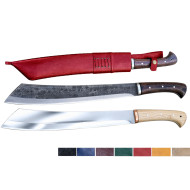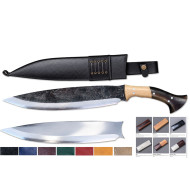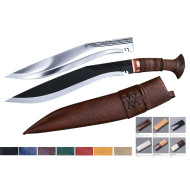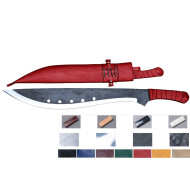
- Model: EF-BYO-KUK-FARM
- Product Code: BYO-KUK-FARM-01
- Location: Kathmandu,Nepal
Available Options
A Working Village Kukri, Built the Way You Want It
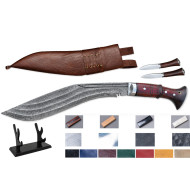
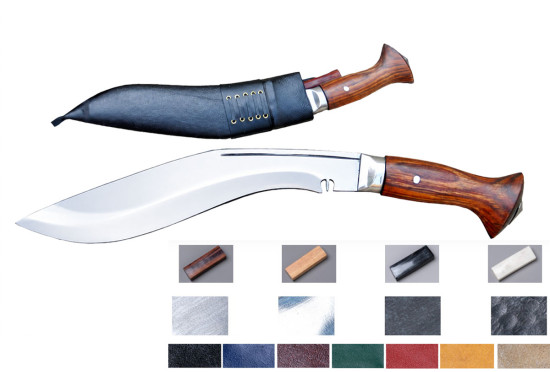
Choose the blade finish, the grip, the bolster and chape metals, the scabbard colour, the tang construction and whether the companion knives come with it — then we forge that exact kukri. Every selection updates the preview and the price on screen. Over 1,700 combinations are possible, and each one is a build our kamis in Kathmandu make routinely.
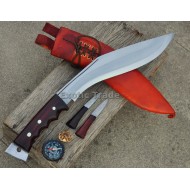
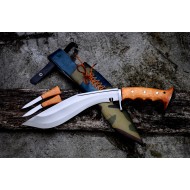
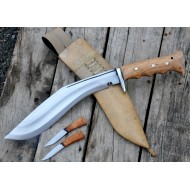
Underneath every combination is the same blade: 10 inches of hand-forged 5160 spring steel, sharpened, with the cho at the ricasso. This is the farmer's kukri — the domestic working pattern of the Nepali hills, sized for clearing brush, splitting kindling, cutting fodder and the hundred small jobs of a working day. Short enough at 15 inches overall to swing in tight cover, heavy enough through the belly to chop without effort.
Your Seven Choices
Which Blade Finish Should You Choose?
For a kukri that will be used outdoors, raw forge or black coated age best. For a gift or a display piece, polished shows the most.
Bolster and Chape: Matching or Contrasting
The bolster is the metal collar where the grip meets the blade. The chape is the fitting at the tip of the scabbard. You choose each independently, in brass, copper or white metal.
Matching bolster and chape reads as traditional and deliberate. Contrasting them — say brass bolster with a white metal chape — is unusual but perfectly legitimate, and it is your kukri.
Want a Kukri We Do Not List Here?
A different blade length, a chirra fuller, a full wooden-cored dap scabbard, a regimental etch, or a specific historical pattern — anything outside this option list goes through our custom forge service, where we quote your design individually.
Request a Custom Forge →Traditional Tang or Panawal Full Tang?
This is the most consequential choice on the page, and it is worth understanding before you pick.
Traditional Peened Tang
- The standard build, and how village kukris have been made for generations
- A thick tang runs through the grip and is peened over the butt cap
- Clean, unbroken grip surface with no rivets showing
- Proven over two centuries of hard use in Nepal
- Choose this for the traditional look and feel
Panawal Full Tang
- Available as an upgrade
- Full-width tang with scales riveted through it, rivets visible on the grip
- The strongest construction we make
- The choice for heavy chopping, batoning and hard field use
- Choose this if the kukri will be worked, not displayed
Both are genuine Nepali constructions. Neither is a shortcut. What separates them is how much abuse they are built to absorb, and panawal is the one to pick if you expect to test it.
Karda and Chakmak: What They Are For
The karda is a small sharp utility knife for work too delicate for a 10-inch blade — cutting cord, preparing food, fine carving. The chakmak is blunt on purpose: a burnisher, drawn along the kukri's edge to realign it between proper sharpenings, in the way a butcher uses a steel. Its spine is hard enough to strike sparks from flint, which is why it earns its place in a camp kit.
Both ride in fitted pockets on the scabbard. Add them if you want the traditional complete set, or take the kukri alone if you already carry a knife you trust.
Why This Kukri Works
Standard Build Specification
Blade length, handle length and overall length are fixed on this pattern and do not change with your selections. Weight varies slightly with your grip material and tang choice. Because these are hand-forged pieces, small variation in weight, dimensions, grain and finish is normal.
An Honest Note on This Kukri
An honest note. Three things worth saying plainly. First, 5160 is not stainless. It is a high-carbon steel, which is exactly why it holds an edge and survives hard use, but it will rust if left wet or stored in a damp sheath. Keep it lightly oiled and it will outlive you. Any seller telling you a carbon steel blade resists corrosion is describing a different steel. Second, at roughly 771 grams this is a solid working blade, not a light one — that weight is what makes it chop, and it is also what you will feel after an hour. If you want something noticeably lighter, a sirupate pattern suits better and we can forge one through custom forge. Third, on the tang: the standard traditional construction is genuine and proven, but if you intend to baton this kukri through seasoned hardwood regularly, take the panawal upgrade. We would rather tell you that now than replace a blade later.
This kukri suits:
- Bushcrafters and campers who want one blade that does most jobs
- Smallholders and gardeners clearing growth, cutting fodder or splitting kindling
- Collectors who want the working pattern rather than the ceremonial one
- Anyone buying a gift and wanting a name or date engraved
- Buyers new to kukris who want a usable size rather than a wall piece
How Your Order Is Made
Caring for a Carbon Steel Kukri
Wipe the blade dry after use and after handling — skin acid marks carbon steel quickly. Keep a light film of oil on the steel in storage; any mineral or machine oil works, and Nepali households traditionally use mustard oil. Do not store the kukri in the leather scabbard for long periods, because leather holds moisture against steel. Touch the edge up with the chakmak between proper sharpenings. Brass and copper fittings will develop a patina, which polishes back with any metal polish if you prefer them bright. A darkening patina on the blade is protective, not damage; only bright orange rust needs attention.
Shipping, Returns and Warranty
Configured blades are made to order, so the build time shown at checkout applies before dispatch. Shipping is DHL or FedEx, 7-14 business days, tracked worldwide. Because a configured or engraved kukri is made to your specification, it falls outside our standard returns window except where the blade is faulty — full terms are on our shipping and returns page. Every blade carries the Everest Forge manufacturer warranty against failure in normal use. Import rules on edged blades vary by country and are the buyer's responsibility to check before ordering.
Explore More Everest Forge Blades
Questions About the Farmer's Kukri
What is a farmer's kukri, and how is it different from a military one?
A farmer's kukri is the domestic working pattern found in Nepali villages — plain, practical and sized for daily use rather than for a soldier's belt. Military kukris follow issue specifications with defined dimensions, regimental markings and standardised fittings, and they are generally longer and heavier. The village pattern varies from smith to smith and district to district, because it was always made for the person who ordered it. That is exactly why it suits being configured: this kukri was never a standardised object to begin with.
What is the difference between the traditional tang and panawal full tang?
The traditional construction runs a thick tang through the grip and peens it over the butt cap, giving a clean unbroken grip with no rivets showing. It is how Nepali kukris have been built for generations and it holds up to normal working use. Panawal uses a full-width tang with the grip scales riveted through it, so you see the rivet heads on the grip. Panawal is stronger and is what we recommend for heavy chopping, batoning or any use where you expect to punish the blade. Both are authentic; they differ in how much abuse they absorb.
Which blade finish is best for outdoor use?
Black coated is the most protective, since the coating shields the flats and only the bare edge needs oiling. Raw forge is the traditional choice and hides marks well because the surface is already dark and uneven. Satin sits between them. Polished is the one to avoid for hard field use — not because it performs worse, but because every scratch shows on it, and a working kukri collects scratches from the first day.
Which grip material should I choose?
Rosewood is the traditional choice, dense and warm in the hand, and it is what most Nepali kukris carry. Buffalo horn is the most striking and takes a deep polish, but it is the least forgiving of very dry heated interiors, where horn can develop hairline checks over years. Whitewood is the lightest in colour and gives the strongest contrast against a dark blade. For a kukri that will live outdoors, rosewood is the safest choice.
Should the bolster and chape match?
Traditionally yes — a kukri usually carries the same metal at the collar and at the scabbard tip, and matching them reads as deliberate. But there is no rule you are breaking by mixing. A brass bolster with a white metal chape looks intentional rather than accidental, and copper against black horn is genuinely striking. Use the preview: this is precisely the kind of decision that is hard to picture and obvious once you see it.
What is white metal?
White metal is the bright silver-coloured alloy traditionally used for kukri fittings in Nepal, giving a cool tone against brass and copper. It polishes up brightly, holds that brightness with minimal care, and suits a modern-looking build — particularly against a polished blade or a black horn grip. If you want fittings that stay bright without work, white metal is the low-maintenance choice of the three.
What is the notch near the handle?
That is the cho, sometimes called the kaudi, and it is the diagnostic mark of a genuine kukri — a blade without one is a kukri-shaped knife rather than a kukri. Structurally it terminates the sharpened edge, so a chip or crack at the edge stops there instead of travelling back into the tang. It also carries religious meaning, usually read as a trident of Shiva or as a cow's hoof. Every kukri we forge has one.
Should I add the karda and chakmak?
If you want the traditional complete set, yes — a Nepali kukri has carried both for as long as anyone can document. The karda handles fine work the main blade cannot, and the chakmak keeps your edge aligned between sharpenings and strikes sparks from flint. If you already carry a small knife you trust and have a sharpening system you like, the kukri alone is a perfectly legitimate choice and saves you the cost. The scabbard is made to suit whichever you pick.
Will 5160 steel rust?
Yes, if you let it. 5160 is a high-carbon spring steel, not stainless, and that is a deliberate trade: it is far tougher and takes a better working edge than any stainless alloy in this class, at the cost of needing care. Wipe it dry after use, keep a light film of oil on it in storage, and do not leave it sheathed in leather for months. Handled that way it lasts generations, as Nepali household kukris routinely do. The black coated finish reduces the maintenance if that matters to you.
Is it sharp when it arrives?
Yes. Every Everest Forge blade ships sharpened and ready to use. We do not sell dull display blades. Handle it accordingly on unboxing, particularly around the recurve where the belly of the blade sweeps forward — the geometry there means the edge meets your hand at an angle you may not expect.
Can I have my name or a date engraved?
Yes. Add your text in the engraving field when you configure. Names, dates, dedications and short phrases all work well, and this pattern's broad flat blade takes an etch cleanly. Bear in mind that an engraved kukri is personal to you and cannot be resold, so it falls outside our standard returns window unless the blade itself is faulty.
Can this kukri chop wood?
Yes — that is what the pattern was designed for. The forward-curved geometry puts the mass of the blade ahead of your hand, so the kukri does work a straight knife of the same weight cannot. It handles kindling, limbing and clearing well. What it is not is an axe: for felling anything substantial or repeatedly splitting large seasoned rounds, use the right tool. If chopping is your main use, take the panawal full tang option.
How long will my kukri take to arrive?
Configured blades are forged to order rather than pulled from stock, so the build time shown at checkout applies before dispatch. Engraving adds a little. Once it ships, DHL or FedEx delivery runs 7-14 business days with tracking to most countries. If you need it by a specific date, contact us before ordering and we will tell you honestly whether it is achievable.