- Model: Bowie knives
- Product Code: EVBB
- Location: Kathmandu,Nepal
A Hand-Forged Heavy-Duty Hunting Bowie, Built the Way You Want It
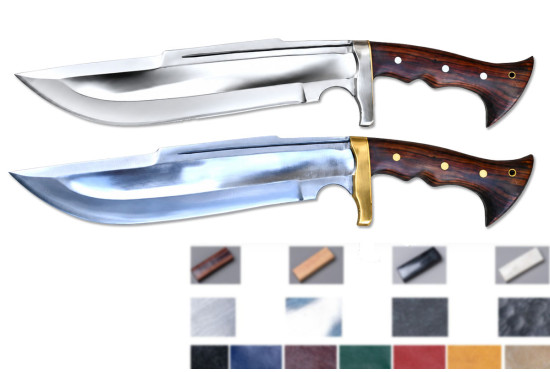
Choose the blade finish, the handle, the fittings and the scabbard colour, then add your engraving — and we forge that exact knife. Every selection updates the preview on screen. There are 960 possible builds before personalisation, and each one is forged to order in Kathmandu.
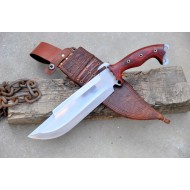
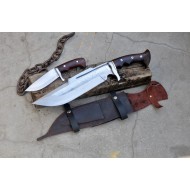
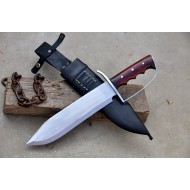
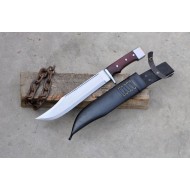
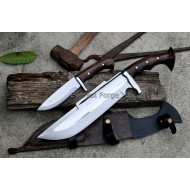
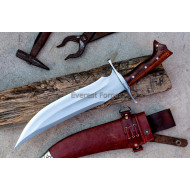
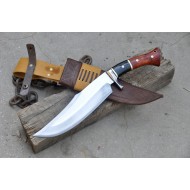
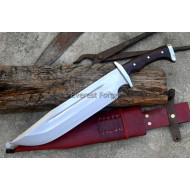
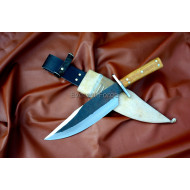
Underneath every combination is the same knife: a wide, deep-bellied clip-point Bowie in hand-forged 5160 spring steel, differentially hardened, on a full tang behind a metal guard, with a contoured grip and a leather belt scabbard. At 19 inches overall and 990 grams it is a working hunting knife rather than a display piece — enough blade to break down a carcass, split kindling and clear camp without reaching for a second tool.
Your Four Choices
Blade length and construction are fixed on this pattern. For a different size, an engraved name or a design of your own, use our custom forge service.
What Makes a Hunting Bowie Different
A Bowie is not simply a big knife. The shape does three jobs at once, and this one is built around all three.
The deep belly — the long curved section ahead of the grip — is the part that skins and breaks down game. A curved edge keeps more steel in contact as you draw it through hide and muscle, which is why a straight-edged knife feels like it is sawing where a bowie slices. The clip point brings the tip down below the line of the spine, so the point lands where you are looking and can be worked into a joint or a cavity without the spine fighting you. And the thick spine and weight forward turn the same knife into a chopper for kindling, limbs and bone.
That combination is why the pattern has outlived almost every knife fashion since the 1830s. It is also why a bowie is heavy: you are carrying the steel that does the chopping even while you are doing the fine work.
Differential Hardening: Hard Edge, Tough Spine
This blade is differentially hardened, the same way our khukuris are. The edge comes out around 58 to 60 HRC, which is hard enough to hold through a long day of cutting. The belly sits around 45 to 46, and the spine is left soft at around 22 to 25, where it absorbs shock instead of transmitting it.
The reason matters when you baton or chop. A blade hardened all the way through is harder to sharpen and far more likely to crack at the spine under impact; one with a soft spine will take a bend or a dent and keep working. On a knife that gets used on bone and seasoned wood, that is the difference between a long service life and a short one.
Which Blade Finish Suits a Working Bowie?
For a knife that will actually be carried and used, acid wash, raw forge and black coated all age better than polished.
Handle and Fittings
Eight grips are fitted to the same full tang, shaped and contoured for a secure hold in a wet or bloodied hand. Rosewood is our standard and the best all-round choice: dense, stable and warm. Whitewood is the pale timber and gives the strongest contrast against a dark blade. Buffalo horn is glossy black and takes a deep polish, though it is the least forgiving of very dry heated rooms. Bone is close to ivory and the most traditional on an American-pattern bowie, which is where a lot of collectors go. The four two-material grips — rosewood + whitewood, rosewood + horn, rosewood + bone and whitewood + horn — band contrasting sections along the handle for a build that reads as your own.
The fittings cover the guard at the front of the grip and the metal at the butt. Brass is the classic bowie look and the warmest against rosewood. Silver-tone is a bright white metal that stays bright longest and reads more modern. Copper darkens fastest into a deep brown, which ages a build quickly. Black is the quietest and pairs naturally with a black coated blade for a working knife that does not catch light.
Scabbard and Engraving
The scabbard is a wooden core wrapped in leather, with a belt loop, in six colours. Black and brown are the field choices and hide blood and dirt best; red, green and blue make a statement; white is the most striking and shows wear soonest.
The personalisation field takes a name, initials, a date or a short line, engraved before the knife ships, and you can upload a crest, insignia, logo or photograph for us to reproduce. A bowie of this size has the broadest flat in our knife range, so detailed artwork and longer inscriptions both sit well on it. This is one of our most common builds for a milestone gift — a first season, a retirement, a knife handed down.
Want a Bowie We Do Not List Here?
A longer or shorter blade, a thinner grind for finer work, a different guard, a sharpened clip, stacked leather or antler scales, or a design of your own — anything outside this option list goes through our custom forge service, where we quote your build individually.
Request a Custom Forge →Why This Bowie Works
Standard Build Specification
Blade, handle and overall length are fixed in this configurator and do not change with your selections. Because every piece is hand-forged, small variation in weight, dimensions, grain and finish is normal.
An Honest Note on This Bowie
An honest note. Three things worth saying plainly. First, this is a big knife — 19 inches overall and nearly a kilogram without the scabbard. It is a hunting and camp knife you wear on a belt and use with both the belly and the weight, not something you forget you are carrying, and it is more knife than most people need for everyday tasks. Second, the soft spine is deliberate. It can take a dent or a slight bend under heavy abuse where a fully hardened blade would crack, and that is the trade we choose on a working knife. Third, 5160 is not stainless. Game, sap and damp will all mark it; wipe it dry, keep a light film of oil on it, and it will outlast you.
This Bowie Suits
- Hunters who want one knife to dress, skin and break down game
- Camp and bush work: kindling, limbs, shelter, general chopping
- Milestone and handed-down gifts, with a name or crest engraved
- Anyone who wants to see their exact combination before it is forged
Look Elsewhere If
- You want a light knife for everyday carry — see our compact and EDC knives
- You want a caping or fine detail knife — a smaller blade does that better
- You want a display piece rather than a working knife
- You want a stainless blade that tolerates neglect
How Your Order Is Made
Caring for a Hunting Knife
Clean and dry the blade as soon as the work is done: blood and gut contents are acidic and will etch carbon steel within hours, not days. Warm water and a little washing-up liquid are enough, followed by a thorough dry and a light film of oil — use a food-grade oil such as camellia if the knife is used on game and food. Pay attention to the join where the blade meets the guard, which is where moisture hides. Do not store the knife in its scabbard for long periods, because the leather and wooden core hold damp against steel. A dark patina from use is protective and worth keeping; only bright orange rust needs attention, and fine steel wool with oil will take it off. Sharpen at the angle it came with rather than thinning the edge, since a knife that chops needs a durable edge more than a keen one.
Shipping, Returns and Warranty
Every piece is prepared at the forge in seven to ten days, and shipping adds a further seven to ten days. Orders to the USA and Canada travel with FedEx; everywhere else ships on a DDP service, which means duties and taxes are settled before the parcel moves so there is nothing to pay on delivery. Every piece carries the Everest Forge manufacturer warranty against defects in forging and heat treatment. Because a configured and engraved knife is made to your specification, it falls outside our standard returns window except where the blade is faulty — full terms are on our shipping and returns page. Import rules on fixed-blade knives vary by country and are the buyer's responsibility to check before ordering.
Explore More Everest Forge Blades
Questions About This Hunting Bowie
Is this a real hunting knife or a display piece?
A working knife. It is forged from 5160 spring steel, differentially hardened, full tang, and sharpened before it ships. The deep belly skins and breaks down game, the clip point works into joints, and the weight and thick spine handle kindling and bone. It displays well, but it was designed to be used.
What does the deep belly actually do?
It keeps more edge in contact with what you are cutting as you draw the knife through. That is what makes a bowie slice through hide and muscle where a straight-edged blade feels like it is sawing. It is the single most useful feature on a hunting knife, and it is the reason the pattern has survived since the 1830s.
Why is the spine softer than the edge?
Because a working knife needs both. The edge comes out around 58 to 60 HRC so it holds its sharpness; the spine is left around 22 to 25 HRC so it absorbs shock. A blade hardened right through is more likely to crack at the spine when you baton it or hit bone. The soft spine means it bends or dents and keeps working.
Is it too big for field dressing?
For the main work, no — opening, skinning and quartering all use the belly, and the extra length helps on large animals. For caping and fine detail around the head, a small knife is better, and most hunters carry one anyway. If you want a pair, our compact knives cover the small end.
Which handle should I choose?
Rosewood is our standard and the best all-round choice for wet-hand grip. Whitewood gives the strongest contrast against a dark blade. Buffalo horn is glossy and striking. Bone is the most traditional on an American-pattern bowie and the most collector-facing. The two-material grips give a two-tone look on the same full tang.
Which finish holds up best in the field?
Acid wash hides marks better than anything else here, and black coated is the most rust-resistant and least reflective. Raw forge ages well because the surface is already dark. Satin is the clean all-round choice and the standard build. Polished is the one to choose for a cabinet or a gift rather than a season of use.
Are the silver fittings real silver?
No. The silver-tone option is a bright white metal chosen for a silver look. It stays bright longer than brass or copper and needs no special care. Brass is the classic bowie fitting if you want the traditional look.
Can I have a name or crest engraved?
Yes. Type the text into the personalisation field, or upload a crest, insignia, logo or photograph for us to reproduce. A bowie of this size has the broadest flat in our knife range, so detailed artwork and longer inscriptions both work. It is one of our most common builds for a milestone gift.
How do I look after it after a hunt?
Clean and dry it straight away. Blood and gut contents are acidic and will etch carbon steel within hours. Warm water and a little washing-up liquid, then dry thoroughly and apply a light film of food-grade oil such as camellia. Do not put it away wet in the scabbard. A dark patina that builds over seasons is protective and worth keeping.
Will it chop and baton?
Yes. The weight sits forward and the spine is thick, so it handles kindling, limbs and camp work as well as game. It is not an axe, so leave felling and large seasoned rounds to the right tool, and do not pry with the tip.
Will 5160 steel rust?
Yes, if you let it. 5160 is a high-carbon spring steel, not stainless, and on a hunting knife that trade is worth making: it is tougher, easier to sharpen in the field and it takes a better edge. Wipe it dry, keep a light film of oil on it and store it out of the scabbard. Black coated and acid wash reduce the upkeep.
Can I order it left-handed or in another size?
Yes to left-handed: write "Left Handed" in the order note and the forge will take care of the rest, which matters most for the scabbard. A different blade length, a thinner grind for finer work, a different guard or antler and stacked-leather grips all go through our custom forge service.